Huiyong Wang,
Bo Tan,
Hucheng Zhang and
Jianji Wang*
Collaborative Innovation Center of Henan Province for Green Manufacturing of Fine Chemicals, School of Chemistry and Chemical Engineering, Key Laboratory of Green Chemical Media and Reactions, Ministry of Education, Henan Normal University, Xinxiang, Henan 453007, P. R. China. E-mail: jwang@htu.cn
First published on 27th July 2015
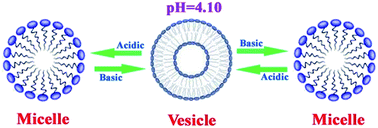
The creation of smart self-assembling fluids that undergo a morphological transition in response to a specific pH value can allow for the enhanced accumulation of drug delivery agents. In this work, we developed a series of pH-responsive fluids composed of 1-alkyl-3-methylimidazolium bromide [Cnmim]Br (n = 12, 14) and one of the pH-responsive hydrotropes of potassium hydrogen phthalate ([C6H4COOKCOOH]), sodium sulfosalicylate ([C6H3OHCOOHSO3Na]), or m-carboxylbenzenesulfonate sodium ([C6H4COOHSO3Na]). The self-assembled structures of these ILs in aqueous hydrotrope solutions were investigated by surface tension, dynamic light scattering, cryogenic-transmission electron microscopy, small-angle X-ray scattering, polarized optical microscopy, and nuclear magnetic resonance spectroscopy. It was found that the ionic liquids, [Cnmim]Br (n = 12, 14), could self-assemble into vesicles with the addition of the hydrotrope, and a reversible transition between spherical micelles and vesicles was observed with the change of solution pH value. The transition in the self-assembled structures of the ILs is suggested to be driven by the change in the molecular structure and hydrophilicity/hydrophobicity of the hydrotrope.
However, more effort should be made to overcome the disadvantages of this strategy before these responsive vesicles can be applied to industrial process. First, this strategy relies on novel synthesis of amphiphiles with pH-responsive functional groups, which requires a time-consuming and low-yield synthetic procedure. This may greatly weaken the application of these responsive vesicles. Second, a given pH-responsive vesicle can only be modulated within a suitable pH range. In principle, this pH range is mainly determined by the pH-responsive group attached to the amphiphile. For any applications, it is necessary to prepare different pH-responsive vesicles with different pH ranges. Consequently, a series of organic syntheses should be conducted to incorporate different pH-responsive functional groups to amphiphiles. Based on this consideration, it is of importance to develop a simple and effective approach for preparing pH-responsive vesicles based on small organic molecules with various pH ranges without complicated organic synthesis. In this context, a new strategy for the preparation of pH-responsive vesicles by incorporating pH-responsive moieties non-covalently to amphiphiles is suggested.
Room temperature ionic liquids (ILs) are composed of organic cations and inorganic or organic anions, which are liquid at temperatures below 100 °C. The most interesting property of ILs is that their structures and properties can be efficiently and easily tailored by a judicious design of cations and anions structures. This makes ILs potentially useful as “designer solvents”.28 Previous investigations had shown that some of the ILs hold inherent amphiphilic character and can form self-assembly structures such as micelle and micelle-like in water.29–34 In the presence of oppositely charged additives, single-chain ionic liquids surfactants can self-assemble into vesicles spontaneously in aqueous solution.35–39 These additives may be a conventional surfactant, an IL or a salt. In some of these mixed systems, reversible transition from micelle to vesicle have been observed by changing the content of the additive added.38–40 For example, single-chain ionic liquid surfactant [C12mim]Br can form vesicle with the addition of 1-butyl-3-methylimidazolium 2-naphthalenesulfonate in aqueous solution, which was driven by the π–π interaction between the imidazolium headgroup of [C12mim]Br and naphthalenesulfonate anion of the added IL.41 Rao et al.42 reported that NaBr can induce the transition from micelle to vesicle for the ionic liquids with dodecylbenzenesulfonate as anion and 1-butyltrimethylammonium, 1-butyl-3-methylimidazolium or 1-butylpyridinium as cation in aqueous solution. Yan et al.43 constructed light-responsive wormlike micelle consisting of ionic liquid surfactant N-methyl-N-cetylpyrrolidinium bromide (C16MPBr) and sodium (4-phenylazo-phenoxy)-acetate (AzoNa) in water. However, to the best of our knowledge, there are no reports on the formation of pH-responsive vesicles and structural transition for single-chain ionic liquids surfactants in the presence of hydrotrope, which is an amphiphilic compound and its hydrophobic moiety is smaller than the typical surfactants, e.g., the number of methylene units in their alkyl chain does not exceed 7. It is expected that pH-responsive vesicles can be formed in the mixtures of [Cnmim]Br (n = 12, 14) ionic liquid surfactant and commercially available hydrotropes with different pH-responsive groups (such as –COOH, –NH2, and –ArOH), because these hydrotropes can strongly bind to the imidazolium ring non-covalently by electrostatic attraction, π–π interaction and hydrophobic effect, which greatly change the self-assembly structure of ILs in solution.32
In this work, pH-responsive vesicles were designed with commonly used ionic liquids [Cnmim]Br (n = 12, 14) and commercially available hydrotropes such as potassium hydrogen phthalate ([C6H4COOKCOOH]), sodium sulfosalicylate ([C6H3OHCOOHSO3Na]) and m-carboxylbenzenesulfonate sodium ([C6H4COOHSO3Na]). The effect of solution pH value on the size and morphology (micelle or vesicle) of the ILs self-assembly was investigated by surface tension, dynamic light scattering (DLS), cryogenic-transmission electron microscopy (Cryo-TEM), small-angle X-ray scattering (SAXS), polarized optical microscopy and nuclear magnetic resonance (NMR) spectroscopy. And then, possible mechanism for the self-assembling structural changes was analyzed from the variation in molecular structure and hydrophilicity/hydrophobicity of the hydrotropes with solution pH value.
Stock solutions of the ILs (around 0.03 mol L−1) were prepared and the test samples were obtained by successive dilution of the stock solutions. Samples with required pH values were prepared by adding a small amount of hydrochloric acid or sodium hydroxide into aqueous solutions. pH measurements were conducted by using a Rex model PHSJ-4F digital pH meter (Leici, China).
1H NMR spectra of the ILs in deuterated water were obtained at 25 °C on a Bruker Avance-400 NMR spectrometer operating at 400.13 MHz, and TMS was used as an internal standard. The solution pH was adjusted by adding deuterated hydrochloric acid (DCl) or deuterated sodium hydroxide (NaOD).
Surface tensions of aqueous ILs solutions were determined by a DCA 315 tensiometer (Cahn Instruments) with a platinum plate (20 × 15 × 0.127 mm3) at 25.0 °C and different solution pH values. The temperature around the sample cell was controlled by circulating water from a HAAKE DC30-K20 thermostat (Thermo Electron, Germany), and the temperature was maintained to be within ±0.1 °C. All measurements were repeated three times to allow the determination of an average surface tension value. The tensiometer was calibrated with double distilled water according to the method provided by the manufacturer, and the uncertainty of the surface tension data was estimated to be around ±0.1 mJ m−2.
The DLS measurements were performed using a laser light scattering photometer (Nano-ZS90, Malvern, U. K) at 25.0 °C and 90° scattering angle. The light source was a solid-state He–Ne laser operated at 633 nm with maximum output power of 4.0 mW. A 0.22 μm hydrophilic PVDF membrane filter was used to filter all sample solutions. At least three measurements were carried out for each solution, and the reproducibility of self-assembly sizes from DLS data was found to be within ±3%.
For the Cryo-TEM measurements, 5 μL solutions were loaded on a TEM grid by a micropipette, and a thin film was produced by blotting off the redundant liquid with two pieces of filter papers. After the excess of solution was blotted away to form a thin liquid film, the grid was immediately plunged into liquid ethane cooled by liquid nitrogen (−175 °C). The samples were maintained at approximately −175 °C and imaged in a transmission electron microscope (JEOL JEM1400) at an accelerating voltage of 200 kV under low dose conditions.
SAXS experiments were carried out on a SAXSpace small-angle X-ray scattering instrument (Anton Paar, Austria, Cu-Kα), equipped with a Kratky block-collimation system at 25 °C. The incident X-ray wavelength was 0.154 nm. The X-ray intensities were recorded by an imaging-plate detection system with a pixel size of 42.3 × 42.3 μm2. Polarized optical microscopy observation was performed by a Motic B2 polarized optical microscope to determine the lyotropic liquid crystals phase of solutions.
![]() | ||
| Fig. 1 Variation of surface tension of aqueous [C12mim]Br solutions in the presence of 30 mM [C6H4COOKCOOH] as a function of IL concentrations at given solution pH values. | ||
| IL | Hydrotrope | CAC/mol L−1 |
|---|---|---|
| [C12mim]Br | [C6H4COOKCOOH] | 1.6 × 10⁻⁴ |
| [C6H3OHCOOHSO3Na] | 1.1 × 10⁻⁴ | |
| [C6H4COOHSO3Na] | 7.4 × 10⁻⁵ | |
| [C14mim]Br | [C6H4COOKCOOH] | 7.3 × 10⁻⁵ |
| [C6H3OHCOOHSO3Na] | 5.4 × 10⁻⁵ | |
| [C6H4COOHSO3Na] | 1.3 × 10⁻⁵ |
![]() | ||
| Fig. 2 Variation of turbidity of aqueous 10 mM [C12mim]Br solutions in the presence of different concentrations of [C6H4COOKCOOH] as a function of solution pH values: ■ 10 mM; ● 20 mM; ▲30 mM. | ||
![]() | ||
| Fig. 3 Cryo-TEM images for the aggregates of [C14mim]Br in aqueous 30 mM [C6H4COOKCOOH] solution at the IL concentration of 10 mM and different pH values: (a) 1.36, (b) 4.10, and (c) 5.70. | ||
![]() | ||
| Fig. 4 SAXS data for [C14mim]Br in aqueous 30 mM [C6H4COOKCOOH] solution at the IL concentration of 10 mM, pH 4.1 and 25 °C. The line was fitted by using a vesicle model. | ||
It is known that Na+ or K+ and Br− were existed in aqueous ionic liquid solutions in combination with hydrotropes. Thus one may wonder if the vesicle formation was resulted from the salting effect of NaBr or KBr? To clarify this point, NaBr and KBr were used to examine the effect of electrolyte addition on the aggregate structure and size of [C14mim]Br at IL concentration of 10 mM. From DLS and Cryo-TEM measurements, it was found that with the increase of NaBr or KBr concentrations, the size of the ILs aggregates increased gradually, but turbid solutions and the vesicle structure were not observed at NaBr or KBr concentration up to 1 mol L−1. This indicates that the vesicle formation cannot be ascribed to the salting effect of NaBr or KBr.
To the best of our knowledge, this is the first observation for conventional single-chain ionic liquid surfactants (not the functionalized ones) to self-assemble into stable vesicles induced by solution pH change in the presence of hydrotropes. For example, with the change of solution pH, self-assembly structure of traditional alkyltrimethylammonium surfactants in aqueous solutions can only change from spherical micelle to wormlike micelle in the presence of [C6H4COOKCOOH], [C6H3OHCOOHSO3Na] or [C6H4COOHSO3Na].46 Obviously, the difference in self-assembly structure of our ionic liquid surfactants with traditional ionic surfactants is ascribed to the unique structure of imidazolium cation of the ILs. Compared with the conventional alkyltrimethylammonium surfactants, cations of the imidazolium ILs have less headgroup repulsion due to lower electron density on the headgroup and favorable π–π interaction between the headgroups and the aromatic ring of hydrotropes,46 thus resulting in the enhanced stack of headgroups. As a result, the vesicle was formed more easily for IL surfactants than for conventional alkyltrimethylammonium surfactants. In addition, spherical micelle was observed by Cryo-TEM in the lower turbidity solution containing 10 mM [C14mim]Br and 30 mM [C6H4COOKCOOH] at pH values of 1.36 and 5.70 (see Fig. 3a and c), which was also confirmed by SAXS measurements (see Fig. S1–S2 in ESI†). This means that when solution pH value increased from 1.36 and 4.10 to 5.70, the self-assembly morphology underwent the transition from spherical micelle to vesicle and then to spherical micelle again. The transition between micelle and vesicle was reversible for at least four cycles by the alternative addition of several drops of aqueous HCl or NaOH solutions to switch pH value between 1.36 and 5.70. Furthermore, morphology of the vesicles was kept unchanged during the cycles according to TEM and SAXS measurements. It was also found that the vesicle and micelle formed from the ILs in aqueous [C6H4COOKCOOH] solution were quite stable after a few weeks storage at room temperature. These results suggest that the vesicle and micelle are thermodynamically stable and their transition takes place under thermodynamic equilibrium.
DLS measurement was further performed to determine the effect of pH value on the size of self-assembly structures. It is clearly indicated that with increasing solution pH value, size of [C14mim]Br aggregates firstly increased and then decreased, and leading to a maximum size at a particular pH value (see Fig. 5). Even a small pH change could induce a remarkable difference in the aggregate size. For example, when pH value varied from 1.01 to 4.10, diameter of the aggregates changed from 20.1 to 90.2 nm in aqueous solution containing 10 mM [C14mim]Br and 30 mM [C6H4COOKCOOH]. In addition, in order to evaluate the stability of the vesicle and micelle during the cycle, reversible change of the size of [C14mim]Br aggregates in aqueous 30 mM [C6H4COOKCOOH] solution was also detected by DLS as a function of solution pH in four cycles at the IL concentration of 10 mM (see Fig. 6). It can be seen that the size of vesicle and micelle was kept unaltered during the cycles, suggesting again that self-assembly structure of the ILs was highly stable.
![]() | ||
| Fig. 5 The variation of the aggregate diameter of [C14mim]Br in aqueous 30 mM [C6H4COOKCOOH] solutions as a function of pH value at the IL concentration of 10 mM. | ||
![]() | ||
| Fig. 6 The reversible change of the size of [C14mim]Br aggregates in aqueous 30 mM [C6H4COOKCOOH] solution with solution pH value at the IL concentration of 10 mM. | ||
Temperature has an important effect on the aggregate structure of ILs in aqueous solution. Therefore, the change of aggregate structures of [C14mim]Br in aqueous solution containing 10 mM of [C14mim]Br and 30 mM of [C6H4COOKCOOH] at pH 1.36, 4.10 and 5.70 were investigated by DLS, SAXS and polarized optical microscopy in the temperatures range from 5 to 45 °C. It can be seen from Fig. 7 that the size of [C14mim]Br aggregate decreased with the increase of temperature in the studied systems. However, for the sample at pH 4.10, the scattering peaks in the SAXS curves (Fig. 8) disappeared gradually as the temperature increases from 5 to 45 °C, indicating the change of [C14mim]Br aggregate structure from vesicle to micelle. In addition, from SAXS and polarized optical microscopy measurements, the lyotropic liquid crystals of all the studied systems were not observed with the decrease of temperature from 45 to 5 °C.
![]() | ||
| Fig. 7 The size change of [C14mim]Br aggregates with temperature in aqueous solutions containing 10 mM of IL and 30 mM of [C6H4COOKCOOH] at different pH values. | ||
![]() | ||
| Fig. 8 SAXS curves for [C14mim]Br in aqueous solution containing 10 mM of IL and 30 mM of [C6H4COOKCOOH] at pH 4.1 as a function of temperature. | ||
It was known that the self-assembly formation of ILs in aqueous solution is dictated by a balance between the repulsive headgroup interactions and the attractive forces arising from a need to minimize the exposure of hydrophobic core to water.29 Due to the electrostatic interaction between [C14mim]+ and phthalic acid with one ionized carboxylic acid, the electrostatic repulsion between IL headgroups was screened and the hydrocarbon chain packing becomes tighter. According to the molecular packing parameter model,50,51 the larger sized aggregates performed when a tight molecular packing was achieved. Compared with phthalic acid with one ionized carboxylic acid moiety, phthalic acid with two ionized carboxylic acid moiety has stronger hydrophilicity, and cannot effectively bind to the IL headgroups. As a result, the electrostatic repulsion between IL headgroups cannot be shield and a loose packing between hydrocarbon chains was adapted. Therefore, the molecular number of phthalic acid containing one ionized carboxylic acid increases with increasing pH value, resulting in the growth of ILs aggregates and transition of spherical micelles into vesicles at a certain pH value. As pH value further increases, the molecular number of phthalic acid containing two ionized carboxylic acid moiety increases as well. This particular molecular structure disfavors the formation of vesicle, leading to the transition from vesicle to spherical micelle. Thus it seems likely that pH triggered structural change of ionic liquids aggregate in aqueous hydrotrope solutions was resulted from the pH dependent hydrophilicity/hydrophobicity of the hydrotrope and its binding ability to ionic liquid headgroup.
Footnote |
| † Electronic supplementary information (ESI) available. See DOI: 10.1039/c5ra12010a |
| This journal is © The Royal Society of Chemistry 2015 |