Tharallah A. Shoker,
Ralph Tanios,
Remi Fayad and
Tarek H. Ghaddar*
Department of Chemistry, American University of Beirut, Beirut 11-0236, Lebanon. E-mail: tarek.ghaddar@aub.edu.lb
First published on 27th July 2015
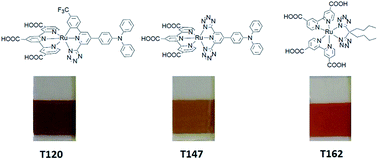
We report a new family of ruthenium poly-pyridyl complexes that bear tetrazolate based ligands (either bi-chelate as in T162 or tri-chelate as in T120 and T147), along with their spectroscopic, electrochemical, and theoretical characterization. Dye-sensitized solar cells (DSSCs) with these complexes show good conversion efficiencies that are highly dependent on the respective electrolyte composition especially in the case of T120 and T147, due to their low lying LUMOs when compared to N719 and T162. DSSCs based on these dyes showed superb stability under light soaking at 70 °C for 2000 h. The T120 and T147 based cells retained their initial efficiencies after the long term-stability test, while the T162 and N719 efficiencies decreased by 18% and 40%, respectively.
The dye (an organic or inorganic sensitizer) is a key component in a DSSC. The well-known N719 dye, (TBA)2[(dcbpy)2Ru(NCS)2] (TBA = tetrabutylammonium and dcbpy = 4,4′-dicarboxy-2,2′-bipyridine),4 has been for a long time one of the best performing sensitizers. Many research groups have been working on the molecular engineering of dyes in order to address the long-term stability and the near-IR absorption ability of such dyes. Designing metal based dyes that lack the thiocyanate ligand (SCN−), which is considered from long-term chemical stability tests as the weakest part in most ruthenium-based dyes,5–7 is of great interest. In addition, red-shifting the absorption band of the sensitizer and increasing the molar absorption extinction coefficient in the visible and near-IR region may have positive effects on the DSSCs' efficiencies. Recently, a new class of ruthenium complexes that lack the SCN− ligand and have better light harvesting properties than N719 has been introduced by different research groups.8–18 The high interest in this class of ruthenium based dyes is due to their extended absorption in the visible region (down to 800 nm). Nevertheless, there are very few reports on the effect of using thiocyanate free dyes on the long-term stability of the DSSC.19,20
Recently, we reported a new class of RuII dyes that bear either a bis- or tris-tetrazolate mono-dentate ligands that showed good DSSC performance.8 However, the ancillary ligands were of the mono-dentate type that could be not advantageous for the long-term stability of DSSCs. Ruthenium complexes baring monodentate ligands are known to be prone to photo-substitution.21,22 Moreover, exchanging mono-dentate and even bi-dentate ligands to their tri-dentate analogs in ruthenium poly-pyridyl complexes usually results in an increase in the absorption extinction coefficient and a slight red shift of the 1MLCT absorption band, as is the case for Ru(bpy)2(py)22+,23 Ru(bpy)32+,24 and Ru(trpy)22+,25 where py = pyridine, bpy = 2,2′-bipyridine and trpy = 2,2′,2′′-terpyridine. In the present study, we report the design and long-term stability tests of DSSCs incorporating three RuII based dyes, T120, T147 and T162, that bear tridentate or bidentate ligands, based on tetrazolate moieties on the ancillary ligand, Scheme 1. The motivation behind the design of such dyes with multi-dentate ancillary ligands was to increase the optical absorptivity in the visible and near-IR that might boost the short-circuit photocurrent (Jsc) and thus the overall efficiency (%ƞ), and to increase the robustness of such dyes when subjected to prolonged thermal and light stress.
![]() | ||
| Scheme 1 Structures of the RuII sensitizers T120, T147, T162 and N719 (TBA+ is tetrabutyl ammonium). | ||
29 and (4,4′,4′′-trimethoxycarbonyl-2,2′:6′,2′′-terpyridine)RuCl3
30 were prepared according to reported procedures in the literature. The NMR spectra (1H and 13C) were measured on a Bruker AM 500 MHz spectrometer. UV-vis spectra were recorded on a Jasco V-570 UV/vis/NIR. Steady state emission spectra were measured on a JobinYvon Horiba Fluorolog-3 spectrofluorometer. The electrochemical setup consisted of a three-electrode cell, with a stained TiO2 film on FTO with the respective dye as the working electrode, a Pt wire ∼ 1 mm diameter as the counter electrode, and Ag/Ag+ (10 mM AgNO3) as the reference electrode. The electrochemical measurements were performed in 0.1 LiClO4 in acetonitrile, and Fc/Fc+ standard (0.63 vs. NHE in acetonitrile) was used as a reference. Electrochemical impedance spectra of the DSSCs were performed with CH Instruments 760B (USA). The obtained impedance spectra were fitted with the Z-view software (v2.8b, Scribner Associates Inc.), and the reported fitted parameters are within a 2% error. The spectra were performed at a forward bias voltage (between −0.5 and −0.8 V) in the frequency range 0.1 Hz to 105 Hz with oscillation potential amplitudes of 10 mV at RT under open circuit conditions at different light levels. IPCE% spectra were recorded using a Newport 74000 Cornerstone™ monochromator and a solar simulator illuminated by a Xenon arc lamp (Oriel) through an AM 1.5 simulation filter (ScienceTech). Photocurrent vs. voltage characteristics were measured with a Keithley 2400 sourcemeter. The irradiated area of the cell was 0.126 cm2. Long-term stability measurements were performed at 70 °C and around 1 sun irradiation from a high-power tungsten lamp.
:
1 t-butanol
:
acetonitrile for 18 h. The counter electrodes were fabricated by applying a 2–3 μl cm−2 of 5 mM H2PtCl6 in 2-propanol to the “Tec8” FTO glass, followed by heating in an oven at 400 °C for 20 minutes. Cell assembly was performed by sealing the counter electrode to the TiO2 electrode with a 60 μm Surlyn (Dupont) spacer at ∼100 °C for 3 min. The corresponding electrolyte was introduced through two small holes, previously drilled through the counter electrode, which were then sealed with Surlyn.
CAUTION! Tetrazoles are highly energetic compounds with sensitivity towards heat and impact. Although we had no problems during the synthesis, proper protective measures should be used when undertaking work involving these compounds.
:
ethyl acetate (5%) as the eluent to yield a pure yellow solid (90% yield). 1H NMR (300 MHz, CDCl3): δ = 7.78–7.72 (d, J = 15.9 Hz, 1H), 7.46–7.43 (d, J = 8.7 Hz, 2H), 7.33–7.26 (m, 5H), 7.14–7.11 (m, 6H), 7.00–6.98 (d, J = 8.7, 2H), 6.95–6.89 (d, J = 15.8 Hz, 1H), 4.76 (s, 1H), 3.44 (s, 6H). 13C NMR (75 MHz, CDCl3): δ = 193.71, 150.46, 146.71, 144.96, 130.03, 129.41, 127.26, 125.57, 124.25, 121.26, 117.93, 103.60, 54.27. APPI MS (m/z): calculated for C24H24NO3 [M + H]+, 374.2; found, 374.0.
:
ethyl acetate (10%) as eluent to yield the final product as a pure yellow solid (70% yield). 1H NMR (300 MHz, CDCl3): δ = 10.21 (s, 1H), 8.26–8.24 (d, J = 8.1 Hz, 2H), 8.15–8.13 (m, 2H), 7.80–7.78 (d, J = 8.1 Hz, 2H), 7.65–7.60 (m, 2H), 7.35–7.29 (m, 4H), 7.18–7.08 (m, 8H). 13C NMR (75 MHz, CDCl3): δ = 193.73, 156.85, 153.25, 150.37, 149.74, 146.96, 141.62, 131.66, 131.23, 129.55, 129.39, 127.90, 127.50, 125.93, 125.28, 124.02, 122.44, 121.79, 117.76. APPI MS (m/z): calculated for C31H21F3N2O [M + H+]+, 495.2; found, 495.0.
:
dichloromethane (30%) as eluent to afford the product as a pure yellow solid (83% yield). 1H NMR (300 MHz, CDCl3): δ = 8.19–8.17 (d, J = 8.1 Hz, 2H), 8.09–8.08 (d, J = 1.8 Hz, 1H), 7.84–7.83 (d, J = 1.8 Hz, 1H), 7.78–7.75 (d, J = 8.4 Hz, 2H), 7.57–7.52 (m, 2H), 7.35–7.29 (m, 4H), 7.18–7.10 (m, 8H). 13C NMR (75 MHz, CDCl3): δ = 157.76, 150.37, 150.12, 146.78, 140.87, 134.47, 129.60, 128.09, 127.78, 127.48, 125.93, 125.88, 125.83, 125.44, 124.68, 124.25, 122.16, 120.65, 117.51. APPI MS (m/z): calculated for C31H21F3N3 [M + H]+, 492.2; found, 492.2.
:
ethyl acetate (20%) as eluent to afford the final product as a pure yellow solid (85% yield). 1H NMR (300 MHz, CDCl3): δ = 8.55–8.54 (d, 1H, J = 1.5 Hz), 8.23–8.21 (d, 2H, J = 8.1 Hz), 8.05–8.03 (m, 2H), 7.77–7.74 (d, 2H, J = 8.4 Hz), 7.67–7.64 (d, 2H, J = 9 Hz),7.35–7.30 (m, 2H), 7.19–7,10 (m, 8H). 13C NMR (75 MHz, CDCl3): δ = 162.89, 156.87, 155.04, 149.82, 146.94, 144.17, 141.78, 129.55, 129.14, 127.88, 127.54, 125.80, 125.75, 125.32, 124.04, 122.35, 119.91, 119.19. APPI MS (m/z): calculated for C31H20F3N6 [M − H+]−, 533.2; found, 533.2.
:
ethyl acetate (5%) as eluent to afford the product as pure solid (60% yield). 1H NMR (300 MHz, CDCl3): δ = 7.984 (s, 2H), 7.50–7.47 (d, J = 9 Hz, 2H), 7.37–7.32 (m, 4H), 7.18–7.10 (m, 8H). 13C NMR (75 MHz, CDCl3) δ = 151.1, 150.9, 146.3, 135.5, 129.7, 127.8, 127.4, 125.8, 124.9, 124.8, 121.3, 115.9. APPI MS (m/z): calculated for C25H17N4 [M + H+]+, 373.1; found, 373.2.
:
1
:
1 ethanol
:
water
:
N-methylmorpholine. The solvent was then taken off under vacuum and the obtained dark solid was dissolved in water containing excess tetra-butyl ammonium hydroxide (TBAOH), refluxed for 2 h and then applied to a preparative C18-column. The compound was purified by a gradient elution with water/methanol 100%
:
0% to 80%
:
20%. Concentrating the solvent containing the major band under reduced pressure and acidifying to pH 4.2 with 0.1 M HNO3 resulted in a dark precipitate. The solid was filtered to yield a dark solid, which was dried under vacuum at 60 °C for 24 h. This afforded the two dyes with a TBA+ as a counter cation with quantitative yields.
:
1
:
1 ethanol
:
water
:
N-methylmorpholine. The solvent was then taken off under vacuum and the obtained dark solid was dissolved in water containing excess tetra-butyl ammonium hydroxide (TBAOH) and then applied to a preparative C18-column. The compound was purified by a gradient elution with water/methanol 100%
:
0% to 80%
:
20%. Concentrating the solvent that contains the major band under reduced pressure and acidifying to pH 4.2 with 0.1 M HNO3 resulted in a dark precipitate. The solid was dried under vacuum at 60 °C for 24 h, affording the dye with one TBA+ as a counter cation with quantitative yields. 1H NMR (500 MHz, MeOD): δ = 8.79–8.78 (d, J = 5.7 Hz, 4H), 7.69–7.68 (d, J = 6 Hz, 2H), 7.64 (s, 4H), 7.57–7.55 (dd, J1 = 6 Hz, J2 = 1.5 Hz, 2H), 3.09–3.05 (m, 8H), 2.14–2.11 (m, 2H), 2.00–1.98 (m, 2H), 1.53–1.47 (m, 8H), 1.28–1.23 (m, 8H), 0.92–0.81 (m, 12H), 0.78–0.58 (m, 4H), 0.48–0.45 (t, J = 14.5 Hz, 6H). APPI MS (m/z): calculated for C51H68N13O8Ru [M + TBA − H+]−, 1092.3; found, 1092.0.
![]() | ||
| Fig. 1 Absorption (solid) and emission (dotted) spectra (λex = 532 nm) of T120 (blue), T147 (red) and T162 (green) in ethanol. | ||
| λabsa, nm (ε, 104 M−1 cm−1) | λemb, nm | E1/2, V vs. NHEc | E*ox, V vs. NHE | Dye loadingf (× 10−8 mol cm−2) | |
|---|---|---|---|---|---|
| a Measured in ethanol.b Measured in aerated ethanol with λex = 532 nm.c Measured as anchored on TiO2 in acetonitrile with 0.1 M LiClO4.d This redox peak is attributed to the triphenylamine moiety.e Measured in DMF with 0.1 M TBAPF6.f The value was calculated at the MLCT band for the desorbed dye solution from 6 μm titania film. | |||||
| T120 | 328 (32.68), 424 (2.25), 522 (1.4), 678 (0.22) | 813 | 1.25,d 0.90 | −0.82 | 5.68 ± 0.04 |
| T147 | 330 (3.64), 388 (2.51), 478 (3.37), 602 (0.22) | 680 | 1.30,d 1.22 | −0.82 | 6.00 ± 0.03 |
| T162 | 305 (4.05), 374 (1.27), 512 (1.58) | 681 | 1.17 | −0.91 | 4.72 ± 0.05 |
| N719 | 306 (4.40), 379 (1.40), 525 (1.35) | 755 | 1.08e | −0.98 | — |
DSSCs employing a 14 μm thick TiO2 layer plus a 6 μm scattering layer (300 nm) were fabricated using the three dyes and N719 for comparison. No co-adsorbent was needed in the case of T162 and T147, however, 20 mM of chenodeoxycholic acid was needed as a de-aggregating agent in the case of T120. An electrolyte solution (EL1) with 1.0 M 1,3-dimethylimidazolium iodide (DMII), 0.1 M guanadinium thiocyanate (GuNCS), 0.1 M LiI, 0.05 M I2 and 0.5 M 4-tert-butylpyridine (TBP), in a mixture of acetonitrile and valeronitrile (85
:
15), was used in these studies. The photocurrent vs. voltage (IV) responses of the four cells are shown in Fig. 2. The T162 based cell afforded the best performance among the three dyes with a short-circuit photocurrent Jsc = 12.7 mA cm−2 (10.4 and 11.3 mA cm−2 for T120 and T147, respectively), an open-circuit photovoltage Voc = 685 mV (569 and 685 mV for T120 and T147, respectively), a fill factor FF = 0.65 (0.72 and 0.67 for T120 and T147, respectively) and a total efficiency η = 6.0% (4.3 and 5.3% for T120 and T147, respectively) under a simulated AM 1.5 G solar illumination at 100 mW cm−2. In the case of N719, the cell showed the highest performance with Jsc = 15.0 mA cm−2, Voc = 694 mV, FF = 0.67 and η = 7.0%. The T120 cell showed a strikingly lower voltage than the other three dyes by more than 115 mV that is probably due to accelerated electron recombination processes as suggested by its dark current (Fig. 2B). The respective IPCE spectra are shown in Fig. 3. As can be seen, the IPCE% of the T162 and N719 maximize between 520 and 530 nm at ∼84%, which suggests that the injection and collection efficiencies for the T162 cell are similar to that of N719. However, the lower photocurrent seen for T162 than N719 is mainly due to the blue-shift of the former's absorption in the visible region.
![]() | ||
| Fig. 3 IPCE% and integrated current spectra of N719 (solid-black), T120 (dotted-dashed-blue), T147 (dashed-red) and T162 (dotted-green) DSSC's assembled with electrolyte EL1. | ||
In order to understand the above mentioned results (low performances of T120 and T147), we performed electrochemical impedance spectroscopy (EIS) measurements on the four different assembled cells at Voc under different light intensities. EIS spectra were analyzed using an established equivalent-circuit that interprets the different interfaces in a DSSC through a transmission line model.37,38 Fig. 4 shows a plot of the chemical capacitance values at the TiO2/electrolyte interface (Cμ), for the different cells extracted from the EIS experiments, versus the applied voltage (nEF − EF,redox), where nEF is the electron quasi-Fermi energy level in the TiO2 film and EF,redox is the electrolyte redox Fermi level. The Cμ values for the four cells show an exponential behavior as a function of the applied voltage, where this is due to the trap energy distribution below the conduction band edge.39 Considering that the four different cells have the same trap energy distribution (since the TiO2 film is identical in all cells and the same electrolyte solution is used in these cells), the observed shifts in the (nEF − EF,redox) towards higher or lower values could be attributed to an upward or downward shifts in the conduction band edge, respectively.40,41 The observed shift Δ(nEF − EF,redox) of T162 compared to N719 lies between −10 and −20 mV, Fig. 4. This small shift might be caused in part by the higher number of protons in the case of T162 than N719 (3H's versus 2H's, respectively). As such, we can assume that there is no significant shift in the conduction band edge between the four different cells.
![]() | ||
| Fig. 4 Capacitance values obtained from EIS of N719 (triangle-black), T120 (square-blue), T147 (rhombus-red) and T162 (triangle-green) assembled cells with electrolyte EL1. | ||
However, the plots of the charge recombination resistance at the TiO2/electrolyte interface (Rct) versus (nEF − EF,redox) show profound difference between the T120 and the other three cells, Fig. 5. The DSSC that incorporates T120 shows significantly smaller Rct value by ∼30 to 35 times. However, the T147 and T162 based DSSC's show similar Rct values to that of N719. These results suggest fast electron recombination processes at the dyed TiO2/electrolyte interface in the T120 dye case and in turn causes the low Voc value of 569 mV. These results are also consistent with the dark currents measured for the respective cells, Fig. 2B. The electron recombination in the T120 based cells can be due to factors such as iodine binding42 and/or inefficient dye regeneration43 that would affect negatively the photo-current and photo-voltage and as a consequence the total efficiency. In addition, any aggregation of the T120 dye or lower electron injection than T162 and N719 would also affect the photo-current negatively to a high extent,44 on a condition that the light harvesting efficiency of T120 would be similar to the other two studied dyes. Indeed, from the LHE% spectra of T120, T147 and T162 dyes when anchored on a 6 μm titania film (Fig. S2†), one can conclude that the three dyes would absorb more than 99% of the incident light up to 500 nm in the studied and fully assembled cells. As for T147, the following can be deduced from the various data: a – its high redox potential of 1.22 V vs. NHE would ensure its fast regeneration by iodide after electron injection, b – the EIS and dark current spectra suggest slow electron recombination processes, c – its high absorption extinction coefficient and light harvesting efficiency (LHE%), (Fig. S2†). However, the IPCE spectrum of T147 maximizes to ∼67% at 470 nm which in turn resulted in its low photocurrent. This made us suspect that T147 does not have high injection efficiency with the electrolyte used (EL1). Indeed, a T147 DSSC incorporating another electrolyte system (EL2) having the same composition as the one described above but lacks the TBP additive, Table 2 and Fig. S3,† gave higher Jsc = 13.6 mA cm−2 and η = 6.2% but a lower Voc = 635 mV as expected when compared to EL1. In addition, a similar effect was seen for T120 which suggested also an inefficient electron injection, where the Jsc increased from 10.4 to 12.6 mA cm−2 and the Voc decreased from 569 to 486 mV. No profound effects were seen for T162 and N719 except on the Voc, Table 2. The lack of TBP in the EL2 electrolyte system will result in a positive shift (compared to EL1) in the titania conduction band (ECB) and hence decreasing the Voc and increasing the driving force for electron injection for low lying LUMO dyes. These results are consistent with the estimated E*ox values of the four dyes, Table 1, where the difference in the driving force of electron injection for T120 and T147 when compared to N719 and T162 are ∼−0.16 and −0.09 V, respectively.
![]() | ||
| Fig. 5 Charge transfer resistance values obtained from EIS of N719 (triangle-black), T120 (square-blue), T147 (rhombus-red) and T162 (triangle-green) assembled cells with electrolyte EL1. | ||
| Electrolytea | Jsc, mA cm−2 | Voc, mV | FF | ηb (%) | |
|---|---|---|---|---|---|
a Electrolyte EL1: 1.0 M DMII, 0.1 M LiI, 0.5 M TBP, 0.1 M GuSCN and 0.05 M I2 in acetonitrile : valeronitrile (85 : 15); EL2: 1.0 M DMII, 0.1 M LiI, 0.1 M GuSCN and 0.05 M I2 in acetonitrile : valeronitrile (85 : 15).b Measured under 100 mW cm−2 simulated AM 1.5 spectrum with an active area = 0.126 cm2.c Integrated photocurrent (AM 1.5 Global). |
|||||
| T120 | EL1 | 10.4 (10.1)c | 569 | 0.72 | 4.3 |
| EL2 | 12.6 (12.4)c | 486 | 0.73 | 4.5 | |
| T147 | EL1 | 11.3 (10.9)c | 685 | 0.67 | 5.3 |
| EL2 | 13.6 (13.3)c | 635 | 0.72 | 6.2 | |
| T162 | EL1 | 12.7 (12.3)c | 685 | 0.65 | 6.0 |
| EL2 | 13.0 (12.7)c | 633 | 0.72 | 5.9 | |
| N719 | EL1 | 15.0 (14.7)c | 694 | 0.67 | 7.0 |
| EL2 | 15.3 (15.1)c | 635 | 0.72 | 7.0 | |
In order to test the robustness under light soaking of the three tetrazolate-based dyes, we performed a somehow harsh long-term stability test under one-sun irradiation at 70 °C for 2000 h (the usual testing is done under 1 sun irradiation between 60 and 65 °C for 1000 h), Fig. 6. DSSCs employing a low volatility electrolyte (EL3) composed of 0.6 M 1,2-dimethyl-3-propylimidazolium iodide (DMPII), 0.5 M N-butylbenzimidazole (NBB), 0.1 M GuNCS, 0.05 M LiI and 0.1 M I2 in 3-methoxypropionitrile (MPN), were fabricated using the above mentioned three dyes in addition to N719 for comparison.
The striking finding from Fig. 6 is the fact that the overall efficiencies of the T120 and T147 cells kept relatively constant with time mainly due to the continuous increase in Jsc and a concurrent decrease in FF and Voc with time. In comparison, the overall efficiencies of the T162 and N719 based cells decreased by ∼18 and 40%, respectively, after 2000 hours. It's important to note here that the Jsc of T162 also increased slightly with time, unlike N719 where the Jsc continuously declined with time after the first 100 hours. The main profound changes in the photovoltaic parameters of the four cells were in the FF and Voc. It is well known that the ECB of TiO2 shifts positively under light irradiation.36,45,46 The reason behind such shift is yet still not that clear but it might be either due to a change in the surface dipole brought about by an increase in the positive charges (induced by intercalation of protons or lithium cations) at the TiO2 surface and/or a decrease in the negative charges36,47 or unpinning of the conduction band brought about by the accumulation of holes trapped in surface especially when the titania film is light illuminated especially with UV.48 It's important to note here that we did not use any UV protection film during light soaking, which in turn may have a profound effect on the positive ECB shifting level due to residual levels of UV light striking the cells from the light source. In addition, UV and thermal stress can cause depletion of the triiodide in the cell, and thus the decrease in Voc can be attributed to a corresponding shift at the electrochemical (Nernst) redox potential of the electrolyte.49,50 Therefore, such phenomena would be the reasons behind the decrease in Voc upon light soaking for all of the studied cells. In addition, such a positive shift in the TiO2 conduction band could also increase the electron-injection yield from a low LUMO dye to the TiO2 electrode, such as in the case of T147 and T120. Therefore, this could explain the constant increase in the Jsc for the T147 and T120 based cell with time, and to a lesser extent that of T162. On the other hand, the decrease in the Jsc for N719 based cells upon thermal and light soaking is attributed by different research groups to the desorption and/or decomposition of the dye especially at the labile SCN− site,51 or even to triiodide loss.49 Comparing the long-term stability of the two somehow similar dyes T162 and N719, both of which have similar electrochemical, photo-physical and photovoltaic parameters that are due to the similarity in their chemical structures, it would be safe to assume that the weak performance of N719 under prolonged light and thermal stress is due mostly to the presence of the labile SCN− ligands as suggested by some reports in the literature.5,6,51
Lastly, in order to understand the constant decrease of the FF of the four cells, we performed EIS experiments on the fresh and stressed cells. Fig. 7 shows the Nyquist plots of a fresh and aged N719 DSSCs. As can be seen, the charge transfer resistance at the Pt/electrolyte interface increased from 2 to 22 Ω cm2 in addition to a slight increase in the series resistance (Rs) from 5 to 6.5 Ω cm2, suggesting a decrease in activity of the Pt cathode with time. The same phenomenon was seen with all of the aged cells.
![]() | ||
| Fig. 7 Nyquist plots of a fresh (solid-black) and an aged (dotted-red) N719 DSSCs at Voc assembled with electrolyte EL3. | ||
Many research groups agree on the fact that the loss of Pt activity in an aged DSSC is due to factors such as the dissolution of Pt in the electrolyte system52–54 and/or adsorption of iodide and iodine on its surface.55 Keeping in mind that any dissolution of Pt to Pt2+ and/or Pt4+ and where these cations can always intercalate and/or adsorb on the titania anode or on the underlying conducting substrate would enhance the electron recombination processes that would affect negatively the Voc in addition to increasing the total DSSC resistance and thus lower FF.52,56 Indeed, we saw acceleration in the recombination processes (∼100 times) in all aged cells when compared to the fresh ones as inferred from the plot of Rct versus the applied potential, Fig. 8, in addition to a shift in Cμ towards lower values by ∼50 to 70 mV, Fig. 9 (only N719 and T147 cells are shown for clarity), both of which would cause a decrease in Voc. Therefore, we can safely hypothesize that the low FF and Voc values for all cells are mainly due to inherent changes in the TiO2, electrolyte, Pt and/or at their interfaces, and hence the three tetrazolate based dyes show excellent intrinsic stability most probably due to the lack of labile mono-dentate ligands such as the SCN− in N719.
![]() | ||
| Fig. 8 Charge transfer resistance values obtained from EIS of fresh and aged DSSCs of N719 (circle-black) and T147 (square-red) assembled cells with electrolyte EL3. | ||
![]() | ||
| Fig. 9 Capacitance values obtained from EIS of fresh and aged DSSCs of N719 (circle-black) and T147 (square-red) assembled cells with electrolyte EL3. | ||
Footnote |
| † Electronic supplementary information (ESI) available. See DOI: 10.1039/c5ra11984g |
| This journal is © The Royal Society of Chemistry 2015 |