U. P. M. Ashik and
W. M. A. Wan Daud*
Department of Chemical Engineering, University of Malaya, 50603, Kuala Lumpur, Malaysia. E-mail: upmashik@gmail.com; ashri@um.edu.my; Fax: +60 379675319; Tel: +60 105023818 Tel: +919496844805
First published on 30th July 2015
n-Ni/SiO2, n-Fe/SiO2 and n-Co/SiO2 nano-catalysts were prepared by co-precipitation cum modified Stöber method and applied for thermocatalytic decomposition of methane in order to investigate their thermal stability and activity to produce greenhouse gas free hydrogen and nano-carbon. The mean particles sizes of the produced nano-catalysts obtained from BET analysis are 32.19 nm, 30.26 nm and 49.92 nm, respectively. Temperature programmed methane decomposition were conducted as a preliminary catalytic examination and further isothermal analyses were performed at 700 °C, 600 °C and 500 °C. Production of hydrogen at each experimental temperatures and corresponding carbon yield were measured. Among the three catalysts inspected, n-Ni/SiO2 was found to be the most efficient one for thermocatalytic methane decomposition. Furthermore, significant catalytic stability was observed with n-Ni/SiO2 at 500 °C and 600 °C. While, the rapid deactivation of the n-Fe/SiO2 and n-Co/SiO2 catalysts are attributed to particle agglomeration and the irregular formation of nano-carbon due to metal fragmentation. Physical and chemical characteristics of the produced nano-catalysts were investigated by N2 adsorption–desorption measurement (BET), X-ray diffraction (XRD), transmission electron microscopy (TEM) and hydrogen-temperature programmed reduction (H2-TPR). Produced nano-carbon were inspected with TEM, FESEM and XRD.
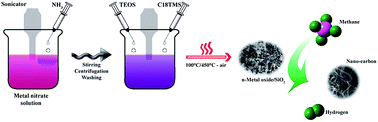
The produced porous and high temperature withstanding catalysts were used for thermocatalytic decomposition of methane (TCD) to produce hydrogen and nano-carbon, two cherished products in the field of environmentally benign energy and nanotechnology. Hence, there have been intense research efforts on methane decomposition in recent years as hydrogen is a relevant raw material in chemical and petroleum industries. However, a higher temperature (>1200 °C) is necessary in methane decomposition process to achieve a rational yield. Hence, a variety of metal catalysts have been studied for methane decomposition with the purpose of reducing the decomposition temperature as well as the increasing conversion rate. Among them, Ni, Fe and Co based catalyst gained major attention because of their advantages like availability, low cost, better activity and stability.4–8 According to Takenaka et al.,9,10 Ni-based catalyst are very active in a temperature range of 400 °C–600 °C for methane decomposition. And they found that Ni-based catalysts deactivated immediately at temperatures above 600 °C. Whereas, Fe-based catalyst are found active at higher temperature as the activation temperature of the Fe-based catalysts is much higher than that of the Ni-based catalysts.11–13 Furthermore, iron-based catalysts are comparatively inexpensive and non-toxic. However, it was reported that Fe-based catalysts are not active below 650 °C.14 It is observed that iron-based catalysts produce thin-wall nano-tubes, which are the most valuable product among carbon nano-fibers.15 Cobalt is adjacent to nickel and iron in periodic system and it is found proficient for methane coupling reactions.16,17 The intention of this work is to implement similar preparation methodology for the preparation of Ni, Fe and Co-based catalyst and study the differences in their activity, accordingly. It was reported that nickel particles larger than 100 nm is incompetent to produce carbon nano filaments in methane decomposition because the produced carbon isolates metal from reaction medium rapidly.15 Hence, a support for the active phase is necessary in order to prevent its sintering in hydrocarbon media. However, a wide variety of dissimilar support materials were investigated to control the catalyst particle size and dispersion by physical interactions (porous support) or chemical interaction (charge transfer effect).18 Takenaka et al.9 explored influence of different catalytic supports like MgO, Al2O3, SiO2, TiO2, ZrO2, MgO·SiO2, Al2O3·SiO2, H+-ZSM-5, etc. and concluded that SiO2 as the most efficient catalyst support for TCD to produce hydrogen and nano-carbon. Hence, we have selected SiO2 as the support material for conserving active metal phase. The porous silica support efficaciously provide enough porosity for accessing reactant molecule to the active metal oxide.19 However, in this paper we have investigated characteristic properties of n-Ni/SiO2, n-Fe/SiO2 and n-Co/SiO2 nano-catalysts and their activity and stability for thermal decomposition of methane. We have given equal importance to catalyst preparation and characterization, methane decomposition and characterization of produced carbon. Various techniques were adopted for physical and chemical characterization of produced nano-catalysts as follows; N2 adsorption–desorption measurement (BET), X-ray diffraction (XRD), transmission electron microscopy (TEM) and hydrogen-temperature programmed reduction (H2-TPR). Furthermore, activity and stability of catalysts were analyzed in a fixed bed pilot plant. In addition, the characterization of the formed nano-carbon fibers and tubes at various temperatures are explained with the help of TEM, FESEM and XRD.
Schematic illustration of catalyst preparation is shown in Scheme 1.
Nitrogen adsorption–desorption measurements (BET method) were carried out in Micromeritics ASAP 2020 BET apparatus at −196 °C. Surface area, pore size distribution and structure, pore volume and the mean particle size were measured. Samples were previously degased at 180 °C for 4 h. The surface area was determined according to the standard Brunauer–Emmett–Teller (BET) method in a relative pressure range of 0.04–0.2 and the total volume was evaluated from the amount of adsorbed N2 at a relative pressure (P/Po) of about 0.98. The pore diameter distributions were calculated based on desorption isotherms by the Barrett–Joyner–Halenda (BJH) method.
PANalytical diffractometer was used to collect X-ray diffraction (XRD) patterns of the fresh and spent catalysts. Crystal phase and structure of the nano-catalysts were determined. X'pert HighScore software were used for diffractogram evaluation. Diffraction patterns of the samples were recorded with a Rigaku Miniflex with Cu Kα radiation with a generator voltage and a current of 45 kV and 40 mA, respectively. The average crystallite size was obtained using the global Scherrer equation as follows:
In equation, the average crystallite size, peak length, line broadening full width at half-maxima after subtracting the instrumental line broadening (in radians), and the Bragg's angle are expressed as Davg (nm), λ (1.54056 Å), β, and 2θ, respectively. 0.9 is the Scherrer constant.
Transmission electron microscopy (TEM) images of fresh catalyst and produced nano-carbon were acquired by using FEI Tecnai™ controlled at an accelerating voltage of 200 keV. Field emission scanning electron microscopic (FESEM) images of produced nano-carbon and elemental composition of the catalysts were obtained with FEG Quanta 450, EDX-OXFORD.
Temperature-programmed reduction (H2-TPR) measurements were carried out using a Micromeritics TPR 2720 analyzer. Typically, 0.03 g of catalyst sample was placed in a U-tube holder and the sample was first cleaned at 130 °C for 60 minutes by flushing with helium gas. Upon degassing, the reductive gas mixture consisting of 5% hydrogen balanced with nitrogen at a flow rate of 20 mL min−1 streamed through the sample. The sample was heated from 200 °C to 700 °C to obtain the TPR profiles of the sample.
Temperature measurements were recorded by using two K-type thermocouples (1/16 in diameter, Omega, USA). The first thermocouple was fixed on the exterior surface of the stainless steel tube. The second thermocouple was inserted into the quartz tube momentarily for calibration and removed afterward from the quartz tube prior to testing because its internal copper material could affect the TCD of methane.20 In addition, pressure and temperature indicators were placed at different locations to control the operating conditions. A two-differential pressure transducer (0′′ H2O to 4′′ H2O) was supplied by Sensocon to measure the pressure drop across the reactor. Mass flow controllers (Dwyer, USA) in the range of 0–2 L min−1 were used to control the gas flow rates. The outflow gas was then cooled down to room temperature by means of an air cooler. Solid particles that had sizes greater than 2 nm and high molecular weight components were separated using two filters (38 M membrane, Avenger, USA). A calibrated Rosemount Analytical X-STREAM (UK) was used as an online analyzer to compute the mole percentage of methane and hydrogen.
![]() | ||
| Fig. 2 XRD patterns of (a) n-NiO/SiO2 and n-Ni/SiO2, (b) n-FeO/SiO2 and n-Fe/SiO2 and (c) n-CoO/SiO2 and n-Co/SiO2. Average crystal sizes computed by using Scherrer equation are provided. | ||
| Catalyst | Single point SAa (m2 g−1) | BET SA (m2 g−1) | Micropore areab (m2 g−1) | Mesopore + external areab (m2 g−1) | Micropore volumeb (cm3 g−1) | Total pore volumec (cm3 g−1) | Mesoporous volume (cm3 g−1) | BET pore size (nm) | Mean particle size (nm) |
|---|---|---|---|---|---|---|---|---|---|
| a Represents the values calculated at a relative pressure (P/Po) of N2 equal to 0.301.b Represents the values calculated from t-plot method.c Represents the total pore volume evaluated from nitrogen uptake at a relative pressure (P/Po) of N2 equal to 0.98. | |||||||||
| n-NiO/SiO2 | 91.50 | 93.18 | 5.17 | 88.01 | 0.0024 | 0.2301 | 0.2277 | 9.987 | 32.19 |
| n-FeO/SiO2 | 97.31 | 99.11 | 7.02 | 92.08 | 0.0033 | 0.3712 | 0.3678 | 14.977 | 30.26 |
| n-CoO/SiO2 | 48.96 | 50.06 | 7.25 | 42.80 | 0.0035 | 0.0957 | 0.0922 | 7.579 | 49.92 |
The porous nature of the prepared n-NiO/SiO2, n-FeO/SiO2 and n-CoO/SiO2 were explored with N2 adsorption–desorption measurements. The corresponding N2 adsorption–desorption isotherms and pore size distributions are presented in Fig. 3(a–c), respectively. The pore diameter distributions of the samples considered from desorption division of the isotherm were calculated using Barrett–Joyner–Halenda (BJH) method. The single point surface area, Brunauer–Emmett–Teller (BET) surface area, pore volume, average pore size and average particle size of all investigated nano-catalysts are shown in Table 1. Comparatively lower particle size and higher surface area and porosity were observed. Those catalytic activity promoting features could be attributed to the presence of silicate support. However, the silicate support is supposed to prevent metal particle agglomeration efficiently during high temperature calcination treatment. The BET surface area of n-NiO/SiO2, n-FeO/SiO2 and n-CoO/SiO2 are 93.18 m2 g−1, 99.11 m2 g−1 and 50.06 m2 g−1, respectively. One can see that the BJH pore width distributions are in wide range from 0 nm to 160 nm, while the majority of the pores of all experimented catalysts are with a width less than 30 nm. Furthermore, the average BET pore width is calculated as 9.9 nm, 14.9 nm and 7.5 nm for n-NiO/SiO2, n-FeO/SiO2 and n-CoO/SiO2, respectively. The pores with higher sizes (50 nm to 150 nm) occurred in the mesoporous and macroporous region may be because of the formation of voids due to inter-nanoparticles in contact.
The morphological appearance of the fresh n-NiO/SiO2, n-FeO/SiO2 and n-CoO/SiO2 catalysts are exhibited in Fig. 4(a–c). Particle size distribution of respective nanoparticles are also exhibited. From the image, it is clearly visible that the particles are found uniformly distributed with various shapes covering a narrow range of sizes. However, crystallite in n-FeO/SiO2 exhibit more or less circular disc morphology with almost similar particle size and dispersion, supporting the particle distribution histogram. While, n-NiO/SiO2 and n-CoO/SiO2 can be seen agglomerated to form giant particles in some area. This agglomeration results in structural intricacy leads to difficulties in reduction, supporting a higher temperature H2-TPR curve (Fig. 6). ImageJ software was used to measure the actual particle sizes. The average particle sizes of all three compounds are lying in the range of 35–50 nm, supporting our BET and XRD report. EDX mapping report of each samples are shown in Fig. 5, assuring the presence of Ni, Fe, Co, Si and O elements.
The H2-TPR profiles of n-NiO/SiO2, n-FeO/SiO2 and n-CoO/SiO2 are shown in Fig. 6. The H2-TPR profile of n-NiO/SiO2 exhibit a single peak in between 300 °C and 692 °C can be assigned to the complete reduction of n-NiO species, supporting previous records.25,26 n-NiO/SiO2 catalyst exhibits only one hydrogen conception peak in between 297 °C and 670 °C with a maximum at 420 °C. This individual peak indicates a homogeneous metal support interaction between nickel and silicate. It can be noted that n-NiO/SiO2 could be reduced in between 300–600 °C supporting previous reports on Ni-based compounds.27 H2-TPR profile of n-NiO/SiO2 starts from 297 °C and hence it can be assumed there is no silica free dispersed nickel oxide. However, Ermakova et al.15 reported that silica free nickel oxide reduces in between 236 °C and 246 °C. Furthermore, the H2-TPR profile of n-NiO/SiO2 quantifies a H2 conception of 330.3 mL gcat−1. n-NiO/SiO2 catalyst exhibits a broad reduction profile irrespective of the conventional metal supported catalysts.28 However, it can be speculate that this strong nickel metal and silicate support interaction may results in difficulty in its reduction.25 Furthermore, the existence of the reduction peak towards a higher value can be attributed to the presence of some higher sized n-NiO particles. Moreover, the denser SiO2 support may cause difficulty in hydrogen diffusion and NiO reduction, supporting the presence of NiO peaks in the XRD results after reduction at 550 °C (Fig. 2(a)). H2-TPR profile of n-FeO/SiO2 exhibits one peak from 264 °C to 448 °C with a maximum value at 388 °C can be attributed to the reduction of Fe2O3.29 Usually Fe has a lower tendency to form a strong interaction with SiO2.30 However, formation of second peak indicates the noticeable shift of complete reduction of n-FeO/SiO2 towards a higher temperature values. Reduction of n-CoO/SiO2 accomplished in three stages. The peak in the temperature range from 243 °C to 360 °C can be accredited to double stage reduction of spinal as Co3O4 to CoO and to Co.31 While, n-Co/SiO2 does not show any peaks above 600 °C reveals its weak metal support interaction compared to that in n-NiO/SiO2.
Fig. 8 shows the changes in hydrogen production percentage with time on stream for the TCD over n-Ni/SiO2, n-Fe/SiO2 and n-Co/SiO2 catalysts at 500 °C, 600 °C and 700 °C. Influence of temperature on hydrogen production, activity and temperature sustainability of each catalyst are analyzed. All isothermal examinations were conducted with 99.995% methane. Rosemount Analytical X-STREAM detected only hydrogen and methane as gaseous products as indicated in the balanced methane decomposition equation (CH4 → 2H2 + C). The maximum hydrogen production percentage was observed in the very beginning of methane decomposition experiment, just after the contact of methane with catalyst. Afterwards, the hydrogen production found decreased gradually with time on stream according to the performance of catalyst. Fig. 8(a) shows that, n-Ni/SiO2 catalyst exhibits a wide range of activity with hydrogen production from 17% to 65% in the experimented temperatures. The experiments were extended up to 240 minutes in order to evaluate the stability of n-Ni/SiO2. Maximum hydrogen production were observed at 700 °C with n-Ni/SiO2 catalyst, while catalyst was deactivated rapidly and turn out to be completely inactive within 100 minutes of experiment. This fast deactivation may be attributed to its thermal degradation at higher temperature.3 It is interesting to notice that, n-Ni/SiO2 maintain its activity even after 240 minutes of experimental duration with a very low catalytic deactivation at 600 °C and 500 °C. However, minimum deactivation was observed at 500 °C. Furthermore, it is worth pointing out that the experimented n-Ni/SiO2 catalyst is noticeably superior to the naked and supported Ni-based catalyst prepared by conventional methods at a temperature range of 500 °C–700 °C,32–36 clearly demonstrate the advantage of co-precipitation cum modified Stöber method for preparation of n-Ni/SiO2 catalyst. Undesirably, n-Fe/SiO2 catalyst was active at 700 °C only. Furthermore, the initial hydrogen production was very less (12.2%) compared to n-Ni/SiO2 catalyst and reached negligible value by 1 hour of stream. It was completely inactive at experimented temperatures like 600 °C and 500 °C as observed in temperature programmed methane decomposition (Fig. 7). n-Co/SiO2 given moderate initial hydrogen production at 700 °C and 600 °C. While, catalytic stability was pitiable and dip to 5% within 10 minutes after methane stream reached the catalyst, similar rapid catalytic deactivation were observed by Lee et al.37 over Co-based catalysts. It is reported that higher methane decomposition to hydrogen and nano-carbon occurs over coalesced metal particles, while it continues until the crystal size of sintered particle favor the nano-carbon growth.38 It is worth to notice that the Ni-particle agglomeration is very less after methane decomposition as shown in TEM images (Fig. 11), results in higher hydrogen production (Fig. 8(a)) as well as huge carbon yield (Fig. 10). However, the lower activity of n-Co/SiO2 (Fig. 8(c)) and n-Fe/SiO2 (Fig. 8(b)) may be attributed to the sintering of metal particle to giant sizes which exceed the critical size for carbon nano-filament growth, as observed in Fig. 12 and 13, respectively. Furthermore, Ashok et al.39 reported that metal particles of very large size were unable to grow carbon nano-filaments. Among the studied catalysts, n-Ni/SiO2 catalyst is superior to Fe and Co based catalyst by all aspects. It is observed that the initial catalytic activity and deactivation rate increases as increasing decomposition temperature, indicates the temperature sensitivity of TCD process. However, it is worth to note that the isothermal methane conversion over all experimented catalyst clearly follows the hydrogen production percentage and active temperature zone revealed by temperature programmed methane decomposition (Fig. 7). Hence, temperature programmed methane decomposition can be considered as an efficient step in order to identify catalytically active temperature zone of any catalyst.
Enormous quantity of carbon were formed over n-Ni/SiO2 compared to n-Co/SiO2 and n-Fe/SiO2. The carbon yield percentage over each catalyst at respective temperatures were calculated with the following equation41,42 and the results are depicted in Fig. 10. The carbon yield of the catalysts was evaluated based on the extent of methane conversion against time on stream at a CH4 flow rate of 0.64 L min−1. Carbon deposition period was 5 hours for n-Ni/SiO2 at 500 °C and 600 °C, while all other percentages are up to the complete deactivation of respective catalyst.
![]() | ||
| Fig. 10 Comparison of calculated carbon yield in percentage produced over respective catalyst at 700 °C, 600 °C and 500 °C. | ||
Fig. 10 comprises the comparison of produced carbon yield over each experimented catalyst which reveals that n-Ni/SiO2 produced very high quantity of nano-carbon compared to n-Co/SiO2 and n-Fe/SiO2. n-Ni/SiO2 produced 4947.3% of carbon at 600 °C during 5 hours of experiment. Hence, it was not deactivated during the experimented period. While, it produced 1372.6% nano-carbon at 700 °C before it deactivated in 100 minutes. However, 105.2% and 144.6% nano-carbon were formed over n-Co/SiO2 catalyst before its complete deactivation at 700 °C and 600 °C, respectively. Whereas, it was very low at 600 °C as n-Co/SiO2 undergone fast deactivation. Very regrettable performance was shown by n-Fe/SiO2, which produced 104.4% of nano-carbon at 700 °C. Though, n-Fe/SiO2 was almost inactive at 500 °C and 600 °C as observed in temperature programmed methane decomposition (Fig. 7). The observed carbon yield is outstanding compared to many other available results over Ni-based catalyst.41 However, the performance of n-Co/SiO2 and n-Fe/SiO2 are pitiable. Likewise, such disgraceful results were reported by Zadeh and Smith43 over Co-based catalysts. This deprived catalyst performance can be attributed to the faster particle agglomerations and complete catalyst encapsulation with produced carbon as shown in TEM images (Fig. 12 and 13).
Fig. 11(a–c) displays TEM images of produced nano-carbon over n-Ni/SiO2 catalyst at 700 °C, 600 °C and 500 °C, respectively. However, TEM images of produced nano-carbon over n-Co/SiO2 and n-Fe/SiO2 exhibited in Fig. 12 and 13, respectively.
TEM images (Fig. 11 and 12) elucidate that n-Ni/SiO2 and n-Co/SiO2 mainly produce carbon nano-tubes, while small quantity of nano-fibers were also identified. Hence, nano-tube can be recognized with the presence of a hallow cavity, though it is absent with nano-fibers.44 Ni and Co metals can be seen at the dip of formed nano-carbon. Very low carbon yield observed over n-Co/SiO2 at 600 °C can be attributed to the complete encapsulation of catalyst with produced nano-carbon and heavy agglomeration of catalyst as shown in Fig. 12(b). However, pear or diamond shaped metals with its sharp tail inserted to the produced nano-tubes can be seen in Fig. 11(a–c) and in Fig. 12(c), following tip-growth carbon formation mechanism,45 which is reinforcing many previous works.46–48 Furthermore, n-Ni/SiO2 catalyst also produces different types of nano-carbons as follows: fish-bone nanocarbon, carbon nano tubes with open end, carbon nano tubes with closed end and carbon nanotube with Ni particle embedded in it. Such varieties of nano-carbons were absent with n-Fe/SiO2. In addition to carbon nano-tubes, irregular carbon formulation was observed over n-Co/SiO2 and n-Fe/SiO2, could be attributed to the occurrence metal particle fragmentation which maintains the availability of more active metal phases.49 The availability of such higher active metal phases because of the diffusion of supersaturated nano-carbon results in the formation of more nano-carbon around the catalyst particles by methane decomposition which leads to its complete encapsulation. Furthermore, the carbon diffusion occurred may be attributed to the less effective interaction between Co and Fe metals with the silicate supports or their incomplete shielding which results in the domination of Co and Fe metal phases at their surface. It is obvious from the displayed TEM images (Fig. 12 and 13) that n-Co/SiO2 and n-Fe/SiO2 catalysts were rapidly agglomerated and encapsulated with produced carbon after methane came in contact with it and hence loose its activity completely. However, such metal particle fragmentation is absent with n-Ni/SiO2 because of the efficient interaction between Ni metal phase and silicate supports results in the enhanced activity and stability. It is worth to note that nano-carbon with larger diameter were formed over n-Co/SiO2 at 600 °C and over n-Fe/SiO2 at 700 °C may be attributed to the formation of carbon over agglomerated larger catalysts particles, and hence encapsulated by carbon leads to their faster deactivation. Similar result was already reported by Jana et al.31 over the spinel catalysts. It was reported that the outer diameter of the carbon nanotubes greatly depend on the size of catalyst particles. Hence, larger particles produce carbon nanotubes with larger diameter.50 Furthermore, Ermakova et al.15 reported such a speedy catalyst encapsulation with carbon over Fe-based catalyst. However, there is no such agglomeration or encapsulation can be seen with n-Ni/SiO2 (Fig. 11) which endure a longer activity and produces a huge carbon deposition at all their experimented temperatures. The formation of nano-carbon over n-Ni/SiO2 occurred at the interface between the Ni particle and silicate support and hence metal is detached from support.51 However, Ni-particle maintained its activity at the surface of growing carbon filaments which results in the longer activity of n-Ni/SiO2. Furthermore, almost similar graphite formation was observed with n-Co/SiO2, while the carbon deposited on it encapsulate active metal face and hence results in its rapid deactivation.52 In accordance to previous reports,53 our results also reveals that stable catalytic performance and catalytic decomposition depend on the catalysts, catalytic characteristics and operating parameters.
FESEM images of produced nano-carbon over n-Ni/SiO2- at respective temperature are displayed in Fig. 14(a–c) and the diameter distribution histogram in Fig. 14(d). FESEM images disclose that the produced nano-carbons have smooth elliptical shape with diameter covering a range of 5 nm to 145 nm. It is very difficult to compute the actual length of the carbon nano-carbon as they exist in an interweaving manner. However, it can speculate that the length exceeds some micrometers. The brighter spot observed in Fig. 14(a–c) at the tips of carbon nano-tubes are Ni-metal particle and it is worth to note that the diameter of nano-carbon are similar to that of Ni-particles. The diameter of nano-carbons were measured with ImageJ software. The average diameter calculated from 50 nano-carbons were 35.75 ± 7.8 nm, 52.64 ± 11.5 nm and 56.34 ± 15.2 nm at 700 °C, 600 °C and 500 °C, respectively. These results are in well consistent with the Ni-crystallite size calculated from XRD patterns using Scherrer equation. Hence, calculated crystallite sizes are 34.2 nm, 47.03 nm and 50.22 nm at 700 °C, 600 °C and 500 °C, respectively. This strong consistency between carbon diameter and Ni-crystallite size are clearly reveals the dependability between them, supporting previous reports.54,55 Furthermore, diameter distribution histogram (Fig. 14(d)) reveals that the diameters of the most of produced nano-carbons are in between 40 nm and 80 nm. It is clear from the FESEM images that the morphology and quality of produced nano-carbons are almost similar at all experimented temperature over n-Ni/SiO2 catalyst. However, methane decomposition at 700 °C produced more nano-carbon with very low (<40 nm) diameter compared to 600 °C and 500 °C. Furthermore, nano-carbon with open end, closed end and with metal particle at the dip also can clearly found in the FESEM images, seconding the TEM images shown in Fig. 11.
| This journal is © The Royal Society of Chemistry 2015 |