Liming Lia,
Chunhua Zhu*a,
Yeping Wua,
Jianhua Wanga,
Tailiang Zhangb and
Yu Liu*a
aInstitute of Chemical Materials, China Academy of Engineering Physics, Mianyang, Sichuan 621900, China. E-mail: zchua@mail.ustc.edu.cn; new615@163.com; Fax: +86-816-2486342
bSchool of Chemistry and Chemical Engineering, Southwest Petroleum University, Xindu, Sichuan 610500, China
First published on 17th July 2015
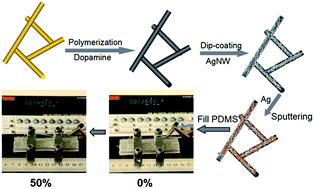
A highly stretchable silver nanowires/silver nanoparticles (AgNWs/AgNPs) conductor based on a polydopamine (PDA) modified three dimensional polyurethane (PU) sponge was fabricated. The PU sponge skeleton was first modified by PDA to improve adhesion to the conductive nanomaterials. The conductive micro-network was fabricated by dip-coating of the PDA modified PU sponge into the solution of AgNWs, and AgNPs were further sputtered onto its surface to improve conductivity, resulting in a conductive ternary network structure. The resistance of the PDA–PU–AgNW–Ag–PDMS stretchable conductor decreased obviously with bending or stretching cycles initially, and then remained stable even up to 1000 cycles. The composites exhibit high electrical conductivity (exceeding 27.78 S cm−1) and excellent electromechanical stability under high tensile strain (50%) owing to the combined effects from the ternary network. The significant electromechanical properties were also demonstrated by a simple stretchable circuit composed of a light-emitting diode (LED) and the stretchable conductor during bending, twisting or stretching.
As we know, conductive and stretchable structures in polymers are core in the fabrication of conductive elastic composites. Although several conductive and stretchable structures have been explored, each one has its own unique properties arising from its specific network. In order to further enhance the stretchable conductivity, multiple network combining different structures was a promising way.9 Ko et al. recently reported a highly stretchable and conductive metal conductor which was prepared by formation of wavy and 2D silver nanowires (AgNWs) network on a highly stretchable polymer substrate.10 The binary structure network here by combining “buckled” and “2D” conductive strategies was responsible for the highly conductive and stretchable ability. In the meantime, a binary structure network was reported by Yu et al. through combining 2D and 3D networks.11 However, to the best of our knowledge, only a few investigations have reported the design of conductive ternary network structures. It is interesting to enhance the properties of stretchable conductor through the combination of three different networks in elastic polymer.
During those different conductive and stretchable structures, using stretchable sponge/foam as skeleton to construct 3D conductive architectures have been widely investigated because the conductivity of those composites during bending or stretching will keep stable by shape deformation before breaking the conductive 3D networks.12–14 For example, Zheng et al. reported continuous 3D conductive metal networks, which was fabricated through solution deposition of metal thin films (Cu, Ag, Au) onto chemically functionalized porous polyurethane (PU) sponges.6 Lee et al. have prepared another stretchable conductive composite film by using an e-beam evaporation process to deposit Ti and Au onto the skeleton of porous poly(dimethylsiloxane) (PDMS).15 Moreover, as one of the most important conductive materials, AgNWs have been widely investigated in much progress for formation of 2D network to realize its electromechanical properties.16–18 Here, it is promising to design the stretchable conductor structures through combining 3D modified polymer sponge with 2D AgNWs film to improve its performance. Moreover, as reported in literatures, nanoparticles in a polymer matrix has greater freedom for reversible nanoscale restructuring than nanotubes or nanowires hence represent a more dynamic system, which is essential for stretch ability.19 Thus, the combination of Ag nanoparticles (AgNPs), 2D AgNWs network with 3D polymer skeleton is promising to construct stretchable conductors with unique properties for various applications.
During the design of conductive ternary network, one important part is to fabricate high adhesion between the conductive nanomaterials and polymer sponge to construct the 3D conductive network.6,20 But the adhesion of most commercial polymer sponges with conductive nanomaterials are not satisfactory, which needs multiple dip-coating process or P(METAC-co-MPTS) copolymer as adhesion layer.6,11,21 As we known, polydopamine (PDA) coating is an amazing method to modify various surfaces arising from its abundant catechol and amine groups, where the lone pair electrons of the functional groups afford a strong binding interaction with the subsequent inorganic or organic layers.22 Moreover, dopamine can easily self-polymerized at room temperature.23,24 Although various PDA modified materials such as graphene, carbon nanotube and PDMS film were reported,25,26 3D polymer architecture which is difficult to modify by most common method such as oxygen plasma irradiation wasn't investigated at present.20 In comparison with P(METAC-co-MPTS) copolymer as adhesion layers produced by multistep for electroless deposition of metal over porous 3D PU sponge,6 the present procedure here resulted polydopamine as adhesion layer is more straightforward and without the use of any initiator, organic solvent, or high temperature.
In this paper, a conductive ternary network structure was fabricated, where the adhesion of PU microfiber was enhanced by PDA coating. Reduced-resistance was developed by sputtering a thin film of AgNPs onto PDA–PU–AgNWs surface, resulted a ternary structures containing two conducting networks. The PDA–PU–AgNW–AgNP–PDMS stretchable conductor showed a decreased resistance upon stretching or bending firstly, and then kept unchanged, which exhibited markedly high stretchability and small resistance increase. As an example of applications, a simple stretchable circuit composed of a light-emitting diode (LED) and stretchable conductor is fabricated to demonstrate its significant electrical properties during bending, twisting or stretching.
To construct PU sponge networks as a 3D skeleton to support the 2D AgNW, the key is to enhance the adhesion between PU and nanowire. As we known, polydopamine-coating is an amazing method to modify various surfaces arising from its abundant catechol and amine groups. And here it was expected to provide additional adhesion between the macroporous architecture and the subsequent AgNWs. As shown in Fig. 1, the dramatic color change is observed in PU sponge modified with and without PDA. The pure PU sponge was yellow (Fig. 1a), whereas the PDA–PU sponge was black (Fig. 1b).24,25 A thin, adherent PDA layer on the surface of PU sponge surface after polymerization of dopamine are clearly recognized in the corresponding optical microscope images (Fig. 1a and b). The SEM images in Fig. 1c and d also reveal that PDA aggregations were coated uniformly on smooth PU surfaces. And the resulting PDA modified microfibers were uniformly wrapped by the thick layer of AgNWs, resulting in a conductive sponge with binary AgNW nano/micro network structures (Fig. 2c and d). Without using PDA coating, only a thin layer of AgNWs with a large number of defects and obvious uncovered area on PU microfiber could be observed (Fig. 2a and b), indicating that the presence of the functional polymer layer is vital for enhancing the adhesion between AgNWs and PU surfaces. That's because the lone pair electrons of the functional groups (catechol and amine groups) on the surface of polydopamine layer cause a strong binding interaction with the subsequent AgNWs.25,26 Importantly, in comparison with similar method proposed by multistep using of the P(METAC-co-MPTS) copolymer modified PU sponge,6 dopamine as a constituent molecule mimicking adhesive proteins was easily self-polymerized in the buffer solution at a weak alkaline pH without the use of any initiator, organic solvent, or high temperature.
![]() | ||
| Fig. 2 SEM images of PU–AgNW (a and b) and PDA–PU–AgNW (c and d) at low and high magnifications, respectively. | ||
The morphology of AgNW coatings on PU microfiber was changed from sparse to dense by modification of PDA, indicating an increased conductivity, which was verified by the decreased resistance after the same fabrication procedure. The PU specimens of the same size (5.0 × 1.5 × 0.1 cm) were all coated with AgNWs in the beginning, and then infiltrated by PDMS. The resistance of PU–AgNW–PDMS was 8.51 Ω, while PDA modified one was 6.56 Ω, suggesting that PDA layer coated on PU surface plays a critical role in the fabrication and final properties of the conductive composite. The result was also confirmed by surrounding optical microscope images of PDMS composites, where AgNW on the PDA modified microfiber was more dense than unmodified one (Fig. S2†). Compared to the recently reported research of using P(METAC-co-MPTS) copolymer as adhesion layer for electroless deposition of metal over porous 3D PU sponges,6 the reason that makes this route unique is obvious decrease of resistance after several bend or stretch process. For example, the resistance of PU–AgNW–PDMS conductor was reduced from 6.51 Ω to 4.50 Ω after several bend cycles. More details will be discussed in later sections.
In order to further improve conductivity, deposition of AgNPs film on the PDA–PU–AgNW substrate was explored through magnetron sputtering. As shown in Fig. 3, AgNWs coated on the surface of the PDA–PU sponge become remarkable thicker upon sputtering, due to deposition of Ag nanoparticles. The decrease of resistance of PDA–PU–AgNW–PDMS was significant, from 6.5 Ω to 1.7 Ω after sputtering. The conductivity was around 19.06 S cm−1 and increased to 27.78 S cm−1 after 1000 stretching cycles from 0% to 50% strain, which is higher than that of PUS–AgNW–PDMS after eight dip-coating cycles and the procedure here is much easier.11 Fig. 3c shows the XRD patterns of PU, PU–AgNW, PDA–PU–AgNW and PDA–PU–AgNW–Ag. A broad peak centered at 2θ = 21.0° were ascribed to the diffraction peaks of pure PU. And the typical diffraction peaks at 38.10, 44.20, 64.34, and 77.39° that represents Bragg reflections from the (111), (200), (220), (311) planes of Ag were observed,27,28 which indicates the existence of Ag in the stretchable conductor respectively. In addition, as shown in Fig. 3d, PDMS was transparent and the modified PU sponge embedded in PDMS can be seen clearly. It should be noted that the distance of two copper wires embedded into the two side of the conductor with silver paste was 5 cm (Fig. 3d), and the size of the PU sponge for all measured samples is uniform, whether modified or not, to ensure the best comparative value.
The reason of unchanged resistance under deformation is due to the PU miro-network as a polymer skeleton. As shown in Fig. 4c, when the tensile strain on PDA–PU–AgNW–Ag–PDMS composites increased, the macropores of PU sponge (marked by the red window) shrank perpendicular to the direction of the tensile force and elongated in the direction of the applied force, resulting share the tensile strain applied on the composite conductive pathway.11,16 Therefore, the 3D architectures embed in composite remarkable enhanced its flexible conductivity than just only 2D nanowire networks. In addition, the AgNWs coated on the modified PU microfibers was connected together to form percolation network which can effectively accommodate the deformation without any significant change in conductivity by alter the shape of network.10,29 Moreover, even with defect section existing, Ag nanoparticles with greater matrix mobility would overcome this negative effect. In one word, the conductive ternary network structure containing 3D polymer architectures, 2D AgNWs percolation network and AgNPs formed in PU–AgNW–Ag–PDMS composite would greatly enhance their performances as stretchable conductors as confirmed by stretching test.
The resistance variations of stretchable conductors were studied as a function of tensile strain. The stretching tests were carried out from 0% to 50% strains for 1000 cycles each. As revealed in Fig. 4d, during the first stretching, the resistance of PDA–PU–AgNW–Ag–PDMS composite increase from 1.75 Ω to 2.10 Ω at the 50% strain, which is much better than for the AgNW/PDMS stretchable conductors (ca. from 0.82 Ω to 2.6 Ω at 50%) strain during first stretching.29 Digital pictures in Fig. 5a shows resistance of stretchable conductor at specific strains of 0%, 20%, and 50% measured with a four-probe method, which clearly exhibits the stretching process as well. From the viewpoint of repeatability, as the stretching cycle number increased, the resistance of stretchable conductor by different stretching cycles was decreased obviously as shown in Fig. 4d. After 400 times stretching, the resistance variation of the PDA–PUS–AgNW–Ag–PDMS composites with increasing cycles gradually became stable under stretching deformation. And the resistance variation curve at the 600th, 800th, and 1000th cycle was completely overlapped, demonstrating the resistance stability of composites which can be used as ideal interconnects in flexible electronic applications. The excellent stability of resistance was also confirmed by comparing with the previous reported PU–CuAg–PDMS conductors where the resistance increased by 20% at the first cycle and gradually increased to 2.2-fold after 1000 cycles under 40% strain.6 Under the 1000th stretching cycle, the resistant of stretchable conductor at 0%, 20%, and 50% strain was reduced to 1.26 Ω, 1.33 Ω, and 1.49 Ω respectively. As revealed in Fig. 5a and b, compared with the resistance during the 1st and 1000th stretching cycles, a decrease of 0.50 Ω, 0.47 Ω, and 0.62 Ω of the PDA–PU–AgNW–Ag–PDMS composites were observed at 0%, 20%, and 50% strain respectively. The increase of resistance is about 0.35 Ω under 50% strain for the 1st stretching cycles, while an increase of 0.23 Ω was observed for the 1000th stretching cycles, which is much better than PUS–AgNW–PDMS conductor.11
Although in most works the resistance was increased after hundreds of the stretching cycles arising from destruction of conductive network, the contrary trend reported here was also observed in other nanowire composite such as CNT/PU, and CNT/bismaleimide composites stretchable conductors.30,31 The resistance decreasing phenomenon may be induced by alignment enhancement of nanowires along the stretching direction of composites under the stretching/releasing process. During stretching, the AgNWs self-assembled and aligned themselves along the load direction without damaging the connection of the conductive network, which induced the decrease of resistance.30,31 In addition, as expected, the stretchable conductor after 1000th stretching cycle mentioned above show remarkable stability upon bending and twisting and the resistance kept unchanged around 1.2 Ω (Fig. 5c).
As a proof-of-principle demonstration for stretchable electronics, a circuit containing a commercial light-emitting diode (LED) was fabricated with as-prepared PDA–PU–AgNW–Ag–PDMS stretchable conductor as connecting wire. As shown in Fig. 6, the digital pictures show that the brightness of the LED lights almost kept unchanged after bending, twisting or stretching the stretchable conductors to a tensile strain of 50% under constant voltage, which implies that the fabricated conductors could retain constant resistance with shape deformation to a certain extent. These results are well demonstration of the excellent electromechanical stability of PDA–PU–AgNW–Ag–PDMS composites and their great potential for high-performance stretchable and flexible conductors.
![]() | ||
| Fig. 6 Optical images of an LED illuminated by using a PDA–PU–AgNW–Ag–PDMS film as the connecting wire under (a) no strain, (b) bending, (c) twisting, and at (e) 0%, (f) 20% and (g) 50% strain. | ||
:
1) were poured into the as-prepared PDA–PU–AgNW–Ag and PU–AgNW–Ag pieces, followed by degassing in vacuum oven for 30 min and thermally cured in a dry oven at 100 °C for 2 h. Then PDA–PU–AgNW–Ag–PDMS and PU–AgNW–Ag–PDMS composites were obtained through peeling off the films from the tailor-made moulds. The size of PU sponges embed in PDMS between two copper wired is 5.0 × 1.5 × 0.1 cm and is uniform for all measured samples.
For the stretchable circuit device experiment, a simple circuit consisting of commercially available light-emitting diode (LED) light was fabricated. PDA–PUS–AgNW–Ag–PDMS film was used as electrical wires in the circuit where the copper wires were adhered to the two sides of the films.
Footnote |
| † Electronic supplementary information (ESI) available. See DOI: 10.1039/c5ra10961b |
| This journal is © The Royal Society of Chemistry 2015 |