Uncapped Au–Pd colloidal nanoparticles show catalytic enhancement

Min-Tsang Liab, Chang-Hai Wanga, Sheng-Feng Laiab, Yu-Han Chena, Edwin B. L. Onga, Chung-Kwei Lincd, G. Margaritondoe and Y. Hwu*abf
aInstitute of Physics, Academia Sinica, Taipei 11529, Taiwan. E-mail: phhwu@sinica.edu.tw
bDepartment of Engineering Science, National Cheng Kung University, Tainan 70100, Taiwan
cDepartment of Material Science and Engineering, Feng-Jia University, Taichung 407, Taiwan
dSchool of Dental Technology, College of Oral Medicine, Taipei Medical University, Taipei 11031, Taiwan
eFaculté des Scences de Base, Ecole Polytechnique Fédérale de Lausanne (EPFL), CH-1015 Lausanne, Switzerland
fAdvanced Optoelectronic Technology Center, National Cheng Kung University, Tainan 70100, Taiwan

Received 9th June 2015 , Accepted 8th July 2015

First published on 8th July 2015


Abstract

The catalytic properties of Pd have triggered a strong interest in the related catalysis by Au–Pd nanoparticles. However, the analysis of such phenomena has been complicated so far due to the presence of capping. Using X-ray irradiation, we produced uncapped Au–Pd nanoparticles and studied their catalytic features, finding in particular their relationship to the Pd content. Furthermore, the fabrication process is per se interesting, yielding excellent and flexibly controllable nanoparticles with a rather simple procedure.

1. Introduction

X-ray irradiation, an approach that has been widely and positively tested on other nanosystems, yielded excellent Au–Pd nanoparticles with a simple process in our study. The products, and in particular their composition-dependent structural and optical properties, were extensively characterized by X-ray diffraction (XRD), UV-VIS (ultraviolet-visible) optical spectroscopy, X-ray absorption near edge spectroscopy (XANES) and transmission electron microscopy (TEM). We could control the structure and particle size by acting on the precursor solution composition, changing it from alloyed Au–Pd to a mixture of Au–Pd alloys and Pd. TEM revealed Pd surface segregation in the alloyed Au–Pd nanoparticles.

The most interesting implication of these results is the possibility to produce uncapped Au–Pd nanoparticles and study their catalytic properties. This yields essential information to understand catalysis by Au–Pd nanosystems, whose analysis has so far been complicated by capping.

Our study is in the mainstream of the expanding interest in the catalytic applications of bimetallic nanoparticles, linked to the composition tunability, possible cost reduction and superior catalytic performance compared to their monometallic counterparts.1–3 Au–Pd is one of the most important systems and the corresponding nanoparticles possess good catalytic properties for a variety of chemical reactions such as CO oxidation and hydrocarbon hydrogenation.4–6

So far, Au–Pd nanoparticles have mainly been prepared by chemical approaches such as reduction7–12 and the polyol process.13,14 Irradiation-based approaches have also been used, based on X-rays,15 electron beams,16 gamma-rays,17,18 ultrasounds19,20 or microwaves.21

Capping agents play an important role in the synthesis of bimetallic nanoparticles, guaranteeing stability, for example. The price to pay in catalytic studies is that capping complicates the issues by influencing the catalytic properties. Capping may in fact negatively affect or even suppress the reactivity15 and may be necessary to burn it out to recover the catalytic function.

It would be thus desirable to analyze bimetallic nanoparticle catalysis without capping. This is what we accomplished with our approach. Alternate methods to produce uncapped nanoparticles, such as vapor or molecular beam deposition,22 are not immune from problems, in particular as far as size and composition control are concerned. Here, we used a combined physico-chemical approach based on intense ray irradiation that removes such problems. The success of this approach depends on the powerful reducing capacity of intense X-rays from a synchrotron radiation source; in another context, it did produce excellent Au–Pt nanoparticles.15 In synthesis, our Au–Pd nanoparticles are not only excellent, with good catalytic properties, but also flexibly controllable by changing the process parameters.

2. Experimental

2.1 Materials and methods

All commercial-grade chemicals were used as received. The aqueous precursor solution contained HAuCl4·3H2O (10 mM, Aldrich, MO, US) and PdCl2 (10 mM, Seedchem company PTY. LTD, Melbourne, Australia). PdCl2 powders were not completely soluble in deionized water, thus were first dissolved in concentrated hydrochloride acid. The desired PdCl2 concentration was achieved by adding deionized (DI) water. A co-reduction approach was adopted and the precursor Aux3+/Pd1−x2+ composition was in the range x = 0–1.0.

The total metal concentration was 1 mM. In a typical fabrication process, 10 mL of the precursor solutions containing 0.5 mM Au3+ and 0.5 mM Pd2+ were put in a 15 mL polypropylene conical tube. Exposure to X-rays was followed for 5 min at the BL01A beamline of the National Synchrotron Radiation Research Center (NSRRC, Hsinchu, Taiwan).23,24 Monometallic Au and Pd nanoparticles were prepared under identical conditions for comparison.

In an alternate (small-volume) approach, 0.7 mL of the pre-mixed precursor solutions with 1 mM metal concentration was put in a 1 mL PS cuvette. The cross-section of the precursor solution was completely covered by the incident X-ray beam and the exposure time was 12 s to guarantee the complete reduction of the metallic ions.

2.2 Materials and methods

Synchrotron powder XRD measurements were performed on the NSRRC beamline BL13A (wavelength = 0.1027 nm). To collect a sufficient amount of nanoparticles, the Au–Pd colloidal solutions were condensed with an Eppendorf 5810R high speed centrifuge and with Amicon Ultra-15, Millipore centrifugal filters, at 3200 g for 30 min. Drying at 45 °C under atmospheric conditions followed.

Transmission XANES measurements at the Au L3 edge were performed at the NSRRC 01C1 and 17C1 beamlines. The particle size, morphology, and composition were analyzed by a JEOL JEM-2100F transmission electron microscope operating at 200 kV and by energy dispersive X-ray spectroscopy (EDS). For TEM sample preparation, solution drops were put on carbon coated copper grids and allowed to dry. The average particle size was evaluated from the images by inspecting >100 individual particles.

The key part of our study was the analysis of catalytic performance. This was done by studying the reduction of p-nitrophenol (PNTP) to p-aminophenol in the presence of NaBH4. All aqueous solutions were freshly prepared right before their use. A typical test was performed by mixing 1 mL 0.2 mM p-nitrophenol, 0.7 mL DI water and 0.2 mL 0.1 M NaBH4 in a quartz cuvette. The color of the solution turned light yellow right after the addition of borohydride. The reaction started after adding 0.1 mL of the 0.1 mM nanoparticle solution. The bleaching of the p-nitrophenol solution, as detected by the absorbance decrease at 400 nm, was monitored by a UV-VIS USB4000 Ocean Optics spectrophotometer.

3. Results and discussion

3.1 Confirmation of Au–Pd alloyed nanoparticles by optical absorption spectroscopy

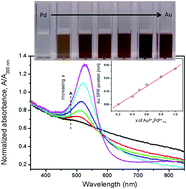
Fig. 1 shows the UV-VIS absorption spectra of Au–Pd nanoparticles for different Au/Pd ratios. The surface plasmon resonance (SPR) peak consistently shifts to a longer wavelength – eventually reaching the value for gold colloids – as the ratio increases and the strength increases. The inset plot shows a linear relationship between the wavelength of the SPR peak and the Au/Pd ratio. This is consistent with the simulation results19 based on the Mie theory. This indicates that our nanoparticles are a Au–Pd alloy.
image file: c5ra10915a-f1.tif
Fig. 1 UV-VIS optical absorption spectra of bimetallic Au–Pd nanoparticles for different Au/Pd values (x). The inset shows a plot of the SPR peak intensity vs. x, with a linear best fit. The visual appearance of the Au–Pd nanoparticle solution is shown in the photograph for x = 0, 0.2, 0.4, 0.5, 0.6, 0.8, 1.0.

As shown by the photograph in Fig. 1, the Au–Pd nanoparticle colloid changes color as the Au/Pd ratio increases – from light brown to red. Pure Pd colloidals are opaque with a dark brown color after irradiation and precipitate in a short time.

To exclude the possibility of the formation of a mixture of Pd and Au nanoparticles, monometallic Au and Pd nanoparticles were separately synthesized and then mixed to achieve the same Au/Pd ratios as in Fig. 1. The SPR absorption peak did not shift and only its intensity increased as the ratio increased. Therefore, our Au–Pd nanoparticles are bimetallic rather than a mixture of monometallic nanoparticles.

Previous irradiation synthesis studies of Au–Pd bimetallic nanoparticles revealed a dose rate effect for precursor solutions containing capping polymers.17 A low dose rate (∼6 kGy h−1) and γ-ray irradiation favored the formation of Au(core)–Pd(shell) nanoparticles, whereas alloyed nanoparticles were obtained at a high dose rate (2.2 kGy s−1) with electron beam bombardment.17 These facts are consistent with our formation of alloyed nanoparticles with high-dose-rate X-ray irradiation (11.5 kGy s−1).

3.2 Nanoparticle structure

As shown in Fig. 2(a), the XRD patterns depend on the Au/Pd ratio with the major reflections located between those of monometallic Au and Pd (111). The lattice parameters calculated from the most prominent (111) reflections are summarized in Fig. 2(b). For bimetallic nanoparticles with Au/Pd ratios x ≥ 0.5, single intense Bragg peaks were detected, which shifted to higher diffraction angles with decreasing x.
image file: c5ra10915a-f2.tif
Fig. 2 Synchrotron powder XRD patterns (a) and (b) the relationship between the derived lattice constant and x, with linear fits. X-ray wavelength: 1.0271 Å. Circles: data. Solid lines: linear fits.

The Au–Pd system is miscible in the full composition range and generally follows Vegard’s law.25,26 We found that Au–Pd alloys formed at x ≥ 0.5. For lower x-values, separated or overlapping reflections were found between those of Au and Pd (111) – indicating phase separation. Still, the reflection shifts with x indicate partial alloying, probably coexisting with monometallic Pd nanoparticles.

The effects of the precursor composition on the lattice parameter, crystal size, and phase structure are summarized in Table 1. The particle size was calculated with the Sherrer equation27 from the (111) reflections. The particle size depends on the Au/Pd ratio: for x ≥ 0.5, Au–Pd alloyed particles are smaller than the Au nanoparticles (35.6 nm) and the size decreases from 31.2 nm to 17.8 nm as x decreases. At x < 0.5, the smallest Au–Pd nanoparticles are observed (8–10 nm). The monometallic Pd nanoparticles obtained for low x-values are smaller (10–17 nm) than those for x = 0 (44.6 nm).

Table 1 Calculated lattice constant, grain size and phase structure of the Au–Pd bimetallic nanoparticles
Sample ID Au fraction (x) in Aux3+/Pd1−x2+ a (Å) Size (nm) Phase structure
Au 1 4.083 35.6 ± 2 Au
Au0.8Pd0.2 0.8 4.067 31.2 ± 8 Au–Pd alloy
Au0.6Pd0.4 0.6 4.062 30.7 ± 1 Au–Pd alloy
Au0.5Pd0.5 0.5 4.056 17.8 ± 5 Au–Pd alloy
Au0.4Pd0.6 0.4 4.020 9.6 ± 2 Au–Pd alloy
3.924 9.8 ± 3 Au–Pd alloy
Au0.2Pd0.8 0.2 3.969 7.8 ± 4 Au–Pd alloy
3.895 16.6 ± 7 Pd (?)
Pd 0 3.891 44.6 ± 9 Pd


3.3 XANES

Fig. 3 shows the XANES curves for different x-values together with that of Au foil. The intensity of the L3 spectrum is related to the number of holes in the empty d-band. The Au–Pd nanoparticles give a more intense spectrum than the Au foil. Thus, the electronic properties of gold are altered by Pd, most likely due to the strong interaction of the Pd 4d band with the Au 5d band, resulting in a decrease of the empty density to states in the latter.
image file: c5ra10915a-f3.tif
Fig. 3 The XANES curves of Au–Pd nanoparticles together with that of Au foil.

3.4 Transmission electron microscopy

As shown in Fig. 4(a), the small Au–Pd nanoparticles (x = 0.5) are spherical, with a diameter of 16.9 ± 3 nm. This is consistent with the size (17.8 ± 5 nm) derived by XRD, which reflects the overall grain size for both small and aggregated nanoparticles. The EDS-derived composition, however, deviated from that of the precursor composition – see Fig. 4(b). Compared to the microstructure-sensitive TEM and EDS, optical absorption and XRD indeed reflect the bulk nanoparticle features and are more reliable in deriving the crystal structure and the phases.
image file: c5ra10915a-f4.tif
Fig. 4 TEM micrograph (a), EDS data (b) and high-resolution TEM micrograph (c) of Au–Pd (x = 0.5) bimetallic nanoparticles. Scale bar in (c): 2 nm.

A typical high-resolution TEM micrograph of an alloyed Au–Pd nanoparticle (x = 0.5) is shown in Fig. 4(c). A core–shell-like structure is observed and the observed lattice fringes are close to the Pd{111} and {100} planes of the Au–Pd alloys. For x = 0.5, the calculated d-spacing is 2.25 Å for the Pd{111} planes and 2.03 Å for the {100} planes. The inner part of the particle shown in the TEM image, revealing a high electron density, could be identified with a high Au concentration. Thus, the core of the nanoparticle could be alloyed but the surface could mostly consist of segregated Pd.20,28–30

3.5 Catalytic properties

The reduction of p-nitrophenol in the presence of NaBH4 is well documented.31–33 p-nitrophenol exhibits an SPR peak at 317 nm due to the formation of p-nitrophenolate under alkaline condition, that shifts to 400 nm when NaBH4 is present. The solution is stable if no catalyst is added. When the reaction takes place, the 400 nm SPR peak intensity decreases and a new peak appears at 300 nm due to the formation of p-aminophenol. We added NaBH4 to guarantee the stability of p-nitrophenolate; the reaction producing p-aminophenol can be treated as pseudo-first-order. To model its kinetics, the concentration ratio was replaced by the ratio of the SPR peak intensities At/A0 measured at the times t and at the start of the reaction. Therefore, the reaction kinetics equation is:
image file: c5ra10915a-t1.tif
where k is the rate constant (s−1). Fig. 5 shows the plot of ln(At/A0) vs. time for different x-values. The Au–Pd nanoparticles for the lowest x-value, 0.2, exhibit the strongest catalytic performance. The reaction was basically completed in 2 min. On the contrary, the highest x-value, 0.8, corresponds to the slowest reaction. Note that the particle size also decreases with x, suggesting a role in the enhanced catalytic properties in addition to that of the Pd content.

image file: c5ra10915a-f5.tif
Fig. 5 The evolution of the UV-VIS absorption spectrum of p-nitrophenol reduced by Au–Pd bimetallic nanoparticles (a), and the plot of ln(At/A0) with increasing reaction times, for three different x-values (b).

We did not observe the “synergistic effect” in the catalytic properties of the Au–Pd nanoparticles as previously reported.34 Note that the catalytic properties of pure Pd nanoparticles are not presented because they are not a stable colloid. However, we can argue from the trend of increasing catalytic performance with Pd concentration that such an effect is not affected by the amount of Au. It is likely that the synergistic effect is linked to capping, validating our argument that studies of uncapped nanoparticles are required to fully clarify the phenomena.

The ultrahigh flux of synchrotron X-rays can be exploited for very fast fabrication of Au–Pd nanoparticles with the already mentioned small-volume approach. Our preliminary results indicate that the uncapped Au–Pd nanoparticles, prepared with a very short exposure time (up to 12 s), have a similar composition-dependent catalytic performance as that described above.

Acknowledgements

This work is supported by the National Science and Technology Program for Nanoscience and Nanotechnology, the Thematic Research Project of Academia Sinica, the Biomedical Nano-Imaging Core Facility at the National Synchrotron Radiation Research Center (Taiwan), the Center for Biomedical Imaging (CIBM) in Lausanne and by the EPFL.

Notes and references

  1. D. Mott, J. Luo, P. N. Njoki, Y. Lin, L. Wang and C.-J. Zhong, Catal. Today, 2007, 122, 378 CrossRef CAS PubMed.
  2. D. Xu, Z. P. Liu, H. Z. Yang, Q. S. Liu, J. Zhang, J. Y. Fang, S. Z. Zou and K. Sun, Angew. Chem., Int. Ed., 2009, 48, 4217 CrossRef CAS PubMed.
  3. D. S. Wang and Y. D. Li, Adv. Mater., 2011, 23, 1044 CrossRef CAS PubMed.
  4. M. S. Chen, D. Kumar, C. W. Yi and D. W. Goodman, Science, 2005, 310, 291 CrossRef CAS PubMed.
  5. D. Wang, A. Villa, F. Porta, D. S. Su and L. Prati, Chem. Commun., 2006, 1956 RSC.
  6. H. Heinz, B. L. Farmer, R. B. Pandey, J. M. Slocik, S. S. Patnaik, R. Pachter and R. R. Naik, J. Am. Chem. Soc., 2009, 131, 9704 CrossRef CAS PubMed.
  7. Z. B. Ge, D. G. Cahill and P. V. Braun, J. Phys. Chem. B, 2004, 108, 18870 CrossRef CAS.
  8. M. R. Knecht, M. G. Weir, A. I. Frenkel and R. M. Crooks, Chem. Mater., 2008, 20, 1019 CrossRef CAS.
  9. S. Marx and A. Baiker, J. Phys. Chem. C, 2009, 113, 6191 CAS.
  10. Y. W. Lee, M. Kim, Z. H. Kim and S. W. Han, J. Am. Chem. Soc., 2009, 131, 17036 CrossRef CAS PubMed.
  11. B. Lim, H. Kobayashi, T. Yu, J. G. Wang, M. J. Kim, Z. Y. Li, M. Rycenga and Y. Xia, J. Am. Chem. Soc., 2010, 132, 2506 CrossRef CAS PubMed.
  12. F. Krumeich, S. Marx, A. Baikere and R. Nesper, Z. Anorg. Allg. Chem., 2011, 637, 875 CrossRef CAS PubMed.
  13. N. Toshima, M. Harada, Y. Yamazaki and K. Askura, J. Phys. Chem., 1992, 96, 9927 CrossRef CAS.
  14. D. Ferrer, A. Torres-Castro, X. Gao, S. Sepúlveda-Guzmán, U. Ortiz-Méndez and M. José-Yacamén, Nano Lett., 2007, 7, 1701 CrossRef CAS PubMed.
  15. C. L. Wang, B. J. Hsao, S. F. Lai, W. C. Chen, H. H. Chen, Y. Y. Chen, C. C. Chien, X. Q. Cai, I. M. Kempson, Y. Hwu and G. Margaritondo, Nanotechnology, 2011, 22, 065605 CrossRef PubMed.
  16. Y. Ohkubo, M. Shibata, S. Kageyama, S. Seino, T. Nakagawa, J. Kugai, H. Nitani and T. A. Yamamoto, J. Mater. Sci., 2012, 9, 2142 Search PubMed.
  17. H. Remita, A. Etcheberry and J. Belloni, J. Phys. Chem. B, 2003, 107, 31 CrossRef CAS.
  18. F. Ksar, L. Ramos, B. Keita, L. Nadjo, P. Beaunier and H. Remita, Chem. Mater., 2009, 21, 3677 CrossRef CAS.
  19. T. Nakagawa, H. Nitani, S. Tanabe, K. Okitsu, S. Seino, Y. Mizukoshi and T. A. Yamamoto, Ultrason. Sonochem., 2005, 12, 249 CrossRef CAS PubMed.
  20. C. X. Kan, W. P. Cai, C. C. Li, L. D. Zhang and H. Hofmeister, J. Phys. D: Appl. Phys., 2003, 36, 1609 CrossRef CAS.
  21. O. V. Belousov, N. V. Belousova, A. V. Sirotina, L. A. Solovyov, A. M. Zhyzhaev, S. M. Zharkov and Y. L. Mikhlin, Langmuir, 2011, 27, 11697 CrossRef CAS PubMed.
  22. C. Binns, Surf. Sci. Rep., 2001, 44, 1 CrossRef CAS.
  23. C. J. Liu, C. H. Wang, C. L. Wang, Y. Hwu, C. Y. Lin and G. Margaritondo, J. Synchrotron Radiat., 2009, 16, 395 CrossRef CAS PubMed.
  24. C. H. Wang, C. C. Chien, Y. L. Yu, C. J. Liu, C. F. Lee, C. H. Chen, Y. Hwu, C. S. Yang, J. H. Je and G. Margaritondo, J. Synchrotron Radiat., 2007, 14, 477 CrossRef CAS PubMed.
  25. A. R. Denton and N. W. Ashcroft, Phys. Rev. A, 1991, 43, 3161 CrossRef CAS.
  26. A. Maeland and T. B. Flanaga, Can. J. Phys., 1964, 42, 2364 CrossRef CAS.
  27. H. Christopher, in The basics of crystallography and diffraction, Oxford University Press, New York, 1997, ch. 9, pp. 145–148 Search PubMed.
  28. J. K. Edwards, A. F. Carley, A. A. Herzing, C. J. Kiely and G. J. Hutchings, Faraday Discuss., 2008, 138, 225 RSC.
  29. A. A. Herzing, M. Watanabe, J. K. Edwards, M. Gonte, Z. R. Tang and G. J. Hutchings, Faraday Discuss., 2008, 138, 337 RSC.
  30. F. Krumeich, S. Marx, A. Baikere and R. Nesper, Z. Anorg. Allg. Chem., 2011, 637, 875 CrossRef CAS PubMed.
  31. J. He, W. Ji, L. Yao, Y. Wang, B. Khezri, R. D. Webster and H. Chen, Adv. Mater., 2014, 26, 4151 CrossRef CAS PubMed.
  32. H. Yazid, R. Adnan, M. A. Farrukh and S. A. Hamid, J. Chin. Chem. Soc., 2011, 58, 593 CrossRef CAS PubMed.
  33. S. K. Ghosh, M. Mandal, S. Kundu, S. Nath and T. Pal, Appl. Catal., A, 2004, 268, 61 CrossRef CAS PubMed.
  34. L. Prati, A. Villa, F. Porta, D. Wang and D. Su, Catal. Today, 2007, 122, 386 CrossRef CAS PubMed.

This journal is © The Royal Society of Chemistry 2015
Click here to see how this site uses Cookies. View our privacy policy here.