DOI:
10.1039/C5RA10834A
(Paper)
RSC Adv., 2015,
5, 63827-63833
Investigation of the difference in liquid superlubricity between water- and oil-based lubricants
Received
8th June 2015
, Accepted 2nd July 2015
First published on 2nd July 2015
Abstract
In the present work, we show that the liquid superlubricity (μ < 0.01) of water-based lubricants can be achieved between sapphire/sapphire even when the average contact pressure is higher than 100 MPa, while the superlubricity of oil-based lubricants cannot be achieved with the same contact pressure. However, when the pressure is reduced to 50 MPa, the friction coefficient of oil-based lubricants can translate from non-superlubricity (μ > 0.01) to superlubricity while the friction coefficient of water-based lubricants is always in the superlubricity region. The calculated friction results indicate that the liquid superlubricity is closely linked to pressure and the pressure–viscosity coefficient. When the pressure is high, the pressure–viscosity coefficient has to be as small as possible to achieve superlubricity, but when the pressure is low, superlubricity can be achieved with a wide range of pressure–viscosity coefficients. Finally, the liquid superlubricity region dependent on pressure and the pressure–viscosity coefficient were established, which are useful for us to design liquid superlubricity systems.
Introduction
The term “superlubricity” was invented by Hirano and Shinjo in the 1990s to describe the phenomenon when the friction force between two sliding surfaces completely vanishes.1 But actually, when the measured sliding friction coefficient is less than 0.01, it can be referred to as superlubricity.2 Because the investigation of the superlubricity phenomenon is very important for saving energy in traditional mechanical lubrication systems and nano-mechanical systems, it has attracted many researchers to investigate the superlubricity mechanism during recent years.3 At present, there are mainly two kinds of lubricants which possess superlubricity properties. The first one is solid lubricants with incommensurate structure or weak interlayer interaction,4–6 such as molybdenum disulfide (MoS2),7 diamond-like carbon film (DLC),8,9 carbon nitride film (CNx),10 and so on. The other one is liquid lubricants with extremely low shear strength, for example, ceramic materials with water lubrication,11–13 a polymer brush immersed in water,14–16 diamond-like carbon film with glycerol lubrication,17,18 polysaccharide solution extracted from red algae,19 and so on. All of them can achieve a friction coefficient of less than 0.01 under ambient conditions. Moreover, our group has recently found that the mucilage of Brasenia schreberi,20 phosphoric acid,21,22 and a mixture of polyhydroxy alcohol and acid,23,24 can all achieve superlubricity with a friction coefficient of less than 0.005.
These examples above indicate that the liquid lubricants with superlubricity properties are all water-based. It is because the pressure–viscosity coefficient of water-based lubricants is usually much lower than that of oil-based lubricants, leading to a much lower shear strength between two friction surfaces under high pressure.25 As for oil-based lubricants, due to their high pressure–viscosity coefficient (viscosity increasing dramatically with pressure), the friction force is usually much higher than that of water-based lubricants. However, it does not mean that the oil-based lubricants cannot achieve superlubricity. Recently, we found that the liquid superlubricity of silicone oil can also be achieved between friction surfaces (Si3N4/glass) through running-in with an acid solution.26 This indicated that the liquid superlubricity of oil-based lubricants can also be achieved under some conditions, but the conditions that satisfy superlubricity are still not clear. Therefore, in the present work, the difference in superlubricity behavior between water- and oil-based lubricants was investigated, and the mechanism of liquid superlubricity for both water- and oil-based lubricants was revealed.
Materials and method
The phosphoric acid (H3PO4) used is the commercial product from J&K with a purity greater than 99%. Before testing, the H3PO4 was diluted using deionized water to a pH value of 1.5. There were four kinds of water-based lubricants, including glycerol solution (70%, v/v), ethanediol solution (100%, v/v), 1,3-propanediol solution (90%, v/v) and 1,4-butanediol solution (90%, v/v), selected as test samples. There were also four kinds of oil-based lubricants, including oleic acid, poly-a-olefins (PAO-4), silicone oil and n-decanol, used for comparison.
The friction coefficient was measured on a Universal Micro-Tribotester (UMT-3, Bruker, USA) with a rotation mode of ball-on-disk. The ball was made of sapphire with a diameter of 4 mm, and a sapphire substrate was used as the disk. Before testing, the ball and substrate were cleaned with acetone, ethanol and deionized water successively for 10 min in an ultrasonic bath and then dried using compressed air. The liquid was introduced between the ball and the disk with a volume of 20–50 μL. The range of load applied on the substrate was from 0.5 N to 3 N, and the range of rotation speed of the substrate was from 6 rpm to 180 rpm with a track radius of 3 mm (corresponding to a sliding speed of 0.002 m s−1 to 0.057 m s−1). The friction coefficient of H3PO4 (pH = 1.5) was measured first for 450 s. After that, the ball and substrate were immersed in de-ionized water for about 3 min, and then the de-ionized water was sucked up using a syringe, and finally the ball and substrate were cleaned using absorbent paper to wash out the remaining H3PO4 solution from the friction surfaces. Second, the water-based and oil-based lubricants were introduced between the ball and substrate to measure their friction coefficients. The friction coefficient under each of the different conditions was measured five times. The measuring accuracy of the friction coefficient is ±0.001. Before testing, the measurement errors were eliminated by adjusting the levelness of the disk to obtain the same friction coefficients in two reverse sliding directions.27 All of the tests were performed at a temperature of 26 °C and a relative humidity of 20–40%.
Results and discussion
Our previous work indicated that liquid superlubricity can be achieved after running-in with an acid solution.28 Therefore, liquid superlubricity in this work was achieved by the same method (running-in with H3PO4 solution). First, the friction coefficient of H3PO4 (pH = 1.5) between the original surfaces of the sapphire and sapphire was measured, as shown in Fig. 1. It was found that the friction coefficient of H3PO4 is reduced to 0.004 after a running-in period of 400 s and then remains constant. After a test lasting for 450 s, we stopped taking measurements and washed the remaining H3PO4 solution from the two friction surfaces. The topography of the friction surfaces after lubrication with H3PO4 is shown in Fig. 2. It can be seen that there is a worn flat region with a diameter of 170 μm on the top region of the ball, but there is no obvious wear in the track on the substrate (observed using an optical microscope), which indicates that the wear mainly originated from the ball. The roughness (Ra) of the worn region of the ball and track on the substrate was measured using AFM with an area of 20 μm × 20 μm. It was found that the roughness (Ra) of the worn region of the ball and track on the substrate was 2.29 nm and 2.03 nm, respectively.
 |
| | Fig. 1 Friction coefficient of H3PO4 (pH = 1.5) and friction coefficient of oleic acid and glycerol (70%) after lubrication with H3PO4 (pH = 1.5). The load was 3 N, and the sliding speed was 0.057 m s−1. | |
 |
| | Fig. 2 Optical image of the friction surfaces after lubrication with H3PO4 (pH = 1.5). (a) The top region of the ball and (b) the track on the substrate. | |
After washing away the remaining H3PO4 solution from the two friction surfaces, one kind of water-based lubricant (glycerol solution (70%)) was introduced between the two friction surfaces instead of H3PO4. It was found that the friction coefficient of glycerol solution decreased to about 0.004 suddenly (no running-in period), as shown in Fig. 1. Similarly, we also used one kind of oil-based lubricant (oleic acid) instead of H3PO4 solution through the same method. It can be seen that the friction coefficient of oleic acid only reduced to about 0.02. On comparing the two results, it is obvious that the glycerol solution has more excellent lubricating properties than oleic acid under the same test conditions, which can lead to the friction coefficient being reduced to a magnitude order of 0.001 (superlubricity).
To further investigate whether the other water-based lubricants also have more excellent lubricating properties than oil-based lubricants, the friction coefficients of another three kinds of water-based lubricants, including ethanediol, 1,3-propanediol and 1,4-butanediol were measured using the same method, as shown in Table 1. It was found that their friction behavior is the same as that of glycerol. The friction coefficient of each one is reduced to less than 0.006 without a running-in period. For comparison, the friction coefficient of another three kinds of oil-based lubricants, including silicone oil, PAO-4 and n-decanol were also measured, as shown in Table 1. It was found that their friction behavior is similar to that of oleic acid. The friction coefficient of each one is greater than 0.02. These results confirm that the friction coefficients of water-based lubricants can be one order of magnitude lower than those of oil-based lubricants to achieve superlubricity under the same test conditions.
Table 1 (a) Friction coefficient of ethanediol (100%), 1,3-propanediol (90%), 1,4-butanediol (90%) silicone oil, PAO-4 and n-decanol after lubrication with H3PO4 (pH = 1.5). The load was 3 N, and the sliding speed was 0.057 m s−1
| |
Water-based lubricants |
Oil-based lubricants |
| Friction coefficient |
Ethanediol |
Propanediol |
Butanediol |
Silicone oil |
PAO-4 |
n-Decanol |
| 0.005 |
0.004 |
0.005 |
0.044 |
0.039 |
0.023 |
Because the sliding speed and applied load have great influence on the friction coefficient of liquid lubricants, the sliding speed was changed from 6 rpm to 180 rpm (corresponding to a sliding speed of 0.002 m s−1 to 0.057 m s−1) when glycerol solution (70%) and oleic acid were used as lubricants, as shown in Fig. 3. For the glycerol solution, the friction coefficient increases from 0.004 to 0.012 when the rotation speed decreases from 180 rpm to 6 rpm. As for oleic acid, the friction coefficient decreases slightly from 0.02 to 0.018 when the rotation speed decreases from 180 rpm to 30 rpm and then it increases from 0.018 to 0.023 when the rotation speed decreases further from 30 rpm to 6 rpm. This indicates that the evolution of the friction coefficient with speed is in accordance with the Stribeck curve. Because the lowest friction coefficient of oleic acid is 0.018, it can be concluded that the superlubricity of oleic acid cannot be achieved no matter how much the sliding speed is changed. Similarly, it was found that superlubricity cannot be achieved for the other three kinds of oil-based lubricants through the method of changing the sliding speed.
 |
| | Fig. 3 Relationship between the rotation speed and friction coefficient of oleic acid and glycerol solution (70%) after lubrication with H3PO4 (pH = 1.5). The load was 3 N. | |
Second, the applied load was changed from 0.5 N to 3 N when glycerol solution (70%) and oleic acid were used as lubricants, as shown in Fig. 4. It is found that the friction coefficient of the glycerol solution did not obviously change when the load decreases from 3 N to 0.5 N. However, the friction coefficient of oleic acid is greatly reduced from 0.02 to 0.009 when the load decreases from 3 N to 0.5 N. This indicates that reducing the contact pressure can lead to reduction of the friction coefficient of oleic acid. As for the other three kinds of oil-based lubricants, the results are the same as for oleic acid (the friction coefficient reduces with decreasing pressure). According to these results, it can be inferred that the superlubricity of oil-based lubricants is possible to achieve as long as the contact pressure is reduced to a very small value.
 |
| | Fig. 4 Relationship between the load and friction coefficient of oleic acid and glycerol solution (70%) after lubrication with H3PO4 (pH = 1.5). The sliding speed was 0.057 m s−1. | |
To confirm this inference, an experiment was designed which increased the contact area to reduce pressure. The method for increasing the contact area was to add about 5 μL water in the contact region repeatedly with an interval of 300 s when measuring the friction coefficient of H3PO4. After a test lasting for about 2000 s, we stopped taking measurements. The wear scar of the ball treated using this method was compared with that resulting from the lubrication with H3PO4 for 450 s, as shown in Fig. 5(a) and (b). It can be seen that the diameter of the contact region increased from 170 μm (original value) to 280 μm, corresponding to the average pressure being reduced from 132 MPa to 49 MPa. The friction coefficients of the four kinds of oil-based lubricants above were measured using this method, as shown in Fig. 5(c). It can be seen that the friction coefficient of each of them is reduced to less than 0.005, which enters the superlubricity region. Compared with their original value when the pressure is 132 MPa, it was confirmed that low pressure is beneficial for oil-based lubricants to achieve superlubricity. In other words, the superlubricity of oil-based lubricants is possible to achieve as long as the pressure is low enough. Similarly, the friction coefficients of the four kinds of water-based lubricants above were also measured using this method, as shown in Fig. 5(d). It was found that the friction coefficient of each of them was not obviously changed (the friction coefficient is always less than 0.005) with decreasing pressure. According to these results, it can be concluded that the superlubricity behavior of oil-based lubricants is more sensitive to the contact pressure relative to water-based lubricants.
 |
| | Fig. 5 (a) Optical image of the ball with a small wear scar. (b) Optical image of the ball with a large wear scar. (c) Friction coefficient of oleic acid, PAO-4, silicone oil and n-decanol with different wear scars. (d) Friction coefficient of glycerol, ethanediol, 1,3-propanediol and 1,4-butanediol with different wear scars. The load was 3 N, and the sliding speed was 0.057 m s−1. | |
Why is the superlubricity behavior of water-based lubricants totally different from that of oil-based lubricants? Because there is no tribochemical reaction between H3PO4 and the sapphire surface after lubrication with H3PO4,22 the formation of an elastohydrodynamic lubrication (EHL) film is the dominant mechanism for the friction coefficient of water- and oil-based lubricants. According to the H–D theory (H–D), the film thickness of EHL between two friction surfaces for different lubricants can be estimated, as described by eqn (1).29
| |
 | (1) |
where
α is the pressure–viscosity coefficient of the lubricant,
η0 is the bulk viscosity of the lubricant,
W is the applied load,
u is the average linear speed of the substrate and ball, and
R is the equivalent radius of the ball that can be described by the Hertz contact theory, as shown in
eqn (2).
| |
 | (2) |
where
D is the diameter of the worn region of the ball (measured using an optical microscope), and
E is the reduced Young’s modulus of the two contacting solids defined by
| | |
E = 1/[(1 − v12)/E1 + (1 − v22)/E2]
| (3) |
where
vi is Poisson’s ratio for material
i, and
Ei is the elasticity modulus of material
i. The viscosity and pressure–viscosity coefficient of these lubricants are measured at 25 °C using a standard rheometer (Physica MCR301, Anton Paar) and a high pressure viscometer (Cambridge, VISCOlab PVT), as shown in
Table 2. The film thickness (
hc) between two friction surfaces is predicted using the above H–D equation when the contact pressure is 132 MPa (
Table 2).
Table 2 Viscosity and pressure–viscosity coefficient of six kinds of lubricants and their film thickness (hc) between two friction surfaces (pressure is 132 MPa) predicted using the H–D equation
| Lubricant |
Oleic acid |
PAO-4 |
n-Decanol |
Glycerol |
Ethanediol |
Propanediol |
| Viscosity (mPa s) |
26 |
30 |
12 |
39 |
18 |
43 |
| Pressure–viscosity coefficient (GPa−1) |
16 |
18 |
17 |
6 |
4 |
5 |
| hc (nm) |
39.9 |
46.8 |
24.6 |
31.1 |
15.0 |
30.2 |
The lubrication regime can be distinguished through the method of using the ratio of theoretical film thickness to the combined surface roughness, and the ratio can be calculated using formula (4).
| |
 | (4) |
where
σ1 and
σ2 are the surface roughnesses of the worn region of the ball and substrate, respectively. The lubrication regime is EHL if the ratio
λ is larger than 3, mixed lubrication if the ratio is between 1 and 3, and boundary lubrication when the ratio is less than 1. According to
Fig. 2 and
Table 2, it is easy to find that the ratio
λ is greater than 3 for all lubricants in our tests when the contact pressure is 132 MPa, meaning that the lubrication states of superlubricity for water-based lubricants and non-superlubricity for oil-based lubricants are both in the regime of EHL. It indicates that there is a great difference in the friction coefficients between water- and oil-based lubricants even if the lubrication state is the same.
To investigate the reason for the difference, the friction coefficient (μ) can be described approximately by the following expression when the lubrication state is EHL.
| |
 | (5) |
where
A is the contact area of the lubricating film,
W is the load, and
τ is the shear stress of the confined lubricant, as given by
eqn (6)| |
 | (6) |
where
η0 is the bulk viscosity of the lubricant,
α is the pressure–viscosity coefficient of the lubricant,
p is the average contact pressure,
u is the average linear speed of the substrate and ball, and
hc is the film thickness of the lubricant, as described by
eqn (1). According to the Hertz contact theory, the relationship between
W,
A and
p can be described
via the two following equations.
| |
 | (7) |
| |
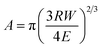 | (8) |
According to the equations above, the friction coefficient can be derived approximately, as given by eqn (9).
| |
 | (9) |
where
K is a constant dependent on
E and
W (
E is dependent on the properties of the material and
W remains constant in our tests).
Eqn (9) indicates that the friction coefficient would increase with increasing viscosity and speed, but their influence on the friction coefficient is not great. For example, if the viscosity or speed becomes five times larger than the original value, the friction coefficient would only increase to 1.7 times the original value. In contrast, the pressure–viscosity coefficient (
α) and pressure (
p) have greater influence on the friction coefficient. To further investigate the influence of
α and
p on the friction coefficient, we assume that the sliding speed (
u) and the bulk viscosity of the lubricant (
η0) remain constant, and then we can get
| |
 | (10) |
where
K0 is a constant dependent on
E,
W,
u and
η0. Assuming

, then the friction coefficient is directly proportional to
F(
α,
p). If we want to obtain an ultralow friction coefficient,
F(
α,
p) has to be as small as possible.
Fig. 6(a) shows four examples of the relationship between F(α, p) and pressure–viscosity coefficient when the average pressure is 30 MPa, 60 MPa, 90 MPa and 120 MPa. For a given pressure, it is found that the friction coefficient reduces first with increasing α and then increases with increasing α, which indicates that a minimum value friction coefficient exists. According to the derivation of eqn (10), we find that the friction coefficient reaches the lowest value when α = 0.53/p0, where p0 is a given pressure. Obviously, if the given pressure is higher, α has to be smaller to achieve the lowest friction coefficient. For example, if the pressure increases from 30 MPa to 120 MPa, α has to decrease from 17.6 GPa−1 to 4.4 GPa−1 to achieve the lowest friction coefficient. In addition, it is also found that the range of the change in the friction coefficient with α is larger if the given pressure is higher. For instance, the friction coefficient would increase to 3 times the original value with α increasing from 6 GPa−1 to 20 GPa−1 when the pressure is 120 MPa. However, the friction coefficient almost remains the same when α is increased from 6 GPa−1 to 20 GPa−1 when the pressure is 60 MPa. This is in accordance with the test results, in that the friction coefficient is the same for both oil-based lubricants and water-based lubricants when the pressure is equal to 49 MPa, but the friction coefficient of oil-based lubricants is much higher than that of water-based lubricants when the pressure is equal to 132 MPa (Fig. 5).
 |
| | Fig. 6 (a) Relationship between F(α, p) and pressure–viscosity coefficient when the average pressure is 30 MPa, 60 MPa, 90 MPa and 120 MPa. (b) Relationship between F(α, p) and pressure when the pressure–viscosity coefficient is 4 GPa−1, 10 GPa−1, 16 GPa−1 and 22 GPa−1. | |
For a given pressure–viscosity coefficient (α), Fig. 6(b) shows four examples of the relationship between F(α, p) and pressure. It can be found that the friction coefficient increases greatly with increasing pressure when α is larger than 15 GPa−1. For example, when α = 22 GPa−1, the friction coefficient increases to 8 times the original value when the pressure is increased from 20 MPa to 140 MPa. However, when α = 4 GPa−1, the friction coefficient is not obviously increased when the pressure is increased from 20 MPa to 140 MPa. This result explains the reason why the friction coefficient has a great reduction with reducing pressure when testing oil-based lubricants, but it remains almost the same with reducing pressure when testing water-based lubricants.
These calculation results confirm that the liquid superlubricity is closely linked to the pressure–viscosity coefficient (α) and contact pressure (p), but it is still not clear under what conditions α and p satisfy superlubricity. Because solving the question is very important for us to design liquid superlubricity systems, the superlubricity region dependent on α and p was established as follows. For a given region of α and p, eqn (10) indicates that there exists a smallest value friction coefficient (μmin). Here, we define the superlubricity region using eqn (11).
| | |
μ(α, p) < Ksμmin(α0, p0) ≤ 0.01
| (11) |
where
μmin(
α0,
p0) is the smallest value of
μ(
α,
p) in a given region of
α and
p, and
Ks is a constant dependent on
μmin(
α0,
p0). Obviously, if there is a superlubricity region, the value of
μmin(
α0,
p0) has to be less than 0.01. Therefore, the experimental parameters, such as
E,
W,
u and
η0 have to satisfy some conditions to make
μmin(
α0,
p0) less than 0.01. According to our experimental results (
Table 1), it can be inferred that the value of
μmin(
α0,
p0) under our test conditions is less than 0.005, which indicates that there must be a superlubricity region. Here, we assume that
Ks = 2, then we can get
eqn (12).
| | |
μ(α, p) < 2μmin(α0, p0) ≤ 0.01
| (12) |
By solving eqn (12), the superlubricity region under our test conditions can be achieved when 0.8 GPa−1 ≤ α ≤ 30 GPa−1 and 0.01 GPa ≤ p ≤ 0.35 GPa are set as a given region, as shown in Fig. 7. It is found that there is a superlubricity region, where the contact pressure has to be less than 285 MPa. In the superlubricity region, it can be found that the range of the pressure–viscosity coefficient becomes narrower with increasing pressure and the range of pressure becomes narrower with increasing pressure–viscosity coefficient. Moreover, the pressure has to reduce to a lower value to achieve superlubricity when the given pressure–viscosity coefficient is higher, and the pressure–viscosity coefficient has to reduce to a lower value to achieve superlubricity when the given pressure is higher. If the contact pressure exceeds 285 MPa, it is found that superlubricity cannot be achieved no matter how much the pressure–viscosity coefficient is changed.
 |
| | Fig. 7 Superlubricity region calculated using eqn (11) when 0.8 GPa−1 ≤ α ≤ 30 GPa−1 and 0.01 GPa ≤ p ≤ 0.35 GPa are set as a given region. The points A, B, C and D are the calculated friction results for oleic acid (A and C) and glycerol (B and D) when the pressure is 49 MPa and 132 MPa, respectively. | |
The calculated friction results for oleic acid and glycerol are shown in Fig. 7 (marked by A, B, C and D) when the pressure is 49 MPa (A and B) and 132 MPa (C and D), respectively. For glycerol, it can be found that it is always in the superlubricity region when the pressure is increased from 49 MPa to 132 MPa. The friction coefficient only increases to 1.22 times the original value, which can be ignored due to the limitation of the measurements. However, for oleic acid, it can be found that it translates from the superlubricity region to the non-superlubricity region when the pressure is increased from 49 MPa to 132 MPa, and the friction coefficient increases to 2.79 times the original value accordingly. Both the calculated friction results of glycerol and oleic acid are in accordance with the measured friction results above.
According to the results above, the superlubricity of water-based lubricants can be achieved at a wide range of pressures due to their low pressure–viscosity coefficients, which indicates that it is easier to achieve superlubricity of water-based lubricants. As for oil-based lubricants, the superlubricity can only be achieved in a narrow range of low pressures due to their high pressure–viscosity coefficients, which is the reason why it is difficult to achieve superlubricity with oil-based lubricants. In other words, we have to reduce the contact pressure to a low value if we want to achieve superlubricity with oil-based lubricants. Although the above friction results were achieved between sapphire and sapphire, the relationship between liquid superlubricity and pressure and the pressure–viscosity coefficient is independent of the properties of the friction pairs (eqn (10)). At present, the average contact pressure is no more than 150 MPa for all liquid superlubricity according to the reported experimental data.2,3 This indicates that obtaining liquid superlubricity under high pressure is still a difficult task, which is in accordance with our calculations shown in Fig. 7. Because our calculations are mainly based on elastohydrodynamic lubrication, we infer that liquid superlubricity is possible to achieve under high pressure if there are other factors playing a leading role instead of the hydrodynamic effect, such as surface tribochemistry, formation of a hydration layer, etc., which we will study in the future.
Conclusion
In summary, we found that the liquid superlubricity of water-based lubricants can always be achieved when the pressure is increased from 49 MPa to 132 MPa, but the friction coefficient of oil-based lubricants translates from superlubricity to non-superlubricity when the pressure is increased from 49 MPa to 132 MPa. The calculated results indicate that the friction coefficient has a great increase with increasing the pressure–viscosity coefficient when the contact pressure is high, but there is almost no change with increasing the pressure–viscosity coefficient when the contact pressure is low, which is in very good accordance with the measured friction results. We also proposed a superlubricity region based on the pressure and pressure–viscosity coefficient, in which the superlubricity of water-based lubricants can be achieved with a wide range of pressures due to their low pressure–viscosity coefficients, but the superlubricity of oil-based lubricants can only be achieved at low pressure due to their high pressure–viscosity coefficients. This new finding has important engineering value, enabling us to design superlubricity in traditional mechanical lubrication systems and nano-mechanical systems.
Acknowledgements
The work is financially supported by the National Key Basic Research Program of China (2013CB934200), NSFC of China (51405256, 51222507, 51335005) and the China Postdoctoral Science Foundation funded project (2014M550056).
References
- M. Hirano and K. Shinjo, Phys. Rev. B: Condens. Matter Mater. Phys., 1990, 41, 11837–11851 CrossRef CAS.
- A. Erdemir and J.-M. Martin, Superlubricity, Elsevier Academic Press, New York, 2007 Search PubMed.
- J. J. Li and J. B. Luo, Sci. China: Technol. Sci., 2013, 56, 2877–2887 CrossRef.
- M. Hirano, K. Shinjo, R. Kaneko and Y. Murata, Phys. Rev. Lett., 1997, 78, 1448–1451 CrossRef CAS.
- A. Socoliuc, R. Bennewitz, E. Gnecco and E. Meyer, Phys. Rev. Lett., 2004, 92, 134301 CrossRef CAS.
- Y. Hu, T. Ma and H. Wang, Friction, 2013, 1, 24–40 CrossRef.
- J. M. Martin, C. Donnet, T. Lemogne and T. Epicier, Phys. Rev. B: Condens. Matter Mater. Phys., 1993, 48, 10583–10586 CrossRef CAS.
- A. Erdemir, O. L. Eryilmaz and G. Fenske, J. Vac. Sci. Technol., A, 2000, 18, 1987–1992 CAS.
- A. Erdemir, Surf. Coat. Technol., 2001, 146, 292–297 CrossRef.
- J. C. Sanchez-Lopez, M. Belin, C. Donnet, C. Quiros and E. Elizalde, Surf. Coat. Technol., 2002, 160, 138–144 CrossRef CAS.
- J. G. Xu and K. Kato, Wear, 2000, 245, 61–75 CrossRef CAS.
- M. Chen, K. J. Kato and K. Adachi, Tribol. Int., 2002, 35, 129–135 CrossRef CAS.
- F. Zhou, K. Adachi and K. Kato, Diamond Relat. Mater., 2005, 14, 1711–1720 CrossRef CAS PubMed.
- M. Chen, W. H. Briscoe, S. P. Armes and J. Klein, Science, 2009, 323, 1698–1701 CrossRef CAS PubMed.
- U. Raviv, S. Giasson, N. Kampf, J. F. Gohy, R. Jerome and J. Klein, Nature, 2003, 425, 163–165 CrossRef CAS PubMed.
- J. Klein, Friction, 2013, 1, 1–23 CrossRef.
- M. I. D. B. Bouchet, C. Matta, T. Le-Mogne, J. M. Martin, Q. Zhang, W. A. Goddard, III, M. Kano, Y. Mabuchi and J. Ye, J. Phys.: Conf. Ser., 2007, 89, 012003 CrossRef.
- C. Matta, L. Joly-Pottuz, M. I. D. Bouchet and J. M. Martin, Phys. Rev. B: Condens. Matter Mater. Phys., 2008, 78, 085436 CrossRef.
- S. Arad, L. Rapoport, A. Moshkovich, D. van Moppes, M. Karpasas, R. Golan and Y. Golan, Langmuir, 2006, 22, 7313–7317 CrossRef CAS PubMed.
- J. J. Li, Y. H. Liu, J. B. Luo, P. X. Liu and C. H. Zhang, Langmuir, 2012, 28, 7797–7802 CrossRef CAS PubMed.
- J. J. Li, C. H. Zhang and J. B. Luo, Langmuir, 2011, 27, 9413–9417 CrossRef CAS PubMed.
- J. J. Li, C. H. Zhang, M. M. Deng and J. B. Luo, Friction, 2014, 2, 164–172 CrossRef.
- J. J. Li, C. H. Zhang and J. B. Luo, Langmuir, 2013, 29, 5239–5245 CrossRef CAS PubMed.
- J. J. Li, C. H. Zhang, L. R. Ma, Y. H. Liu and J. B. Luo, Langmuir, 2013, 29, 271–275 CrossRef CAS PubMed.
- U. Raviv, P. Laurat and J. Klein, Nature, 2001, 413, 51–54 CrossRef CAS PubMed.
- J. J. Li, C. H. Zhang, M. M. Deng and J. B. Luo, RSC Adv., 2015, 5, 30861–30868 RSC.
- J. J. Li, C. H. Zhang, L. Sun and J. B. Luo, Tribol. Trans., 2013, 56, 141–147 CrossRef CAS PubMed.
- J. J. Li, C. H. Zhang, M. M. Deng and J. B. Luo, Sci. Rep., 2014, 4, 7226, DOI:10.1038/srep07226.
- D. Dowson and G. R. Higginson, Elasto-Hydrodynamic Lubrication, Pergamon Press, Oxford, 1977 Search PubMed.
|
| This journal is © The Royal Society of Chemistry 2015 |
Click here to see how this site uses Cookies. View our privacy policy here. 


 , then the friction coefficient is directly proportional to F(α, p). If we want to obtain an ultralow friction coefficient, F(α, p) has to be as small as possible.

