The effect of liquid stabilization on the structures and the conductive properties of polyimide-based graphite fibers

Ang Li, Zhaokun Ma*, Huaihe Song, Na Li and Mingyue Hou
State Key Laboratory of Chemical Resource Engineering, Key Laboratory of Carbon Fiber and Functional Polymers Ministry of Education, Beijing Key Laboratory of Electrochemical Process and Technology for Materials, Beijing University of Chemical Technology, Beijing, 100029, P. R. China. E-mail: mazk@mail.buct.edu.cn; Fax: +86-10-6443-4916; Tel: +86-10-6443-4916

Received 3rd June 2015 , Accepted 14th September 2015

First published on 14th September 2015


Abstract

Polyimide (PI) fibers, stabilized under reflux of hot nitric acid, are carbonized and graphitized in an inert atmosphere to obtain polyimide-based graphite fibers (PI-GFs). The results of DSC show that the exothermic interval of stabilized PI fibers becomes broad, accompanied by a reduction in total heat release, from 875.18 mW mg−1 (non-stabilized) to 166.13 mW mg−1 (stabilized for 15 min). And the carbon yields substantially increase, from the initial 15.98% (non-stabilized) to 49.93% (stabilized for 30 min) as proved by TGA. In addition, when the stabilization time is over 15 min, some defects such as cracks will appear on the fiber surface, which have a negative influence on the properties of the resulting PI-GFs. After being graphitized at 2800 °C, the stabilized PI-GFs have a high degree of graphitization and thermal conductivity which could be as high as 415.35 W m−1 K−1. It is indicated that PI fibers may be a good potential candidate for graphite fibers with high conductivity.

1. Introduction

With the rapid development of aerospace technology, electronic components with compact designs and high power density have been developed. But these components often generate a large amount of heat while in operation, which must be immediately removed along the desired direction in order to make sure the components can work smoothly and efficiently. However, the materials currently used, such as high-temperature alloys and ceramic matrix composites, are difficult to achieve the requirements simultaneously for low specific gravity, high temperature resistance, high thermal conductivity (TC), low thermal expansion coefficient and thermal shock resistance.1 Graphite material not only has low density, excellent mechanical property and thermal shock resistance, but also has a high TC. Its TC could be theoretically up to 2500 W m−1 K−1 along the graphite sheets direction, but only 6 W m−1 K−1 in perpendicular direction.2 So it is thought to be an excellent candidate material with a high directional TC. The continuous graphite fibers with high TC can be arranged or weaved into the desired materials with high directional TC by appropriate design. The TC of K-1100 mesophase pitch-based carbon fibers made by Cytec Co., Ltd could reach as high as 1120 W m−1 K−1.3 However, due to the complexity in refinement for the special mesophase pitch and high brittleness of the as-spun fibers fabricated by melt spinning, the production cost of the mesophase pitch-based carbon fibers remains high all the time.

It is well known that the aromatic polymer can be transformed into carbon materials by solid-phase carbonization, of which the polyimide (PI) material is one.4 The researches on polyimide-based carbon films have been already commenced as early as the 1970s.5,6 It is found that the polyimide films can be well graphitized and the TCs of their graphitizing films can reach as high as 1800 W m−1 K−1.4 Zhao et al. measured the electrical conductivity of polyimide-based graphite thin films and polyacrylonitrile-based graphite fibers (PAN-GFs), and found that the electrical conductivity of polyimide-based graphite film is, with an order of magnitude, higher than that of PAN-GFs.7 As compared with those in the PI films, macromolecular chains in the PI fibers could have a higher preferred orientation along the fiber axis, so it is reasonable to infer that polyimide-based graphite fibers (PI-GFs) may have a higher electrical conductivity. So far, however, the researches on polyimide-based carbon fibers (PI-CFs) have been rarely reported.

The carbon fiber precursors have to be stabilized before carbonization in order to convert the thermoplastic linear molecular structures into thermosetting crosslinked ones, by which the precursor fibers can keep their high preferred orientation from being changed during carbonization.8,9 Since the PI chain itself contains a large number of aromatic heterocyclic rings, the process of imidization equates the traditional stabilization process partly.10 But the imidization reaction is just to make the intramolecular chains cyclized, the intermolecular chains can't be effective to form crosslinks. Bhat and Schwanke found that the PI fibers treated at 300–560 °C in air or nitrogen show an increase in the inflection point as well as reduction in the exothermic heat evolved.11 In this paper, we discuss a novel PI fiber stabilization method. The new method will make the stabilization process easy to control, carbon yields increased and energy consumption reduced during carbonization. It is expected that this study will provide a better understanding on the stabilization of PI fibers, and furnish an important application for the development of high-performance carbon fibers, particularly the PI-CFs.

2. Experimental

2.1 Materials

The PI fibers owning molecular composition (Fig. 1) of pyromellitic dianhydride/4,4′-oxydianiline/1H-benzimidazol-5-amine-2-(4-aminophenyl) (PMDA/ODA/BIA) are used in this study. The synthesis of PAA is described as following: the BIA/ODA with a mole ratio of 3[thin space (1/6-em)]:[thin space (1/6-em)]7 is dissolved in DMAc in a three-necked round bottom flask. In a flow of nitrogen, equal molar amount of PMDA is added to the solution. The reaction mixture is stirred at 0 °C for 6 hours to yield a 12% solid PAA solution.12 The PI fibers are fabricated by wet spinning and the details in preparation can be described previously.13,14
image file: c5ra10497a-f1.tif
Fig. 1 Molecular composition of the PI fibers.

2.2 Stabilization

The PI fibers prepared above are treated under reflux of concentrated nitric acid for 5–30 min, then naturally cooled, washed by water and dried.

2.3 Carbonization

The stabilized PI fibers are placed in a vacuum tube furnace and their two ends are fixed during pyrolysis treatment. Then these fibers are heated to 1000 °C at a rate of 3 °C min−1, kept at this temperature for 60 min under nitrogen, finally naturally cooled and obtained the black PI-CFs.

2.4 Graphitization

The PI-CFs are placed in a graphitizing furnace and heated to 2800 °C at a rate of 10 °C min−1, kept at this temperature for 60 min under argon, and then naturally cooled to room temperature and obtained the PI-GFs.

2.5 Characterization

Fourier transform infrared (FT-IR) measurements were made by the use of a Thermo Nicolet IS50 Series spectrometer, by loading samples on KBr disks (0.5 mg sample with 200 mg KBr) for the specimens; the FT-IR spectra were acquired by scanning the samples from 500 to 4000 cm−1 with a resolution of 4 cm−1. Mechanical properties of the fibers were measured by single-filament testing (YG001A, Taicang Instrument Corp. of China), according to the ASTM standard D3544-76 procedure. 50 single filament tests were conducted to evaluate the average tensile strength and elongation at break for each set.

The morphology of fiber surface and cross section was observed by a Hitachi S-4700 field emission scanning electron microscope (SEM), with an accelerating voltage 20 kV. Prior to SEM evaluation, the samples were coated with gold by means of a plasma sputtering apparatus. The thermal analysis experiment was carried out in high purity argon atmosphere using the Thermal Sync Analyzer (NETZSCH STA 499C, German). Less than 5 mg of sample was used for the DSC/TGA study in order to avoid the potential thermal lag. The DSC/TGA curves were recorded from 30 to 1000 °C, and the scanning rate was set as 5 °C min. The working conditions of DSC instrument is very stable (28 °C, 40 ± 5% relative humidity), we obtain the calibrated baseline before sample measurement, then our samples are tested under the same conditions. The DSC curves obtained in this experiment are measured after the deduction of the base line.

The structure of samples was analyzed by the use of Raman spectroscopy (LabRamHR800), with scanning range of 0–4000 cm−1. The degree of graphitization can be represented by R = I1360/I1580, the smaller R value is, the higher degree of graphitization is.15 X-ray diffraction (XRD) measurements were performed on a Bruker D8 ADVANCE. The diffracted intensity of Cu Kα radiation (k = 0.1542 nm; 40 kV and 40 mA) was measured between 5 and 90°.

The electrical resistivity of PI-GFs was measured by the use of EC430 resistivity instrument, and 20 specimens were tested for each type of fibers. In this paper, the thermal conductivity of PI-GFs can be calculated according to the following empirical formula.16

 
λ = 1261/σ (1)
here, λ and σ represent the thermal conductivity (W m−1 K−1) and electrical resistivity (μΩ m), respectively.

3. Result and discussion

3.1 Structural and morphologic changes of PI fibers

The characteristic FT-IR absorption peaks were assigned according to previous works.17–20 Usually, polyamide acid (PAA) spectra is compound of the N–H stretch bonds at 3300–3500 cm−1, the C[double bond, length as m-dash]O carbonyl stretch from carboxylic acid at 1710–1720 cm−1, the symmetric carboxylate stretch bonds at 1330–1415 cm−1, the C[double bond, length as m-dash]O carbonyl stretch of the amide I mode around 1665 cm−1, the 1530–1550 cm−1 amide II mode and the 1240–1270 cm−1 band due to the C–O–C ether aromatic stretch.

After the conversion reaction, the absence of the absorption bands near 1550 cm−1 (amide II) and 1665 cm−1 (amide I), as shown in Fig. 2, indicates that PAA has been turned into PI. Simultaneously, this is confirmed by the occurrence of the C[double bond, length as m-dash]O stretch (imide I) peaks at 1770–1780 cm−1 (symmetric) and 1720–1740 cm−1 (asymmetric), the typical C–N stretch (imide II) peak around 1380 cm−1, the C–H bend (imide III) and C[double bond, length as m-dash]O bend (imide IV) absorption bands respectively in the ranges of 1070–1140 cm−1 and of 720–740 cm−1. The presence of a strong absorption band at 3443 cm−1 is associated to the N–H stretch bonds from the BIA unit.


image file: c5ra10497a-f2.tif
Fig. 2 FT-IR spectra of PAA and PI.

As the HNO3 treatment time prolongs, the structure of the samples changes gradually. The occurrence of the absorption bands at 1538 cm−1 corresponding to the N–O stretch bounds and absence of the absorption bands near 3443 cm−1 associated to the N–H stretch bonds from the BIA unit, as shown in Fig. 3, indicate that the N–H groups from PI molecules have been oxidized by HNO3 to form N–O groups. When the samples are treated to 30 min, the N–H groups in PI fibers are almost disappeared.


image file: c5ra10497a-f3.tif
Fig. 3 FT-IR spectra of PI fibers with different stabilization time.

SEM images of PI fibers, as shown in Fig. 4, could intuitionally illustrate that the stabilization reaction has taken place. The non-stabilized PI fibers would have a smooth surface, but after HNO3 treatment the fiber surface becomes rough and obviously defective, even interconnected with each other. The occurrence of reaction also could be confirmed by the SEM images of the cross-sections of PI fibers.


image file: c5ra10497a-f4.tif
Fig. 4 SEM images of surfaces and cross-sections of (a) PI and (b) stabilized PI fibers.

3.2 Mechanical and thermal behaviors of the stabilized PI fibers

As Fig. 5 shows, with the stabilization time extending, it will bring a bit of increase in PI fiber's diameter, which leads to the decrease in tensile strength because the calculation of cross-sectional area of PI fibers grows. As the stabilization time reaches 30 min, the tensile strength of PI fibers decreases. An increase in oxidation time is expected to be confined to surface in the initial stages but extended exposure to HNO3 may lead to an increase in the depth of the oxidation which may reach the core of the fibers making them brittle. A decrease in mechanical properties is expected due to such oxidation. At the same time, since the formation of crosslinks in PI fibers, the flexibility of molecular chains decreases, and naturally the breaking elongation of PI fibers declines.
image file: c5ra10497a-f5.tif
Fig. 5 Mechanical properties of the stabilized PI fibers.

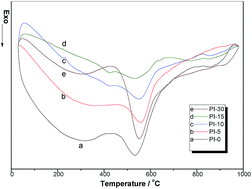
As the stabilization time ranges from 0–15 min, the exothermic interval widens with a milder curving and the heat release is significantly reduced from 875.18 mW mg−1 (non-stabilized) to 166.13 mW mg−1 (stabilized for 15 min) throughout 30–1000 °C (Fig. 6). Thus, this stabilization method could effectively avoid a sudden jump in temperature and the local heat storage during the carbonization, as well as help reduce the opportunity of breakage in backbone and maintain the uniformity and integrity of the fibers.21,22 However, when the stabilization time is up to 30 min, the situation of heat release is slightly different, which may be associated with the defects introduced by HNO3 treatment. If the oxidation time is too long, it will make the PI fibers produced more defects which would have some negative effects on their properties. The PI-30 fibers would have a concentrated heat release within a certain temperature range of 500–650 °C. Nevertheless, the evolution of heat of PI-30 (407.45 mW mg−1) is still much lower than that of the non-stabilized PI fibers (875.18 mW mg−1). Therefore, this stabilization method can effectively improve the controllability and reduce the energy consumption during carbonization.


image file: c5ra10497a-f6.tif
Fig. 6 DSC curves of the modified PI fibers.

The TGA curves of PI fibers are also visibly different, as seen in Fig. 7. The T10% is gradually moved forward with the extension of the stabilization time, PI-0 sample T10% = 547.0 °C and PI-30 sample T10% = 496.2 °C. At the same time, the stabilized PI-CFs will have the residual carbon content improved remarkably, from the initial 15.98% (PI-0-CFs) to 49.93% (PI-30-CFs). The reason for that is attributed to the small gas molecules releasing at a slower rate during carbonization because of the existence of cross-linked structures, reducing the opportunity of carbon atoms escaping.


image file: c5ra10497a-f7.tif
Fig. 7 TGA curves of the stabilized PI fibers (a) PI (b) PI-5 (c) PI-10 (d) PI-15 (e) PI-30.

3.3 Morphology of the stabilized PI-CFs

The structure of the stabilized PI-CFs is becoming looser as the stabilization time prolongs. The small voids on PI-0-CFs surface will gradually grow into holes or even ruptures, as shown in Fig. 8. Due to more oxygen atoms introduced by the stabilization process, more gas is removed from fibers in the subsequent carbonization, resulting in the formation of voids, holes and other defects. That is similar to the pre-oxidation process of PAN-CFs, if the degree of pre-oxidation is too low, the fibers could not form a stable heat-resistant ladder-like structure; but if the degree of pre-oxidation is too high, it will make more gas removed from the fibers, creating more defects.23 Therefore, the degree of stabilization of PI fibers should be controlled moderately.
image file: c5ra10497a-f8.tif
Fig. 8 SEM images of PI-CFs with different stabilization time (a) PI-0-CFs (b) PI-5-CFs (c) PI-10-CFs (d) PI-15-CFs (e) PI-30-CFs.

After graphitization, the PI-10 GFs and PI-15 GFs have a better arrangement of graphite layers along the axis direction than PI-0-GFs, and all of them have no obvious structural defects (Fig. 9). However, the arrangement of graphite layers of PI-30 GFs are relatively disordered, with more and bigger defects such as ruptures on their surfaces, which have some negative impacts on their performance.


image file: c5ra10497a-f9.tif
Fig. 9 SEM images of the stabilized PI-GFs (a) PI-0-GFs (b) PI-5-GFs (c) PI-10 GFs (d) PI-15 GFs (e) PI-30 GFs.

3.4 Structural changes and conductivity of the stabilized PI-GFs

Laser Raman spectroscopy is an effective method for the carbon materials study which is based on the Raman active vibration of carbon atoms when the laser irradiates to the sample.24,25 Usually, we use the relative intensity ratio R = I1360/I1580 to evaluate the degree of graphitization. The smaller R value is, the higher degree of graphitization is. It is shown in Fig. 10 that the degree of graphitization increases in the beginning and then decreases with the stabilization time extends. An appropriate degree of crosslink could improve the perfection of fibers because of their high aromatization efficiency at the early age of carbonization; but if the degree of crosslink is excessive, it will disturb the orientation of fibers and make the structural defects and unsaturated carbon atoms increased.
image file: c5ra10497a-f10.tif
Fig. 10 Raman spectrum of PI-GFs with different stabilization time.

The results of Raman and XRD analysis on PI-GFs are listed in Table 1, from which we can find that the degree of graphitization keeps increasing when the stabilization within 15 min, with a minimum R = 0.130 (stabilized for 15 min); but when the stabilization time is 30 min, the degree of graphitization decreases. The reason for that, as mentioned above, is the increasing number of structural defects and unsaturated carbon atoms. Meanwhile, the size of graphite crystallites maintains a growing trend as the stabilization time ranges from 0–30 min that can be explained as the stabilization could promote the growth of graphite crystallite. The Raman and XRD analysis of PI-GFs are in agreement with the observations of SEM above.

Table 1 The results of Raman and XRD analysis on PI-GFs
Stabilization time (min) ID/IG ID/IG′ FWHMG d002 (nm) La (nm) Lc (nm)
0 0.217 0.295 25.695 0.33947 6.6441 7.7524
5 0.215 0.265 25.233 0.33997 6.9800 7.7442
10 0.180 0.240 25.022 0.33922 7.1127 7.7924
15 0.130 0.197 22.559 0.33901 7.1865 7.7907
30 0.234 0.245 25.796 0.33972 7.5085 7.9875


We measure the electrical resistivity of PI-GFs and find that the electrical resistivity of PI-0-GFs is 3.61 μΩ m along the fiber axis direction, which is 1.2 times of the PI-15-GFs' (Fig. 11). The stabilization process could facilitate the conjugated hexagonal wire mesh growing during carbonization, as well as play an important role in fixing the molecular chain orientation so that more covalent electrons could transfer into conduction electrons. As a result, the density of interlayers' conduction electrons increases and the band gap narrows.26 According to the empirical formula (1), we know that the thermal conductivity of highly-oriented carbon fibers is inversely proportional to the electrical resistivity. So the maximum thermal conductivity of PI-GFs could reach 415.35 W m−1 K−1 after graphitized at 2800 °C.


image file: c5ra10497a-f11.tif
Fig. 11 The electrical resistivity and thermal conductivity of PI-GFs.

4. Conclusion

The exothermic interval of stabilized PI fibers widens with a mild curving and the total heat release is significantly reduced from 875.18 mW mg−1 (non-stabilized) to 166.19 mW mg−1 (stabilized for 15 min). Thus, this stabilization method could effectively avoid a sudden jump in temperature and local heat storage during the carbonization, as well as help improve the stability of PI fibers. Simultaneously, the obtained PI-CFs will have the residual carbon content improved remarkably. However, as the stabilization time further extends, some defects such as ruptures will appear on fiber surface, which would have some negative effects on the properties of the resulting products. So a moderate degree of stabilization is needed (recommended time 10–15 min). Furthermore, the conductive property of PI-GFs exhibits the same regularity related to the changes in structure, which increases in the beginning and then decreases, with a maximum thermal conductivity of 415.35 W m−1 K−1 after graphitization at 2800 °C.

Acknowledgements

In this paper, we get some help from Dr Dezhen Wu in the preparation of PI fibers and thanks to her supports.

References

  1. T. Q. Li and Z. J. Hu, Aerosp. Mater. Technol., 2007, 37, 16 CAS.
  2. A. M. Druma, M. K. Alam and C. Druma, Int. J. Therm. Sci., 2004, 43, 689 CrossRef CAS PubMed.
  3. P. M. Adams, H. A. Katzman, G. S. Rellick and G. W. Stupian, Carbon, 1998, 36, 233 CrossRef CAS.
  4. M. Murakami, N. Nishiki, K. Knakamura, J. Ehara, H. Okada, T. Kouzaki, K. Watanabe, T. Hoshi and S. Yoshimura, Carbon, 1992, 30, 255 CrossRef CAS.
  5. A. Burger, E. Fitzer, M. Heym and B. Terwiesch, Carbon, 1975, 13, 149 CrossRef.
  6. M. Inagaki, T. Ibuki and T. Takeichi, J. Appl. Polym. Sci., 1992, 44, 521 CrossRef CAS PubMed.
  7. G. X. Zhao and H. P. Qiu, China Synth. Fiber Ind., 2000, 23, 71 CAS.
  8. H. Kakida and K. Tashird, Polym. J., 1997, 29, 557 CrossRef CAS.
  9. G. T. Sivy, B. Gordon and M. M. Coleman, Carbon, 1983, 21, 573 CrossRef CAS.
  10. D. Wu, CN. Pat., CN 102605477 B, 2013.
  11. G. S. Bhat and R. Schwanke, J. Therm. Anal., 1997, 39, 399 CrossRef.
  12. X. Y. Liu, G. Q. Gao, L. Dong, G. D. Ye and Y. Gu, Polym. Adv. Technol., 2009, 20, 362 CrossRef CAS PubMed.
  13. H. Q. Niu, S. L. Qi, E. L. Han, G. F. Tian, X. D. Wang and D. Z. Wu, Mater. Lett., 2012, 89, 63 CrossRef CAS PubMed.
  14. C. Q. Yin, J. Dong, Z. T. Li, Z. X. Zhang and Q. H. Zhang, Composites, Part B, 2014, 58, 430 CrossRef CAS PubMed.
  15. F. Tuinstra and J. L. Koenig, J. Chem. Phys., 1970, 53, 1126 CrossRef CAS PubMed.
  16. X. Zhang, S. Fujiwara and M. Fujii, Int. J. Thermophys., 2000, 21, 965 CrossRef CAS.
  17. K. P. Pramoda, S. L. Liu and T. S. Chung, Macromol. Mater. Eng., 2003, 287, 931 CrossRef PubMed.
  18. H. Deligöz, T. Yalcinyuva, S. Özgümüs and S. Yildirim, Eur. Polym. J., 2006, 42, 1370 CrossRef PubMed.
  19. M. B. Saeed and M. S. Zhan, Eur. Polym. J., 2006, 42, 1844 CrossRef CAS PubMed.
  20. S. Diaham, M. L. Locatelli, T. Lebey and D. Malec, Thin Solid Films, 2011, 519, 1851 CrossRef CAS PubMed.
  21. J. Liu, D. Y. Du, J. Y. Liang and Z. K. Ma, The Effect on Structure and Properties of Chemical Modification on PAN Precursor, Hi-Tech Fiber Appl., 2009, 34, 21 CrossRef CAS PubMed.
  22. A. Sedghi, R. E. Farsani and A. Shokuhfar, J. Mater. Process. Technol., 2008, 198, 60 CrossRef CAS PubMed.
  23. W. S. Wang, J. F. Sun, Z. Wang and S. Q. Guo, Hi-Tech Fiber Appl., 2002, 27, 33 Search PubMed.
  24. F. He, Hi-Tech Fiber Appl., 2005, 30, 20 Search PubMed.
  25. A. C. Ferrari, J. C. Meyer, V. Scardaci, C. Casiraghi, M. Lazzeri, F. Mauri, S. Piscanec, D. Jiang, K. S. Novoselov, S. Roth and A. K. Geim, Phys. Rev. Lett., 2006, 97, 187401 CrossRef CAS.
  26. J. G. Lavin, D. R. Boyington, J. Lahijani, N. Bernard and J. P. Issi, Carbon, 1993, 31, 1001 CrossRef CAS.

This journal is © The Royal Society of Chemistry 2015
Click here to see how this site uses Cookies. View our privacy policy here.