
B. G. Singh*a,
S. A. Nadkarnia,
V. K. Jainb and
K. I. Priyadarsinia
aRadiation & Photochemistry Division, Bhabha Atomic Research Centre, Trombay, Mumbai-400 085, India. E-mail: beenam@barc.gov.in
bChemistry Division, Bhabha Atomic Research Centre, Trombay, Mumbai-400 085, India
First published on 29th July 2015
One-electron redox reactions of three bis(alkyl carboxylic acid) selenide (SeC) derivatives viz., seleno bis(butanoic acid) (SeBA), seleno bis(propanoic acid) (SePA) and seleno bis(ethanoic acid) (SeEA), were carried out in aqueous solutions using nanosecond pulse radiolysis and the resultant transients were detected by absorption spectroscopy. SeC reacted with ˙OH radicals to form hydroxyl selenouranyl radicals (
Se∴OH) which subsequently gave different transient species, like the selenium centered radical cation (SeC˙+), dimer radical cation (
Se∴Se
)+, or a selenium-carboxyl oxygen stabilized monomer radical (
Se∴O). The relative yield of these transient species depended on pH, concentration of SeC and position of the carboxylate functional group. SeEA and SeBA gave exclusively (
Se∴Se
)+ absorbing at 490 nm, while in the case of SePA, along with (
Se∴Se
)+, (
Se∴O) was also formed. The stability of (
Se∴Se
)+ was estimated in terms of the equilibrium constant and was in the order SeBA > SeEA > SePA. Secondary electron transfer reactions of the transients were performed with 2,2′-azino-bis(3-ethylbenzthiazoline-6-sulphonic acid), thionine and methyl viologen. The study showed that SeC˙+ undergoes decarboxylation with the formation of the corresponding α-(alkylseleno)alkyl radical and the yield of CO2 formed was in the order SeEA < SeBA < SePA. The formation of a stabilised monomer radical cation in SePA is responsible for its lower yield of CO2 and the same is reflected in its higher free radical scavenging antioxidant activity, established by comparing the rate constants for scavenging of peroxyl radicals.
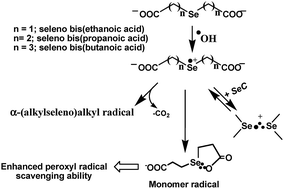
Pulse radiolysis offers an excellent technique to follow one-electron induced redox processes, in the real timescale, especially those induced by free radicals which are often short lived.8
With an aim to develop selenium based antioxidant/radioprotector,9–14 we have earlier reported pulse radiolysis studies on functionalized selenium compounds, wherein the selenium atom was primarily oxidized to form selenium centred radical.15–21 The oxidation mechanism and stability of this selenium centred radical cation is greatly influenced by the presence of different functional groups.15–21 Among the series of aliphatic selenoethers containing different functional groups and varying chain lengths, the carboxylic functionalized derivatives showed higher activity compared to other substituted derivatives.15 The higher antioxidant ability was correlated with energy level of highest occupied molecular orbital (HOMO) of the moderately electron donating carboxylate ion.15 To gain further insight on the effect of alkyl chain length on the mechanism and the nature of the transients formed during the free radical scavenging by the carboxylic acid group substituted selenides, detailed pulse radiolysis studies have been carried out on seleno bis(ethanoic acid) (SeEA), seleno bis(propanoic acid) (SePA) and seleno bis(butanoic acid) (SeBA) (Scheme 1). The results of this work are reported herein.
Under similar condition, irradiation of 200 μM SeBA generated time dependent transient absorption spectrum in the range from 300 nm to 600 nm with a very broad absorption band from 320 nm to 380 nm at 2 μs after the pulse. This broad absorption band slightly decreased in intensity and a new intense band appeared at 490 nm after 20 μs of the pulse (plot a and b in the inset of Fig. 1). Further, similar experiments with 5 mM SeBA, generated transient absorption spectrum with absorption maxima at 320 nm and 490 nm at 1 μs after the pulse (Fig. 2). In general, selenium radicals form dimer radical species and the yield of such species increases with increase in the concentration of the selenium compound.20 Therefore to verify the nature of the transient formed by ˙OH radical, the absorbance values at 360 nm (where maximum changes were observed) and 490 nm were monitored at different concentration of SeBA. As seen from inset of Fig. 2, on increasing the concentration of SeBA, the absorbance at 360 nm decreased with concomitant increase in the absorbance at 490 nm. Also, the decay of the absorbance at 360 nm increased on increasing the concentration of SeBA from 50 μM to 5 mM (inset c and d of Fig. 2). As noticed in our previous studies, the increase in the absorbance at 490 nm is attributed to dimer radical formation.15–21 The absorbance at 360 nm can be due to the selenuranyl radical (
Se∴OH) formed by OH adduct formation at the selenium centre or it may be due to intramolecularly stabilized selenium monomer radical species formed between the selenium centred radical cation and the negatively charged oxygen of the carboxylate functional group. To distinguish this, the absorbance at 360 nm was followed at different concentration of perchloric acid (proton donor).19 The yield of the transient at 360 nm decreased with increasing proton concentration, indicating that the 360 nm absorbance is due to
Se∴OH, which undergoes acid catalyzed dehydration to form selenium centred radical cation.
Since the absorbance at 360 nm is dependent both on the concentration of the proton and SeBA, the apparent decay of
Se∴OH (kobs) derived from SeBA would be due to three competing pathways i.e. uncatalyzed spontaneous dissociation (kd), acid catalyzed elimination of OH− from
Se∴OH (kh) and reaction with another SeBA molecule (ks). The deconvolution of the kobs into individual rate constants was carried out using the method reported in the literature.22,23 Considering the probable pathways for the decay of
Se∴OH as given in Scheme 2, kobs is expressed in terms of kd, kh and ks as shown in eqn (1).
| kobs = ks[SeBA] + kh[H+] + kd | (1) |
The individual components were estimated by performing two different sets of experiments. In the first experiment, the decay at 360 nm was followed as a function of SeBA concentration at a fixed pH = 7. This results in a linear graph where the respective slope and intercept can be equated to ks and (kh[H+] + kd). In the second experiment, the decay at 360 nm as a function of H+ ion concentration was followed in the presence of constant SeBA concentration, giving a linear relation, where the respective slope and intercept is equal to kh and (kd + ks[SeBA]). Using these relations, the value of ks, kh and kd were estimated to be 3.0 ± 0.1 × 10⁶ M−1 s−1, 4.4 ± 0.4 × 10⁶ M−1 s−1 and 3.5 ± 0.4 × 10³ s−1, respectively. The mechanism is supported by experimentally obtained first order decay constant at 50 μM SeBA (4 × 10³ s−1) where the contribution of kh[H+] and ks[SeBA] is negligible.
Since ˙OH radical is not explicit with its reaction with organic substrate, specific one-electron oxidant like azide (N3˙) radical at pH 7 was employed.24 The reaction of SeBA (6 mM) with N3˙ radical produced a transient spectrum with absorption maximum at 490 nm, which increased with increasing SeBA concentration, confirming that one-electron oxidation of SeBA at pH 7, produced dimer radical cation (ESI Fig. S1†).
Like SeBA, the transient absorption spectrum generated in the reaction of ˙OH radical with SePA was also found to depend on SePA concentration. The reaction of ˙OH radical with 75 μM SePA at pH 7, generated a transient with absorption maximum at 350 nm (Fig. 3a), while at 5 mM SePA, along with the 350 nm absorbing species, a broad absorbing species from 400 nm to 490 nm (Fig. 3b) was observed. The transient at 350 nm decayed by first order kinetics with a rate constant of 2.3 × 10³ s−1, while at 490 nm decayed by second order kinetics with 2k/εl = 2.8 × 10⁵ s−1, indicating the formation of two different types of transients.
Like SeBA, the absorption band at 350 nm has been attributed to
Se∴OH adduct, while that at 490 nm to dimer radical formation. Therefore the yield of the absorbance at 350 nm and 490 nm was monitored as a function of SePA concentration. As seen in the inset (c) of Fig. 3, the absorbance at 350 nm was independent of SePA concentration, while that at 490 nm increased (inset d of Fig. 3) with increasing SePA concentration, indicating that the 350 nm band is not due to
Se∴OH formation, and the latter absorption at 490 nm is due to the dimer radical. This was further confirmed by following the effect of phosphate ion concentration (as proton donor), where the absorbance at 350 nm, was found to be independent of phosphate ion concentration.21 The absorption spectrum obtained on ˙OH radical induced oxidation of 6 mM SePA is very broad and becomes broader with increasing SePA concentration (ESI Fig. S2†), while the absorbance at 350 nm was unaffected. Due to extensive overlapping spectral characteristics, the
Se∴OH spectrum could not be characterized explicitly at any concentration. To resolve the ambiguity on the nature of the transient absorbing at 350 nm, oxidation reaction of SePA (6 mM) with N3˙ radical was studied (ESI Fig. S3†). Formation of 350 nm and 490 nm transients in this reaction, confirmed that the transients are generated due to one-electron oxidation. Therefore the transient with absorption maximum at 350 nm is a selenium-carboxyl oxygen stabilized monomer radical cation (
Se∴O) (Scheme 3). On comparing the spectra (ESI Fig. S3†), it can be inferred that the absorption spectrum generated by ˙OH radical in the wavelength range from 350 nm to 420 nm is due to the formation of
Se∴O and
Se∴OH radicals. At pH 1, the ˙OH radical reaction with SePA at different concentrations (50 μM, 100 μM and 5 mM), generated only 490 nm transient indicating formation of dimer radical cation only (ESI Fig. S4†).
As seen in other derivatives, reaction between 50 μM SeEA and ˙OH radical gave transient spectrum with absorption maximum at 320 nm. On increasing the concentration of SeEA to 200 μM, along with the 320 nm band, a very broad absorption spectrum ranging from 380 nm to 600 nm, with maximum at 490 nm was observed (Fig. 4), which increased with increasing SeEA concentration, indicating dimer radical formation. Comparing the spectra obtained on reaction of ˙OH radical with 200 μM and 1 mM SeEA, it is noticed that there is a broad absorbance near 350 nm to 400 nm. In analogy with sulfur compounds, this band has been attributed to the formation of Se–OH adduct (
Se∴OH). Attempt to get pure spectrum of
Se∴OH, as obtained in SeBA, was not successful due to overlapping absorbances at several regions. At pH 1, the ˙OH radical reaction with SeEA produced only dimer radical cation (Scheme 4). Interestingly SeEA did not react with N3˙, even at a concentration of 10 mM, indicating that its reduction potential for the couple SeC˙+/SeC is higher than that for SePA and SeBA.
The above results indicate that the reaction of SeC with ˙OH radical proceeds through a sequence of complex reactions, and hence the bimolecular rate constant (k1) for reaction between ˙OH radical and the selenium compounds could not be estimated directly from the build-up kinetics at any wavelength. Hence k1 was estimated by employing competition kinetics using 2-propanol as a reference solute (rate constant 1.9 × 10⁹ M−1 s−1),25 k1 was determined and are listed in Table 1.
Se∴Se
)+
| SeC | kSeC+OH/109 M−1 s−1 | kCCl3O2˙+SeC/108 M−1 s−1 | υ (nmol min−1) | Keq/103 (M−1) | k (decay) |
|---|---|---|---|---|---|
| a Estimated by buildup kinetics at 340 nm. | |||||
| SeEA | 6.3 | 1.2 | 36 | (i) 1.7 (pH 7) (ii) 1.0 (pH 1) | (i) 2.1 × 10⁵ s−1 (490 nm; pH 1) (ii) 1.3 × 10⁴ s−1 (490 nm; pH 7) |
| SePA | 5.7a | 8.1 | 54 | (i) 0.5 (pH 7) (ii) 2.5 (pH 1) | (i) k = 2.3 × 10³ s−1 (350 nm) (ii) 2k/εl = 2.8 × 10⁵ s−1 (490 nm) |
| SeBA | 12 | 4.2 | 85 | (i) 3.8 (pH 7) (ii) 210 (pH 7) | (i) k = 5.9 × 10⁴ s−1 (50 μM, 370 nm, pH 7) (ii) k = 2.9 × 10³ s−1 (50 μM, 490 nm, pH 7) (iii) 2k/εl = 1.7 × 10⁵ s−1 (5 mM, 490 nm, pH 7) |
![]() | (2) |
Se∴Se
)+. The double reciprocal plot for the variation of absorbance at 490 nm as a function of SeC concentration gave a straight line and from the ratio of the intercept and slope, Keq was estimated, which indicates the stability for the formation of (
Se∴Se
)+. From Table 1, it can be noted that the stability of the dimer radical cation decreased in the order SeBA > SeEA > SePA. Interestingly the (
Se∴Se
)+ of SePA is less stable by an order of magnitude compared to the dimers of SeEA and SeBA.
At higher concentration, SeBA (5 mM) mainly forms (
Se∴Se
)+ radicals, which is found to oxidize ABTS2− to ABTS˙− with a bimolecular rate constant of 9.9 ± 0.6 × 10⁸ M−1 s−1 at pH 7. The G-value of the (
Se∴Se
)+ radical derived from SeBA was estimated to be 0.33 ± 0.04 μmol J−1. SePA (5 mM) at pH 7 reacts with ˙OH radical to form two types of transients, viz., monomer radical cation and a dimer radical cation. At lower concentration, i.e. 400 μM, SePA reacts with ˙OH radical to form the monomer radical cation, which oxidizes ABTS2− with a rate constant of 1.2 ± 0.1 × 10⁹ M−1 s−1. The G-value of the monomer radical cation obtained on pulse radiolyzing N2O saturated solution containing 400 μM SePA and 25 μM ABTS2− was estimated to be 0.35 ± 0.02 μmol J−1. Similarly, at pH 7, titrating 5 mM SePA with 100 μM ABTS2− gave the yield of the oxidizing transient to be 0.48 μmol J−1, which corresponds to ∼80% of the ˙OH radical yield. At pH 1, (
Se∴Se
)+ radicals of SePA react with ABTS2− with a bimolecular rate constant of 1.56 ± 0.7 × 10⁹ M−1 s−1. The G-value of the (
Se∴Se
)+ radical derived from SePA at pH 1, was estimated to be 0.22 ± 0.05 μmol J−1, which corresponds to ∼78% of ˙OH radicals. The (
Se∴Se
)+ radicals derived from SeEA did not react with ABTS2−. This may be ascribed to the fast decay rate of the dimer radical cation compared to its electron transfer with ABTS2−.
Earlier, Bobrowski et al. showed that the radical cation of carboxylic acid derivatives of alkyl sulfides undergo decarboxylation to form carbon centred radical of the type α-(alkylthio)alkyl radicals, which are reducing in nature.22,23 Similarly, we expect that the radical cations of seleno carboxylic acid derivatives also undergo decarboxylation to generate α-(alkylseleno)alkyl radical. The reducing capacity of these radicals can be estimated by monitoring reduction of electron acceptors such as methyl viologen (MV2+) and thionine.28,29 The α-(alkylseleno)alkyl radical generated on decarboxylation of all the three compounds did not reduce MV2+ to MV˙+. However, the α-(methylseleno)ethanoic radical generated from SeEA reduced thionine with a bimolecular rate constant of 7.4 ± 0.2 × 10⁷ M−1 s−1 indicating that the reduction potential of the α-(methylseleno)ethyl radical derived from SeEA lies near to that of thionine (−0.045 V to +0.05 V vs. NHE).29 Similar reaction of α-(alkylseleno)alkyl radical derived from SePA and SeEA with thionine was not observed, from which it can be inferred that the reduction potential of the reducing radical is less negative than −0.045 V vs. NHE. In the above system, the estimated yield of CO2 was 0.47 ± 0.03, 0.12 ± 0.02, 0.24 ± 0.04 μmol J−1 for SeEA, SePA and SeBA, respectively.
Se∴OH), which depending on the length of the alkyl chain, is converted into different transients, viz. SeC˙+, (
Se∴Se
)+, (
Se∴O) and carbon centered radical of the type α-(alkylseleno)alkyl radical, the details are included in Schemes 2–4 respectively for SeBA, SePA and SeEA. The (
Se∴Se
)+ radical cation shows broad transient absorption with maximum at 490 nm. Although the dimers from all the three compounds exhibit similar absorption behaviour, they differ in their stability constant and decay kinetics.
In the case of SeBA and SePA, the decay was concentration dependent, while it is first order at low concentration (100 μM), and at concentration above 250 μM, the decay profile followed second order kinetics. The dimer radical cation of SeEA decays by following first order kinetics at all concentration. From this decay pattern of SeBA and SePA, one can infer that the SeC˙+ once formed has two competing reactions: (i) irreversible loss of proton to form α-reducing radical which will be unimolecular in kinetics and (ii) getting stabilized by formation of two center three electron bonded (
Se∴Se
)+ radical cation.4 The latter species is stabilized at higher concentration and undergoes radical–radical reaction to form diselenide, which will follow a second order kinetics. In case of SeEA, the results suggest that the rate of formation for (
Se∴Se
)+ is lower than that for the unimolecular proton loss. The driving force for the higher unimolecular proton loss in SeEA is favoured by higher stability of the resulting α-reducing radical due to captodative stabilization, and also (
Se∴Se
)+ of SeEA is destabilized by the repulsive forces due to close proximity of negative charge of the carboxylate group (Scheme 4). The Keq for dimerization of the compounds was in the order SeBA > SeEA > SePA, indicating that the most stable dimers are formed from SeBA. In the case of SePA, the lower yield of (
Se∴Se
)+ radical cation may be associated with the formation of (
Se∴O) absorbing at 340 nm, as such formation was not clearly observed with SeEA and SeBA. This could be due to fact that five membered stabilized (
Se∴O) radical species are formed from SePA while similar species in the case of SeEA and SeBA would be four- and six-membered respectively, which are not generally observed under transient conditions. The higher Keq value for SeEA as compared to SePA may also be due to additional hydrogen bonding interaction between the carboxylic acid groups as suggested in the ground state structure of SeEA, which was not observed in the case of SePA.30,31
In addition to these two types of radicals as discussed above, ˙OH radical reactions with these the compounds can also form radicals of the type (alkyl seleno)-alkyl radical (denoted as α-reducing radical, hereafter). These radicals have transient absorption in the wavelength region ∼300 to 320 nm, but cannot be characterized due to their overlapping absorption from other carbon centred radicals formed by different routes such as direct ˙OH radical abstraction or loss of H+ from the
Se∴OH radical, etc.4 However formation of the α-reducing radical can be detected by release of CO2. Therefore estimating released CO2 is an indirect indication of formation of α-reducing radical. Indeed our experiments on CO2 estimation followed the order SeEA > SeBA > SePA. The significantly lower yield of CO2 from SePA could be due to the contribution of the stabilized monomer radical cation that is resistant to degradation while higher yield with SeEA may be due to the stabilization of its α-(methyl seleno) ethanoic radical through captodative and hyperconjugation stabilization. Such formation makes SeEA less powerful antioxidant than the other two.
To verify this we have studied the reactions of these compounds with trichloromethyl peroxyl (CCl3O2˙) radical, a model for lipid peroxyl radical.32 By employing competition kinetics using ABTS2− as reference solute, the bimolecular rate constant (Table 1) for the scavenging of the CCl3O2˙ radical by the SeC was in the order of SePA > SeBA > SeEA.15 Additionally, the GPx like catalytic activity of these compounds was also studied. The υ values (listed in Table 1) for the relative catalytic activity under similar experimental condition showed increase with increasing alkyl chain length and decreased in the order SeBA > SePA > SeEA (ESI Fig. S5†). This indicates that the one-electron oxidation reactions with free radicals and the GPx catalytic reactions are not following the same order, which may be due to the involvement of two-electron oxidation or oxygen transfer reaction in the latter case. The GPx activity for similar selenoethers is reported to proceed through the formation of spirocyclic intermediates. However, these studies were restricted to organic solvent.33–35 Our earlier studies on GPx activity of substituted selenoethers showed formation of corresponding selenoxide on reaction with hydrogen peroxide in water. It has also been observed that the rate determining step is the oxidation of the selenide to selenoxide. It is established that the oxidation can be facilitated by elevating the HOMO energy level. Increasing the number of methylene groups between the selenium and carboxylate functional group would elevate the HOMO energy level and therefore the GPx activity is expected to increase in the order of SeBA > SePA > SeEA. These structural aspects are important in designing selenium based antioxidants.
When these results are compared with those for similar sulfur analogues for SeEA it can be noted that such radical cations could not be detected in case of thio bis(ethanonic acid). However formation of (
Se∴Se
) in SeEA could be seen, mainly due to higher covalent radius of selenium atom, that stabilizes the corresponding radical cations much more than the sulfur.23
Thus our pulse radiolysis studies on bis(alkyl carboxylic acid) selenides show how small changes in alkyl chain length in selenium compounds can affect their reactivity towards free radical oxidants, which have direct relevance in their antioxidant activity.
Pulse radiolysis experiments were carried out with high-energy electron pulses (7 MeV, 100 ns) obtained from a linear electron accelerator and the details are given elsewhere.37 Aerated aqueous solution of KSCN (1 × 10⁻² M) was used for determining the dose delivered per pulse, monitoring the transient (SCN)2˙− at 475 nm, using Gε475 = 2.59 × 10⁻⁴ m2 J−1. Here, G denotes the radiation chemical yield in mol J−1 and ε denotes the molar extinction coefficient in m2 mol−1.24 The transient species formed on pulse radiolysis were detected by optical absorption method. The dose per pulse was close to 8 Gy (1 Gy = 1 J kg−1).
Radiolysis of N2-saturated neutral aqueous solution leads to the formation of three highly reactive species (H, ˙OH, eaq−) in addition to the less reactive or inert molecular product (H2, H2O2, H3O˙+).24 The reaction with ˙OH radicals was carried out in N2O-saturated solutions, where eaq− is quantitatively converted to ˙OH radicals giving a total G value of 0.6 μmol J−1.24 One-electron oxidation was carried out by employing azide radical (N3˙), which was generated by the reaction of ˙OH radical with 0.1 M N3−.24 CCl3O2˙ radicals were generated by radiolyzing air saturated aqueous solution containing a mixture of 48% 2-propanol and 4% carbon tetrachloride.21 For secondary electron transfer reaction of the SeC, the absorbed dose was kept as low as possible to minimize radical–radical reactions competing with one-electron oxidant/reductant and the SeC concentration was kept as high as 5 mM. To estimate liberated carbon dioxide during the oxidative degradation of SeC, N2O-saturated aqueous solutions of SeC (5 mM) were irradiated using a 60Co γ-source with a dose rate of 20 Gy min−1 determined by Fricke dosimeter, at normal temperature and pressure. The irradiation dose and concentrations of reactants were adjusted in such a way that not more than 10% of parent compound undergoes radiolysis. After radiolysis of the sample, CO2 was liberated by adding 1 M HClO4 and analyzed by gas chromatography (GC) using a poropak Q-S column and helium as a carrier gas. Typically, ∼300 μL of gaseous sample was injected into the GC, where CO2 was converted into methane by using methanator which was detected by flame ionization detector (FID).19
GPx like catalytic activity of the SeC was monitored spectrophotometrically by using NADPH–GSSG reductase coupled assay.38 In brief, the test mixture contained NADPH (0.34 mM), GSH (1 mM), hydrogen peroxide (1 mM) and glutathione reductase (5.0 Units per mL) in 0.1 M potassium salts of phosphate buffer (pH 7.4) and the reaction was initiated by addition of SeC (0.1 mM). The initial reduction rate (υ) of the hydroperoxide was calculated from the rate of NADPH oxidation by following the decay of absorbance due to NADPH at 340 nm.15
Footnote |
| † Electronic supplementary information (ESI) available. See DOI: 10.1039/c5ra10355j |
| This journal is © The Royal Society of Chemistry 2015 |