DOI:
10.1039/C5RA09960A
(Review Article)
RSC Adv., 2015,
5, 62202-62213
Carbastannatranes: a powerful coupling mediators in Stille coupling
Received
27th May 2015
, Accepted 13th July 2015
First published on 13th July 2015
Abstract
Stille coupling is an emerging application of carbastannatranes in organic synthesis because of their excellent tendency to transfer the axial Sn-bound hydrocarbyl substituent. Carbastannatranes have become powerful and versatile cross-coupling mediators in conventionally difficult synthetic routes for producing numerous organic compounds. These reagents belong to the most interesting class of tricyclic compounds, i.e. atranes, which captured the attention of researchers due to the uniqueness of the transannular N→M bond (bonding and variation with axial substituent). Simplicity in synthetic strategies and relatively high stability of carbastannatranes over their analogs (such as organostannanes) is responsible for a wide diversity in conveniently accessible exocyclic substituents. The particular ease of cleaving the axial Sn–C bond (due to the stability of the fused tricyclic skeleton and Sn–C bond activation by the trans-disposed N→Sn bond) made it possible to use carbastannatranes as a reagent in organic and inorganic synthesis. Due to important applications of carbastannatranes in organic synthesis, it is of utmost importance to know these reagents. Thus, a complete coverage of the reports on utilization of carbastannatranes in Stille coupling with various aspects is reported herein to facilitate and motivate the researchers working in this area.
 Neha Srivastav | Neha Srivastav received her Master's degree from Panjab University, Chandigarh in 2009 and currently, she is pursuing Ph.D. on structural aspects of cyclic tin(IV) compounds with modified coordinating frameworks under the supervision of Dr Varinder Kaur in the Department of Chemistry, Panjab University, Chandigarh. |
 Raghubir Singh | Raghubir Singh completed his Master's degree in Chemistry in 2003 and Ph.D. degree in 2011 on hypercoordinate compounds of silicon from Panjab University, Chandigarh. Currently, he is working as Assistant Professor of Chemistry at DAV College, Chandigarh. His main research areas involve the study of hypercoordinated silicon and tin compounds and the research scheme is financially supported by DST, New Delhi. |
 Varinder Kaur | Varinder Kaur Chahal received her PhD degree in 2008 on the analysis of metal ions using SPME-HPLC-UV system. She worked as Dr D. S. Kothari Postdoctoral Fellow awarded by UGC, New Delhi in the area of analysis of toxic metal ions using modified SPME fibers in the Department of Chemistry, Panjab University, Chandigarh. She was awarded SWARN JYANTI PURSKAR for young scientists by National Academy of Sciences, India. Presently, she is working as Assistant Professor in the Department of Chemistry, Panjab University, Chandigarh. Her main research interests are molecularly imprinted sorbents for the analysis of toxins, organosilicon and organotin chemistry. |
1. Introduction
Modern chemists are actively engaged in designing new organotin compounds for their wide applications as reagents in synthetic reactions and excellent in vitro antitumor activities.1–6 The emergence of organotin compounds as coupling mediators led to a remarkable growth in the field of cross-coupling reactions over the past 40 years. Consequently, these reactions have found numerous applications in both academic and industrial settings for the syntheses of complex natural products and biologically active molecules.7–10 Stille reaction is one of the most efficient and valuable carbon–carbon bond forming reactions that utilize a combination of a transition metal catalyst and an organotin nucleophile. This particular kind of cross-coupling reaction was first observed by M. Kosugi11–13 in the late 1970s and was further developed by J. K. Stille.14–16
Generally, Stille coupling involves the reaction of an organotin(IV) reagent and an organic halide or pseudohalide in the presence of a palladium catalyst to give the carbon–carbon coupled product either by inter- or intramolecular reaction.10,17,18 Palladium complexes such as Pd(PPh3)4, PdCl2(PPh3)2, Pd2(dba)3, Pd(CH3CN)2Cl2, [Pd(Pfur3)2]Cl2 (dba = dibenzylideneacetone, fur = furyl) and palladium nanoparticles served as efficient pre-catalysts.19–24 A very interesting feature of organostannanes to tolerate some highly sensitive functional groups, makes them efficient reagents for the transformations of functionalized molecules in cross-coupling reactions. This eliminates tedious steps involved in the protection and deprotection of functional groups and formulates the cross-coupling procedure straightforward. Moreover, the intermediate electropositive character of Sn prevents some side reactions (such as hydrolysis of the Sn–C bond) and thus favors the formation of the cross-coupling product. These features and the wide diversity in the synthetic methods to access stannanes renders them superior over organozinc and organomercurial reagents.25 Most significantly, Stille coupling has been successfully employed for double coupling in a single step and producing carbocyclic and heterocyclic ring systems with sensitive functional groups among the substituents.26–29 Consequently, organostannanes are some of the most reliable coupling mediators due to the stability towards air and moisture, mild reaction conditions of the coupling process, wide functional group tolerance and capability to accomplish syntheses of complex target molecules in a highly stereospecific and regioselective manner.10
In the past, trimethyltin or tributyltin derivatives have been used extensively as coupling reagents in Stille coupling for the transfer of a particular group (such as aryl) selectively in the presence of the less labile alkyl substituents. The preference was given to tributyltin derivatives in most of the cases as these are comparatively less toxic, while in some cases trimethyltin derivatives were preferred because of the easy removal of the side product (e.g., trimethyltin chloride) from the reaction mixture. In addition to C–C coupling these reagents have been effectively utilized for forming various bonds such as C–H or other C–X (where X is other than H and C) bonds as reported in numerous papers.10,20,21,30–32 Even though a variety of similar reactions are known for organic compounds of magnesium, zinc, boron and silicon, the alkylstannanes show a convenient balance of stability and reactivity.
Some attempts of cross coupling via stannanes failed either due to the strength and low polarity of their Sn–C bond, interference from other substituents during the migration, or difficulties in the removal of byproducts formed in the reaction. Though, aryl and alkenyl stannanes couple readily with a variety of electrophiles, whereas transfer of alkyl groups from the tin atom is much slower than that of the unsaturated substituents. There are relatively few examples of the successful transfer of primary alkyl groups (sp3) in Stille cross-coupling reactions described in the literature14 with relatively extreme conditions33 and high temperature.34 Failure of this transfer is likely to result either from the competing β-hydride elimination (when employing stannanes with alkyl groups bearing β-hydrogen) or from the low reactivity of the system.35–37 Indeed, it is the latter that makes the methyl and especially the butyl group such excellent “dummy,” i.e., “nontransferable,” ligands in some cases. Nevertheless, the α heteroatom substituted sp3 alkyltin cross-couple with success as heteroatom enhances the nucleophilicity of carbon to be transferred.38–43 Also, the transfer of secondary alkyl groups from tin requires a coordinatively stabilized intermediate to accelerate transmetallation.44 Furthermore, cine substitution may occur in sterically hindered olefins as side reaction and hence reduces the selectivity.45–48
Therefore, development of a more powerful reagent capable of easy separation with the trend for the specific and selective transfer of the desired group during the organic synthesis remains challenging. One of the best strategies to resolve common problems associated with hydrocarbyl (without any activation/substitution) group transfer was to increase length and to enhance polarity of the Sn–C bond of interest. Therefore, carbastannatranes turned into interesting coupling mediators due to the enhanced nucleophilicity and the longer Sn–C bond with respect to their alkylstannane analogs. Easy recovery and recycling of by-products formed in the reaction mixture is another advantageous feature of carbastannatrane. In cross-coupling reactions using stannanes, only one out of four hydrocarbyl substituents migrates during the transmetallation step and the other three substituents are wasted in the form of a byproduct. The use of expensive reagents for the synthesis of tetraalkyltin compounds can be avoided by using a cost effective carbastannatrane analog as it needs only one expensive unit (for Sn–C bond formation) during its synthesis. The development of modified reaction conditions using carbastannatranes has expanded the scope of some difficult coupling reactions. Consequently, involvement of carbastannatranes in Stille coupling reactions offers a number of advantages over the more traditional organotin reagent such as milder reaction conditions, retention of regio- and stereochemistry during coupling, low toxicity (no report on toxicity of carbastannatranes) and increased chemical stability.49
2. Importance of carbastannatranes as coupling mediators
In organotin chemistry, it is commonly observed that the intramolecular donation of nitrogen to tin increases the reactivity of the trans-situated Sn–R bond.50–52 Thus, this characteristic feature is responsible for the usefulness of some cyclic organotin reagents in synthetic routes.53–57 Amongst different organotin cyclic systems, stannatranes possess cage like structures with transannular donor–acceptor interaction.58–61 They contain the tin atom coordinated to the heteroatoms of a tripod-like tetradentate ligand, thus generating heterocyclic N–C–C–Y–Sn chelate rings fused by the axial Sn←N bond containing tin in a bridgehead position. Depending upon the equatorial donor atoms (Y), they are categorized into stannatranes, carbastannatranes, azastannatranes and thiastannatranes (Chart 1). The main feature of stannatranes is intramolecular coordination between the amine nitrogen and the tin atom, which exhibits cage structure with trigonal bipyramidal geometry.59,60,62–68
 |
| | Chart 1 General structure of various stannatranes. | |
Tin-atranes possessing heteroatoms like oxygen (stannatranes), nitrogen (azastannatranes) and sulphur (thiastannatranes) at the equatorial donor site have not been reported as coupling mediators. On the other hand carbastannatranes possess similar chemical environment around Sn as commonly used stannanes (i.e. C atoms around Sn), therefore, it is the only carbastannatrane within the large family of stannatrane which offers wider scope for Stille cross-coupling.
Also, association of organotin compounds to form dimers or trimers in the solid state as well as in solution phase is well known.69–71 Stannatranes (except carbastannatrane) generally associates in solid state due to the presence of reactive moieties (heteroatom at equatorial position) to form dimeric or trimeric units. This property of oligomerization in stannatranes (with O, N and S at equatorial position) may be the reason that only carbastannatranes have been used in the coupling reactions. These structural aspects of carbastannatranes offer excellent opportunities for transferring desired groups in cross coupling reactions and make them a versatile reagent in organic synthesis. The ease with which carbastannatranes transfer their axial group (as compared to alkylstannanes) is attributed to the following structural features of carbastannatranes.
2.1. Longer exocyclic Sn–C bond
Carbastannatrane possess longer Sn–C bond as a consequence of the intramolecular Sn←N bond. The formation of this transannular Sn←N bond reduces the electrophilicity of the metal centre and enhances the cleavage tendency of the trans-disposed hydrocarbyl substituent. This alters various electronic and steric features of the molecule, thus facilitating the transmetallation step50,72 by providing stabilization to the Sn valence shell octet through donor–acceptor bond formation. It is expected that the (relative to their analogs: silatranes, boratranes and germatranes) comparatively weaker Sn–C bond and stronger Sn←N transannular bond makes carbastannatranes efficient reagents for the selective transfer of alkyl group in Stille coupling reactions.22,52,73–79
2.2. Strained framework
Structural framework of carbastannatranes is equally important to impart uniqueness to carbastannatranes in the shifting of the axial substituent. In carbastannatranes, one apical and three equatorial positions are occupied by the tricyclic ring skeleton, which is a stable cage and difficult to break under normal reaction conditions. Therefore, the coupling mediator is left with only one labile substituent for migration during C–C coupling, which results in the selective transfer of this particular group.22,52
2.3. Higher polarization of Sn–C bond
Relatively higher polarization in the Sn–C bond of carbastannatranes compared to that of organostannanes is due to strained ring together with the adjacent nitrogen electron pair.
3. Mechanistic aspects
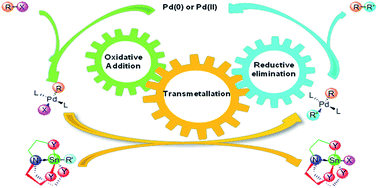
Stille proposed a simple and a detailed mechanism for Pd-catalyzed organotin-based cross-coupling reactions, which involves three fundamental steps; oxidative addition, transmetallation (rate determining step)80,81–84 and reductive elimination. Afterwards, the mechanism was modified by Espinet et al. giving more detailed insights into the transmetallation step.25,49,85 An illustration explained by Espinet et al. for the Stille reaction using organotin compounds in the presence of a palladium catalyst is shown in Chart 2. The details of the steps are not discussed here.
 |
| | Chart 2 General catalytic cycle for Stille coupling reactions employing organotin reagents. | |
The exact mechanism involved in the carbastannatrane mediated cross coupling reactions is not sketched yet, but two possible transition states are expected on the basis of electrophilic substitution reactions reported for the organotin compounds. These pathways involve either the formation of a cyclic or an open transition state as explained below;
3.1. Cyclic transition state
During the exchange process between Sn–C and Pd–X bond (X = Br or I) the reagents may undergo formation of a four centre cyclic transition state (TSI). This cyclic transition state is likely to appear in inert solvents and intramolecular nucleophilic assistance plays a major role in the stabilization of this transition state. Sn(IV) can expand its coordination as well as has the ability to form single bridged compounds.86–88 Therefore, tin is easily accessible to transmetallation via a 4-membered transition state involving Sn and Pd with migrating substituents (Chart 3).49,50 The shifting of an alkyl group from Sn to C is facilitated by the enhanced stability of a C–C bond relative to a Sn–C bond.52 Retention of configuration is observed when transmetallation proceeds via cyclic transition state through associative substitution of L for R.
 |
| | Chart 3 A proposed scheme for the transmetallation step (TSI) Four-membered cyclic transition state (TSII) Open transition state with stabilized stannatranyl cation. | |
3.2. Open transition state
An alternative is the transfer of the axially situated alkyl group to the transition metal catalyst via an open transition state. In this pathway a positive charge develops on the Sn atom (TSII), which is stabilized by the transannular Sn←N bond (Chart 3).49,50 Also open transition state is likely to appear in case of polar, coordinating, non bridging solvents and non bridging anionic ligands. Inversion of configuration occurs through open transition state. The formation of a stable stannatranyl cation is also evidenced by the mass fragmentation pattern of carbastannatranes (where it is observed as a base peak value (m/z),89 like the formation of similar atranyl cations in analogous compounds, i.e. (silatranyl cation in silatranes))90 and by ionic triptych derivative.91 The cleavage of the Sn–C bond due to extra stabilization acquired by the transannular Sn←N bond also support the stabilization of a stannatranyl cation.92
Also most of the coupling reaction using carbastannatranes proceeds through retention of configuration and intramolecular nucleophilic assistance provided by apical N plays major role in stabilizing the transition state. Therefore, prospects of the former proposed pathway, which involves a hexacoordinated tin atom in the transition state (TSI) is likely when compared to the latter.
4. Application of carbastannatranes in Stille reactions
Stannatranes exploited in the Stille coupling are mainly carbastannatranes, i.e., tricyclic compounds of trialkylamine, where three equatorial carbon atoms and an apical nitrogen atom envelope the Sn atom to form three cyclic wings consisting of an N–C–C–C–Sn skeleton. From reports on the Stille coupling, it is known that out of various carbastannatranes with F, Cl, Br, I and CH3 as axial substituents,62,91,93–95 chlorocarbastannatrane is most widely used. Brief survey of preparative methods used for the synthesis of chlorocarbastannatrane is discussed by Mahoney et al.96 Most of the reported methods are less efficient and the best one till date is the thermal redistribution approach being more pragmatic and reliable to improve the efficiency of the synthetic route. In this method, SnCl4 is added to the tributyltin derivative of a tripodal amine obtained either by the reaction of Bu3SnLi and N(CH2CH2CH2Cl)3 or by hydrostannylation of triallylamine in the presence of Pd/Al2O3 to produce chlorocarbastannatrane in 50–55% yield.95 Another approach involved a metathesis reaction between Grignard reagent N(CH2CH2CH2MgCl)3 and SnCl4.62,91,94 Although this method is simple, it is not very efficient as this produces chlorocarbastannatrane with 15% yield. Therefore, yields were improved by the treatment of dimethyldichlorotin with tris(trimethylstannylpropyl)amine91 and from in situ metal exchange between hydrozirconised triallylamine using Cp2ZrHCl and SnCl4
52 to provide chlorocarbastannatrane in 40% and 50% yield, respectively. While the yields were improved but expensive, explosive reagents and harsh reaction conditions makes them difficult to perform (Scheme 1).
 |
| | Scheme 1 Synthetic route for chlorocarbastannatrane and alkylcarbastannatrane. | |
A straightforward and efficient chlorocarbastannatrane is usually used to append a desired alkyl substituent in the exocyclic position of a tricyclic skeleton via treatment with the corresponding alkyl lithium or alkyl Grignard reagent.22,52
In the first approach for exploiting carbastannatranes as coupling mediators, Vedejs et al. utilized chloro- and bromocarbastannatranes to produce alkylcarbastannatranes.52 A scheme showing formation of various cross coupling products with the corresponding carbastannatrane mediators is given below (Scheme 2). The simplest member, methylcarbastannatrane, is a very efficient reagent to transfer a methyl group even to electron rich substrates like 4-bromo-N,N-dimethylaniline, where coupling with conventional reagents (vinyl stannanes) was not successful. In several cases such as the methylcarbastannatrane mediated conversion of p-bromoanisole to p-methoxytoluene, yields were significantly higher than in related reactions employing tetramethyltin as coupling mediator.50 Besides, selective transfer of the alkoxymethyl group (–CH2OR) with tributyltin derivatives was complicated due to competing reactions between the transfer of a butyl and the alkoxymethyl substituent. Using carbastannatrane derivatives, this transfer was achieved successfully in excellent yields.52
 |
| | Scheme 2 Synthesis of some organic molecules using alkylcarbastannatranes as coupling mediators. | |
Cross-coupling of carbapenem with Bu3SnCH2OH by means of alkyltin reagents was highly facile, whereas it failed to couple with the CH2NRR' group in several attempts. The rationale for the failure of cross-coupling might be the transmetallation step involved in the group transfer. To lower the energy of the transition state, weakening of Sn–C bond was attempted and utilizing a carbastannatrane was thus viewed as a substitute. Hence, coupling of carbapenem with the desired moiety in one step involves the modification of the axial group of a carbastannatrane via numerous steps followed by its reaction with an enol triflate to get substituted carbapenem (Scheme 3). The strategy is advantageous as the complete heteroalkyl chain can be transferred in a single step and eliminates the need for hexamethylphosphoramide as a solvent generally required for some of the analogous cross coupling reactions.73
 |
| | Scheme 3 A route for carbastannatrane mediated synthesis of substituted carbapenem. | |
Alkylation of allylic esters via transmetallation reaction was also challenging, one reason being their poor reactivity towards oxidative addition reactions and another is hindrance of the transmetallation step either to their strong binding with palladium or presence of bulky groups on palladium in a π-allyl intermediate. Consequently, cross coupling reactions of allylic esters failed with a plenty of palladium catalysts, main group organometallic compounds and organotin reagents under different conditions. In such challenging cross coupling reactions, carbastannatranes with phenyl and vinyl substituents yielded the desired products in good yields. Moreover, contrary to regioselectivity of alkylation by external nucleophiles, alkylation was achieved at the allyl terminus (opposite to the oxazolidinone group) and the reaction occurred with inversion (Scheme 4).74
 |
| | Scheme 4 Cross-coupling of allylic esters. | |
The tricyclic cage of carbastannatranes with longer exocyclic Sn–C bond is very helpful in sensitive cases where the transfer of the desired group is a crucial step. A most important example is the incorporation of radionuclides into biologically active molecules wherein half lives of radionuclides are very short. These reactions demand development of strategies with fast and selective group transfer. Thus, both the rapidity in group transfer and prevention of side reactions can be accomplished by carbastannatranes. The strategy was implemented to produce positron emission tomography (PET) tracers via Stille coupling.76 Some of the tracers synthesized from methylcarbastannatrane are given in Scheme 5. Carbastannatranes may be useful for producing 11C- and 18F-functionalized chains containing β-hydrogen where conventional reagents for Stille coupling failed due to β-hydrogen elimination.
 |
| | Scheme 5 PET tracers produced from carbastannatrane mediated cross-coupling reactions. | |
Labelled methylcarbastannatrane was also utilized for labeling other biologically active moieties (Scheme 6).77
 |
| | Scheme 6 Cross-coupling of iodoisoxazole with 14C labelled methylcarbastannatrane. | |
Recently, Vedejs et al. utilized chlorocarbastannatrane as coupling mediator to improve the reactivity of aziridines with p-halo ester derivatives of benzene in the generation of substituted aziridines. Carbastannatranes showed the increase in the polarization of Sn–C bond with enhanced reactivity due to the presence of the strained aziridine ring together with the apical N atom of the carbastannatrane cage. Thus, some substituted aziridines were prepared efficiently employing carbastannatranes (Scheme 7).78
 |
| | Scheme 7 Synthesis of various aziridines employing a carbastannatrane. | |
Similarly, n-butylcarbastannatrane found application in the synthesis of triazolo-tetrahydrofluorenones, which are selective estrogen receptor beta agonists.79 In this pathway, methylchloromethylether (MoMCl) and 2-(trimethylsilyl)ethoxymethyl chloride (SEMCl) protected (protection is shown with symbol G) derivative of triazolo-tetrahydrofluorenones reacted with n-butylcarbastannatrane to give cross-coupled product (Scheme 8).
 |
| | Scheme 8 Coupling reactions of triazolo-tetrahydrofluorenone derivative with butylcarbastannatrane. | |
Studies on cine-substitution mechanism in Stille coupling reactions substantiated high reactivity of carbastannatranes in oxidative insertion reactions in contrast to their alkyl analogs. Fillion et al. studied two pathways to establish the Busacca–Farina cine-substitution mechanism via palladium-carbenoid reactivity. First pathway requires oxidative insertion of Pd(0) catalysts into iodomethyltrialkylstannane (methyl and butyl) and the corresponding iodomethylcarbastannatrane. Second one proceeds through the reaction of (trimethylstannyl)methylcarbastannatrane with cationic PdI2 species. Decomposition of iodomethylcarbastannatrane and (trimethylstannyl)methylcarbastannatrane into ethylene, iodocarbastannatrane and formaldehyde supported the formation of methylene carbenoid as intermediate (Scheme 9). In addition, cyclopropanation of norbornene in the presence of iodomethylcarbastannatrane was achieved only in 5-fold excess of norbornene for 48 h contrary to 9-fold excess demanded by alkyltin derivatives over the period of 15 days.75 The increased reactivity of iodomethylcarbastannatrane in the oxidative insertion reaction as compared to alkyltin appears to be associated with internal Sn←N coordination.
 |
| | Scheme 9 Insertion of Pd(0) catalyst into iodomethylcarbastannatrane. | |
In the previous approaches, primary organotin nucleophiles were utilized for C–C bond formation via Stille coupling. It is found that secondary and tertiary main group organometallic nucleophiles usually undergo β-hydride elimination or reinsertion sequences and are challenging nucleophiles in C–C bond formation. Some of the attempts to achieve secondary and tertiary alkyl group transfer were less efficient due to the requirement of activated electrophiles, reduced nucleophilicity and slow transmetallation reaction. Therefore, a rapid reductive elimination was essential to compete with the β-hydride elimination. To achieve efficient transfer of the group, use of tetraalkylstannane with four secondary or tertiary substituents was viewed as an alternative to this problem, but it was difficult as well as not economical. Therefore, carbastannatranes offered the best alternative to cope with such problems where only one secondary nucleophile is linked to tin and selective transfer of the group is possible due to the presence of the tricyclic atrane skeleton. Li et al. reported a general Pd-catalyzed process for the stereoretentive cross-coupling of optically active secondary alkylcarbastannatrane nucleophiles and various electrophiles.22 A number of products were yielded successfully with the reduced isomerization of the secondary nucleophile and the series of results displayed minimal dependence on the electronic characteristics of either coupling partner. Furthermore, these cross-coupling reactions occurred with the retention of configuration with excellent stability. A general stereoretentive strategy for the transfer of a secondary butyl nucleophile from unactivated secondary butylcarbastannatrane to aryl/heteroaryl electrophiles is given (Scheme 10).
 |
| | Scheme 10 Stereoretentive cross coupling of sec-butylcarbastannatrane and various electrophiles. | |
In addition, a variety of optically active secondary alkylcarbastannatranes with aryl and heteroaryl substituents coupled stereospecifically well with various heteroaryl electrophiles (Scheme 11a) and aryl electrophiles (Scheme 11b). Hence, carbastannatranes possess an edge over previously used activated alkyltin nucleophiles as no α-heteroatom or a carbonyl coordinating group was involved in the exocyclic substituent.
 |
| | Scheme 11 A general strategy for cross-coupling of secondary nucleophiles with (a) heteroaryl electrophiles (b) aryl electrophiles. | |
5. Conclusion
The unique features of carbastannatranes; for instance easy group transfer, specificity and selectivity, easy separation and high reactivity make them highly efficient and cost effective reagents for group transfer in organic synthesis. Stille coupling is the emerging application of carbastannatranes, which deals with the transfer of the axial substitutent to produce a new C–C bond in organic compounds. Till date, reports on carbastannatranes are not much as compared to other atranes, which may be due to lack of sufficient and systematic data on this topic. Therefore, to explore the potential of carbastannatranes as coupling agent, a wide diversity in axial substituents is required. This review will add new horizons to show that carbastannatranes are excellent coupling agents in organic synthesis.
Acknowledgements
Authors are thankful to UGC, New Delhi [17-06/2012 (i) EU-V] and DST, New Delhi [Regd No. CS-099/2012] for providing financial support. We are also grateful to Dr Jörg Wagler for constructive criticism, continuous support and valuable suggestions.
References
- F. Arjmand and I. Yousuf, J. Organomet. Chem., 2013, 743, 55–62 CrossRef CAS PubMed
. - M. A. Girasolo, S. Rubino, P. Portanova, G. Calvaruso, G. Ruisi and G. Stocco, J. Organomet. Chem., 2010, 695, 609–618 CrossRef PubMed
. - S. K. Hadjikakou and N. Hadjiliadis, Coord. Chem. Rev., 2009, 253, 235–249 CrossRef CAS PubMed
. - M. M. Kireenko, K. V. Zaitsev, Y. F. Oprunenko, A. V. Churakov, V. A. Tafeenko, S. S. Karlov and G. S. Zaitseva, Dalton Trans., 2013, 7901–7912 RSC
. - M. Gock, B. Wiedemann, C. Dietz, C. Bai, M. Lutter, V. Abeyawarathan and K. Jurkschat, Organometallics, 2013, 32, 4262–4269 CrossRef CAS
. - V. Poirier, T. Roisnel, S. Sinbandhit, M. Bochmann, J.-F. Carpentier and Y. Sarazin, Chem.–Eur. J., 2012, 18, 2998–3013 CrossRef CAS PubMed
. - Z. Bao, W. Chan and L. Yu, Chem. Mater., 1993, 5, 2–3 CrossRef CAS
. - Z. Bao, W. K. Chan and L. Yu, J. Am. Chem. Soc., 1995, 117, 12426–12435 CrossRef CAS
. - C. Zhang, T. Matos, R. Li, S. S. Sun, J. E. Lewis, J. Zhang and X. Jiang, Polym. Chem., 2010, 1, 663–669 RSC
. - M. M. Heravi, E. Hashemi and F. Azimian, Tetrahedron, 2014, 70, 7–21 CrossRef CAS PubMed
. - M. Kosugi, K. Sasazawa, Y. Shimizu and T. Migita, Chem. Lett., 1977, 6, 301–302 CrossRef
. - M. Kosugi, K. Sasazawa and T. Migita, Chem. Lett., 1977, 6, 1423–1424 CrossRef
. - M. Kosugi, Y. Shimizu and T. Migita, J. Organomet. Chem., 1977, 129, C36–C38 CrossRef CAS
. - D. Milstein and J. K. Stille, J. Am. Chem. Soc., 1978, 100, 3636–3638 CrossRef CAS
. - D. Milstein and J. K. Stille, J. Am. Chem. Soc., 1979, 101, 4992–4998 CrossRef CAS
. - D. Milstein and J. K. Stille, J. Org. Chem., 1979, 44, 1613–1618 CrossRef CAS
. - E. Fouquet and A. Herve, in Handbook of Functionalized Organometallics Application in synthesis, ed. P. Knochel, WILEY-VCH, Weinheim, Germany, 2005, vol. 1, ch. 6, pp. 203–236 Search PubMed
. - M. A. J. Duncton and G. Pattenden, J. Chem. Soc., Perkin Trans. 1, 1999, 1, 1235–1246 RSC
. - A. Boudier, L. O. Bromm, M. Lotz and P. Knochel, Angew. Chem., Int. Ed., 2000, 39, 4414–4435 CrossRef
. - T. N. Mitchell, J. Organomet. Chem., 1986, 304, 1–16 CrossRef CAS
. - T. N. Mitchell, Synthesis, 1992, 1992, 803–815 CrossRef
. - L. Li, C.-Y. Wang, R. Huang and M. R. Biscoe, Nat. Chem., 2013, 5, 607–612 CrossRef CAS PubMed
. - J. C. Garcia-Martinez, R. Lezutekong and R. M. Crooks, J. Am. Chem. Soc., 2005, 127, 5097–5103 CrossRef CAS PubMed
. - B. V. Calo, A. Nacci, A. Monopoli and F. Montingelli, J. Org. Chem., 2005, 70, 6040–6044 CrossRef PubMed
. - J. K. Stille, Angew. Chem., Int. Ed. Engl., 1986, 25, 508–524 CrossRef PubMed
. - M. D. Shair, T. Y. Yoon, K. K. Mosny, T. C. Chou and S. J. Danishefsky, J. Am. Chem. Soc., 1996, 118, 9509–9525 CrossRef CAS
. - K. C. Nicolaou, T. K. Chakraborty, A. D. Piscopio, N. Minowa and P. Bertinato, J. Am. Chem. Soc., 1993, 115, 4419–4420 CrossRef CAS
. - K. C. Nicolaou, A. D. Piscopio, P. Bertinato, T. K. Chakraborty, N. Minowa and K. Koide, Chem.–Eur. J., 1995, 1, 318–323 CrossRef CAS PubMed
. - C. H. Cummins, Tetrahedron Lett., 1994, 35, 857–860 CrossRef CAS
. - M. Kosugi and K. Fugami, J. Organomet. Chem., 2002, 653, 50–53 CrossRef CAS
. - V. Farina, V. Krishnamurthy and W. J. Scott, in Organic Reactions, ed. S. E. Denmark, John Wiley and Sons, New York, 1997, vol. 50, ch. 1, pp. 1–652 Search PubMed
. - B. Carsten, F. He, H. J. Son, T. Xu and L. Yu, Chem. Rev., 2011, 111, 1493–1528 CrossRef CAS PubMed
. - W. G. Peet and W. Tan, J. Chem. Soc., Chem. Commun., 1983, 853–854 RSC
. - H. Xie, Y. Shao, J. M. Becker, F. Naider and R. A. Gibbs, J. Org. Chem., 2000, 65, 8552–8563 CrossRef CAS PubMed
. - A. Rudolph and M. Lautens, Angew. Chem., Int. Ed., 2009, 48, 2656–2670 CrossRef CAS PubMed
. - K. Menzel and G. C. Fu, J. Am. Chem. Soc., 2003, 125, 3718–3719 CrossRef CAS PubMed
. - J. Terao and N. Kambe, Bull. Chem. Soc. Jpn., 2006, 79, 663–672 CrossRef CAS
. - S. Mohapatra, A. Bandyopadhyay, D. K. Barma, J. H. Capdevila and J. R. Falck, Org. Lett., 2003, 5, 4759–4762 CrossRef CAS PubMed
. - J. R. Falck, P. K. Patel and A. Bandyopadhyay, J. Am. Chem. Soc., 2007, 129, 790–793 CrossRef CAS PubMed
. - M. Goli, A. He and J. R. Falck, Org. Lett., 2011, 13, 344–346 CrossRef CAS PubMed
. - R. Kalkofen and D. Hoppe, Synlett, 2006, 2006, 1959–1961 CrossRef
. - H. Lange, R. Frohlich and D. Hoppe, Tetrahedron, 2008, 64, 9123–9135 CrossRef CAS PubMed
. - K. Itami, T. Kamei and J. Yoshida, J. Am. Chem. Soc., 2001, 123, 8773–8779 CrossRef CAS PubMed
. - K. W. Kells and J. M. Chong, J. Am. Chem. Soc., 2004, 126, 15666–15667 CrossRef CAS PubMed
. - P. Quayle, J. Wang and J. Xu, Tetrahedron Lett., 1998, 39, 489–492 CrossRef CAS
. - C. A. Busacca, J. Swestock, R. E. Johnson, T. R. Bailey, L. Musza and C. A. Rodger, J. Org. Chem., 1994, 59, 7553–7556 CrossRef CAS
. - G. Stork and R. C. A. Isaacsr, J. Am. Chem. Soc., 1990, 112, 7399–7400 CrossRef CAS
. - T. Choshi, S. Yamada, J. Nobuhiro, Y. Mihara, E. Sugino and S. Hibino, Heterocycles, 1998, 48, 11–14 CrossRef CAS
. - P. Espinet and A. M. Echavarren, Angew. Chem., Int. Ed., 2004, 43, 4704–4734 CAS
. - V. Farina, Pure Appl. Chem., 1996, 68, 73–78 CrossRef CAS
. - J. M. Brown, M. Pearson, J. T. B. H. Jastrzebski and G. V. Koten, J. Chem. Soc., Chem. Commun., 1992, 1440–1441 RSC
. - E. Vedejs, A. R. Haight and W. O. Moss, J. Am. Chem. Soc., 1992, 114, 6556–6558 CrossRef CAS
. - Tin Chemistry: Fundamentals, Frontiers, and Applications, ed. A. G. Davies, M. Gielen, K. H. Pannell and E. R. T. Tiekink, John Wiley & Sons Ltd. United Kingdom, 2008 Search PubMed
. - Organotin Chemistry, ed. A. G. Davies, Wiley-VCH Verlag GmbH & Co. KGaA, Weinheim, Germany, 2nd edn, 2004 Search PubMed
. - Chemistry of Tin, ed. P. J. Smith, Blackie Academic & Professional, London, 2nd edn, 1998 Search PubMed
. - J. Parr, Annu. Rep. Prog. Chem., Sect. A: Inorg. Chem., 2009, 105, 117–139 RSC
. - G. P. Harrison, Coord. Chem. Rev., 1985, 66, 190–289 CrossRef
. - J. G. Verkade, Acc. Chem. Res., 1993, 26, 483–489 CrossRef CAS
. - M. G. Voronkov and V. P. Baryshok, J. Organomet. Chem., 1982, 239, 199–249 CrossRef CAS
. - J. G. Verkade, Coord. Chem. Rev., 1994, 137, 233–295 CrossRef CAS
. - A. Tzschach, L. Ponicke, L. Korecz and K. Burger, J. Organomet. Chem., 1973, 59, 199–206 CrossRef CAS
. - K. Jurkschat and A. J. Tzchach, Organomet. Chem., 1984, 272, C13–C16 CrossRef CAS
. - K. Jurkschat, A. Tzchach and J. J. Meunier-Piret, Organomet. Chem., 1986, 315, 45–49 CrossRef CAS
. - T. Zoller, C. Dietz, L. I. Berends, O. Karsten, G. Bradtmoller, A.-K. Wiegand, Y. Wang, V. Jouikov and K. Jurkschat, Inorg. Chem., 2012, 51, 1041–1056 CrossRef CAS PubMed
. - K. Jurkschat, C. Mugge, A. Tzschach, A. Zschunke, G. Engelhardt, E. Lippmaa, M. Magi, M. F. Larin, V. A. Pestunovich and M. G. Voronkov, J. Organomet. Chem., 1979, 171, 301–308 CrossRef CAS
. - L. Korecz, A. A. Saghier, K. Burger, A. Tzschach and K. Jurkschat, Inorg. Chim. Acta, 1982, 58, 243–249 CrossRef CAS
. - C. Mugge, H. Pepermans, M. Gielen, R. Willem, A. Tzschach and K. Jurkschat, Z. Anorg. Allg. Chem., 1988, 567, 122–130 CrossRef PubMed
. - T. Zoller and K. Jurkschat, Inorg. Chem., 2013, 52, 1872–1882 CrossRef PubMed
. - K. Jurkschat, C. Mugge, A. Tzschach and A. Zschunke, Z. Anorg. Allg. Chem., 1980, 463, 123–131 CrossRef CAS PubMed
. - R. G. Swisher, R. O. Day and R. R. Holmes, Inorg. Chem., 1983, 22, 3692–3695 CrossRef CAS
. - S. S. Karlov, D. A. Tyurin, M. V. Zabalov, A. V. Churakov and G. S. Zaitseva, J. Mol. Struct.: THEOCHEM, 2005, 724, 31–37 CrossRef CAS PubMed
. - E. Napolitano, V. Farina and M. Persico, Organometallics, 2003, 22, 4030–4037 CrossRef CAS
. - M. S. Jensen, C. Yang, Y. Hsiao, N. Rivera, K. M. Wells, J. Y. L. Chung, N. Yasuda, D. L. Hughes and P. J. Reider, Org. Lett., 2000, 2, 1081–1084 CrossRef CAS
. - H. L. Sebahar, K. Yoshida and L. S. Hegedus, J. Org. Chem., 2002, 67, 3788–3795 CrossRef CAS PubMed
. - E. Fillion and N. J. Taylor, J. Am. Chem. Soc., 2003, 125, 12700–12701 CrossRef CAS PubMed
. - T. Forngren, L. Samuelsson and B. A. Langstrom, J. Labelled Compd. Radiopharm., 2004, 47, 71–78 (Chem. Abstr., 2004, 141, 140605) CrossRef CAS PubMed
. - P. Jones, J. R. Atack, M. P. Braun, B. P. Cato, M. S. Chambers, D. Connor, S. M. Cook, S. C. Hobbs, R. Maxey, H. J. Szekeres, N. Szeto, K. A. Wafford and A. M. MacLeod, Bioorg. Med. Chem. Lett., 2006, 16, 872–875 CrossRef CAS PubMed
. - N. Theddu and E. Vedejs, J. Org. Chem., 2013, 78, 5061–5066 CrossRef CAS PubMed
. - D. L. Parker, D. Meng, R. W. Ratcliffe, R. R. Wilkening, D. M. Sperbeck, M. L. Greenlee, L. F. Colwell, S. Lambert, E. T. Birzin, K. Frisch, S. P. Rohrer, S. Nilsson, A. G. Thorsell and M. L. Hammond, Bioorg. Med. Chem. Lett., 2006, 16, 4652–4656 CrossRef CAS PubMed
. - A. L. Casado and P. Espinet, J. Am. Chem. Soc., 1998, 120, 8978–8985 CrossRef CAS
. - V. Farina and G. P. Roth, in Advances in Metal–Organic Chemistry, ed. L. S. Liebeskind, JAI Press, Greenwich, Connecticut, 1996, vol. 5, pp. 1–53 Search PubMed
. - V. Farina and B. Krishnan, J. Am. Chem. Soc., 1991, 113, 9585–9595 CrossRef CAS
. - J. W. Labadie and J. K. Stille, J. Am. Chem. Soc., 1983, 105, 6129–6137 CrossRef CAS
. - L. Xue and Z. Lin, Chem. Soc. Rev., 2010, 39, 1692–1705 RSC
. - J. K. Stille, Pure Appl. Chem., 1985, 57, 1771–1780 CrossRef CAS
. - A. G. Davies, in Comprehensive Organometallic Chemistry II, ed. E. W. Abel, F. G. A. Stone and G. Wilkinson, Elsevier Science Ltd., Pergamon, Oxford, 1995, vol. 2, ch. 6, pp. 217–303 Search PubMed
. - P. G. Harrison, in Comprehensive Coordination Chemistry; ed. G. Wilkinson, R. D. Gillard and J. A. McCleverty, Pergamon press, Oxford, 1987, vol. 3, ch. 26, pp. 183–235 Search PubMed
. - A. G. Davies and P. J. Smith, in Comprehensive Organometallic Chemistry, ed. G. Wilkinson, F. G. A. Stone and E. W. Abel, Elsevier Science Ltd., Pergamon, Oxford, 1982, vol. 2, ch. 11, pp. 519–627 Search PubMed
. - M. Zeldin and J. Ochs, J. Organomet. Chem., 1975, 86, 369–382 CrossRef CAS
. - J. K. Puri, R. Singh and V. K. Chahal, Chem. Soc. Rev., 2011, 40, 1791–1840 RSC
. - A. Tzschach and K. Jurkschat, Pure Appl. Chem., 1986, 58, 639–646 CrossRef CAS
. - M. D. Ravenscroft and R. M. G. Roberts, J. Organomet. Chem., 1986, 312, 33–43 CrossRef CAS
. - U. Kolb, M. Drager, M. Dargatz and K. Jurkschat, Organometallics, 1995, 14, 2827–2834 CrossRef CAS
. - N. Yasuda, J. Organomet. Chem., 2002, 253, 279–287 CrossRef
. - C. Yang, M. S. Jensen, D. A. Conlon, N. Yasuda and D. L. Hughes, Tetrahedron Lett., 2000, 41, 8677–8681 CrossRef CAS
. - S. J. Mahoney and E. Fillion, in e-EROS Encyclopedia of Reagents for Organic Synthesis, ed. D. Crich, P. L. Fuchs, A. B. Charette and T. Rovis, John Wiley & Sons, Inc., New York, 2013, DOI:10.1002/047084289x.rn01600
.
|
| This journal is © The Royal Society of Chemistry 2015 |
Click here to see how this site uses Cookies. View our privacy policy here.