Lu Yana,
Truong T. H. Anhab,
Tee Shang-Youb and
Eileen Fong*a
aNanyang Technological University, School of Materials Science and Engineering, 50 Nanyang Avenue, Block N4.1, Singapore 639798. E-mail: wmfong@ntu.edu.sg; Fax: +65 6790 9081; Tel: +65 6513 8139
bNanyang Technological University, School of Physical and Mathematical Sciences, 21 Nanyang Link, Singapore 637371
First published on 12th October 2015
In this work, we report a straightforward and green method to prepare fibrous self-assembled silver-based coatings on polypropylene surfaces under physiological conditions. The silver coatings exhibited excellent antibacterial properties against both gram-negative E. coli and gram-positive bacteria S. aureus.
Silver, particularly nano-sized silver particles have been shown to have more potent antimicrobial properties due to their large surface areas. Since, nanosilver has been immobilized onto surfaces,7 incorporated as coatings,8 or directly impregnated into polymers and fabrics.9 Recently, immobilization of silver nanoparticles onto electrospun polymeric nanofibers have been reported to yield materials potent antibacterial properties, further exploiting the high surface areas and porosities of the nanofibrous architectures.10–12
Conventionally, nano-silver is synthesized using chemical approaches involving the reduction of silver precursors.13 Alternative approaches to mineralize silver nanoparticles from soluble precursors such as silver nitrate, have also been explored. For example, Kaplan and coworkers developed silk fusion proteins that incorporated silver-binding domains, and showed that films made from such fusion proteins have the ability to mineralize silver.14 Recently, Philip et al., also designed mussel adhesive fusion proteins that were able to synthesize silver nanoparticles from soluble precursors after 6 days.15 Likewise, we previously reported successful preparation of fusion proteins containing elastin-like domains and silver-binding motifs (named GPG-AG3).7 We also showed that aggregates or thin films made out of GPG-AG3 proteins biomineralized silver nanoparticles with dimensions ranging from 20 nm to several microns in diameters.
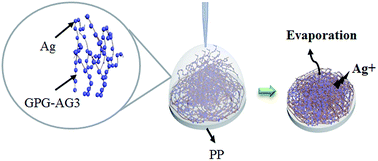
In this work, we demonstrate a straightforward and green approach to prepare antibacterial coatings on polypropylene (PP) surfaces using GPG-AG3. PP is a polymer used in a wide variety of applications; yet untreated PP suffers from poor wettability and printability due to its hydrophobic characteristics.16,17 Here, we exploit the self-assembling characteristics of the GPG domains to create fibrous templates for silver nucleation. The self-assembled silver-coated protein fibers were subsequently deposited directly onto untreated PP films, and allowed to evaporate in air, leaving behind a thick fibrous silver mat (Fig. 1).
![]() | ||
| Fig. 1 Schematic illustrations of the steps involved in the formation of silver nanoparticle (AgNPs) covered protein nanofibers on PP films. | ||
The entire process is environmentally friendly; both synthesis and coating processes were performed in physiological buffers and temperatures, eliminating the use of toxic organic solvents, otherwise required in methods such as electrospinning.12,18 The coating process is simple, does not require specialized equipment and can be applied to any hydrophobic engineering plastics. It is also possible to mass produce the silver-coated proteins elsewhere and brought on-site to prepare antibacterial coatings on the required surfaces.
Here, trifluoroethanol (TFE) was added to GPG-AG3 protein solution (final concentration of 30%) to trigger the formation of protein fibers. The self-assembled GPG-AG3 fibers were subsequently exposed to silver nitrate for 3 days at room temperature and dialyzed. Fig. 2a and b show AFM images of the self-assembled GPG-AG3 fibers. Each fiber was found to be of more than 10 μm in length with an average diameter of around 50 nm. A magnified image of the fibers revealed a bead-like morphology, where each protein fibril consisted of protein “beads” joined end-to-end; each “bead” is about 20–50 nm in diameter (Fig. 2b). In the presence of TFE, the hydrogen bonding between water and protein is disrupted, and this drives the irreversible formation of beta-turn or beta-sheet secondary structures to result in the fibrous morphology.19 The protein fibers were found to remain stable when stored in water at 4 °C for 1 week, with no observable changes in morphologies observed from TEM images (Fig. S1†).
Transmission electron microscopy (TEM) confirmed the presence of GPG-AG3 protein fibers, where each fibril was indeed coated with silver nanoparticles with diameters of 10–50 nm (Fig. 2c and d). The selected area electron diffraction (inset in Fig. 2d) indicated that the silver nanoparticles were crystalline in nature, and have (111) face-centered-cubic lattice structures.
Solutions containing varying concentrations of silver-coated GPG-AG3 fibers were directly deposited onto 8 mm circular untreated PP films, and allowed to dry in air. Dried PP films were analysed using FESEM and UV-Vis. Fig. 3a shows a representative FESEM image of a PP film treated with 10 μM of proteins. A magnified image of the coating revealed that a dense network of silver-coated protein fibers was indeed present on the surface of the film (Fig. 3b). Energy-dispersive X-ray spectroscopy (EDX) spectrum further confirmed the presence of elemental silver (Fig. 3c). Other elements such as C, O, Cu, Si, K and Ca were due to the presence of protein matter and silicon wafer sample holder.
The silver content on the PP films could be varied by varying GPG-AG3 protein concentrations. At a protein concentration of 20 μM, a complete coverage of the film surface was achieved (∼95.8%) (Fig. S2†). This observation was also consistent with FTIR spectra of the PP films (Fig. 3d) as well as the darkening coloration in the PP films (Fig. 3f). Peaks corresponding to amide I (wavelengths 1627 cm−1 and 1534 cm−1) and amide II peaks (wavelength 3285 cm−1) could be detected in all of the protein-coated films except for when the protein concentration was 1 μM. This could be due to the low surface coverage (∼5%) at a protein concentration of 1 μM; (Fig. S2†).
We showed that silver-coated GPG-AG3 protein fibers could be readily deposited onto the surfaces of untreated PP via a simple evaporation step. We next evaluated the antibacterial properties of the protein-coated PP films using both gram-negative Escherichia coli (E. coli) and gram-positive Staphylococcus aureus (S. aureus). First, PP films containing varying concentrations of silver-coated protein fibers were placed in contact with bacteria (at 107 CFU) pre-coated onto 2× YT agar plates. Agar plates were incubated overnight at 37 °C and the widths of the inhibition zones were determined. Fig. 4 show images of agar plates incubated with various protein-coated PP films for E. coli and S. aureus respectively. Magnified images of the inhibition zones could be found in the ESI (Fig. S3†). Black arrows indicate the edges of the bacterial inhibition zones in each sample. Table S1† summarizes the measured widths of the inhibition zones for all the samples analyzed. A maximal width of inhibition zone (∼1 mm) was achieved at 15 μM for E. coli where further increase in protein concentrations did not increase the widths of the inhibition zones. In comparison, an inhibition zone with widths of 0.9 mm was obtained for S. aureus. As expected, untreated PP film controls had no effect on bacteria growth. The formation of inhibition zones were likely a result of released Ag+ ions20 from the silver nanoparticles found on the surfaces of the GPG-AG3 protein fibers; the antibacterial properties of Ag+ has been reported by others.20–24 We noted higher amounts of silver-coated GPG-AG3 protein fibers were needed to kill S. aureus, as compared to E. coli. This could be due to the thicker cell walls of S. aureus, which are harder for silver ions to penetrate and disrupt.3
![]() | ||
| Fig. 4 Images of agar plates with PP films treated with varying amounts of silver-coated protein nanofibers for E. coli (left panel) and S. aureus (right panel). Magnified images of individual samples are provided in the ESI for clarity (Fig. S3†). | ||
Growth kinetics of bacterial strains were used to assess the relative rate and extent of bactericidal activities of the protein-coated PP films. Bacteria were cultured in 2× YT media in the presence of protein-coated PP films, and agitated at 250 rpm at 37 °C. Bacteria growth was monitored by measuring the optical density at 600 nm (OD 600 nm) over time. Fig. S4a and b† show the time courses of bacteria growth in the presence of PP films coated with varying concentrations of silver-coated GPG-AG3 protein fibers. Films coated with at least 15 μM of proteins were found to be effective in inhibiting the growth of both E. coli and S. aureus. In addition, we also found that silver nanoparticles presented together with GPG-AG3 fibers had enhanced antibacterial properties compared to silver nanoparticles alone (Fig. S4c and d†). This could be due to a higher concentration of Ag+ ions resulting from the large surface areas provided by the fibrous network.
Finally, the stability of the protein coatings deposited onto PP films was examined. PP films coated with 20 μM of GPG-AG3 fibers were placed in 50 mL conical tubes containing 30 mL of ddH2O, 2× YT and PBS, and shaken at 60 rpm for 24 h at 25 °C. Washed samples were subjected to FTIR and UV-Vis analysis to determine the remaining protein and silver contents after washing (Fig. S5a and b†). There were no observable changes in both amide I and II peaks for the films washed in ddH2O and PBS, compared to the unwashed sample (Fig. S5a†). Likewise, we also did not detect significant decrease in silver contents for films washed in ddH2O and PBS (Fig. S5b†). However, we noted a slight decrease in the intensities of both amide I and II peaks for samples washed in 2× YT (Fig. S5a†). However, there was no significant drop in the silver content in films washed in 2× YT (Fig. S5b†). Nonetheless, all washed films exhibited comparable antibacterial properties compared to the unwashed samples (Fig. S5c†).
We also found that the protein GPG-AG3 fibers were physically adsorbed onto the PP surfaces, since no proteins could be detected after washing in 2% SDS at 70 °C for 1 h. The SDS wash test is used to determine the type of interactions between proteins and surface.25,26 FTIR analysis show dramatic reduction in the intensities of both amide I and II peaks for films subjected to SDS washing (Fig. S6†). Given the high concentration of proteins in the solution, it is likely that the final coating consisted of multiple protein layers. While several layers of proteins on top of the coating could be removed by rigorous washing in ddH2O, 2× YT and PBS, it is likely that there remain sufficient layers of silver-coated proteins on the PP surfaces to confer antibacterial properties.
Finally, we investigated if the coatings themselves indeed have the bactericidal abilities. Bacteria (105 CFU) were cultured directly on protein-coated PP films for 2 h, and the surface was washed in 1 mL of 2× YT to harvest the bacteria. 100 μl of the culture was directly plated onto 2× YT agar plates and incubated overnight at 37 °C. The next day, the colonies found on the agar plates were counted to obtain the CFU. Fig. S7† shows representative images of the agar plates for uncoated PP films and protein-coated PP films. The average CFU for protein-coated PP films was 102, 100-fold less than the value obtained for uncoated PP film control (104). Hence, our protein coatings are indeed able to kill bacteria upon contact, confirming their antibacterial characteristics.
In summary, a simple, low cost approach to fabricate antibacterial coatings on PP surfaces was demonstrated. We showed that silver-binding fusion proteins (GPG-AG3) readily self-assembled into fibrous templates for the nucleation of silver under physiological conditions. We showed that silver-coated protein coatings could be generated using a single evaporation step to confer antibacterial properties to PP surfaces. Protein-coated PP films inhibited the growth of both gram-negative E. coli and gram-positive S. aureus, demonstrating a scalable and green strategy to prepare antibacterial coatings. Future work to strengthen the adhesion of the proteins to the underlying substrates is necessary to prolong the antibacterial effects of the coatings.
Footnote |
| † Electronic supplementary information (ESI) available: Methods, quantification of film coverage with varying protein concentrations, antibacterial data. See DOI: 10.1039/c5ra09463a |
| This journal is © The Royal Society of Chemistry 2015 |