
Yace Miab,
Weiqing Zhoua,
Qiang Lia,
Donglai Zhanga,
Rongyue Zhang*a,
Guanghui Ma*a and
Zhiguo Sua
aNational Key Laboratory of Biochemical Engineering, Institute of Process Engineering, Chinese Academy of Sciences, Beijing 100190, PR China. E-mail: ryzhang@iccas.ac.cn; ghma@ipe.ac.cn; Fax: +86 010 82627072; Tel: +86 010 82627072
bUniversity of Chinese Academy of Sciences, Beijing 100049, PR China
First published on 17th June 2015
To explore a clear formation mechanism of a three-dimensional (3D) bicontinuous skeleton and control the structure of an epoxy-based monolith, we have prepared the monolith using a mixture of good and poor solvents. The influences of reaction and phase separation parameters, such as molecular weights and content of porogenic poor solvents, porogenic good solvent concentration, equivalent ratio of epoxy group to amine and reaction temperature on the final morphology are systematically studied by monitoring the reaction process with differential scanning calorimetry (DSC) and observing the cloud points (CP). Depending on the above parameters, the resultant morphology can be varied ranging from closed pore structure to globules aggregated structure, which was controlled by the competitive kinetics between the domain coarsening and the structure freezing. The optimized monoliths with uniform and controllable pores have great potential for application in chromatographic separation, membrane filters, and membrane emulsification.
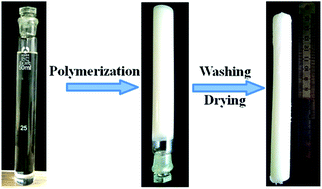
To the best of our knowledge, the polymer monolith prepared by the free radical polymerization using the usual porogenic solvent showed a shared feature: the polymer skeleton was consisted of the connected globules due to the rapid polymerization rate. This type of structure was not favor to form large-sized object because of low strength and fragile property. Meanwhile, the formed pores in-between the globules aggregated to random and it was difficult to control pore diameters precisely.13 In order to avoid the heterogeneity of the monolith structure, a lot of methods were explored, for example, Aoki et al. prepared monoliths with bicontinuous skeleton structure using ultra-high molecular weight polystyrene (Mw = 3050–8420 kD) as porogen to induce viscoelastic phase separation.14 Ultra-high molecular weight polystyrene solution enhanced the viscoelasticity in the polymer phase, and afforded a transient network-like morphology. In our previous study, a controlled radical polymerization for preparation of poly(methacrylate) monolith with three-dimensional (3D) bicontinuous structure was developed using methanol and hexane as porogenic solvent to moderate the phase separation rate in atom transfer radical polymerization (ATRP).15 In recent years, step-wise polymerization method has been studied by more and more researchers for 3D bicontinuous monoliths. Tsujioka et al.14,16 proposed a step-wise polymerization method and obtained the 3D bicontinuous monolith based on epoxy resin using a single compound of polyethylene glycol (PEG) as porogenic solvent, and various influence factors on the structure of the monolith were evaluated, such as reaction temperature, monomer weight ratio, and PEG with different molecular weights. The solubility parameter of PEG had an influence on the formation of 3D bicontinuous skeleton, however, it was not the only factor that determined the exact mechanism of morphology variety; Takuya et al.17 have tried to control the structures of epoxy-based monoliths by changing the polymerization conditions such as the monomer to porogen ratio, content of the curing agent, and polymerization temperature. But they neither provided the detailed relationships between these polymerization conditions and the structures of epoxy-based monolith nor explained the reasons for the relationships. Therefore, it usually needs tedious experiments to search for the designed structure of 3D bicontinous skeleton; Jianhua Li et al.18,19 have made a serious of research to regulate the polymer structures, and found that the average pore size increased with increasing porogen concentration, increasing curing temperature, and decreasing the content of curing agent. However, these study results were only for the structure of closed pores.
In this study, to explore a clear formation mechanism of 3D bicontinuous skeleton and control the structure of epoxy-based monoliths, reaction and phase separation parameters, including porogenic poor and good solvents, equivalent ratio of epoxy group and amine, and curing temperature were varied systematically to study the impact on reaction/phase separation dynamics and final monoliths morphology. Various morphologies, such as closed pores, skeletal network, skeletal network with larger size, a mixed structure of skeletal network and globules, and globules were obtained by changing the above parameters, which was related with the competitive kinetics between the domain coarsening and the structure freezing. The corresponding relations between these parameters and morphologies were obtained and explained in detail by monitoring the reaction process with differential scanning calorimetry (DSC) and observing the cloud points (CP).
![]() | (1) |
![]() | (2) |
The detailed procedures about DSC measurement were cleared as follows: some quality of reaction mixture was sealed in a pan, which maintained tight sealing during the measurement. The sample was heated up to the curing temperature quickly with a heating rate of 70 °C min−1 and then kept at curing temperature. The starting time (t = 0) was set at the instant when the sample was heated up to the curing temperature. CP time determined by light transmission represented the beginnings of the phase separation process.
| E-51/g | DDCM/g | Good solvent/g | Poor solvent/g | |
|---|---|---|---|---|
| a The reaction temperature was 70 °C except these samples with special notations. In the sample notations, E, D, P, dmf represent monomers (E-51), curing agent (DDCM), poor porogenic solvent (PEG) and good porogenic solvent (DMF), respectively. | ||||
| E/D/P150-2.3 | 0.75 | 0.25 | — | P150(2.30) |
| E/D/P200-2.3 | 0.75 | 0.25 | — | P200(2.30) |
| E/D/P300-2.3 | 0.75 | 0.25 | — | P300(2.30) |
| E/D/P400-2.3 | 0.75 | 0.25 | — | P400(2.30) |
| E/D/P200-2.0 | 0.75 | 0.25 | — | P200(2.00) |
| E/D/P200-2.6 | 0.75 | 0.25 | — | P200(2.60) |
| E/D/P200-2.9 | 0.75 | 0.25 | — | P200(2.90) |
| E/D/dmf-0.45/P200-2.55 | 0.75 | 0.25 | DMF(0.45) | P200(2.55) |
| E/D/dmf-0.42/P200-2.58 | 0.75 | 0.25 | DMF(0.42) | P200(2.58) |
| E/D/dmf-0.39/P200-2.61 | 0.75 | 0.25 | DMF(0.39) | P200(2.61) |
| E/D/dmf-0.36/P200-2.64 | 0.75 | 0.25 | DMF(0.36) | P200(2.64) |
| E-0.87/D-0.19/dmf/P200 | 0.87 | 0.19 | DMF(0.45) | P200(2.55) |
| E-0.80/D-0.26/dmf/P200 | 0.80 | 0.26 | DMF(0.45) | P200(2.55) |
| E-0.70/D-0.36/dmf/P200 | 0.70 | 0.36 | DMF(0.45) | P200(2.55) |
| E-0.64/D-0.42/dmf/P200 | 0.64 | 0.42 | DMF(0.45) | P200(2.55) |
| E/D/dmf-0.45/P200-2.55-T = 80 °C | 0.75 | 0.25 | DMF(0.45) | P200(2.55) |
| E/D/dmf-0.45/P200-2.55-T = 90 °C | 0.75 | 0.25 | DMF(0.45) | P200(2.55) |
Fig. 4 showed the SEM photographs of the resulted epoxy-based monolith with different molecular weight of porogenic poor solvent PEG. It can be seen that the structures of epoxy-based monoliths prepared with PEG150 and PEG200 were mixtures of skeletal network and globules (Fig. 4a and b) and the other two structures prepared with PEG300 and PEG400 were skeletal network (Fig. 4c and d). With the increase of porogen molecular weight, the characteristic size of pore and skeleton became smaller, which meant the degree of phase separation decreased. To explain this phenomenon, DSC curves and cloud points of systems with different types of porogens were measured. It can be seen from Fig. 5a that the reaction rates gradually reduced with the increase of PEG molecular weight. This phenomenon could be explained by the differences of these solvents in viscosity (Fig. 5b). High molecular weight of PEG restricted the molecular movement for the long molecular chains and hindered the collision between reaction molecules resulting in low reaction rate.25,26 The low reaction rate followed by the smaller molecular chain growth rate caused the delay of phase separation. Meanwhile porogens with high viscosity also hindered the phase separation. So the cloud points were prolonged with the increase of the molecular weight of PEG as shown in Fig. 5b.
![]() | ||
| Fig. 4 SEM photographs of epoxy monoliths by different molecular weight of porogenic poor solvent PEG. (a) E/D/P150-2.3; (b) E/D/P200-2.3; (c) E/D/P300-2.3; (d) E/D/P400-2.3. | ||
These systems with low molecular weight of PEG as porogen have high reaction rates and fast phase separation rates according to the results of Fig. 5. It was known that slow structure freezing rate and fast domain coarsening rate resulted in high phase separation degree because the final morphologies of the epoxy-based monoliths were fixed at the late phase separation stage. The resulted morphologies of epoxy-based monolith (Fig. 4) indicated that these systems with low molecular weight of PEG as porogen had high degree of phase separation, i.e., larger size of phase structure. So for these systems, the fast phase separation rate played a major role instead of the high reaction rate.
Generally, the amount of porogenic poor solvent has an important influence on the final epoxy-based monolith morphology.27 Here, we further investigated the effects of the amount of porogenic poor solvent. PEG200 was selected to complete the polymerization. Fig. 6 showed the resulted epoxy-based monoliths with different contents of PEG200. The structure of epoxy-based monolith prepared with low content of PEG200 was closed pores (Fig. 6a) and with the increase of porogen content, the structures changed into skeletons with increasing size of pores (Fig. 6b–d). Fig. 7a was DSC curves for systems with different contents of PEG200, which showed system of E/D/P200-2.0 had the highest reaction rate and reaction rate decreased with the increase of PEG200. The addition of PEG200 in the epoxy-amine system decreased the reaction rate by diluting the reactants,28 which was consistent with the DSC results. Since the affinity of the porogen with polymer chains were the same for the same porogen, the reaction rate directly influenced the phase separation. The faster the reaction rate was, and the earlier the cloud point appeared (Fig. 7b).
![]() | ||
| Fig. 6 SEM photographs of epoxy monoliths by different contents of PEG200: (a) E/D/P200-2.0; (b) E/D/P200-2.3; (c) E/D/P200-2.6; (d) E/D/P200-2.9. | ||
Large amount of porogen decreased the system reaction rate, which caused the delay of the phase separation. But, the differences of reaction rate and cloud points of these systems with different amount of porogen were small, while the morphologies of these systems greatly changed. Because the porogenic solvent content was high, the continuous solvent-rich phase could be fully developed, which contributes to large size of pores. Phase inversion occurred when the amount of porogen was increased to a certain extent, which resulted in the globules structure (Fig. 6d). So when the porogen dosage increased, the phase separation degree of epoxy-based monolith increased (Fig. 6).
| Swelling coefficient | |
|---|---|
| a All of data were the average values from three determinations. The size of samples used for experiments was about 1 × 1 × 2 cm3. | |
| PEG200 | 0 ± 0.05 |
| DMF | 1.42 ± 0.05 |
Good solvent in the porogenic solvents has great influence on moderating the interaction between the polymer chains and the porogen. Consequently, the amount of good solvent was an important factor on the morphology. The increased amount of the good solvent enhanced the affinity of porogens and epoxy-based monoliths. Fig. 8 was SEM photographs of epoxy-based monoliths by different amount of good solvents. With the increasing amount of good solvent, pore size of monoliths decreased.
![]() | ||
| Fig. 8 SEM photographs of epoxy monoliths by different contents of DMF: (a) E/D/dmf-0.36/P200-2.64; (b) E/D/dmf-0.39/P200-2.61; (c) E/D/dmf-0.42/P200-2.58; (d) E/D/dmf-0.45/P200-2.55. | ||
Degree of phase separation depended primarily on reaction and phase separation rates. The fast reaction rate shorted the phase structure evolution time which directly reduced the degree of phase separation. The small affinity between porogen and polymer chains accelerated the phase separation, and finally increased the degree of phase separation. Fig. 9a showed DSC curves for systems with different good solvent contents. With the increase of good solvent, the reaction rate slightly increased. This result may be owing to the changes of viscosity caused by the addition of good solvent.
In reaction-induced phase separation, the occurrence of cloud point mainly be affected by the following two factors: firstly, reaction rate. Only when the polymer chains were long enough, the cloud point would appear; secondly, affinity between porogen and polymer. Good affinity inhibited phase separation, while bad affinity promoted it. From Fig. 9b, it can be seen that the cloud point of E/D/dmf-0.45/P200-2.55 was the latest, which indicated the affinity between porogen and polymer chains played a more important role than reaction rate. Thus, with the increasing amount of good solvent, the cloud points were postponed and the size of pores and skeletons decreased for the increase of affinity.
![]() | ||
| Fig. 10 SEM photographs of epoxy monoliths by different weight ratio of curing agent to monomer: (a) E-0.87/D-0.19/dmf/P200; (b) E-0.80/D-0.26/dmf/P200; (c) E-0.70/D-0.36/dmf/P200. | ||
Fig. 11a was DSC curves with different weight ratio of curing agent to monomer. The reaction rate rose with the increase of weight ratio of curing agent to monomer. Amine functional group of curing agent had two hydrogen atoms, and the activity of the primary hydrogen was much larger than the secondary one.31 The large amount of curing agent can offer more primary hydrogen and improve the activity of curing reaction. When the primary hydrogen was excessive, the increase of the amount of curing agent will decrease the reaction rate because increasing the amount of curing agent will accordingly reduce the amount of monomer for the total amount of the reaction components was constant.
![]() | ||
| Fig. 11 DSC curves and cloud points of systems with different weight ratio of curing agent to monomer (the cloud point of E-0.64/D-0.42/dmf/P200 didn't occur). | ||
In Fig. 11b, the cloud point appeared earlier with the increase of weight ratio of curing agent to monomer for the two systems of E-0.87/D-0.19/dmf/P200 and E-0.80/D-0.26/dmf/P200, which was because that the excessive curing agent promoted the chain-growth polymerization reaction. However, the excessive curing agent also contributed to the producing of polymer chains with few cross-linking points that have a better affinity with porogens.32 So when the curing agent was excessive enough, the cloud point would be delayed by the excessive curing agent. So the delay of cloud point occurred in system of E-0.70/D-0.36/dmf/P200 and the cloud point did not occur in system of E-0.64/D-0.42/dmf/P200, which meant that the phase separation did not start.
The increase of weight ratio of curing agent to monomer meant the increase of primary hydrogen and the decrease of the amount of monomers, both of which would inhibited the reaction of secondary hydrogen and the generation of cross-linking points.32 So the increase of weight ratio of curing agent to monomer increased the degree of phase separation for the large proportion of polymer chains with few cross-linking points postponed the structural fixation (Fig. 10).
![]() | ||
| Fig. 12 SEM photographs of epoxy monoliths by different reaction temperatures: (a) E/D/dmf-0.45/P200-2.55-T = 70 °C; (b) E/D/dmf-0.45/P200-2.55-T = 80 °C; (c) E/D/dmf-0.45/P200-2.55-T = 90 °C. | ||
Fig. 13a described curves of DSC versus time for systems with different reaction temperature, and it showed that the rise of temperature increased the reaction rate. High temperature also can elevate the affinity of system which can cause the delay of the cloud point by inhibiting phase separation. However, Fig. 13b showed that with high temperature, the cloud point was earlier for the higher reaction rate. So the effects of temperature on reaction rates played a dominant role. Elevated temperature accelerated the reaction rate which inhibited the process of phase separation and decreased the phase separation degree of the resulted epoxy-based monoliths.
| This journal is © The Royal Society of Chemistry 2015 |