
Seungjun
Baek
,
Juwon
Min
and
Jae W.
Lee
*
Department of Chemical and Biomolecular Engineering, KAIST, 291 Daehak-ro, Yuseong-gu, Daejeon 305-701, Republic of Korea. E-mail: jaewlee@kaist.ac.kr
First published on 22nd June 2015
This study presents the inhibition effects of activated carbon particles on the formation of cyclopentane and propane mixed hydrates in the presence of non-hydrate formers and a surfactant. Activated carbon particles gather around the interface between water and oil phases due to their hydrophobicity and this particle layer prevents water molecules from contacting any hydrate guests. The coexistence of cyclopentane and propane mixed hydrates was clearly observed through Raman spectroscopy. The Raman spectra showed that the propane and cyclopentane were enclathrated in the large cages of structure II hydrate. The inhibition efficiency of the activated carbon particles was quantified using high pressure micro differential scanning calorimetry (HP Micro-DSC). The dissociation enthalpies of the mixed hydrates were significantly reduced at 0.5 wt% of activated carbon particles based on the weight of the oil phase. At 1.0 wt% of activated carbon particles, the particle layer completely covered the interface and the seeding hydrate slurry could not penetrate into the water phase and thus hydrate growth was not observed over a 6 hour period. These results show that carbon particles may have good potential as kinetic hydrate inhibitors in offshore gas–oil pipelines.
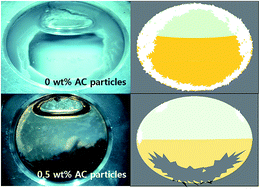
Interfacial hydrate growth has been studied by its morphological features. Tanaka et al.9 reported the hydrate crystal morphologies on water droplets with methane, ethane, and propane. The lateral growth morphologies were determined by a degree of subcooling and were labeled as sword-like, triangle, and polygon. The sizes of the individual crystals were also reduced with an increasing degree of subcooling. Moreover Karanjkar et al.10 revealed the effect of the surfactant Span 80 (sorbitan monooleate) on cyclopentane hydrate crystallization. The surfactant induced a hollow conical shape in the hydrate crystal growth and also changed the morphology of the cyclopentane hydrate from a lateral facet-like to a hairy structure. Recently, hydrophobic silica nanoparticles were utilized as a hydrate inhibitor on cyclopentane hydrate formation with surfactant Span 80 and the inhibition effect of the silica nanoparticles on the hydrate growth was investigated with optical microscopy and micro differential scanning calorimetry (Micro-DSC).11 The hydrophobic silica nanoparticles formed the particle layer between the oil and water phases and then they delayed or prevented the cyclopentane hydrate formation. The hydrate conversion rate and the size of the conical crystals were also reduced in the presence of the nanoparticles.
Although many studies have investigated the hydrate formation and inhibition in single-phase or single-guest systems, inhibition studies in multi-phase guest systems are rarely found. Since the crude oil pipelines usually contain multi-guest, multi-phase hydrate formers and non-hydrate formers (large molecular weight components) with natural surfactants, this complex system should be considered for a better understanding of hydrate plugging in the pipelines. Thus, this work utilized two types of guest molecules, cyclopentane and propane, with each guest existing in liquid oil and vapor phases, respectively, above the ice point. In addition, the liquid oil phase contained a non-hydrate former of isooctane to investigate the inhibition effect of the activated carbon particles on the hydrate formation in a complex system.
We have demonstrated the first attempt of employing activated carbon particles as a new kind of kinetic hydrate inhibitor on cyclopentane and propane mixed hydrate crystallization at the interface between water and oil phases. Several studies have employed activated carbon as a hydrate promoter by constructing porous media to increase the contact area between gas and water molecules. They commonly utilized large-size activated carbon particles (over 250 µm in diameter) and filled the pores with water.12–15 On the other hand, this study utilized small activated carbon particles below 150 µm in diameter which are tightly packed, forming a layer at the interface between the oil and water phases to interrupt the diffusion of the hydrate slurry and guest molecules to the aqueous phase. The quantitative inhibition efficiency was measured via dissociation enthalpies which determined the amount of hydrate formation in high pressure micro differential scanning calorimetry. The change in the morphology and the kinetics of the hydrate crystallization was observed using an optical stereoscope. We also analysed the guest distributions of the hydrate samples to confirm the existence of the mixed cyclopentane and propane hydrates through Raman spectroscopy. This study may provide fundamental insight into the hydrate inhibition action of activated carbon particles and is an unprecedented case of utilizing activated carbon particles as a low cost kinetic inhibitor.
The CP hydrate slurry, a hydrate promoter, was prepared in a similar way to the method described in previous studies.11,20,21 To make the CP hydrate slurry, 10 wt% liquid CP and 90 wt% DI water were mixed in a vial. Because the CP cannot be solubilized into DI water, the vial was shaken every 15 min to promote CP hydrate formation on the whole region. The vial was placed in a freezer at −20 °C for about 3 hours and was then moved to the refrigerator at 4 °C for one week and was periodically shaken every day.
The crystallization of the CP and propane mixed hydrates was observed through a horizontal viewing window of the experimental setup (Fig. 1) because the AC particle layer hindered a top view of hydrate growth as it covered the water–oil mixture interface. The aluminium visualization cell was used for good thermal conduction and it was 20 mm in diameter and 15 mm in depth with a cooling jacket. The cell was filled with 1 mL of DI water and 1 mL of oil solution consisting of 60 wt% CP and 40 wt% isooctane. The oil phase contained 0.1 vol% Span 80 and the dosage of AC particles applied was between 0 and 1 wt% based on the weight of the oil phase. The cell was cooled to 2 ± 0.1 °C with an ethylene glycol chiller. The cell was stabilized at this temperature for 15 min and then 10 µL of the CP hydrate slurry was injected into the AC particle layer formed at the interface between the water and oil solutions using a syringe. After purging the cell with propane gas to remove the air, the propane gas was charged up to 3.65 bar in the visualization cell. The hydrate crystal growth was captured with an Omano Zoom stereoscope OM99T equipped with a Nikon DS-Fi1 HD color camera. This camera was connected to a PC through the Nikon Digital Sight Processor and the images were processed using the NIS-Elements Br 3.0 image processing software.
Calorimetric analysis measured the dissociation enthalpy of the mixed hydrates using high pressure micro differential scanning calorimetry (High pressure Micro-DSCVII, SETARAM). The high pressure stainless steel cell can hold a volume of 0.33 mL and operates up to 100 bar at a temperature range of −45 °C to 135 °C.
The HP Micro-DSC was calibrated with n-decane (−30 °C), water (0 °C), and naphthalene (80.17 °C) with a temperature precision of 0.02 °C. The test cell was filled with 50 µL of DI water and 50 µL of an oil mixture containing 60 wt% CP, 40 wt% isooctane, and 0.1 vol% Span 80. SETSOFT software was utilized to collect the DSC thermograph data. After the test cell was flushed with propane gas, the propane gas was pressurized up to 5.65 bar at 17 °C for 30 min. The HP Micro-DSC was operated with the following temperature sequence: the cell was initially cooled to −30 °C before warming back to −5 °C at 1 °C min−1, and then it was heated up to 17 °C at 0.3 °C min−1. During the heating step, the vapor pressure of the test cell was around 3.65 bar at 2 °C. Calorimetric measurements were also performed on the same oil solution containing AC particles at concentrations of 0, 0.1, 0.25, 0.5, 0.75, and 1 wt% based on the mass of the oil phase.
Because the gas and liquid guest molecules were utilized for hydrate formation, their distributions need to be identified in order to confirm that both CP and propane hydrates were produced simultaneously in the experimental setup. After the hydrate crystallization experiment had been carried out in the absence of AC particles, the visualization cell was cooled to −70 °C with liquid nitrogen. Then, the solid samples were finely ground with a 200 µm sieve in order to obtain accurate spectroscopic data of the cage occupation. The Raman spectroscopy experiments used the Horiba Jobin Yvon model with an Ar ion laser emitting 514 nm light as an excitation source, and liquid nitrogen to quench the CCD detector. The laser intensity was 25 mW and it was calibrated with a silica plate. A Linkam cell (THMS600G model) was used to stabilize the temperature at −70 °C for the Raman experiments.
The Raman spectrum of the ring breathing mode of CP molecules in the liquid phase is known to appear at 890 cm−1 for A1′ symmetry but this signal is also moved to a higher frequency (about 896 cm−1) owing to enclathration of the CP molecules in large sII cages.22,23,26 However, the peak at 896 cm−1 is slightly blue-shifted compared to the reference data of CP hydrates (894 cm−1 at 275 K and 895 cm−1 at 243.15 K).18,19 This difference may come from the different analysis temperature of the Raman spectroscopy. Because the operating temperature of our Raman experiments (203.15 K) is much lower than for the previous works, 275 K (ref. 22) and 243.15 K (ref. 23), the Raman frequency was increased by thermal contraction and by changes in the population of the vibrational energy states. This tendency is fully verified for crystalline solids.27–29 Therefore, the peak at 896 cm−1 can be identified as CP molecules in large cages of the sII hydrate structure. In summary, the two divided peaks reveal the coexistence of the CP and propane hydrates and the growth of the CP-propane mixed hydrate under the experimental conditions.
The dissociation temperature of the CP and propane mixed hydrate was 5.5 °C and it was kept almost the same for the various AC concentrations as shown in Fig. S2† because the hydrate formation occurred in the bulk water–oil interface and not in the small droplet of Pickering emulsions. Thus the quantitative evaluation of the inhibition effects of the AC particles was determined in a similar way to our previous work.11
Fig. 3 shows the inhibition performance of the AC particles on the CP and propane mixed hydrate through a graphical representation of the dissociation enthalpies of the mixed hydrate versus the AC particle concentration. The heat of melting from the reference sample of the non-AC particle system was 124 J gwater−1, this value decreased with increasing AC particle concentration down to 1.5 J gwater−1 at 1 wt% AC particles. In addition, the significant inhibition of hydrate formation was observed at 0.5 wt% AC particles as the dissociation enthalpy of the mixed hydrate suddenly decreased. This result indicates that the degree of AC particle coverage at the interface between the water and oil phases is the most important factor for the inhibition of hydrate formation at that interface. The AC particles were not able to cover the entire region of the interface at concentrations below 0.5 wt%. However, the particle layer fully enveloped the whole interface and interrupted any hydrate formation there, when above 0.5 wt% the thickness of the particle layer was merely changed with the amount of particles on the interface. Our main assumption to be tested here was if hydrate growth would be significantly reduced when the AC particles covered the entire interface at certain concentrations. Thus, the crystallization of the CP and propane mixed hydrates with the AC particles should be visualized to confirm the inhibition performance for various AC particle concentrations.
![]() | ||
| Fig. 3 Variation of the dissociation enthalpies of CP and propane mixed hydrates versus the activated carbon concentrations. | ||
The crystallization of the CP and propane mixed hydrates with 0.25 wt% AC particles is illustrated in Fig. 5. A large number of small hydrate crystals grew and were immersed into the aqueous phase as shown in Fig. 5C and D, they then filled the bottom of the cell unlike the case without AC particles as shown in Fig. 4. These hydrate particles were much smaller than the conical or needle-like crystals in Fig. 4B–E, but there was a larger number of crystals in the aqueous phase, meaning that they could disperse to the bottom part of the cell. When the AC particles were not used in Fig. 4, the hydrate crystals were packed together and rapidly grew on the side of the wall. But the tiny crystals agglomerated on the floor and climbed up side of the wall with 0.25 wt% AC particles in Fig. 5D and E. Moreover, the hydrate formation cannot occur at the top side of the wall but instead fully took place at the bottom region in Fig. 5F. The hydrate growth on the side was highly inhibited and the total duration of the hydrate crystallization was delayed for about 30 minutes compared to the case without using the AC particles. Fig. 6 portrays the formation of the CP and propane mixed hydrates in the presence of 0.5 wt% AC particles. In spite of the formation of the tiny hydrate crystals that were fully immersed into the water phase, as with the crystallization of the hydrates with 0.25 wt% AC particles, the initial hydrate crystallization and subsequent growth was significantly retarded for 124 minutes by the 0.5 wt% AC particle layer as described in Fig. 6B. The AC particle layer only formed on the left side of the seeding point of the CP hydrate slurry and then these particles were dispersed slowly into the overall aqueous phase. In addition, the hydrate growth on the side wall was inhibited and thus the hydrate crystals were packed into the aqueous phase and mainly accumulated on the floor of the cell. The hydrate growth behaviour with 0.5 wt% AC particles also differed from the two previous cases with no and 0.25 wt% AC particles. In the previous cases, the hydrates grew along the cell wall surface, not along the cover glass located on both the front and back sides of the visualization window. However, the hydrates on the side wall spread to both cover glass windows with 0.5 wt% AC particles as shown in Fig. 6D–F due to the thin particle layer on the cover glass. The hydrate crystallization was delayed effectively, thus hydrate formation was finished after 220 min with 0.5 wt% AC particles.
There was negligible hydrate formation with 1 wt% AC particles as shown in Fig. 7. Since hydrate crystallization was not observed for over 6 h, it means that the AC particle layer had completely hindered the penetration of the CP hydrate slurry into the aqueous phase and prevented the hydrate crystallization. It was reported that a silica nanoparticle layer can completely prevent CP hydrate crystallization in a non-gaseous hydrate system.11 The current study, however, shows that the micro-sized AC particles can be employed for the inhibition of the gas hydrates even in a mixed gaseous and liquid hydrate system.
The overall kinetic data is divided into two terms: the initial detectable crystallization with a crystal size of around 70 µm in the linear dimension, and the completion time of CP and propane mixed hydrate formation, as represented in Table 1. As shown in Table 1, the initial and overall hydrate growth rate of the CP and propane mixed hydrates decreases when the amount of the AC particles is increased. Adding 0.5 wt% AC particles to the interface significantly delayed the hydrate formation and thus the growth period for the complete conversion of the CP-propane mixed hydrates is twice as long as for the case in the absence of AC particles. At this point, there is a high correlation between these visual observations and the HP Micro-DSC results. The slope of the plot in Fig. 3 rapidly decreases at 0.5 wt% AC particles and the hydrate crystallization was highly delayed in the visualization of Fig. 6. In this aspect, it is important for the particle layer to fully cover the interface for the prevention of hydrate formation as shown in Fig. 6A–C. Furthermore we do not observe any hydrate growth or crystal morphological change with the 1 wt% AC particles, because the AC particles fully cover the water–oil interface, thus completely preventing the penetration of the CP hydrate slurry at the interface.
| Activated carbon concentration (wt%) | |||||
|---|---|---|---|---|---|
| 0 | 0.25 | 0.5 | 1 | ||
| Initial detectable crystallization (min) | 1st test | 4 | 7 | 24 | ✗ |
| 2nd test | 5 | 12 | 49 | ✗ | |
| Complete conversion (min) | 1st test | 90 | 135.33 | 232 | ✗ |
| 2nd test | 106 | 120.25 | 212 | ✗ | |
Although hydrate crystallization occurred across the whole interface, hydrate crystals are also predominantly observed near the side wall due to heterogeneous nucleation on the solid surface from the coolant circulation in the side wall of the visualization cell. Kashchiev et al.3,36 reported that the heterogeneous nucleation of hydrate clusters on the solid surface in solutions is thermodynamically preferred over homogenous nucleation due to better substrate and hydrate wetting. The nucleation at the side wall of the oil–water interface rapidly occurs because this interface has a contact surface of three phases (oil–water–solid surface). In addition, the ethylene glycol circulation passing through under the side wall caused the highest degree of formation. Because the hydrate crystals developed a porous structure within the surfactant system, the water molecules go upwards on the surface owing to the capillary effect of the porous hydrate layer represented by the arrows in Fig. 8A(5).37
However, dispersion of the hydrate slurry at the interface is restricted by the particle layer as shown in Fig. 8A(2), the CP hydrate slurry cannot disperse into the layer and is located only at the injection site for the 0.5 wt% AC particles in Fig. 9A(2). Moreover, the hydrate growth on the side wall is significantly delayed by the AC particles because the particle layers at the side are partially thicker than the layers on the centre of the interface. Hence, the hydrate growth on the side wall is hindered more as the amount of the AC particles at the interface increases. The hydrate crystals even grow upwards on the cover glass due to the relatively thinner layers of AC particles in Fig. 9A(5 and 6). If the AC particle layer is thick enough to prevent the penetration of the hydrate slurry, there is no hydrate crystal growth or morphological change at the interface between the oil and water phases as shown in Fig. 9B.
Footnote |
| † Electronic supplementary information (ESI) available: Thermograph & dissociation temperature curve. See DOI: 10.1039/c5ra08335d |
| This journal is © The Royal Society of Chemistry 2015 |