Lei Xu,
Xiaoqiong Lu and
Xiaomin Cheng*
School of Chemistry and Chemical Engineering of Anhui University & Key Laboratory of Environment-friendly Polymer Materials of Anhui Province, Hefei 230601, China. E-mail: xmcheng@adu.edu.cn
First published on 7th September 2015
A series of novel cotton cellulose-graft-polycaprolactone copolymers with different grafting contents were successfully prepared via ring-opening polymerization (ROP) in an ionic liquid 1-N-butyl-3-methylimidazolium chloride ([Bmim]Cl). The structures of the grafting copolymers were systematically characterized by FTIR, CP/MAS13C-NMR, XRD, SEM and AFM, while thermal properties were investigated by DSC and TGA. Subsequently, Langmuir, Freundlich, Temkin, and Dubinin–Radushkevich (D–R) adsorption isotherms were representative to simulate adsorption isotherms of Cu(II) and Ni(II) ions in aqueous solution. From the comparison of different adsorption isotherm models, it was found that adsorption of Cu(II) by modified cellulose followed Langmuir, Freundlich and Temkin models, while that of Ni(II) followed the Freundlich model. The results of adsorption indicated that the selectivity sequence of metal ions on graft copolymers was Cu(II) > Ni(II) and the maximum removal capacities of Cu(II) and Ni(II) ions were 98.7% and 35.6%, respectively. Hence, the graft copolymers exhibited significant potential to be an environmentally feasible biosorbent for removal of Cu(II) and Ni(II) ions from aqueous solution.
In the past years, much attention has been paid to the graft polymerization of monomers onto cellulose.5–10 Lönnberg et al. reported surface grafting of microfibrillated cellulose (MFC) with poly(ε-caprolactone) via ring-opening polymerization (ROP) to enable dispersion of MFC in nonpolar organic solvents, or in hydrophobic polymeric matrices.5 Hokkanen et al. studied the adsorption properties of aminopropyltriethoxysilane (APS) modified microfibrillated cellulose (MFC) in aqueous solutions containing Ni(II), Cu(II) and Cd(II) ions.6 Various synthetic polymers such as poly(methacylic acid-co-maleic acid)7 and poly(glycidyl methacrylate)8,9 have also been grafted onto cellulose or cellulose derivatives. In previous studies, nanofibrillated cellulose (NFC), microfibrillated cellulose (MFC) or regenerated cellulose were selected as the sources of cellulose. However, the potential of cellulose has not yet been completely exploited due to the limited number of common solvents that readily dissolve cellulose.
Since Swatloski et al. firstly reported the use of an ionic liquid as solvent media for cellulose, an environmental-friendly reaction scheme for cellulose modifications became practicable under homogeneous solution conditions.11 Compared with heterogeneous reaction, the advantages of the homogeneous reaction in ionic liquid include: opening new avenues for the design of grafting copolymers, opening up the opportunity to control the degree of substitution and physicochemical property of products, etc.12,13 Many studies have been carried out to use ionic liquids as reaction media for the homogeneous functionalization of different cellulose.14–22 For example, poly(N-isopropylacrylamide),14 poly(p-dioxanone)18 and poly(methylmethacrylate)19 were successively reported to be grafted on cellulose or cellulose derivatives in ionic liquid.
An important application of modified cellulose is used for adsorbent. Maater7 reported a poly(methacrylic acid-co-maleic acid) grafted nanofibrillated cellulose (NFC-MAA-MA) aerogel via radical polymerization in an aqueous solution using Fenton's reagent, which showed an efficient adsorption, exceeding 95% toward Pb2+, Cd2+, Zn2+ and Ni2+. Lin et al.22 successfully prepared glycidyl methacrylate grafted cellulose and used them as good sorbents for metal ions. The products showed more effective adsorption of Cr(VI) ions than other adsorbents reported in the literature. Another biosorbent, developed by chemically modifying the Moringa oleifera leaves powder by esterifying with NaOH followed by citric acid treatment, were reported by Kumar Reddy.23 The modified biosorbent could be used for the removal of Cd(II), Cu(II) and Ni(II) from aqueous solution. Yu and coworkers24 deposited CoFe2O4 nanoparticles on cellulose beads to obtain porous magnetic cellulose beads for the removal of metal ions. The encapsulated CoFe2O4 nanoparticles act as the magnetic substrate and the active sites to adsorb metal ions.
In our work, cotton cellulose, a semi-product of cotton-plant with α-cellulose as the major component was used as the raw material to prepare cellulose-g-PCL copolymers via ring opening polymerization (ROP) in an ionic liquid 1-N-butyl-3-methylimidazolium chloride ([Bmim]Cl). Poly(ε-caprolactone) (PCL) is an important aliphatic polyesters with good biocompatibility, mechanical and biodegradability and has been used in many fields, such as biological medicine, adsorption, etc.25,26 Although the grafting of PCL on cellulose has been studied in various system,5,10,16 biodegradable adsorbent prepared in ionic liquid [Bmim]Cl based on cotton cellulose and PCL as we report in this work was observed for the first time to the best of our knowledge. In order to well understand the copolymers, the resultant copolymers were systematically characterized by FT-IR, CP/MAS13C-NMR, XRD SEM and AFM. Their thermal property was studied by DSC and TGA. In addition, the adsorption behaviors of cellulose-g-PCL copolymers for Cu(II) and Ni(II) ions were carefully studied. Langmuir, Freundlich, Temkin, and Dubinin–Radushkevich (D–R) adsorption isotherms were used to simulate adsorption isotherms of Cu(II) and Ni(II) ions. The efficiency of this modified cellulose material in removal of Cu(II) ions from aqueous solutions is very promising.
The absorption capacity of copolymers was evaluated by a batch method. Two solutions of Cu(II) and Ni(II) ions were prepared from analytical-grade copper(II) sulfate and nickel(II) sulfate, respectively. Sorption experiments were conducted in a conical flask and equilibrated using a shaker. Then, 50, 100, 200, 300, 400 and 500 mg L−1 of each of these solutions were separately placed in flasks and equilibrated with a certain samples at room temperature. After a certain time of shaking, the solutions were filtered, and the filtrates were analyzed using a M6-5000 atomic absorption spectrometer (AAS, TA).
The adsorption capacity qe (mg g−1) was calculated as described by the following eqn (1):
![]() | (1) |
The removal efficiency (R%) of the adsorbent was calculated with the following formula:
![]() | (2) |
![]() | (3) |
![]() | ||
| Scheme 1 The grafting copolymerization of PCL onto cotton cellulose backbone in ionic liquid [Bmim]Cl. | ||
| Samples | ε-CL/cell (g g−1) | Catalysts (wt%) | Reaction time (h) | Yield (g) | GR (%) |
|---|---|---|---|---|---|
| C1 | 8 :![]() 1 |
0.5 | 18 | 0.554 | 10.8 |
| C2 | 10 : 1 |
0.5 | 18 | 0.585 | 16.9 |
| C3 | 15 : 1 |
0.5 | 18 | 0.662 | 32.4 |
| C4 | 20 : 1 |
0.5 | 18 | 0.607 | 21.3 |
| C5 | 15 : 1 |
0.2 | 18 | 0.564 | 12.7 |
| C6 | 15 : 1 |
1.0 | 18 | 0.573 | 14.6 |
| C7 | 15 : 1 |
0.5 | 12 | 0.536 | 7.2 |
| C8 | 15 : 1 |
0.5 | 24 | 0.577 | 15.3 |
It could be found that the grafting content of copolymers increased with the increasing mass ratio of CL/cell (g g−1) up to 15/1, then decreased with further increasing the mass ratio of CL/Cell (g g−1). This trend could be explained as that probability of collision and reaction between ε-CL monomers and anhydrous glucose units (AGU) units increased when more ε-CL monomers were introduced. With the further increasing monomers dosage, the concentration of active groups also increased in favor of the collision between ε-CL monomers and active groups, thus decreasing the grafting content of grafting polymers. Another tendency was that the grafting content of copolymers varied with catalysts dosages. The grafting content of copolymers increased with increasing the amount of Sn(Oct)2 up to 0.5 wt% of ε-CL monomers, and then decreased. With further increasing catalysts dosage, the speed of the chain transfer and termination can increase, thus decreasing the grafting ratio of copolymers. In addition, the grafting content of copolymers increased with reaction time up to 18 h then decreased. With further increasing reaction time, polymers of reactive system can be thermal decomposition under high temperature, so the grafting content of copolymers also decreased. However, all samples had poor solubility in organic solvent or water due to the limited graft ratio.
![]() | ||
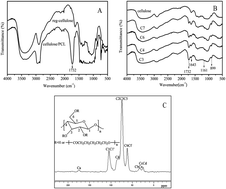
| Fig. 1 FTIR spectra (A and B) of samples and CP/MAS13C-NMR (C) spectrum of cellulose-g-PCL copolymer. | ||
The FT-IR spectra of cellulose and cellulose-g-PCL copolymers with various graft contents were displayed in Fig. 1B. From the result of extraction, the peak at 1732 cm−1 of Fig. 1B was just from the PCL segments of copolymers. In the FTIR spectrum of cellulose, the peak in the range of 3000–3500 cm−1 was assigned to the –OH stretching, the characteristic peak at 1161 cm−1 was attributed to the asymmetric C–O stretching of –C–O–C bridge, the peak 899 cm−1 was assigned to the C–O stretching of glycoside linkage and the peak at 1643 cm−1 belonged to the C–H stretching of CH2 groups. For the FTIR spectrums of copolymers (C3, 4, 6, 7), the characteristic peaks at 1732 cm−1 were assigned to the stretching vibration of C
O of PCL ester group, and the intensity of the peaks enhanced with increasing the grafting ratio of copolymers. The results showed that PCL parts were grafted onto cellulose.
The CP/MAS13C-NMR spectrum of cotton cellulose-g-PCL copolymer was shown in Fig. 1C. The carbonyl carbon signal Ca of the PCL segments in copolymer appeared at δ = 174.1 ppm, and the methylene carbon signals of the PCL segments also could be observed at δ = 62 ppm, 34 ppm, and 25 ppm, corresponding to Cf, Cb and Ce, Cc and Cd positions, respectively. The carbon signals of the cellulose backbone appeared at δ = 105.4 ppm, 88.6 ppm, 71–75 ppm and 64.6 ppm, assigned to C1, C4, C235, and C6 of anhydrous glucose units (AGU), respectively. Compared with the CP/MAS13C-NMR spectrum of pure reg-cellulose, the carbon location of anhydrous glucose units in copolymers appeared drifting. Moreover, the carbon signal located at δ = 97.8 ppm (C1′) belonged to the C1 adjacent to the C2 with substituted –OH groups, which was cleaved from signal from C1 by the affection of groups in PCL chains. The results further indicated the PCL chains were grafted onto cellulose.
![]() | ||
| Fig. 3 DSC thermograms ((A): first heating runs; (B): second heating runs), TGA curves (C) and DTG curves (D) of PCL and cotton cellulose-g-PCL copolymer. | ||
The TGA and DTG curves for both cellulose and copolymer at a heating rate of 20 °C min−1 under nitrogen atmosphere were displayed in Fig. 4C and D. It can be found that cellulose went through a stage of thermal degradation from 60 °C to 200 °C with a slight weight loss about 4% owing to the vaporization of water or elimination of unstable fragments. Subsequently, a weight loss started from 240 °C to 431 °C due to the degradation of cellulose main chains. And the maximum degradation rate of cellulose could be recorded at the temperature of 321 °C. In contrast with cellulose, the thermal degradation of cellulose-g-PCL copolymers exhibited two separated pyrolysis. The first process extending from 230 °C to 265 °C was possibly ascribed to the degradation of cellulose fragments, and the second process starting from 265 °C to 406 °C should be corresponded to the degradation of copolymers. Moreover, a maximum degradation rate could be observed at the temperature of 293 °C from the TG and DTG curves. Furthermore, we can find that the onset decomposition temperature and the maximum decomposition temperatures of copolymers were lower than those of cellulose. The results could be attributed to the fact that the introduction of PCL parts partially destroyed the hydrogen bonds of cotton cellulose, thereby affected the crystalline structure of cellulose.
The distribution characterizations of cellulose and copolymer powders in acetone were examined by AFM, as displayed in Fig. 5A and B. The particles of cellulose and copolymer showed a kind of grain shape. Fig. 5A showed that cellulose samples had a good dispersion in acetone, and the size of particles was comparatively non-uniform. However, in Fig. 5B, the copolymer particles had a relatively dense distribution as well as orderly arrangement, and the size of particles was relatively uniform. From AFM measurement, it can be seen that the average diameter (28.1 nm) of copolymer particles was smaller than (32.2 nm) that of cellulose, and the roughness average value (Ra = 0.709 nm) of copolymer sample was higher than that (Ra = 0.436 nm) of cellulose. The results may be because that the surface property of cellulose was changed by grafting PCL chains.
The Langmuir model is often applied to assume the occurrence of adsorption at specific homogeneous adsorption sites within the adsorbent.28 The linear form of the Langmuir equation can be written as follows:
![]() | (4) |
The linear Langmuir adsorption isotherms of Cu(II) and Ni(II) ions on copolymers were displayed in Fig. 6A, and isotherm constants were presented in Table 2. For Cu(II) ions, high R2 values (correlation coefficients) showed that the Langmuir isotherm fit rather well with the experimental data. However, the adsorption of Ni(II) ions on copolymers did not follow Langmuir model, indicating more complex adsorption phenomena than simple monolayer formation.
![]() | ||
| Fig. 6 Langmuir (A), Freundlich (B), Dubinin–Radushkevich (D–R) (C) and Temkin (D) adsorption isotherms for Cu(II) and Ni(II) ions on cellulose-g-PCL copolymers. | ||
| Type of metal | Q0 (mg g−1) | b (L mg−1) | R2 |
|---|---|---|---|
| Langmuir | |||
| Cu(II) | 256.4 | 0.0024 | 0.9951 |
| Ni(II) | 50 | 0.0041 | 0.8032 |
| Type of metal | K (L g−1) | 1/n | R2 |
|---|---|---|---|
| Freundlich | |||
| Cu(II) | 1.5791 | 0.7341 | 0.9898 |
| Ni(II) | 0.0248 | 1.2455 | 0.9799 |
| Type of metal | qm (mg g−1) | β | E | R2 |
|---|---|---|---|---|
| D–R | ||||
| Cu(II) | 97.58 | 0.0005 | 0.032 | 0.8365 |
| Ni(II) | 24.68 | 0.0005 | 0.032 | 0.7062 |
| Type of metal | B (mg g−1) | KT | b′ (J mol−1) | R2 |
|---|---|---|---|---|
| Temkin | ||||
| Cu(II) | 45.36 | 0.0325 | 54.62 | 0.9831 |
| Ni(II) | 14.52 | 0.025 | 170.61 | 0.8405 |
The separation constant RL (dimensionless constant) of Langmuir isotherm, defined by Weber and Chakraborty,29 can be used to predict the affinity between the adsorbate and adsorbent in the absorption system and represented as follows:
![]() | (5) |
Another linear equation of the Freundlich adsorption model30 is
![]() | (6) |
qe vs. log
Ce gave a straight line with the slope (1/n) and intercept (log
K), as shown in Fig. 6B. The higher correlation coefficients indicated that the adsorption of Cu(II) and Ni(II) ions followed the Freundlich model. With the help of slope and intercept, the n and the K values were calculated and listed in Table 2. For the adsorption of Ni(II), the higher correlation coefficient was obtained from Freundlich model when compared to the Langmuir model. This observed result suggests that the adsorption of Ni(II) was taken place on the heterogeneous surface of the adsorbent much better than the monolayer adsorption.
In order to deduce the heterogeneity of the surface energies of adsorption and the characteristic porosity of the adsorbent, the Dubinin–Radushkevich (D–R) isotherm model was further applied to the data of adsorption.31 The linear form of D–R isotherm model is given as follows:
ln qe = ln qm − βε2
| (7) |
![]() | (8) |
![]() | (9) |
The (D–R) constants for Cu(II) and Ni(II) ions were calculated from Fig. 6C, and results are given in Table 2. R2 values of Cu(II) and Ni(II) ions were less than 0.98, hence, the adsorption of Cu(II) and Ni(II) ions on copolymers cannot follow the D–R isotherm model. The E of adsorption was found to be 0.032 kJ mol−1. If the value of E (kJ mol−1) lies between 8 and 16 kJ mol−1, the nature of the sorption process is chemical; the value below 8 kJ mol−1 indicates a physical adsorption process.34 Therefore, the adsorption of Cu(II) and Ni(II) ions was physical in nature. Since the adsorption of Cu(II) and Ni(II) ions did not follow D–R isotherm model, the E values only provided an estimation of nature of adsorption process.
Temkin isotherm assumes that heat of adsorption decreases linearly with the adsorption onto the surface at a particular temperature, and the adsorption is characterized by a uniform distribution of binding energies.35 Temkin isotherm is expressed in linear form by the following equation:
qe = B ln KT + B ln Ce
| (10) |
![]() | (11) |
Ce (Fig. 6D). The R2 values indicated that the adsorption of Cu(II) ions on copolymers followed Temkin model, while that of Ni(II) ions did not.
From the comparison of various adsorption isotherm models, the adsorption of Cu(II) ions on copolymers followed Langmuir, Freundlich and Temkin isotherm models. For Ni(II) ions, its adsorption only followed Freundlich isotherm model.
As shown in Fig. 7, the removal capacity R decreased with the increase of initial concentration (C0) of Cu(II) and Ni(II) ions. This may be because the adsorption sites and space of copolymer were limited. In addition, when C0 was 50 mg L−1, the maximum R values of Cu(II) ions and Ni(II) ions were 98.7% and 35.6%, respectively. For all selected concentrations (50–500 mg L−1), R value of Cu(II) ions was higher than that of Ni(II) ions. This suggested that the selectivity sequence of cellulose-g-PCL copolymers for metal ions was Cu(II) > Ni(II). Hajeeth et al.36 investigated the adsorption of cellulose-g-acrylic acid for Cu(II) and Ni(II) ions, and the removal capacity of Cu(II) ions (78.2%) was higher than that of Ni(II) ions (57.3%). O'Connell et al.8,9 studied the adsorption of cellulose-g-GMA-imidazole for Cu(II) and Ni(II) ions, and the removal capacity of Cu(II) ions was also higher than that of Ni(II) ions. These results were similar to that of cellulose-g-PCL copolymers. However, the adsorption data of metal ions on aminopropyltriethoxysilane modified microfibrillated cellulose (Hokkanen et al.6) and cellulose-g-α-thioglycerol (Aoki et al.37) showed a opposite selectivity sequence, Ni(II) > Cu(II). It is possible that introducing different grafting groups plays an important role in the adsorption of cellulose for metal ions.
| This journal is © The Royal Society of Chemistry 2015 |