Quan Guab,
Ziwei Gaoa,
Hongan Zhaob,
Zaizhu Loub,
Yusen Liaob and
Can Xue*b
aKey Laboratory of Applied Surface and Colloid Chemistry, Ministry of Education, School of Chemistry and Chemical Engineering, Shaanxi Normal University, Xi'an, 710062, China
bSchool of Materials Science and Engineering, Nanyang Technological University, 50 Nanyang Avenue, Singapore 639798. E-mail: cxue@ntu.edu.sg
First published on 27th May 2015
A series of g-C3N4 photocatalysts were synthesized by changing the temperature through air-assisted thermal polymerization and etching. The detailed characterization and analysis clearly revealed that the texture, surface structure, optical properties, and band structure of g-C3N4 depend on the preparation conditions such as atmosphere and temperature. The morphology of samples obtained at different temperatures undergoes sequential evolution from bulk to nanosheet with multilayer, nanosheet with few layer, moderately rolled nanosheet, tailored nanotube, nanoflakelet and even nanoparticles. Accordingly, the BET surface area increased dramatically from 4.5 m2 g−1 of bulk g-C3N4 to 210.1 m2 g−1 of modified sample obtained at 540 °C. The different textural and structural properties resulted in the different optical and electronic features. The exfoliated and tailored samples obtained by this method presented better photocatalytic performance as compared with bulk g-C3N4. Factors affecting the photocatalytic activity of g-C3N4 were discussed in details on the basis of the textural and structural characterization as well as the photocatalytic activity results. We found that the surface area, surface defects, and light absorption have great impacts on the photocatalytic activities of g-C3N4.
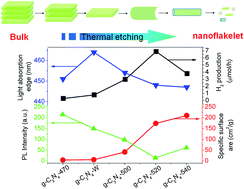
As expected, recently, in the research of modification on the microstructure of g-C3N4, many breakthrough discoveries have been reported, ranging from bulk to nanosheets, nanotubes, and nanoparticles, from three-dimensional to two-dimensional or zero-dimensional growth. The methods for exfoliating and tailoring laminar structure of g-C3N4 include liquid exfoliation,9–12 hydrothermal approach,13 protonation,14 and so on. For example, Zhang et al.9 utilized ultrasonic exfoliation route in water to prepare the ultrathin g-C3N4 nanosheets. The bulk g-C3N4 can be also exfoliated in 1,3-butanediol after ultrasonic processing.11 Similarly, the crystalline C3N4 nanosheets was prepared by one-step liquid exfoliation from layered bulk poly(triazine imide) in water.10 Wang et al.14 reported that protonation can breaks up both sheets and stacks, and thus provides a facile method to modify the morphology and microstructure of g-C3N4. Besides, heat treatment of bulk g-C3N4 in air was also found be an impactful method to achieve the modification of g-C3N4.15,16 All above mentioned methods for exfoliating and tailoring bulk g-C3N4 seem a bit complicated, and are consisting of two or more steps including the preparation of bulk g-C3N4 and subsequent post-treatment. It should be finding a simple alternative method to attempt one-step preparation to obtain nanosheets and/or tailored g-C3N4 by directly precursor heating.
A large number of studies showed that the exfoliation and tailoring of g-C3N4 can not only increase the surface area but also influence the surface structure, optical properties, electronic structure and energy band of g-C3N4.9,11,13–15 Moreover, during the exfoliating process by thermal etching, both the atmosphere and calcination temperature greatly influence the morphology, structure, and optical properties of as-obtained samples.15–17 All of these can affect the photocatalytic activity of g-C3N4. Under certain conditions, there are some contradictions between effects of some factors on the photocatalytic activity. For example, after exfoliation, the specific surface area increased but light absorption decreased.9,11,13,15 Moreover, bandgap narrowing due to the modification of the defects such as nitrogen vacancies leads to the enhanced light absorption but lowered redox ability as a result of the down-shifted conduction band and up-shifted valence band.18,19 Hence, an in-depth understanding on the main factors influencing the photocatalytic activity of g-C3N4 is very important for the synthesis of efficient g-C3N4 based photocatalysts.
Herein, in the present work, we use the method of air-assisted thermal polymerization and etching to obtain a series of g-C3N4 photocatalysts by changing the calcination temperature, and have systemically investigated the effects of calcination temperature on exfoliation process of g-C3N4, morphology evolution, optical properties, band-gap engineering, and photocatalytic activity for water splitting. Factors affecting the photocatalytic activity of g-C3N4 are discussed in details on the basis of the textural and structural characterization as well as the photocatalytic activity test. This work not only provides a simple strategy for exfoliating and tailoring bulk g-C3N4, but also offers in-depth understanding on structure–activity relationship of graphitic carbon nitride.
Then, the photocatalytic oxygen evolution was carried out in a quartz reactor at room temperature. Typically, 10 mg of the as-prepared RuOx loaded sample was dispersed into 10 mL AgNO3 (0.1 M) solution. The suspension was degassed with Ar for 15 min to remove the O2 in the system prior to irradiation under a 300 W xenon lamp (MAX-302, Asahi Spectra, USA) with a UV cut-off filter (λ > 420 nm). The produced O2 was analyzed at a regular interval (1 h) by gas chromatograph (Agilent 7890A) with TCD detector.
N stretching vibrations), two bands caused by the N–H stretches at 3328 and 3168 cm−1, and a band corresponding to the out of plane bending of the s-triazine ring at 806 cm−1.17,21 The FTIR spectra of g-C3N4-T samples are not changed along with the different preparation temperature. According to the XRD and FTIR results, we can conclude that the g-C3N4-T samples also have poly tri-s-triazine structure but with destroyed planar structure and denser interlayer distances.
![]() | ||
| Fig. 1 XRD patterns (a) and FTIR spectra (b) of g-C3N4-W reference, g-C3N4-470, g-C3N4-500, g-C3N4-520, and g-C3N4-540. | ||
The XPS analyses results for the g-C3N4-T samples and the bulk g-C3N4-W reference are shown in Fig. 2. The C 1s signals (Fig. 2a) of all samples can be fitted into two peaks centered at around 284.6 and 288.0 eV, which can be attributed to the aromatic carbon atom and the sp2 C
N bond in the s-triazine ring, respectively.15,23–25 As shown in Fig. 2b, the N 1s signals in the binding energy region of 396–402 eV for these samples can be fitted into three peaks located at 398.5 eV, 399.9 eV, and 400.9 eV for sp2-hybridized nitrogen in triazine rings (C–N
C), tertiary nitrogen N–(C)3 groups, amino functions caring hydrogen (C–N–H), respectively.26,27 A weak peak of N 1s at 404.1 eV for all samples is attributed to charging effects.26 Comparing to bulk g-C3N4-W sample, no obvious binding energy shift of C 1s and N 1s signals for g-C3N4-T can be observed, suggesting that the surface chemical states of both C and N in the g-C3N4-T samples are the same as in the bulk g-C3N4 reference. The binding energies of O 1s peaks at 531.8 and 533.4 eV of bulk g-C3N4-W sample (Fig. 2c) are ascribed to adsorbed oxygen species (water and oxygen).19,28 For g-C3N4-T synthesized in an opened crucible, the peak at low binding energy gradually shifted to the higher binding energy along with higher preparation temperature (531.8, 531.9, 532.0, and 532.1 eV for g-C3N4-470, g-C3N4-500, g-C3N4-520, and g-C3N4-540, respectively), which might be due to the oxidation of some carbon atoms into C
O species at high temperature under air atmosphere.29 The percentages of elements (C and N) on the surface of various carbon nitride samples are determined by XPS. For g-C3N4-470, the surface atomic ratio of C/N is about 0.69, which is close to that of bulk g-C3N4-W (0.70). The surface C/N ratio of g-C3N4-T increases with increasing of temperature (0.73 for g-C3N4-500, 0.81 for g-C3N4-520, and 0.82 for g-C3N4-540), which suggests that the surface of g-C3N4-T obtained at high temperature is poor in nitrogen. This is might be due to the thermal oxidation at high temperature, which leads to exfoliation and tailoring of bulk structure of g-C3N4. These findings are in good consistence with the XRD, SEM, TEM, and N2 adsorption results.
![]() | ||
| Fig. 2 High resolution XPS spectra of (a) C 1s, (b) N 1s, and (c) O 1s for bulk g-C3N4-W reference, g-C3N4-470, g-C3N4-500, g-C3N4-520, and g-C3N4-540. | ||
The morphology and microstructure of the obtained carbon nitride are changed dramatically with increasing of the preparation temperature. As shown in Fig. 3, the SEM and TEM images of bulk g-C3N4 reference (Fig. 3a and f) and g-C3N4-470 obtained at lower heating temperature (Fig. 3b and g) represent typical monolith like morphology. When the temperature increased to 500 °C, the g-C3N4-500 became sheet-like (Fig. 3c and h), suggesting the exfoliation of bulk carbon nitride materials to form the two-dimensional nanosheets by direct heating melamine in air atmosphere. With reaction temperature further increased, nanotube type g-C3N4 is synthesized at 520 °C, which achieves a one-dimensional nanotube growth of g-C3N4 (shown in Fig. 3d and i). This indicates that the carbon nitride nanosheets can be rolled up to minimize the surface free energy.16,30 Additionally, some destroyed tubes and fragments can be observed, indicating the further tailoring by the thermal etching, which can be confirmed by the fact that the tailored nanotubes, nanoflakelets, nanoparticles, even nanodots were formed when the calcination temperature rised up to 540 °C (Fig. 3e and j).
![]() | ||
| Fig. 3 FESEM and TEM images of bulk g-C3N4-W reference (a and f), g-C3N4-470 (b and g), g-C3N4-500 (c and h), g-C3N4-520 (d and i), and g-C3N4-540 (e and j), respectively. | ||
N2 adsorption at 77 K was used to further characterize the microstructural change of obtained carbon nitride with increasing the temperature. The N2 adsorption–desorption isotherm and the corresponding BJH pore-size distribution curve of the g-C3N4-T samples and bulk g-C3N4-W reference are shown in Fig. 4. The obtained specific BET surface area, pore volume, and pore size of these samples are summarized in Table 1. The specific BET surface area of g-C3N4-470 sample is relatively low (6.0 cm2 g−1), which is highly comparable to that of bulk g-C3N4-W reference (4.5 cm2 g−1). Accordingly, there is no obvious hysteresis loop observed in the N2 adsorption–desorption isotherm of g-C3N4-470 and bulk g-C3N4-W reference (Fig. 4), suggesting that no mesopores in the g-C3N4-470 and bulk g-C3N4-W reference, which can be confirmed by corresponding BJH pore-size distribution result (inset of Fig. 4). The N2 adsorption–desorption isotherm of g-C3N4-500, g-C3N4-520, and g-C3N4-540 can be identified as type IV according to the IUPAC classification.31,32 The obtained specific BET surface area are 41.5, 173.6, and 210.1 cm2 g−1, respectively, for g-C3N4-500, g-C3N4-520, and g-C3N4-540 samples, indicating the increased specific BET surface area. For g-C3N4-500 sample obtained at 500 °C, the most probable distribution of pore is centered at around 3.5 nm (inset in Fig. 4), which can be attributed to the mesopores between exfoliated carbon nitride nanosheets. When the treatment temperature is further increased, the exfoliated carbon nitride nanosheets rolled up and then the formed nanotubes can be further tailored, therefore the pore distribution centered at 20 nm are observed in the BJH pore-size distribution curves of g-C3N4-520 and g-C3N4-540 samples, supporting the SEM and TEM observation. These results further confirm that increasing polymerization temperature leads to exfoliation and tailoring of laminar structure of g-C3N4. Most importantly, g-C3N4 material with mesopores and large surface area can be obtained by using this simple method even though the collection yields decrease at higher preparation temperature (as shown in Table 1). Therefore, according to the results obtained from the SEM, TEM, and N2 adsorption, we can conclude that the increased temperature in our study gives rise to significant changes in the textural properties of carbon nitride.
| Samples | Yields | Absorption edge (nm) | Eg (eV) | ECB (V) | EVB (V) | Emission peak (nm) | SBET (cm2 g−1) | Pore volume (mL g−1) | Pore size (nm) |
|---|---|---|---|---|---|---|---|---|---|
| g-C3N4-W | 33.4% | 464 | 2.79 | −1.29 | 1.50 | 458 | 4.5 | 0.035 | 40.2 |
| g-C3N4-470 | 40.7% | 451 | 2.87 | −1.26 | 1.61 | 448 | 6.0 | 0.02 | 35.2 |
| g-C3N4-500 | 16.2% | 454 | 2.85 | −0.88 | 1.97 | 449 | 41.5 | 0.14 | 9.2 |
| g-C3N4-520 | 1.70% | 448 | 2.89 | −1.03 | 1.86 | 439 | 173.6 | 0.77 | 15.6 |
| g-C3N4-540 | 0.35% | 447 | 2.93 | −0.99 | 1.94 | 436 | 210.1 | 0.94 | 16.5 |
Fig. 5b shows the UV-visible absorption spectra of bulk g-C3N4 reference and g-C3N4-T samples. The g-C3N4-470 sample prepared at lower temperature exhibits an absorption edge at 451 nm, which is shorter than that of bulk g-C3N4-W reference (464 nm). This might be due to the low degree of condensation and packing between the layers at low heating temperature.14,20 Increased preparation temperature leads to the enhanced condensation and packing between the layers, and therefore the obtained g-C3N4-500 presents a longer adsorption edge (454 nm), but it is still shorter than that of bulk g-C3N4-W reference, which might be due to quantum size effect.9,17,20,26 With increasing preparation temperature from 500 to 540 °C, the light absorption thresholds of obtained samples gradually shift from 454 to 447 nm (Fig. 5b and Table 1), which should also be attributed to quantum size effect.9,17,20,26 Fig. 5c shows the Tauc plot as a function of light energy of all samples. According to Fig. 5b and c, the estimated bandgaps are 2.79, 2.87, 2.85, 2.89, and 2.93 eV, corresponding to bulk g-C3N4-W reference, g-C3N4-470, g-C3N4-500, g-C3N4-520, and g-C3N4-540, respectively, as shown in Table 1. Based on the Mott–Schottky plots (Fig. 5d) the conduction band potentials (ECB) of bulk g-C3N4-W reference, g-C3N4-470, g-C3N4-500, g-C3N4-520, and g-C3N4-540 are estimated as −1.29 V, −1.26 V, −0.88 V, −1.03 V, and −0.99 V, respectively (Table 1). Accordingly, the band structures of these samples can be depicted as Fig. 5e.
The photoluminescence (PL) spectra of the samples were tested at room temperature with an excitation wavelength of 380 nm. As shown in Fig. 5f, the g-C3N4-470 shows a very strong emission peak centered at 448 nm, which is shorter than that of bulk g-C3N4-W reference (458 nm), suggesting the lower condensation and packing. This is consistent with the blue-shift of absorption band edge, as shown in Fig. 5b. In addition, the intensity of peak at 448 nm for g-C3N4-470 is larger than that for g-C3N4-W reference, suggesting the strong radiative transition of g-C3N4-470. When the preparation temperature increased to 500 °C, the obtained sample showed a red-shifted PL peak at 449 nm, but it is still shorter than that of bulk g-C3N4-W reference. The former is due to the enhanced condensation and packing between the layers caused by the increased temperature, and the latter is due to quantum size effect,9,20 which can be verified by the fact that further increasing preparation temperature leads to the gradual blue-shift of PL peak from 449 to 436 nm (Fig. 5f and Table 1). Increasing preparation temperature from 470 °C to 520 °C leads to the decreased PL intensity, indicating the enhanced non-radiative recombination at trapping states or defects on carbon nitride structure due to the thermal exfoliation and tailoring (shown in SEM and TEM images). However, further increase to 540 °C results in an increase of PL intensity, which might be attributed to the PL of very small g-C3N4 nanostructures (Fig. 3e and j) with quantum size effect.36–38 These results indicate that the fluorescence spectrum of carbon nitride strongly depends on their structure and texture. It is worth noting that the variation of PL intensity of samples is in good agreement with the photocatalytic activity results, suggesting that the structural defects and textural property of samples have great impacts on their photocatalytic performance as discussed in details below.
Then, we also evaluated the photocatalytic O2 evolution of RuOx clusters (2.0 wt%) loaded carbon nitride samples (Fig. S6, see ESI†) from aqueous solution with AgNO3 as the sacrificial agent under visible light irradiation. The results are shown in Fig. 6c and d. All samples exhibit visible light activity for O2 evolution, although the order of magnitude for O2 evolution rates is lower than that for H2 evolution (comparison between Fig. 6b and d). Similar to H2 evolution, the O2 evolution rates increase with increasing preparation temperature from 470 °C to 520 °C and reach a maximum at 520 °C, followed by a decrease when the temperature increases to 540 °C. The g-C3N4-470 sample with bulk structure also shows the lowest O2 evolution rate (0.28 μmol h−1). The exfoliated and tailored samples present the enhanced photocatalytic O2 evolution activity (1.20 μmol h−1, 1.24 μmol h−1, and 0.72 μmol h−1 for g-C3N4-500, g-C3N4-520, and g-C3N4-540, respectively) as compared to g-C3N4-W reference (0.32 μmol h−1).
During the process of heat treatment, the layer structure can be gradually exfoliated and the conjugated poly-triazine ring structure is damaged to a certain extent (as shown in Fig. 3). Accordingly, the g-C3N4 surface structure will be changed, such as increased surface defects, which can be confirmed by PL results (Fig. 5f). The photocatalytic activity results showed that surface defects are helpful to improve the activity because the surface defects can capture the photogenerated carriers, inhibiting the radiative recombination (as shown in PL spectra). But redundant defects can act as recombination centers of photogenerated charge carriers, promoting charge recombination and thus reducing the photocatalytic activity. This can be proved by the fact that the g-C3N4-540 sample exhibits reduced photocatalytic activities.
The different textural and structural properties result in the different optical and electronic characterization (EPR, UV-vis absorption, Mott–Schottky, and PL), as shown in Fig. 5. Light absorption of semiconductor photocatalyst is also one of the important factors affecting the photocatalytic activity. Generally, the longer optical absorption edge allows more light be absorbed by the materials and thus leads to the enhanced photocatalytic activity. Because of the low polymerization degree, g-C3N4-470 sample shows the narrow light absorption range as compared to the bulk g-C3N4-W reference, which is also one of the reasons for its low activity. As shown in SEM and TEM images (Fig. 3), the size and thickness of g-C3N4 gradually decrease as a result of the thermal cutting and stripping effect. Therefore, the optical absorption edge of g-C3N4-500, g-C3N4-520, and g-C3N4-540 samples shift to short wavelength as compared to g-C3N4-W reference and further gradually blue shift to with increasing of temperature (Fig. 5b and c) due to the quantum effect. The activity results indicate that their activities displayed a volcano-type of H2 and O2 evolution rates instead of linear decrease. But the photocatalytic activities of each sample (g-C3N4-500, g-C3N4-520, and g-C3N4-540) are still much higher than that of bulk C3N4-W reference. Hence one can see that only when the temperature is increased up to 540 °C, effects of light absorption on the photocatalytic activity predominated. So, the reasons for decreased photocatalytic activity of g-C3N4-540 sample with the largest specific surface area are attributable to the too many surface defects as the recombination centers and the blue shift of absorption edge.
Footnote |
| † Electronic supplementary information (ESI) available. See DOI: 10.1039/c5ra07284k |
| This journal is © The Royal Society of Chemistry 2015 |