
DOI:
10.1039/C5RA06917C
(Paper)
RSC Adv., 2015,
5, 43328-43333
Synthesis of 1D upconversion CeO2:Er, Yb nanofibers via electrospinning and their performance in dye-sensitized solar cells
Received
13th February 2015
, Accepted 28th April 2015
First published on 28th April 2015
Abstract
1D upconversion CeO2:Er, Yb nanofibers, which could absorb NIR light and upconvert it to visible light, to increase the photocurrent of DSSCs has been fabricated by an electrospinning method. The products were confirmed by transmission electron microscopy (TEM), high-resolution TEM (HRTEM) and X-ray diffraction (XRD), and fluorescence spectroscopy (PL) techniques. An enhancement of 14% in the light harvesting efficiency was observed due to the upconversion and scattering effect. It is anticipated that these nanostructures may provide a new direction for CeO2 application in DSSCs.
Introduction
Dye-sensitized solar cells (DSSCs) have drawn considerable attention for decades because of their high-efficiency and potential for manufacturing at a low cost.1,2 Over the past decades, extensive efforts have been focused on the improvement of their photoelectric conversion efficiency by optimizing the structure and properties of the photoelectrode.3,4 The photoelectrode is one of the most important components in the DSSC because the amount of light absorbed in the DSSC is dependent on the absorption spectrum of the photoelectrode. Generally, a conventional photoelectrode of DSSCs is composed of TiO2 nanoparticles with a small size of 20–40 nm. However, due to their small size, the scattering effects are negligible for visible light. Hence, a large proportion of incident light would not be utilized in solar cells, and results in a low light harvesting efficiency.5–8 To date, an effective way to enhance the light harvesting capability is to introduce a scattering layer on top of the transparent TiO2 layer. But the most absorption is in the visible region of the total solar irradiation, which means that approximately 50% of solar irradiation energy in the ultraviolet (7%) and infrared region (43%) is not utilized.9–11 Therefore, the main constraints for true utilization of solar and the improvement of efficiency is the spectral mismatch between the incident solar photon spectrum and the semiconductor's band gap.12 Considering to resolve this problem is modifying the solar energy spectrum via luminescence phenomenon to the wavelength range, and in this range the solar cells can get high absorption probability. The solar spectrum adjustable results in efficiency enhancement of solar cell through downconversion and especially upconversion.13–16 Upconversion phenomenon refers to nonlinear optical processes in which the sequential adsorption of two or more photons leads to the mission of light at shorter wavelength than the excitation wave length (anti-Stokes emission).17,18 It is well known that the NIR irradiation and nonradiative relaxation of excited ion can generate thermal energy. Meanwhile, solar cells generally operate at high temperature. It is reasonable to expect that the more thermally stable, green metal oxide will play an important role.19 A great deal of research effort has been focused on the upconversion materials NaYF4:Ln (Ln = Yb, Er and Tm) because of their low phonon energy, which suppresses nonradiative transition of excited electrons,20,21 but the stable and nontoxic oxide upconversion materials are preferable to fluoride. The CeO2:Ln upconversion nanomaterials using in DSSC remains largely unexplored, and CeO2 normally is such a cheap materials with nontoxic and high stable property in the family of rare earth oxide, which has been widely used for many regions, it is reasonable that CeO2 also has been considered as a useful host for phosphors activated with lanthanide ions.22–24 In addition, CeO2 has low phonon energy and the ionic radius of Er3+ and Yb3+ is very close to Ce4+. It is easy to introduce the Er3+ and Yb3+ into the Ce4+ host lattice.25 In this paper, 1D upconversion CeO2:Er, Yb nanofibers were prepared by electrospinning and tested for the light scattering materials and further clarify the effect of upconversion materials in our system, so that the efficiency of solar cells can be increased.
Experimental
Synthesis of 1D upconversion CeO2:Er, Yb nanofibers
To synthesize CeO2:Er, Yb luminescent nanofibers, all the chemicals reagents used in experiments were of analytical grade and used as received without further purification. In order to obtain uniform 1D morphology, electrospinning method is used. By adjusting some of the electrospinning parameters, 1D hybrid fiber-like precursor materials was fabricated. First, 1.2 g polyvinylpyrrolidone (PVP, 30 kDa), and 4 ml N,N-dimethyl-formamide (DMF) were dissolved in 10 g ethanol, then 1 ml 2.5 M Ln(NO3)3 (Ln = Ce, Yb and Er) was slowly added to the above solution with stirring at room temperature to form uniform polymer solution. Under applied electrical force, the polymer solution is ejected from the needle, and the solvents are evaporated, the samples are collected on a grounded collector. A high temperature annealing is employed to remove the organic polymer templates to obtain pure 1D inorganic nanofibers. The 1D hybrid fiber-like precursor materials PVP/CeO2:Er, Yb was annealed at 1150 °C for 3 h to remove the organic polymer templates, and the resulting powders were 1D upconversion luminescence CeO2:Er, Yb nanofibers. For comparison, the CeO2 undoped with Er, Yb nanofibers was obtained by the same route without the addition of Er(NO3)3 and Yb(NO3)3 solution.
Characterization
High-resolution TEM (HRTEM) and energy dispersive X-ray (EDS) were performed on a FEI Tecnai G2 F30 STWIN (U.S.A.) operating at 200 kV. Diffraction (XRD) data were obtained with a graphite monochromator and Cu Kα radiation (λ = 0.1541 nm) on a D8 advance superspeed powder diffractometer (Bruker). X-Ray photoelectron spectra (XPS) were recorded by ESCALAB250Xi spectrometer (ThermoFisher, America). The upconversion photoluminescence spectra were measured by the shimadzu 4500 fluorescence spectrophotometer combined steady state fluorescence, using a 980 nm laser as the excitation source. The morphologies and microstructures of the samples were investigated by field-emission scanning electron microscope (FESEM) using a Hitachi S-4800 (Japan) apparatus and transition electron microscopy (TEM) on a Philips TECNAI-12 instrument under an acceleration voltage of 200 kV. Solar energy conversion efficiency was measured using solar simulator (Oriel Sol 3A Solar Simulator, 94063A, Newport Stratford Inc. USA).
Fabrication of photoelectrode and the assembly of DSSCs
The photoelectrode films of commercial P25 (Degussa) were prepared by adding P25, triton X-100 and 2,4-pentanedione to the terpineol solution of ethyl cellulose, and coated on a conducting glass with F:SnO2 film (FTO, 7 Ω per aq) using a doctor-blade printing technique. The pre-treatment with TiCl4 was applied to the FTO glass, through immersing in TiCl4 solution at 70 °C for 30 min, and then printing TiO2 paste. After printing, the electrode was dried at 60 °C. In order to obtain the paste for the scattering layer, the CeO2:Er, Yb upconversion nanofibers were added into the solution containing terpineol, ethyl cellulose and stirred for 1 h, which were pasted onto the TiO2 transparent layer. Finally, the modified photoelectrode were sintered in a muffle at 450 °C. After cooling to 80 °C, the electrode was immersed into dye solution (N719, dyesol, Australia 0.5 mM in acetonitrile) and kept at the room temperature for 24 h. Then, the dye-adsorbed electrode was washed with ethanol and dried. Platinum counter electrode was prepared by conventional thermal decomposition method using H2PtCl6 precursor onto FTO glass. The liquid electrolyte was composed of LiI (0.1 M), I2 (0.05 M) and TBP (0.5 M) in acetonitrile.
Results and discussion
Fig. 1a shows the XRD patterns of CeO2:Er, Yb nanofibers, and All the reflection peaks could be readily indexed to pure cubic fluorite CeO2 (JCPDS card no. 34-0394). No diffraction peaks for Er2O3 or Yb2O3 was observed in the materials, which might confirms the formation of a single phase resulting in successful doping of Er, Yb ions into ceria. As shown in PXRD pattern of the strongest diffraction peaks of the CeO2:Er, Yb in Fig. 1b, the intensity and the position of peaks are different each other, such peak shifts reflect little changes in the crystal lattices of host materials and can be caused by incorporating alien ions with sizes different to those of the host ions. The peak become sharper with increasing concentrations of Er when the value of Yb is consistent. When the content value is Ce
:
Er
:
Yb = 96.7
:
3
:
0.3, the highest intensity of diffraction peak are obtained.
 |
| | Fig. 1 (a) XRD patterns of the CeO2:Er, Yb nanofibers with different ratios of Yb/Er, (b) PXRD patterns of the strongest diffraction peaks of the CeO2:Er, Yb nanofibers with different ratios of Yb/Er. | |
To elucidate the elemental composition of the CeO2:Er, Yb nanofibers XPS analysis was used. The peak position of different atoms are shown in Fig. 2. Fig. 2a shows the wide scan of this materials, the binding energy for Ce (3d) and Er (4d) can be noted. As shown in Fig. 2b and c, several Ce 3d peaks corresponding to Ce3+ (901.4 and 883.1 eV), Ce4+ (917.1 and 898.9 eV) and Er3+ (168.2 eV) mean the existence of Ce3+ and Er3+ in the lattice of CeO2:Er, Yb nanofibers. The Yb peak is not detected because of the small concentration of Yb in the nanofibers.
 |
| | Fig. 2 XPS spectrum of CeO2:Er, Yb nanofibers (a), Ce 3d region (b) and Er 4d region (c). | |
The EDS analysis was employed to investigate the chemical composition and purity of as-synthesized CeO2:Er, Yb nanofibers. The pattern of Ce0.967O2:Er0.03, Yb0.003 nanofibers shown in Fig. 3, reveals that there only exist elements Ce, O, Yb and Er, no other element were detected in the spectrum.
 |
| | Fig. 3 EDS spectra of CeO2:Er, Yb nanofibers. | |
The typical SEM, TEM and HRTEM images of CeO2:Er, Yb nanofibers are shown in Fig. 4. From the SEM micrograph, it can be seen that the as-formed precursor fibers are uniform with diameters ranging from 300–400 nm. After being calcined at 1150 °C for 3 h, the fibers shrink and become curvy due to the decomposition of PVP and crystallization of ceria oxide. It can be found from Fig. 4c and d that 1D nanofibers consist of particles with size of about 80–100 nm. The corresponding HRTEM image in Fig. 3e revealed that the particles in upconversion nanofibers have well lattice planes and good crystallinity. The d-spacing of 0.34 nm was well consistent with those of pure cubic CeO2 phase. These results further confirm the formation of the 1D upconversion CeO2:Er, Yb nanofibers.
 |
| | Fig. 4 SEM images of (a and b) 1D hybrid fiber-like precursor materials PVP/CeO2:Er, Yb, (c and d) TEM and SEM images (e) HRTEM image of CeO2:Er, Yb nanofibers after calcination at 1150 °C. | |
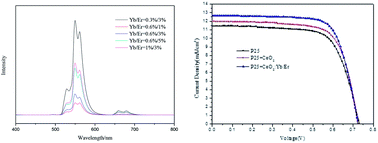
The room temperature PL spectra of 1D CeO2:Er, Yb nanofibers with different ratio of Yb/Er recorded in alcohol and following excitation at 980 nm is shown in Fig. 5. The most intense spectral green peaks located at 525 nm, 550 nm and 562 nm, which was attributed to the energy transitions from 2H11/2 and 4S3/2 to 4I15/2. The red peak at 660 nm and 680 nm correspond to the energy transitions from 4F9/2 to 4I15/2 of Er3+ ions, respectively, which were excited by using a commercial continuous wave diode 980 nm laser. According to the emission spectra, the relative photoluminescence intensity of 1D CeO2:Er, Yb nanofibers is enhanced with better crystallinity along with enhanced v–v separation after raising the activator in host lattice. But larger concentrations of Er3+ do not increase the PL intensity because of filling the quenching sites.
 |
| | Fig. 5 The upconversion emission spectrum of the CeO2:Er, Yb nanofibers with different ratios of Yb/Er. | |
In order to investigate the DSSC performance of the sample, bilayer films were constructed by printing an upconversion layer and CeO2 undoped with Er, Yb nanofibers layer on the top of layer P25. The photocurrent density–voltage curves (J–V) of DSSCs based on different photoelectrodes are shown in Fig. 6, and their photovoltaic parameters are summarized in Table 1. Under illuminating to 100 mW cm−2 solar spectrum, the uncoated solar cell had a short current density (Jsc) of 11.43 mA cm−2, open circuit voltage (Voc) of 0.730 V and a fill factor (FF) of 0.693 with an efficiency (η) of 5.791%, while for the solar cells with an upconversion layer, Jsc of 12.65 mA cm−2, Voc of 0.723 V, FF of 0.729 and η of 6.661% were obtained. Therefore, the solar cell coated with luminescent film, improved the current density and energy conversion efficiency with an increase of 10.6% and 15.02%, respectively. The DSSCs composed of CeO2 undoped with Er, Yb nanofibers layer had a Jsc of 12.046 mA cm−2, Voc of 0.724 V, FF of 0.706 and η of 6.158% respectively.
 |
| | Fig. 6 The photocurrent–voltage curves of dye-sensitized solar cells without upconvernsion layer, with CeO2 undoped with Er, Yb nanofibers layer and with upconvernsion layer. | |
Table 1 Detailed photovoltaic characteristics of DSSCs based on different photoelectrodes
| |
Jsc (mA cm−2) |
Voc (V) |
FF |
η% |
| P25 |
11.436 |
0.730 |
0.693 |
5.791 |
| P25 + CeO2 |
12.046 |
0.724 |
0.706 |
6.158 |
| P25 + CeO2:Yb/Er |
12.647 |
0.723 |
0.729 |
6.661 |
Fig. 7 shows the typical curves of IPCE in the 300–800 nm wavelength range. It indicates that when the upconversion layer is coated onto P25 film the IPCE increases, which is caused by the upconversion and scattering effect. By adding the CeO2 undoped with Er, Yb nanofibers layer, the IPCE also increases compared with P25 film, which can be totally attributed to the light scattering effect. The phenomenon of light scattering effect can also be drawn by the color of the photoelectrode which were immersed into N719 dye solution. The electrode without upconversion layer has the same color at both sides owing to the bare P25 nanoparticles, which means that the dye absorbed evenly. Whereas, the color of the side with upconversion layer is different with another side because of the big size of upconversion CeO2:Er, Yb nanoparticles, and the dye absorbed onto the big size particles is not enough than the small size P25 particles. However, the IPCE of DSSCs by adding the CeO2 undoped with Er, Yb nanofibers layer still lower than those composed of upconversion CeO2:Er, Yb nanofibers layer, therefore, the enhancement of current and efficiency may be due to light absorption of the upconversion induced DSSCs.
 |
| | Fig. 7 IPCE spectra of DSSCs without upconversion layer, with CeO2 undoped with Er, Yb nanofibers layer and with upconvernsion layer. | |
 |
| | Fig. 8 I–V curves of DSSCs under illumination with a 2 W power 980 nm laser. | |
This remarkable reflectance is obviously attributed to the strong mirror-like scattering with the large cubic CeO2 facets, on which the incident light can directly be reflected backwards. To confirm the fact that the upconversion layer composed DSSCs can utilize the NIR light and generate photocurrents, the I–V curve of the DSSCs with upconversion layer and without layer P25 photoelectrode under 980 nm light are also measured in Fig. 8, little photocurrent is produced in the photoelectrodecomposed DSSCs in P25 layer about 0.001 mA cm−2, but the photocurrent with upconversion layer is about 0.0013 mA cm−2, the increased Jsc should be attributed to the upconversion effect. Fig. 8 I–V curves of DSSCs under illumination with a 2 W power 980 nm laser.
Fig. 9 shows the SEM images of the bilayer photoelectrode. An overview of the bilayer photoelectrode (Fig. 9a) indicates that the bifunctional scattering and upconverting layer is coated on the surface of the dense TiO2 film. From Fig. 9b, mesoporous particles of TiO2 were uniformly and densely distributed on the surface. As can be observed in Fig. 9c, during the fabrication of the upconversion layer, the CeO2:Er, Yb upconversion nanofibers were oriented and fused with each other, large assemblies were formed. Another reason for the assemblies is deduced because of triton X-100 and terpineol solution of ethyl cellulose when DSSCs were fabricated.
 |
| | Fig. 9 SEM images of cross-section of the bilayer photoelectrode (a), TiO2 layer (b) and CeO2:Er, Yb nanofibers layer (c). | |
Conclusion
In conclusion, 1D CeO2:Er, Yb upconversion nanofibers were designed and fabricated by electrospinning for making more efficient DSSCs. Compared to the P25 photoelectrode, the efficiency of DSSCs with CeO2:Er, Yb layer is as large as 15% enhancement. It can be observed that the utilization of the CeO2:Er, Yb nanofibers leads to an increase in the overall photocurrent of the solar cells under simulated sunlight irradiation. Apart from using as an upconversion materials to harvest the NIR light, it can also serve as scattering materials to enhance the absorbance of the solar cells.
Acknowledgements
This work was financially supported by the National Natural Science Foundation of China (Grant 20973151, 20901065, and 21273195), a Project Funded by the Priority Academic Program Development of Jiangsu Higher Education Institutions. The authors also acknowledge the Testing Center of Yangzhou University for SEM and EDS experiments.
References
- M. Grätzel, Nature, 2001, 414, 338 CrossRef PubMed.
- B. O'Regan and M. Grätzel, Nature, 1991, 353, 24 CrossRef PubMed.
- B. M. van der Ende, L. Aarts and A. Meijerink, Phys. Chem. Chem. Phys., 2009, 11, 11081 RSC.
- C. Strumpel, M. Mccann, G. Beaucarne, V. Arkhipov, A. Slaoui, V. Svrcek, C. Delcanizo and I. Tobias, Sol. Energy Mater. Sol. Cells, 2007, 91, 238 CrossRef PubMed.
- Y. C. Park, Y. J. Chang, B. G. Kum, E. H. Kong, J. Y. Son, Y. S. Kwon, T. Park and H. M. Jang, J. Mater. Chem., 2011, 21, 9582 RSC.
- H. Yu, Y. Bai, X. Zong, F. Q. Tang, G. Q. M. Lu and L. Z. Wang, Chem. Commun., 2012, 48, 7386 RSC.
- Z. Y. Zhou, J. H. Wang, F. Nan, C. H. Bu, Z. H. Yu, W. Liu, S. S. Guo, H. Hu and X. Z. Zhao, Nanoscale, 2014, 6, 2052 RSC.
- C. Z. Yuan, G. Y. Chen, P. N. Prasad, T. Y. Ohulchanskyy, Z. J. Ning, H. N. Tian, L. Sund and H. Agren, J. Mater. Chem., 2012, 22, 16709 RSC.
- R. Levinson, P. Berdahl and H. Akbari, Sol. Energy Mater. Sol. Cells, 2005, 89, 351 CrossRef CAS PubMed.
- R. Levinson, P. Berdahl and H. Akbari, Sol. Energy Mater. Sol. Cells, 2005, 89, 319 CrossRef CAS PubMed.
- W. Qin, D. Zhang, D. Zhao, L. Wang and K. Zheng, Chem. Commun., 2010, 46, 2304 RSC.
- M. Zahedifar, Z. Chamanzadeh and S. M. Hosseinpoormshkani, J. Lumin., 2013, 135, 66 CrossRef CAS PubMed.
- E. Klampaftis, D. Ross, K. R. Macintosh and B. S. Richards, Sol. Energy Mater. Sol. Cells, 2009, 93, 1182 CrossRef CAS PubMed.
- P. Ramasamy, P. Manivasakan and J. W. Kim, RSC Adv., 2014, 4, 34873 RSC.
- M. Liu, Y. Lu, Z. B. Xie and G. M. Chow, Sol. Energy Mater. Sol. Cells, 2011, 95, 800 CrossRef CAS PubMed.
- D. Li, C. Ding, H. Shen, Y. Liu, Y. Zhang and M. Li, J. Phys. D: Appl. Phys., 2010, 13, 015101 CrossRef.
- F. Wang and X. Liu, J. Am. Chem. Soc., 2008, 130, 5642 CrossRef CAS PubMed.
- J. W. Stouwdam and F. van Veggel, Nano Lett., 2002, 2, 733 CrossRef CAS.
- X. M. Li, F. Zhang and D. Y. Zhao, Nano Today, 2013, 8, 643 CrossRef CAS PubMed.
- K. W. Kramer, D. Biner, G. Frei, H. U. Gudel, M. P. Hehlen and S. R. Luthi, Chem. Mater., 2004, 16, 1244 CrossRef.
- J. F. Suyver, J. Grimm, M. K. van Veen, D. Biner, K. W. Kramer and H. U. Gudel, J. Lumin., 2006, 117, 112 CrossRef PubMed.
- S. Song, L. Xu, Z. Q. He and J. M. Chen, Environ. Sci. Technol., 2007, 41, 5849 Search PubMed.
- F. B. Li, X. Z. Li, M. F. Huo, K. W. Cheah and W.
C. H. Choy, Appl. Catal., A, 2005, 285, 181 CrossRef CAS PubMed.
- A. K. Sinha and K. Suzuki, J. Phys. Chem. B, 2005, 109, 1708 CrossRef CAS PubMed.
- H. J. Wu, Z. W. Yang, J. Y. Liao, S. F. Lai, J. B. Qiu, Z. G. Song, Y. Yang, D. C. Zhou and Z. Y. Yin, J. Alloys Compd., 2014, 586, 485 CrossRef CAS PubMed.
|
| This journal is © The Royal Society of Chemistry 2015 |
Click here to see how this site uses Cookies. View our privacy policy here.