Yun-Hui Wua,
Jun-Wei Zha*abc,
Zhi-Qiang Yaoa,
Fang Suna,
Robert K. Y. Lib and
Zhi-Min Dang*a
aLaboratory of Dielectric Polymer Materials and Devices, Department of Polymer Science and Engineering, University of Science and Technology Beijing, Beijing 100083, People's Republic of China. E-mail: zhajw@ustb.edu.cn; dangzm@ustb.edu.cn; Tel: +86-10-62334516
bDepartment of Physics and Materials Science, City University of Hong Kong, Kowloon, Hong Kong, People's Republic of China
cState Key Laboratory of Power Transmission Equipment & System Security and New Technology, Chongqing University, Chongqing 400030, P. R. China
First published on 7th May 2015
Barium titanate (BaTiO3, BT) fibers were prepared via electrospinning with a sol–gel precursor, followed by a calcination process. Polyimide (PI) nanocomposite films with the electrospun BT fibers were fabricated using an in situ dispersion polymerization method. The morphology and crystal structure of the BT fibers were analyzed through scanning electron microscopy and X-ray diffraction. It was found that their diameter and length were greatly dependent on the calcination temperature. Compared to the spherical BT nanoparticles, the introduction of one-dimensional BT fibers into the PI matrix gave rise to improved thermal stability. Besides, the dielectric behaviors of the PI/BT-fiber composite films were investigated over the frequency range from 102 Hz to 106 Hz and within a temperature range of 20–150 °C. The results demonstrated that the dielectric permittivity at 102 Hz of the PI nanocomposite films with 30 vol% BT fibers was improved up to ∼27, and the corresponding dielectric loss is relatively low (∼0.015). The dielectric permittivity of the PI/BT-fiber composite films exhibited a slight dependence on temperature, while it is highly dependent on the calcination temperature of the electrospun BT fibers. This work opens a new path to optimize the dielectric properties of thermosetting polymer composite films with high energy storage density.
Owing to their excellent dielectric and ferroelectric properties, nanostructured barium titanate (BaTiO3, BT) fillers and BT based nanocrystals such as barium strontium titanate (BST) have been employed in polymer–matrix composites, giving rise to improve dielectric permittivity and to lower dielectric loss.6–8 Fan et al. reported that PI nanocomposite films filled BT nanoparticles with three kinds of diameters were prepared and argued that the roles of nanoparticles such as size and crystal phase has great influence on the dielectric behaviors.9 Li et al. investigated the dielectric properties of polyvinylidene-fluoride (PVDF) nanocomposites with embedded BST/silver core/shell nanoparticles. The relative permittivity of composites was significantly increased to 153 at 100 Hz while the loss tangent was kept low.10 It is well know that the filler morphology (size, shape, aspect ratio, etc.) plays an important role on the properties of polymer composite. In recent years, one-dimensional (1D) materials such as fibers, nanowires, nanotubes and nanorods have been focused on to prepare composites with a wide range of applications due to their small size, high surface-to-volume ratio, high density of surface sites, and unique chemical and physical properties.11–14 Compared to spherical BT particles, the BT fibers with larger aspect ratios and dipolar movement along the longitudinal axis could give rise to improving dielectric properties of the composites at the same concentration of BT loading.
Electrospinning is a simple and effective method for preparing one-dimensional material systems, including metal oxides, ceramics, polymers, and composites.15–17 It is worth noting that BT fibers have been successfully synthesized via electrospinning.18,19 It is known that the properties of ceramic fillers (particles) are related to their crystallization and microstructure. In the fabrication of electrospun ceramic fibers, organic binder removal and calcination need to be carried out under elevated temperature. However, the influences of the calcination condition on the morphology and crystal structure of the BT fibers and their composites might affect the dielectric properties, which have not been properly investigated until now.
In this work, the BT fibers were prepared by electrospinning and calcination. Due to its outstanding dielectric and mechanical properties, as well as high thermal and chemical stability, polyimide (PI) was selected as polymer matrix. The PI nanocomposite films with electrospun BT fibers were prepared using in situ dispersion polymerization process. The microstructures and crystal phases of BT fibers at different calcination temperatures were investigated. And their influence on dielectric properties of the nanocomposite films was discussed. Finally, the high ε and low dielectric loss thermosetting polymer films with high thermal stability and potentially high energy storage density are realized in this work.
:
1.
:
1.2. The obtained suspension sol was mixed with PVP in ethanol, and magnetically stirred for 2 h. Then the evenly dispersed precursor was filled into a plastic syringe. During the electrospinning process, a direct current (DC) voltage of 18 kV was applied to the needle by a power supply unit and the syringe pump fed the sol at a constant rate of 0.06 mm min−1. The distance between the needle tip and collecting plate was set as 10 cm. The electrospun fibers were collected on an aluminum foil attached to the collector. Schematic of the electrospinning process used in this study were illustrated in Fig. 1. Subsequently, they were calcined at 600 °C, 800 °C and 1000 °C for 1 h in air, respectively.
![]() | ||
| Fig. 2 SEM observation on the BT fibers with different calcination temperature (a) 600 °C, (b) 800 °C and (c) 1000 °C, and (d) TEM image of the BT fibers with the calcination temperature of 1000 °C. | ||
To observe the phase transformation with temperature, XRD patterns of the BT fibers calcined at 600 °C, 800 °C and 1000 °C are shown in Fig. 3a. It can be seen that most peaks of the as-synthesized BT fibers can well match the standard pattern of BT spectra (PDF#75-0462), and there is no impurity phase in all the three patterns. Meanwhile, it can also be found that the diffraction peaks of BT fibers become sharper with increasing the calcination temperature, suggesting that high calcination temperature will give rise to better crystallization. With regard to the XRD patterns of samples calcined at 600 °C and 800 °C, all the diffraction peaks are considered to be the cubic phases. For the BT fibers calcined at 1000 °C, it is worth noting that the characteristic splitting of the peaks at 2θ = 44–46° as shown in Fig. 3a corresponding to the (002) and (200) planes of tetragonal phase. Besides, as shown in the magnification of 2θ = 44–46° zone (in Fig. 3b), there is obvious difference of the peak breadth of the samples treated at 1000 °C compared to those at 600 °C to 800 °C. It suggests that the increase of calcination temperature can make the phase of BT fibers gradually transform from cubic to tetragonal phase. On the other hand, with the calcination temperature increased from 600 °C to 800 °C, it can be observed that the peak intensities become higher, implying the better crystallization during the calcination process.
XRD patterns of pure PI films and PI nanocomposite films with 10 vol% BT fibers loading are shown in Fig. 3c. For pure PI films, it can be seen that there is a broad peak which starts from about 2θ = 17.8°. This broad peak can be attributed to the regular arrangement of PI polymer chain. However, a broad peak starting from about 2θ = 15.8° can be observed in the PI/BT-fiber composite films, indicating the increase of averaged interplanar distance of polymer resulted from the incorporation of BT fibers. The chemical structure of BT fibers, pure PI film and the PI/BT-fiber composite films are characterized using FTIR as shown in Fig. 4a. The characteristic peaks of symmetric C
O stretching, asymmetric C
O stretching, and C
N stretching of the imide group are clearly visible at about 1720 cm−1, 1780 cm−1, and 1380 cm−1, respectively. The absorption peak near 1650 cm−1 disappears in the spectra of all the films (carbonyl group in PAA). These results indicate that the imidization of nanocomposite films could not be impeded by the presence of the BT fibers.
![]() | ||
| Fig. 4 (a) FTIR spectra of the (1) BT fibers, (2) pure PI films, and (3) PI/BT-fiber composite films, and (b) TGA curves of PI/BT composite films with BT fibers and nanoparticles. | ||
Fig. 4b shows thermogravimetric analysis (TGA) curves of the PI nanocomposite films with BT fibers and nanoparticles loading. Table 1 lists the characteristic temperatures of the PI nanocomposite films determined from TGA curves. It is clearly observed that the thermal decomposition temperature of PI/BT-fiber composite films is higher than that of PI/BT-nanoparticle ones. For the PI/BT-fiber composite films, their decomposition shifts to higher temperature with increasing calcination temperature (see T5 listed in Table 1). And the composites filled with BT fibers (1000 °C) show the higher temperature (628 °C) at maximum rate of mass loss (Tm). The residual weight of the composites at 750 °C also increased with increasing the calcination temperature. Therefore, it could be concluded that the BT fibers calcined at high temperature leads to higher thermal stability of the PI/BT-fiber composite films. The BT fibers calcined at higher temperature have larger specific surface area, possibly giving rise to the improved interfacial fiber/matrix interaction. This will restrict the thermal motion of PI chains, thus resulting in more stable thermal properties of the PI/BT-fiber composites.
| Fillers | T5 | Tm |
|---|---|---|
| a T5: degradation temperature at 5% mass loss; Tm: temperature at maximum rate of mass loss. | ||
| BT particles | 535 | 576 |
| BT fibers (600 °C) | 582 | 606 |
| BT fibers (800 °C) | 616 | 625 |
| BT fibers (1000 °C) | 618 | 628 |
Fig. 5 shows the surface and fracture section morphologies of PI/BT-fiber composite films with 10 vol% BT fibers calcined at 1000 °C. It reveals that the BT fibers are evenly dispersed in the PI matrix and the BT fiber networks can be well formed between the neighboring fibers. Besides, good interfacial interaction between BT fibers and PI matrix can be observed. The existence of this interfacial interaction possibly gives rise to more interfacial polarization of the composite system, which can lead to the Maxwell–Wagner–Sillars (MWS) effect.20 It is well known that the dielectric properties of materials are closely related to the molecular polarization. Thus, the interfacial polarization between BT fibers and PI matrix would play an important role in improving the dielectric properties of the PI/BT-fiber composite films.
![]() | ||
| Fig. 5 SEM images of (a) surface and (b) fracture section of the PI composite films with 10 vol% BT fibers loading. | ||
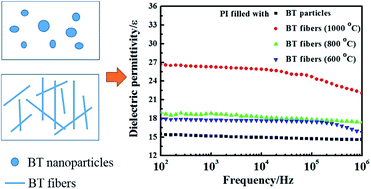
Dielectric properties of the ceramic filled polymer composites are influenced not only by the inherent dielectric properties of polymer and ceramic phases, but also the ceramic morphologies in the polymer matrix. Generally, the 1D fibers are considered to be able to increase the dielectric permittivity more efficiently than the spherical fillers. It is found that dielectric permittivity and dielectric loss increase with BT fibers concentration as shown in Fig. 6a and b. The ε of PI/BT-fiber composite films is up to 26.6 when the content of BT fibers is 30 vol% as shown in Fig. 6a. In comparison with pure PI film (ε = 3.2), the dielectric permittivity of the composite is nearly 8 times higher than that of pure PI. This value is much larger than that of PI/BT hybrid films (ε = 18.35) with 40 vol% BT nanoparticles.21 It can also be observed that the ε of PI/BT-fiber composite films is higher than that of PI/BT-nanoparticle composite films with the concentration of 30 vol%, and the calcination temperature takes a great effect on the ε of PI/BT-fiber composite films, as shown in Fig. 6c. The ε of PI composite films with BT fibers calcined at 1000 °C is higher than that of films with BT fibers calcined at 600 °C and 800 °C, which is attributed to the tetragonal phase formed at 1000 °C calcination temperature (Fig. 3a and b). In addition, the increase of interface and contact between filler and matrix would lead to an improvement of electron mobility and interface polarization, which results in larger dielectric permittivity of the composites.
The dielectric loss PI/BT-fiber composite film is 0.015 when the 10 vol% BT fibers is loaded and it reaches the highest value of 0.10 at 30 vol% BT fibers loading. The increase of dielectric loss is attributed to clusters of BT fibers in the polymer matrix. It shows that when BT fibers is 10 vol%, dielectric loss of the composite film does not show a large increase, indicating that there is no accumulation of interfacial charges inside the composites. A clear frequency dependence is observed for the PI nanocomposite film with 30 vol% BT fibers loading, which is mainly attributed to the remarkably interfacial polarization or commonly referred to MWS polarization between BT fibers and PI matrix.
In order to identify the influence of temperature on dielectric behavior of the PI/BT-fiber composite films, the dielectric permittivity and dielectric loss were measured in the temperature range from 20 °C to 150 °C as shown in Fig. 7. The ε and dielectric loss of PI/BT-fiber composite films exhibit a weak temperature dependence as shown in Fig. 7a and b. It can be concluded that PI matrix has excellent thermal properties whose glass transition temperature (Tg) is about 350 °C.22,23 Both the mobility and thermal expansion of the polymer have an effect on the dielectric properties. However, the BT fibers loaded in the PI matrix form more contact networks which could restrict the chain mobility and thermal expansion of the PI matrix. Thus the ε and dielectric loss do not remarkable change over the temperature range.
![]() | ||
| Fig. 7 Temperature dependence of dielectric permittivity (a) and dielectric loss (b) of the PI composite films with 30 vol% BT fibers and nanoparticles measured at f = 102 Hz. | ||
Energy density of the pure PI film and PI nanocomposite films with different BT fillers loading is shown in Fig. 8a. It is notable that the energy density of PI nanocomposite films is higher than that of pure PI film and the energy density of PI nanocomposite films with BT fibers calcined at 1000 °C is the highest one.
As we know, the maximum energy density, W, can be described as follows.24,25
![]() | (1) |
![]() | (2) |
Because the testing voltage is constant and all the samples have the same thickness of ∼50 μm, Etest is the constant in this study. Therefore, the higher energy density is attributed to the higher ε (at 100 Hz) of the samples. The results demonstrate the advantage of the PI/BT-fiber composite films that exhibit excellent dielectric property significantly showing high energy density. Temperature dependency of the energy density is also shown in Fig. 8b. It can be noted that the energy density does not remarkable change over the temperature range due to the thermal stability of PI matrix. Hence, these electrospun fibers filled PI nanocomposites can provide a new approach for developing high-density energy storage capacitors.
| This journal is © The Royal Society of Chemistry 2015 |