Synthesis of 2-trifluoromethyl indoles via visible-light induced intramolecular radical cyclization

Xichang Dong, Yumin Hu, Tiebo Xiao and Lei Zhou*
School of Chemistry and Chemical Engineering, Sun Yat-Sen University, 135 Xingang west road, Guangzhou 510275, China. E-mail: zhoul39@mail.sysu.edu.cn; Tel: +8620-84110217

Received 3rd April 2015 , Accepted 24th April 2015

First published on 27th April 2015


Abstract

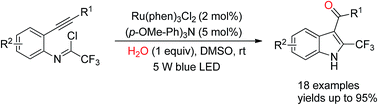
A visible-light induced intramolecular radical cyclization of N-[2-(alkynyl)phenyl]trifluoroacetimidoyl chlorides is described. The reaction allows the rapid construction of diverse 2-trifluoromethyl-3-acylindoles in a sequential C–C and C–O bond formation process under mild conditions.

Organofluorine compounds are playing more and more important roles in medicinal chemistry, agriculture chemistry and material science.1 Screening of fluorinated derivatives by means of fragment based drug discovery (FBDD) has become a widely used method to discover novel therapeutics.2 Owing to the high prevalence of indole scaffolds in natural products,3 the development of pharmaceutically important molecules based on 2-trifluoromethylated indoles core structures has been frequently employed over the last decades.4 Consequently, it is of importance to develop novel and efficient approaches to access this compound class.5–12 Transition-metal catalyzed radical5 or electrophilic trifluoromethylation6 are straight approaches to introduce a CF3 group into indoles. However, these methods revealed some drawbacks such as the use of expensive trifluoromethylated reagents, poor regioselectivity, or extra steps for N-protection and deprotection. Another commonly used strategy is the assembly of 2-(trifluoromethyl)indoles starting from easily available trifluoromethylated building blocks.7–12 Several methods such as Cu-catalyzed coupling of 2-halotrifluoroacetanilides with β-keto esters,8 Pd-catalyzed intramolecular cyclization of N-(o-haloaryl)-alkynylimines,9 titanium-catalyzed carbonyl coupling of 2-acyltrifluoroacetanilides,10 Pd-catalyzed annulation of fluoroalkylated alkynes with o-iodoaniline,11 and radical trifluoromethylation of isonitriles12 have been reported. Despite great achievements in this area, there is still room for innovation, especially from the viewpoints of green and environmentally friendly organic synthesis.

Recently, visible-light photoredox catalyst has emerged as a powerful tool to develop sustainable chemical processes.13 In this context, we reported a visible-light-promoted intermolecular radical cyclization of trifluoroacetimidoyl chlorides with alkynes leading to the formation of 2-trifluoromethyl quinolines.14 Fu and co-worker developed an intramolecular radical cyclization of trifluoroacetimidoyl chlorides for the synthesis of 6-(trifluoromethyl)phenanthridine derivatives based on the activation of C(sp2)–Cl bond under visible-light irradiation.15 As a continuation of our interest in visible-light photoredox radical chemistry,16 we envisioned that this protocol could facilitate the intramolecular radical cyclization of N-(o-alkylaryl) trifluoroacetimidoyl chlorides 1 to give 2-trifluoromethyl-3-acylindole derivatives. Although Uneyama reported a similar radical process in 1993, the reaction required the irradiation of iodide or telluride of 1 under a 438 W high-pressure mercury lamp for 3–4 days, which restricted its practical application in the synthesis.17

To validate our hypothesis, trifluoroacetimidoyl chloride 1a, which could be easily prepared from CF3CO2H, CCl4, and o-alkynylaniline,18 was chosen as the model substrate for the optimization. Initially, 1a was irradiated with a 5 W blue LED in the presence of Ru(bpy)3Cl2 (2 mol%), nBu3N (2 equiv.) and H2O (1 equiv.) in 0.5 mL of MeCN at room temperature for 12 hours. To our disappointment, 1a was completely hydrolyzed to give trifluoroacetamide (Table 1, entry 1). The use of the mixture of nBu3N (0.25 equiv.) and K2CO3 (2 equiv.), which is a good option in our previous intermolecular reaction,14 also led to the full hydrolysis of 1a (Table 1, entry 2). We speculated this outcome was caused by two reasons: (1) the direct hydrolysis is favored by the strong bases; (2) the electron donation ability of tributylamine is not competent enough to initiate a fast radical reaction. To circumvent these problems, four weak bases including Ph3N (Ered = +0.92 V vs. SCE), (p-OMe-Ph)Ph2N (Ered = +0.76 V vs. SCE), (p-OMe-Ph)2PhN (Ered = +0.63 V vs. SCE) and (p-OMe-Ph)3N (Ered = +0.55 V vs. SCE) were examined (Table 1 entries 3–6).19 We were delight to find that the desired 2-CF3 indole 2a was obtained in the yield of 26% when 30 mol% of (p-OMe-Ph)Ph2N was used. (p-OMe-Ph)Ph2N has similar electron donation ability as nBu3N (Ered = +0.78 V vs. SCE),20 but is a weaker base than nBu3N. The yields were further increased to 43% and then 55% when (p-OMe-Ph)2PhN and (p-OMe-Ph)3N were used as the electron donors respectively. It is worth noting that the red solution of 1a, Ru(bpy)3Cl2 and (p-OMe-Ph)3N in MeCN turns into deep blue immediately upon stirring under visible light irradiation. This dramatic color change indicates the formation of triarylamine radical cation, which has been confirmed by Gopidas and Flowers in their kinetic investigation of the electron–transfer reaction.19b When Ru(bpy)3Cl2 was replaced with Ir(ppy)3 catalyst, the yield was almost identical (Table 1, entry 7), while [Ir(ppy)2(dtbbpy)]PF6 afforded the indole 2a only in 28% yield (Table 1, entry 8). We also examined the reactions using organic dyes such as eosin Y and Rose Bengals as the catalysts, but none of desired product was detected (Table 1, entries 9 and 10). Gratifyingly, the reaction gave the 2-CF3 indole 2a in 71% yield when Ru(phen)3Cl2 was employed (Table 1, entry 11). By applying this catalyst system with dry DMSO as the solvent, 2a was formed in 89% yield (Table 1, entry 12). Reducing the loading of (p-OMe-Ph)3N to 5 mol% led to an almost quantitative 96% yield (Table 1, entry 13). The reaction did not take place in the absence of photocatalyst, or without the irradiation of blue LED (Table 1, entries 14 and 15). Notably, as a sharp contrast to time consuming method developed by Uneyama, the present reaction could be completed in 1 hour.

Table 1 Optimization of reaction conditionsa

image file: c5ra05967d-u1.tif

Entry Catalyst Base (mol%) Solvent Yieldb (%)
a Reaction conditions: 1a (0.2 mmol), catalyst (2 mol%), H2O (1 equiv.), solvent (0.5 mL), rt, N2, 5 W blue LED.b Yields were determined by 1H NMR.c Not detected.d 2 equiv. of K2CO3 was added.e No light.
1 Ru(bpy)3Cl2 nBu3N (200) MeCN NDc
2d Ru(bpy)3Cl2 nBu3N (30) MeCN ND
3 Ru(bpy)3Cl2 Ph3N (30) MeCN ND
4 Ru(bpy)3Cl2 (p-OMe-Ph) Ph2N (30) MeCN 26
5 Ru(bpy)3Cl2 (p-OMe-Ph)2PhN (30) MeCN 43
6 Ru(bpy)3Cl2 (p-OMe-Ph)3N (30) MeCN 55
7 Ir(ppy)3 (p-OMe-Ph)3N (30) MeCN 55
8 [Ir(ppy)2(dtbbpy)]PF6 (p-OMe-Ph)3N (30) MeCN 28
9 Eosin Y (p-OMe-Ph)3N (30) MeCN ND
10 Rose Bengals (p-OMe-Ph)3N (30) MeCN ND
11 Ru(phen)3Cl2 (p-OMe-Ph)3N (30) MeCN 71
12 Ru(phen)3Cl2 (p-OMe-Ph)3N (30) DMSO 89
13 Ru(phen)3Cl2 (p-OMe-Ph)3N (5) DMSO 96
14 (p-OMe-Ph)3N (5) DMSO ND
15e Ru(phen)3Cl2 (p-OMe-Ph)3N (5) DMSO ND


With the optimized reaction conditions in hand, we explored the versatility and functional group tolerance of this photoreaction. First, the different alkynes connected to the ortho-position of N-phenyl trifluoroacetimidoyl chlorides were varied. As summarized in Table 2, the reaction was not significantly affected by the substitutents on the phenyl ring of the alkyne moiety, both electron-donating groups such as Me, OMe and electron-withdrawing groups including halogen (F, Cl, Br) and cyano group could be well-tolerated. Substrates with the other aromatics and heteroaromatic ring were also examined, and they also worked efficiently and gave good yields of the desired products such as 2i and 2j. Hexynyl substituted trifluoroacetimidoyl chloride 1k was successfully assembled to form 2-trifluoromethylindole 2k in the yield of 43%. Substrate 1l bearing a cyclopropane motif generated the desired product 2l in diminished yield, but no ring open product was detected in this case. It is worth noting that terminal alkyne 1m was suitable substrate for the reaction, affording 2- trifluoromethyl-3-formyl indole 2m in 50% yield. Owing to the prosperous chemical transformation of formyl group, this compound has been used as the key intermediate for the preparation of various 2-trifluoromethylindole based drug candidates. Finally, trimethylsilane group, which is easily removed in visible-light reactions, also tolerate the reaction conditions.

Table 2 Substrate scope of alkyne motifa

image file: c5ra05967d-u2.tif

Entry Substrate R Product Yieldb %
a All the reaction were carried out by using trifluoroacetimidoyl chlorides 1 (0.2 mmol), Ru(phen)3Cl2 (2 mol%), (p-OMe-Ph)3N (5 mol%), H2O (1 equiv.) in 0.5 mL dry DMSO under the irradiation of 5 W blue LED at room temperature.b Isolated yield.
1 1a Ph 2a 90
2 1b image file: c5ra05967d-u3.tif 2b 73
3 1c image file: c5ra05967d-u4.tif 2c 68
4 1d image file: c5ra05967d-u5.tif 2d 82
5 1e image file: c5ra05967d-u6.tif 2e 75
6 1f image file: c5ra05967d-u7.tif 2f 75
7 1g image file: c5ra05967d-u8.tif 2g 77
8 1h image file: c5ra05967d-u9.tif 2h 78
9 1i image file: c5ra05967d-u10.tif 2i 79
10 1j image file: c5ra05967d-u11.tif 2j 76
11 1k n-C4H9 2k 43
12 1l image file: c5ra05967d-u12.tif 2l 28
13 1m H 2m 50
14 1n TMS 2n 36


Subsequently, substrates scope with respects to substitutes on the phenyl group attached to nitrogen were investigated (Table 3). The reaction of the o,p-Cl2 substituted imidoyl chloride 1o gave the 93% yield of 2o and no dehalogenated product observed. Good yields were obtained when placing a methyl-substituent at the para- or meta-position of the aromatic ring. An analogous substrate bearing a perfluoroethyl substituent on acetimidoyl chloride 1r afforded an excellent yield of 2r as well.

Table 3 Substrate scopea

image file: c5ra05967d-u13.tif

Entry Substrate Product Yieldb %
a All the reactions were carried out under the same conditions as described in Table 2.b Isolated yield.
1 image file: c5ra05967d-u14.tif image file: c5ra05967d-u15.tif 93
2 image file: c5ra05967d-u16.tif image file: c5ra05967d-u17.tif 75
3 image file: c5ra05967d-u18.tif image file: c5ra05967d-u19.tif 76
4 image file: c5ra05967d-u20.tif image file: c5ra05967d-u21.tif 95


A plausible mechanism for this visible-light induced intramolecular radical cyclization is proposed in Scheme 1.13,14 Initially, photoexcitation of Ru(phen)32+ generates excited [Ru(phen)32+]*. Single-electron transfer from electron donor tris(4-anisyl)amine to excited [Ru(phen)32+]* gives rise to Ru(phen)3+ and NAr3 radical cation via a reductive quenching process. Reductive cleavage of the sp2 C–Cl bond of trifluoroacetimidoyl chloride 1 by the Ru(phen)3+ gives imidoyl radical A with concomitant regeneration of Ru(phen)32+ catalyst. Subsequently, intramolecular radical addition of A to alkyne provide vinyl radical B, which might deliver 2-CF3 indole 2 through two different pathways: path a is the propagation between vinyl radical B and 1, affording vinyl chloride C and imidoyl radical A. The 3-acyl moiety would be derived by hydrolysis of vinyl chloride C;17 path b involves single-electron oxidation of A by excited [Ru(phen)32+]* or by the tris(4-anisyl)amine radical cation B to give vinyl cation D, which was trapped by H2O and then enol isomerization. To understand the mechanism of the reaction, a “light/dark” experiment was performed. Initially, the reaction was irradiated with visible-light for 5 minutes, 1H-NMR analysis revealed only 26% of 1a was consumed. Then the light source was removed and the reaction was stirred in the dark for additional 1 hour, the desired indole 2a was finally obtained in the yield of 79%. This experiment demonstrated that continuous irradiation of visible light was not necessary for this transformation. Moreover, the oxidant of a vinyl radical to a vinyl cation has been proved to be a thermodynamically unfavored process in Stephenson's report on visible-light mediated atom transfer radical addition of organic halides to alkynes.21 As a result, an alternative mechanism which the formation of vinyl cation is less likely in this transformation.


image file: c5ra05967d-s1.tif
Scheme 1 Plausible reaction mechanism.

Conclusions

In conclusion, we have developed an efficient method for the synthesis of 2-trifluoromethyl indoles via intramolecular radical cyclization of trifluoroacetimidoyl chlorides. Moreover, this approach allows the installation of various acyl groups or formyl group onto the 3-position of indoles under mild conditions. A wide range of functional groups were found that are able to tolerate the reaction conditions. Mechanistically, this photoreaction was initiated by visible-light photoredox catalyst, followed by a radical chain propagation process. Further application of this method is currently under investigation in our laboratory.

Acknowledgements

We are grateful to the funds from the National Natural Science Foundation of China (21472249 and 21202207), the Pearl River S&T Nova Program of Guangzhou (2013J2200017), and the Fundamental Research Funds for the Central Universities (14lgzd05).

Notes and references

  1. (a) R. D. Chambers, Fluorine in Organic Chemistry, 2nd edn, Blackwell, London, 2004 Search PubMed; (b) P. Kirsch, Modern Fluoroorganic Chemistry, Wiley-VCH, Weinheim, 2004 Search PubMed; (c) Fluorine, in Medicinal Chemistry And Chemical Biology, ed. I. Ojima, Wiley, Hoboken, 2009 Search PubMed; (d) J. Wang, M. Sánchez-Roselló, J. L. Aceña, C. del Pozo, A. E. Sorochinsky, S. Fustero, V. A. Soloshonok and H. Liu, Chem. Rev., 2014, 114, 2432–2506 CrossRef CAS PubMed; (e) X.-H. Xu, K. Matsuzaki and N. Shibata, Chem. Rev., 2015, 115, 731–764 CrossRef CAS PubMed.
  2. (a) Fluorine in Pharmaceutical and Medicinal Chemistry, from Biophysical Aspects to Clinical Applications, ed. V. Gouverneur and K. Mueller, ICP, Oxford, 2012 Search PubMed; (b) J. P. Bégué and D. Bonnet-Delpon, Bioorganic and Medicinal Chemistry of Fluorine; J. Wiley & Sons: Hoboken, NJ, 2008 Search PubMed.
  3. (a) The Chemistry of Heterocyclic Compounds, ed. E. C. Taylor and J. E. Saxton, Wiley-Interscience, New York, 1983/1994, vol. 25 Search PubMed; (b) R. J. Sundberg, Indoles, Academic Press, New York, 1996 Search PubMed; (c) T. Kawasaki and K. Higuchi, Nat. Prod. Rep., 2005, 22, 761–793 RSC; (d) S. M. Bronner, G.-Y. J. Im and N. K. Garg, in Heterocycles in Natural Product Synthesis, ed. K. C. Majumdar and S. K. Chattopadhyay, Wiley-VCH, Weinheim, 2011, p. 221 Search PubMed.
  4. (a) M. A. Akanmu, C. Songkram, H. Kagechika and K. Honda, Neurosci. Lett., 2004, 364, 199–202 CrossRef CAS PubMed; (b) Y. Fukuda, H. Furuta, Y. Kusama, H. Ebisu, Y. Oomori and S. Terashima, J. Med. Chem., 1999, 42, 1448–1458 CrossRef CAS PubMed; (c) Y. Fukuda, H. Furuta, F. Shiga, Y. Oomori, Y. Kusama, H. Ebisu and S. Terashima, Bioorg. Med. Chem. Lett., 1997, 7, 1683–1688 CrossRef CAS.
  5. (a) T. Iqbal, S. Choi, E. Ko and E. J. Cho, Tetrahedron Lett., 2012, 53, 2005–2008 CrossRef PubMed; (b) D. A. Nagib and D. W. C. MacMillan, Nature, 2011, 480, 225–228 CrossRef PubMed; (c) T. Kino, Y. Nagase, Y. Ohtsuka, K. Yamamoto, D. Uraguchi, K. Tokuhisa and T. Yamakawa, J. Fluorine Chem., 2010, 131, 98–105 CrossRef CAS PubMed.
  6. (a) E. Mejía and A. Togni, ACS Catal., 2012, 2, 521–527 CrossRef; (b) M. S. Wiehn, E. V. Vinogradova and A. Togni, J. Fluorine Chem., 2010, 131, 951–957 CrossRef CAS PubMed; (c) R. Shimizu, H. Egami, T. Nagi, J. Chae, Y. Hamashima and M. Sodeoka, Tetrahedron Lett., 2010, 51, 5947–5949 CrossRef CAS PubMed.
  7. (a) V. M. Muzalevskiy, V. G. Nenajdenko, A. V. Shastin, E. S. Balenkova and G. Haufe, Tetrahedron, 2009, 65, 7553–7561 CrossRef CAS PubMed; (b) H. Jiang, Y. Wang, W. Wan and J. Hao, Tetrahedron, 2010, 66, 2746–2751 CrossRef CAS PubMed; (c) B. I. Usachev, D. L. Obydennov and V. Y. Sosnovskikh, J. Fluorine Chem., 2012, 135, 278–284 CrossRef CAS PubMed; (d) Z. Chen, J. Zhu, H. Xie, S. Li, Y. Wu and Y. Gong, Adv. Synth. Catal., 2011, 353, 325–330 CrossRef CAS PubMed.
  8. Y. Chen, Y. Wang, Z. Sun and D. Ma, Org. Lett., 2008, 10, 625–628 CrossRef CAS PubMed.
  9. Z. Chen, J. Zhu, H. Xie, S. Li, Y. Wu and Y. Gong, Synlett, 2010, 1418–1420 CAS.
  10. A. Fuerstner and A. Hupperts, J. Am. Chem. Soc., 1995, 117, 4468–4475 CrossRef CAS.
  11. T. Konno, J. Chae, T. Ishihara and H. Yamanaka, J. Org. Chem., 2004, 69, 8258–8265 CrossRef CAS PubMed.
  12. B. Zhang and A. Studer, Org. Lett., 2014, 16, 1216–1219 CrossRef CAS PubMed.
  13. For selected reviews on visible-light photoredox catalysis, see: (a) M. Reckenthälera and A. G. Griesbeck, Adv. Synth. Catal., 2013, 355, 2727–2744 CrossRef PubMed; (b) J. Xuan, L.-Q. Lu, J.-R. Chen and W.-J. Xiao, Eur. J. Org. Chem., 2013, 6755–6770 CrossRef CAS PubMed; (c) C. K. Prier, D. A. Rankic and D. W. C. MacMillan, Chem. Rev., 2013, 113, 5322–5363 CrossRef CAS PubMed; (d) Y. Xi, H. Yi and A. Lei, Org. Biomol. Chem., 2013, 11, 2387–2403 RSC; (e) D. P. Hari and B. König, Angew. Chem., Int. Ed., 2013, 52, 4734–4743 CrossRef CAS PubMed; (f) L. Shi and W. J. Xia, Chem. Soc. Rev., 2012, 41, 7687–7697 RSC.
  14. X. Dong, Y. Xu, J. J. Liu, Y. Hu, T. Xiao and L. Zhou, Chem.–Eur. J., 2013, 19, 16928–16933 CrossRef CAS PubMed.
  15. W. Fu, M. Zhu, F. Xu, Y. Fu, C. Xu and D. Zou, RSC Adv., 2014, 4, 17226–17229 RSC.
  16. (a) T. Xiao, X. Dong, Y. Tang and L. Zhou, Adv. Synth. Catal., 2012, 354, 3195 CrossRef CAS PubMed; (b) T. Xiao, L. Li, G. Lin, Q. Wang, P. Zhang, Z.-W. Mao and L. Zhou, Green Chem., 2014, 16, 2418 RSC; (c) P. Zhang, T. Xiao, S. Xiong, X. Dong and L. Zhou, Org. Lett., 2014, 16, 3264–3267 CrossRef CAS PubMed; (d) T. Xiao, L. Li, G. Lin, Z.-W. Mao and L. Zhou, Org. Lett., 2014, 16, 4232–4235 CrossRef CAS PubMed.
  17. (a) Y. Ueda, H. Watanabe, J. Uemura and K. Uneyama, Tetrahedron Lett., 1993, 34, 7933–7934 CrossRef CAS; (b) Y. Dan-oh, H. Matta, J. Uemura, H. Watanabe and K. Uneyama, Bull. Chem. Soc. Jpn., 1995, 68, 1497–1507 CrossRef CAS.
  18. (a) K. Uneyama, H. Amii, T. Katagiri, T. Kobayashi and T. Hosokawa, J. Fluorine Chem., 2005, 126, 165–171 CrossRef CAS PubMed; (b) K. Uneyama, J. Fluorine Chem., 1999, 97, 11–25 CrossRef CAS.
  19. (a) S. Sumalekshmy and K. R. Gopidas, Chem. Phys. Lett., 2005, 413, 294–299 CrossRef CAS PubMed; (b) K. Sreenath, C. V. Suneesh, K. R. Gopidas and R. A. Flowers, J. Phys. Chem. A, 2009, 113, 6477–6483 CrossRef CAS PubMed; (c) K. Sreenath, C. V. Suneesh, V. K. Ratheesh Kumar and K. R. Gopidas, J. Org. Chem., 2008, 73, 3245–3251 CrossRef CAS PubMed; (d) K. Sreenath, T. G. Thomas and K. R. Gopidas, Org. Lett., 2011, 13, 1134–1137 CrossRef CAS PubMed.
  20. M. F. Broglia, S. G. Bertolotti and C. M. Previtali, Photochem. Photobiol., 2007, 83, 535–541 CrossRef CAS PubMed.
  21. C.-J. Wallentin, J. D. Nguyen, P. Finkbeiner and C. R. J. Stephenson, J. Am. Chem. Soc., 2012, 134, 8875–8884 CrossRef CAS PubMed.

Footnote

Electronic supplementary information (ESI) available. See DOI: 10.1039/c5ra05967d

This journal is © The Royal Society of Chemistry 2015
Click here to see how this site uses Cookies. View our privacy policy here.