Chrystelle Salameha,
Alina Brumab,
Sylvie Malob,
Umit B. Demircia,
Philippe Mielea and
Samuel Bernard*a
aIEM (Institut Europeen des Membranes), UMR 5635 (CNRS-ENSCM-UM), Universite Montpellier, Place E. Bataillon, F-34095, Montpellier, France. E-mail: Samuel.Bernard@univ-montp2.fr; Fax: +33 467 149 119; Tel: +33 467 149 159
bCRISMAT Laboratory, UMR 6508 (CNRS-ENSICAEN-UNICAEN), 6 Bld Marechal Juin, 14050, Caen, France
First published on 29th June 2015
Late transition metal have attracted considerable interest for catalytic applications. Their immobilization over supports with tailored porosity is advantageous for nanosizing metal particles and avoiding their agglomeration which is known to bring a serious issue to the catalytic performance. Herein, ordered mesoporous silicon nitride (Si3N4) nanoblocks with hexagonal symmetry of the pores, high specific surface areas (772.4 m2 g−1) and pore volume (1.19 cm3 g−1) are synthesized by nanocasting using perhydropolysilazane as precursor. Then, Si3N4 nanoblocks are used as supports to synthesize platinum nanoparticles (Pt NPs) by precursor wet impregnation. Detailed characterizations by TEM show that monodispersed spherical Pt NPs with a 6.77 nm diameter are successfully loaded over nanoblocks to generate nanocatalysts. The latter are subsequently used for the catalytic hydrolysis of sodium borohydride (NaBH4). A hydrogen generation rate of 13.54 L min−1 gPt−1 is measured. It is notably higher than the catalytic hydrolysis using Pt/CMK-3 nanocatalysts (2.58 L min−1 gPt−1) most probably due to the textural properties of the Si3N4 supports associated with the intrinsic properties of Si3N4. This leads to an attractive nanocatalyst in pursuit of practical implementation of B-/N-based chemical hydrides as a hydrogen source for fuel cell application.
NaBH4 carries 10.8 wt% of hydridic (Hδ−) hydrogen. Hydrogen can be easily released by reaction with the protic (Hδ+) hydrogen of water, which thus provides half of the hydrogen H2 generated. The hydrolysis has to be accelerated by a metal-based catalyst.5–9 As an illustration, effective gravimetric hydrogen storage capacities up to 9 wt% can be achieved in the presence of a supported catalyst.8 However, such attractive performances imply harsh operating conditions such as high temperatures (e.g. 80–100 °C) or high pressures (e.g. >6 bars H2). These studies demonstrate that both the catalyst and the support play a key role in the production of H2 from NaBH4 to withstand these harsh conditions.
Late transition metals like ruthenium (Ru) or platinum (Pt) are generally more active and stable than cobalt (Co)10–12 but the cost issue is a limiting factor. Therefore, catalytic application requires significant reduction in the amount of expensive metal while catalytic performance is expected to be enhanced. It is therefore crucial to use very low amounts of metals (≤1 wt%) in the form of nanoparticles (NPs) in order to optimize catalytic activities. However, the nanoparticles agglomeration is problematic during the long-term catalytic process, bringing a serious issue to the catalyst stability. Consequently, the active surface areas of Pt NPs are continuously destroyed, resulting in continuous catalyst degradation with aging. An efficient solution is the immobilization of the catalyst over a support.13 The resulting dispersed particles exhibit a much higher total surface area per unit weight than the bulk metal, therefore allowing better utilization of the metal as a result of dispersion.
In general, the specific surface area, the pore volume, the arrangement and type of the porosity as well as the Lewis and/or Brønsted acidity of materials are primarily considered when selecting a support for catalysts to be used in H2 generation. The thermal conductivity, mechanical strength and especially the chemical resistance towards the reaction medium are not always viewed as the most important properties. Alumina, silica, zeolites and MOFs are generally used as catalyst supports for various catalytic reactions.14–19 As an illustration, silica has been used as a support for the catalytic hydrolysis of ammonia borane.20 However, the application of silica, zeolites, metal oxides or MOFs in catalytic hydrolysis is somehow limited because their hydrothermal stability may turn to be poor in the severe conditions we have imposed in our study, leading in general to the collapse of the porous structure. To address the issue of highly stable supports to produce H2 from the alkaline solution of NaBH4, alternative support materials should be explored.
Carbonaceous supports may represent an alternative solution. However, silicon carbide (SiC) and silicon nitride (Si3N4) attract much more attention, primarily due to their good mechanical and particularly chemical properties, their high thermal stability and their relative high thermal conductivity. Up to now, one group has investigated the use of Si3N4 as a non-porous powdered support (specific surface area < 60 m2 g−1) of metals (Ag, Pd, Pt, etc.), in particular for the catalytic oxidation of methane and alcohols.21–25 In order to better control the size of the particle and avoid the sintering of the metals which inherently occurs on non-porous supports, development of porosity is required.
The Polymer-Derived Ceramics (PDCs) route has been widely investigated to prepare non-oxide ceramics with a tailored porosity.26–38 In contrast, reports focused on their use as supports are extremely limited. There are two strategies to prepare metal-supported porous PDCs. The basis of the first strategy is to mix in a controlled molar ratio a metal-containing molecule with a polymeric precursor to generate a metal-containing polymer. This synthesis strategy, usually investigated to produce ceramic–ceramic nanocomposites,39 is directed to produce metal–ceramic nanocomposites after pyrolysis during which in situ controlled growth of metal occurs in the matrix.26–29 From a chemistry point of view, the strategy, developed particularly in ref. 28, is very promising and allows producing various compositions of nanocomposites. This molecular approach is advantageous owing to the dispersion of the metal at an atomic level, and the broad applicability (coordination compounds of many metals can be used). As an illustration, using nickel (Ni) as metal, particles seem to be located near the external surface of the nanocomposites and within the internal voids and therefore the nanocomposites demonstrate catalytic activity for hydrogenation reactions.28b,d Despite these very recent advances and the possibility to prepare the targeted nanocatalysts within one step,28b,d we focused on the second strategy that consists into the replication of the porous structure of templates such as SBA-15 (or CMK-3 in our case) by polymer nanocasting.35,36 As-obtained materials with tailored porosity are impregnated with the metal precursor in order to be chemically reduced (Fig. 1). This allowed to (i) tune the porosity much more effectively, (ii) fully convert the preceramic polymers into ceramics (which is relatively difficult when metals and ceramics are prepared together in the same composite), (iii) optimize chemical and thermal stability and (iv) avoid possible reactions between the metal and the matrix (formation of metal silicides28c).
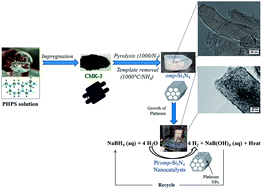
In this general context, we propose herein the synthesis and characterization of a new class of ordered mesoporous Si3N4 labelled omp-Si3N4 in the form of nanoblocks with hexagonal symmetry, very high specific surface area and large pore volume by perhydropolysilazane nanocasting, followed by platinum nanoparticle growth leading second to the generation of new nanocatalysts labelled Pt/omp-Si3N4 (Fig. 2).
Finally, these nanocatalysts were tested for H2 generation by hydrolysis of NaBH4. The performance is compared to the H2 evolution over other nanocatalysts40 to extrapolate and highlight the performance in the catalytic activity of the new Si3N4-based nanocatalysts.
| Type | SSA [m2 g−1] | Pore diameter [nm] | Total pore volume [cm3 g−1] | Micropore volume [cm3 g−1] | Size [μm] |
|---|---|---|---|---|---|
| BET1000 | 983 | 5.57 | 1.35 | 0.01 | 0.5–5 |
Perhydropolysilazane in xylene (20 wt%) (PHPS, AQUAMICA NN-310) is provided by Mitsuya Boeki Ltd., Japan. Anal. found (wt%): Si, 65.1; N, 26.2; H, 8.3; O, 0.4. FTIR (KBr/cm−1): ν(N–H) = 3374 (m), ν(Si–H) = 2125 (s), ν(N–H) = 1180 (s), ν(Si–N) = 840–1020 (s). 1H NMR (300 MHz, C6D6, δ/ppm): 1.6–0.3 (NH), 5.8–4.3 (SiH). 29Si NMR (79.43 MHz, C6D6, δ/ppm): −39.0 ppm (HSiN3/H2SiN2).
For the preparation of the Pt supported samples and the hydrogen generation experiments, chloroplatinic acid hexahydrate (H2PtCl6·6H2O, Sigma-Aldrich), sodium borohydride (NaBH4, Acros Organics), sodium hydroxide (NaOH, Carlo Erba) and deionized ultra-pure water (Milli-Q grade; resistivity > 18 MΩ cm) are used.
In the present paper, nanocasting provides access to mesopores by replicating the nanostructure of CMK-3 into a locally ordered pore system through (i) the impregnation of the pore template with PHPS solution (20 wt% in xylene) at 10 °C for 48 h under static vacuum, (ii) the subsequent filtration step that consists to selectively remove the PHPS molecules deposited outside while the capillary forces kept the PHPS molecules effectively inside the pores, (iii) the post-treatment of the infiltrated template at low pressure and 30 °C in order to slowly remove the solvent while PHPS crosslinks, (iv) the pyrolysis under nitrogen at 1000 °C (dwelling time of 2 h) of the composite PHPS/CMK-3 to convert the PHPS confined in the porosity of CMK-3 into a composite Si3N4/Si, and (v) the heat-treatment under ammonia (dwelling time of 5 h) to remove CMK-3 involving a weight loss of 54.5% while the title sample is generated.
The thermogravimetric curve in Fig. 3a shows that the template is eliminated at high temperature above 800 °C. At this temperature, the ceramic conversion of PHPS is almost achieved. Within this context, we tentatively performed the heat-treatment of the composite PHPS/CMK-3 directly under ammonia (dwelling time of 5 h) to convert PHPS into a ceramic while the template was removed. This allowed us to reduce the number of steps in the process. In that case, a hydrogenated compound with composition close to Si3N4 is obtained.47 We obtained a nitrogen adsorption–desorption isotherms of IV-type similarly to mesoporous materials with a specific surface of 715.8 m2 g−1, a mean pore size of 4.85 nm (with a certain proportion of macropores) and a pore volume of 0.94 cm3 g−1 (Fig. 1SI, see ESI†). Because of values slightly lower than those obtained with the two-step heat-treatment (see later) and the presence of macropores, we focused on the samples labeled omp-Si3N4 obtained with the two-step heat-treatment described above and illustrated in Fig. 2.
![]() | ||
| Fig. 3 (a) TGA curves of PHPS-derived Si3N4@CMK-3 recorded during decomposition under ammonia at 1000 °C (5 °C min−1), (b) XRD patterns and SEM picture of omp-Si3N4. | ||
:
N ratio is almost that one found in Si3N4. It should be mentioned that the Si
:
N ratio is around 1 after the first step of the process under nitrogen at 1000 °C (chemical composition of the sample is Si3.0N2.9O0.1 by EDXS). This means that the second treatment under ammonia allows removing CMK-3 while nitridation of the silicon present in the material after thermal conversion of PHPS under nitrogen at 1000 °C occurs to form near-stoichiometric Si3N4.48 The absence of carbon is confirmed by the heat-treatment in air of the sample which does not exhibit any weight change in the temperature domain where CMK-3 is oxidized (350–550 °C, Fig. 2SI, see ESI†). Fig. 4a and b depicts the corresponding low and high magnification Transmission Electron Microscope (TEM) images of the sample.
To confirm the TEM observations, the samples have been analyzed by Small-Angle X-ray Diffraction (SA-XRD), Small-Angle X-ray Scattering (SAXS) and nitrogen gas adsorption–desorption measurements (Fig. 5).
![]() | ||
| Fig. 5 (a) SA-XRD and SAXS patterns (as inset), (Cu Kα radiation) and (b) N2 adsorption–desorption isotherms recorded at 77 K of omp-Si3N4. Pore size distribution as inset. | ||
The SA-XRD pattern confirms the ordered structure of the specimens (Fig. 5a). A clear diffraction peak at 2θ = 1.39° corresponding to d = 6.35 nm is observed. This peak is assigned to the (100) reflection of the 2D hexagonal lattice (space group P6mm) with a lattice parameter a100 = 7.3 nm. Other peaks characteristic of the hexagonal structure and observed in CMK-3 do not appear because of a partial loss of the order in omp-Si3N4 due to the impregnation-heat-treatment cycle which inherently involves loss of matter. The SAXS pattern of omp-Si3N4 (Fig. 5a as inset) that displays a well-resolved (100) peak at the q vector of 0.99 also demonstrates the presence of ordered hexagonal pore arrays with mesoporous structure. The analysis of the nitrogen adsorption–desorption isotherms of omp-Si3N4 (Fig. 5b) allows to estimate the pore-network dimension and structure of nanoblocks. The isotherms show IV-type-curves in which the adsorption and desorption isotherms do not coincide over the region of relative pressure P/P0 = 0.4–0.72. The IV-type isotherms suggest that the samples have uniform mesoporous channels.49 At relative pressure below 0.1, the relatively high uptake implies the presence of micropores. The type of the adsorption hysteresis is relatively complex and usually speculative. We can suggest that it represents a mixture of H1-type (typical for SBA-15 (ref. 50)) and H2-type which is due to the interconnectivity of the pores.51 Therefore, we can consider that omp-Si3N4 samples are mesoporous materials with interconnected pores. A specific BET surface area as high as 772.4 m2 g−1 is measured. The total pore volume determined from the amount of nitrogen adsorbed at P/P0 = 0.97 is as high as 1.19 cm3 g−1. The pore size distribution (PSD) was calculated from the desorption branch by means of the Barett–Joyner–Halenda method. A uniform diameter of 4.83 nm is found (Fig. 5b as inset). In comparison to the textural properties of CMK-3, the values are logically lower but they are in the range of the highest values reported for PDCs to our knowledge. This means that the PHPS solution is efficiency infiltrated in the porosity of CMK-3 most probably due its low viscosity and the good wettability. The high BET surface area, tailored mesoporous structure and large pore volume of omp-Si3N4 are also the results of the high ceramic yield of PHPS. These textural characteristics are positive features for heterogeneous catalysis and in particular, they are beneficial to the growth of monodisperse Pt nanoparticles for the catalytic hydrolysis of NaBH4 which is investigated in the following section.
![]() | ||
| Fig. 6 (a and b) TEM images and particle size distribution, and (c) elemental mapping of Pt/omp-Si3N4. | ||
TEM images of Pt/omp-Si3N4 are shown in Fig. 6a and b (as inset). We clearly observe a majority of homogeneously dispersed Pt nanoparticles with a spherical shape on the surface of the Si3N4 nanoblocks (Fig. 6a and marked with white arrows) and a few ones that tend to agglomerate are found (circle). The omp-Si3N4 sample does not show any crystallinity in the Selected Area Electron Diffraction (SAED) pattern (Fig. 6 as inset) confirming its amorphous structure as previously observed by XRD. Once Pt is impregnated, we observe a few spots and extremely diffuse rings belonging to Pt, which crystallizes in the fcc system. We identified the (200) and (222) crystalline planes of fcc Pt, according to a direct comparison with the values specified in the crystallographic database. The rings are not more pronounced due to the prominent amorphous character of the Si3N4 substrate and the scarce loading of Pt nanoparticles on the selected area. Fig. 6b shows one Pt nanoparticle supported on the surface of the nanoblocks in a 〈110〉 orientation. Lattice fringes are clearly distinguishable, emphasizing a lattice spacing of 0.24 ± 0.03 nm, which corresponds to the (111) crystalline planes of Pt. The mean size of the Pt nanoparticles distributed on the surface of omp-Si3N4 has been found to be 6.77 nm, as shown in the histogram of the nanoparticles diameters, for which we have considered 100 nanoparticles (Fig. 6b). The histogram emphasizes the low size distribution of the NPs (comprised between 5–9 nm), which confirms that the support contains a homogeneous size distribution of mesopores. Then cross-sections were prepared by using a focused ion beam unit, and EDXS maps were superimposed on the cross-sectional images (Fig. 3SI, see ESI†). Elemental mapping (Fig. 6d) reveals the uniform distribution of silicon and nitrogen from the support as well as Pt on omp-Si3N4. EDXS spectroscopy indicates the presence of 0.61 wt%.
After Pt growth, the shape of the isotherms and the hysteresis loop of Pt/omp-Si3N4 (Fig. 4SI, see ESI†) are similar to the isotherms of the parent omp-Si3N4 revealing that the highly ordered structure is maintained even after deposition and/or encapsulation of the Pt nanoparticles. The specific BET surface was found to decrease by only 25–30% from 772.4 m2 g−1 to 586.7 m2 g−1. These results are clearly attributed to the formation of the nanoparticles inside the pore channels. However, the absence of an abrupt change in the surface area of the support after Pt growth further proves that the pores of the support are not blocked by nanoparticles larger than the pore size of the support, revealing that this support in general hinders the agglomeration or migration of the nanoparticles. This is also fundamental to allow diffusion of the borates through the porosity.
The activity of Pt/omp-Si3N4 for the hydrolysis of sodium borohydride was investigated at 80 °C, in a very alkaline solution (pH > 10), and with the presence of water. It is important to mention that the catalytic ability of the Pt-free supports omp-Si3N4 was assessed and, as expected, they were found to be inactive. The hydrogen generation results for Pt/omp-Si3N4 are presented in Fig. 7. It should be mentioned that there is usually a lack of direct comparison on the catalytic performance among mesoporous supports. As a consequence, this renders difficult to pinpoint which is the best composition for H2 generation or which parameters are critical for an efficient process. Therefore, we decided to compare the Pt/omp-Si3N4 nanocatalyst firstly with a Pt/omp-Si/Al/C/N nanocatalyst. The latter is prepared through the same process using PHPS as a precursor.40 omp-Si/Al/C/N represents an ordered mesoporous silicon aluminum carbonitride sample with a SSA of 326 m2 g−1 and a pore volume of 0.61 cm3 g−1. The idea behind the preparation of this sample is to follow the effect of textural parameters (SSA and pore volume) on the quantity of hydrogen which is generated during the hydrolysis of NaBH4. Secondly, we synthesized a Pt-supported CMK-3 (SSA = 983 m2 g−1, Table 1) labeled Pt/CMK-3 through the same process we applied to prepare Pt/omp-Si3N4. CMK-3 was the template used to prepare omp-Si3N4. Our objective was to assess the advantage of using or not PDCs as catalytic supports for the catalytic hydrolysis of NaBH4 in the severe conditions we imposed.
![]() | ||
| Fig. 7 Hydrogen generation by hydrolysis of sodium borohydride at 80 °C over Pt-based nanocatalysts. | ||
Using the Pt/omp-Si3N4 nanocatalyst, the hydrolysis starts immediately; no induction period is observed, which is in agreement with the metallic state of Pt as the occurrence of an induction period is generally observed with oxidized metals.10 A hydrogen generation rate (slope of the curves at a conversion <50%) of 1.3 mL min−1 was measured. Expressed per gram of Pt, the rate is 13.54 L min−1 gPt−1, which is a high performance, especially when compared to many of the supported platinum catalysts reviewed elsewhere.52 A direct comparison to the literature is somehow complicated because of the discrepancies in the experimental conditions, but it may give a good idea about the aforementioned performance. For example, hydrogen generation rates of 0.2, 0.7 and 1.6 L min−1 gPt−1 in the presence of 1 wt% Pt/γAl2O3, 1 wt% Pt/C and 1 wt% Pt/TiO2, respectively, were reported at 40 °C for diluted NaBH4 solutions.53
To highlight the performance of Pt/omp-Si3N4, it seems better to test other materials, i.e., Pt/omp-Si/Al/C/N (with 0.8 wt% of Pt as measured by EDXS) and Pt/CMK-3 (with 0.91 wt% of Pt as measured by EDXS), in the same conditions and for the same reaction (Fig. 7). The hydrogen evolution profile using the Pt/omp-Si/Al/C/N nanocatalyst is kinetically lower. Expressed per gram of Pt, the rate is calculated to be 5.67 L min−1 gPt−1, which is a significantly lower performance most probably attributed to the textural parameters (SSA and pore volume) of the supports: the SSA and pore volume values of omp-Si/Al/C/N are significantly lower than those of omp-Si3N4. The hydrogen evolution of the Pt/CMK-3 nanocatalyst is markedly different from that observed with the Si3N4-based nanocatalyst. During the first minutes, the hydrogen release is fast: this is explained by the catalytic activity of the Pt nanoparticles as well as some contribution of the acid groups available on the surface of the carbonaceous support. However, this fast step is soon followed by a process with slow kinetics. Visual inspection of the reactor showed that the carbonaceous support favorably adsorbs water and significantly swells. The consequence is that the diffusion of the anions BH4− and B(OH)4− is negatively affected; accordingly, the surface reactions are restricted, the borates desorption is hindered (leading to a catalyst surface “poisoning”) and the hydrolysis kinetics are decreased. Expressed per gram of Pt, the hydrogen evolution rate is as low as 2.58 L min−1 gPt−1. In other words, the adsorption/swelling ability of carbon is a drawback in our experimental conditions (excess of water and high temperature) as it leads to harsh experimental conditions in the vicinity of the platinum nanoparticles, which makes then the catalytic reaction more challenging. In contrast, these phenomena do not appear with the Pt/omp-Si3N4 nanocatalysts. As a matter of fact, omp-Si3N4 is a most suitable support for the aforementioned reaction. Considering the recyclability of the borates, the proposed nanocatalyst may be viewed as an effective hydrogen source to meet the overall energy requirements for civil vehicles applications such as for small Unmanned Aerial Vehicles (UAVs). However, these nanoblocks have necessary some difficulties in practical use, i.e. in the scale of the demonstrator reactor. Recently, Seven et al. proposed the use of monolithic cryogel supported Co and Ni catalysts.54 Porous cryogels were prepared from poly(acrylamide). However, in the conditions we impose, the use of these cryogels can be problematic. Within this context, further investigations are under progress to prepare monolithic Si3N4 with different types of porosity as well as other forms of PDCs. In particular, porous felts obtained by electrospinning preceramic polymers55–57 are promising. These materials, the related metal supported monoliths, their catalytic performance and their reusability in operating conditions will be published separately.
Footnote |
| † Electronic supplementary information (ESI) available. See DOI: 10.1039/c5ra05901a |
| This journal is © The Royal Society of Chemistry 2015 |