Xin Wang‡
,
Canbin Ouyang‡,
Shuo Dou,
Dongdong Liu and
Shuangyin Wang*
State Key Laboratory of Chem/Bio-Sensing and Chemometrics, College of Chemistry and Chemical Engineering, Hunan University, Changsha, 410082, P. R. China. E-mail: shuangyinwang@hnu.edu.cn
First published on 1st May 2015
An acid treatment can efficiently incorporate a large number of oxygen containing functional groups including –OH, –COOH, C
O onto the surface of a carbon nanotube. These oxidized carbon nanotubes significantly improve the electrocatalytic activity towards the oxygen reduction reaction due to a more hydrophilic surface, more defect sites and the doping effect.
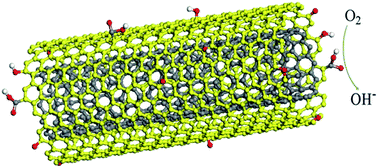
As we all know, carbon nanotubes (CNTs) have poor surface wettability because of its hydrophobic and inert surface.19 However, the formation of surface oxygen-containing functional groups could effectively improve the wettability because these groups are hydrophilic.20 Many literatures have reported ways to oxidize CNT in gas or liquid phase.21 Furthermore, oxidized CNTs have been widely used as support to anchor metal particles.22,23 More recently, mildly oxidized CNT was used as efficient electrocatalyst for oxygen evolution reaction according to Zhao's report.24 However, few literatures have reported oxidized CNT as metal-free electrocatalyst for oxygen reduction reaction.
Herein, we have successfully fabricated chemically oxidized CNT by a simple mild acid treatment approach. It is revealed that the surface oxidation of CNT is due to acid treatment which can damage covalent C–C to produce defect sites for the introduction of oxidized carbon species (–OH, –COOH, C
O, etc.).25 According to Martin Muhler's report,26 nitrogen doping could also create defects on carbon surfaces which lead to an increase in edge plane exposure and thus enhanced catalytic activity.27 After oxidization, the surface oxygen containing groups of CNT enhance the wettability in both ethanol and water. On one hand, acid treated oxidized CNT dispersed well for electrochemical measurements. On the other hand, the acid-oxidized CNT could easily contact with electrolytes which were necessary for ORR. The interaction between surface oxygen containing groups and CNT was by strong covalent including C–C, C–O and C
O. Like nitrogen doped carbon nanotubes,26,28–30 the oxygen atom of C–O and C
O may work the same as doped nitrogen atom which could induce changes in both atomic charge and spin density of adjacent carbon atoms which could properly absorb oxygen molecule during the oxygen reduction reaction.31 By acid treatment oxidation, CNTs have changed from sluggish ORR electrocatalysts to efficient electrocatalysts which also show better catalytic stability.
In this work, we prepared oxidized CNTs through the acid-treatment strategy with different acids: H2SO4 (the product was denoted as ST-CNT) and mixed acid of H2SO4 and HNO3 (the product was denoted as NST-CNT). To investigate the structural morphology of the as-obtained samples, the scanning electron microscopy (SEM) images were collected for all the samples (Fig. S1†). No significant change of the morphology and structural integrity of the CNTs was observed from SEM images after acid treated oxidation. The electronic properties of the obtained samples were investigated by Raman spectroscopy. As can be seen from the Raman spectra (Fig. 1A), at an excitation energy of 633 nm, the D band, D′ band and G band were located at about 1320 cm−1, 1600 cm−1 and 1570 cm−1. As we all know, the G band is related to C–C and C–O stretching vibrations, the D band and D′ band reflect the high density of states for zone-edge and midzone phonons indicating defects.32 The higher-order peaks appeared at about 2640 cm−1 and 2900 cm−1 could be assigned to 2D band and D + G band respectively. ID/IG is an important parameter of the defects level in the Raman spectra of carbon-based materials. It can be read from Fig. 1B that the ID/IG ratios of both ST-CNT (1.28) and NST-CNT (1.52) are bigger than that of pristine CNT (0.99) owing to defects derived from the incorporation of oxygen containing groups. Interestingly, for the acid treatment with the mixed acid, as the volume ratio of HNO3 in the acid hybrid increases, the ID/IG ratio decreases from 1.52 to 1.19 (Fig. S2B†). This phenomenon is due to that less oxygen containing groups are incorporated as the HNO3 volume ratio increases, as confirmed by the following X-ray photoelectron spectroscopy (XPS) results. Meanwhile, obvious red shifts can be observed from Fig. S2C and D† for D band, D′ band, G band and 2D band suggesting the changes in the CNTs' structural properties due to oxygen containing groups attached to oxidized CNTs walls or edges and increased oxygen content in the nanotubes framework that acts as p-type dopant.33,34 As the volume ratio of HNO3 decreases, the red shift becomes less significant due to the decrease of oxygen content.
![]() | ||
Fig. 1 Raman spectra of Pristine CNT, ST-CNT and NST-CNT (1 : 3) (A); ID/IG for Pristine CNT, ST-CNT and NST-CNT (1 : 3) (B). | ||
X-ray photoelectron spectroscopy (XPS) analysis was performed to investigate the combination and chemical state of acid treated CNTs. As shown by the XPS spectra in Fig. 2A, only C 1s peak and O 1s peak are observed for both ST-CNT and NST-CNT.35 Obviously, the oxygen containing groups attached to oxidized CNT walls or edges and the oxygen content in the CNTs' framework increased significantly especially for NST-CNT. C/O (atom) value also reflected this phenomenon that 7.78 (NST-CNT) < 32.67 (ST-CNT) < 42.29 (Pristine CNT) (Fig. 2B). As the HNO3 volume ratio increases, the C/O value increases from 7.78 (NST-CNT) to 45.47 (NT-CNT) indicating NST-CNT (1
:
3) has the highest degree of oxidization (Fig. S3†). Furthermore, to investigate the chemical bind between C and O atom after acid treatment, the high-resolution O 1s peaks were fitted into two peaks: C
O and C–O at the binding energies of around 531.5 eV and 533.8 eV, respectively (Fig. 2C). The XPS studies clearly demonstrate that carbon nanotubes treated with H2SO4 (ST-CNT) and HNO3/H2SO4 (NST-CNT) showed enhanced O 1s peaks compared with pristine CNT (Fig. 2C). These results confirm the successful incorporation of a great amount of oxygen containing groups which is consistent with the following FTIR results and oxygen content in the nanotubes' framework. It can also be found that the O 1s peak of NST-CNT is bigger than others' indicating the higher efficiency of HNO3/H2SO4 (1
:
3) in the modification of the carbon nanotube surface.
Besides XPS analyses, FTIR, an important technique to detect the functional groups on the surface of materials, was employed to study the oxygen containing groups on the surface of CNTs after acid oxidation. Fig. 2D shows that some new peaks appearing at 1600–1700 cm−1 indicating carbonyl and carboxyl groups and peaks at 3300–3500 cm−1 indicating hydroxyl and phenolic groups compared to pristine CNT. Moreover, much stronger absorption bands in NST-CNT are found around 3300–3500 and 1600–1700 cm−1 than ST-CNT indicating HNO3/H2SO4 could incorporate more oxygen containing groups. Fig. S3B† showed that NST-CNT (1
:
3) had more oxygen containing groups than NST-CNT (1
:
1), NST-CNT (3
:
1) and NT-CNT. All the FTIR results support the conclusion above.
To investigate the electrocatalytic activity towards ORR, the cyclic voltammograms (CVs) of oxygen reduction in both nitrogen and oxygen-saturated 0.1 M KOH solution with different electrodes (Pristine CNT, ST-CNT and NST-CNT (1
:
3)) are shown in Fig. 3. All the three samples present an oxygen reduction peak not present under a nitrogen saturated environment. As can be seen in Fig. 3D, both the onset potential and peak potential of ST-CNT shift more positively than those of pristine CNT indicating the incorporation of oxygen containing groups can enhance the ORR activity. Meanwhile, both the onset potential and peak potential of NST-CNT (1
:
3) shift more positively than those of ST-CNT indicating more oxygen containing groups can enhance the ORR activity significantly. On one hand, more oxygen containing groups mean more C–O and C
O which enhance the charge-transfer effect, thus properly facilitate adsorption of oxygen to adjacent carbon atoms. On the other hand, the electrolyte diffuses more quickly because the oxygen containing groups improve the wettability of the electrode.
Linear-sweep voltammetry (LSV) measurements were performed to further investigate the ORR performance of pristine CNT, ST-CNT and NST-CNT (1
:
3) on a rotating-disk electrode (RDE) in 0.1 M O2-saturated KOH solution at a scan rate of 10 mV s−1 (Fig. 4). As shown in Fig. 4D, the typical two-step pathway was observed for pristine CNT, indicating a successive two-electron reaction pathway, consistent with our previous study.36 The ORR onset potential of ST-CNT electrode shifts more positively featuring higher electrocatalytic activity in respect to the pristine CNT electrode. Moreover, compared to Pristine CNT and ST-CNT, the most positive and strongest limiting diffusion current with a relatively wide plateau are observed for NST-CNT (1
:
3) indicating probably an efficient four electron pathway. In order to confirm a more efficient electron pathway for NST-CNT (1
:
3), the transferred electron number per oxygen molecule involved in the oxygen reduction at each of the CNT electrodes was determined on the basis of the Koutechy–Levich equation (see ESI†).17 The electron transfer numbers (n) are calculated to be 2.33, 2.76 and 3.45 at −0.8 V for Pristine CNT, ST-CNT and NST-CNT (1
:
3), respectively (Fig. 4F). The electron transfer number of 3.45 for NST-CNT (1
:
3) is the direct evidence that NST-CNT (1
:
3) possesses the best catalytic activity indicating more oxygen containing groups can enhance the ORR activity significantly. The RRDE test was performed to further investigate the ORR process. The polarization curves of disk and ring electrodes at 1600 rpm by coating NST-CNT, ST-CNT and Pristine CNT onto disc electrode with a scan rate of 10 mV s−1 are displayed in Fig. S5A (see ESI†). As can be seen in Fig. S5B,† the calculated electron transfer number of NST-CNT is bigger than that of ST-CNT which is bigger than pristine CNT, over the potential region of −1.2 to 0.4 V (vs. SCE). Obviously, the calculated hydrogen peroxide percentage of NST-CNT is much lower than that of pristine CNT indicating a more efficient four electron pathway during the ORR process.28,37
To investigate the catalytic stability for NST-CNT and commercial Pt/C, the accelerated CV scanning was performed for comparison (Fig. 5). The accelerated CV scanning was performed for 2000 cycles at a scan rate of 100 mV s−1 within the potential window of −0.5 V to 0 V. Fig. 5A and B show the LSV curves of NST-CNT and Pt/C before and after the accelerated CV scanning of 2000 cycles, respectively. Obviously, the onset potential of ORR for commercial Pt/C shifts more negatively, while the onset potential of ORR for NST-CNT (1
:
3) only has a very slightly negative shift. These results clearly confirm that the electrochemical activity of NST-CNT is much more stable than that of the commercial Pt/C.
In summary, surface oxidized carbon nanotubes can be used as efficient electrocatalysts for oxygen reduction reaction in fuel cells. The oxygen containing functional groups such as C–O and C
O attached to the surface of carbon nanotubes play a key role in the enhancement of ORR activity. (1) Like nitrogen doping, the introduction of oxygen containing groups could create more defect sites; (2) these functional groups could improve the wettability which benefits electrolyte diffusion; (3) C–O and C
O change the charge distribution of adjacent carbon atoms and properly facilitate the oxygen adsorption.
Footnotes |
| † Electronic supplementary information (ESI) available. See DOI: 10.1039/c5ra05172j |
| ‡ These authors contributed equally to this work. |
| This journal is © The Royal Society of Chemistry 2015 |