
Darshna Sharmaa,
Anuradha Moirangthemb,
Rajender Kumara,
S. K. Ashok Kumarc,
Anil Kuward,
John F. Callane,
Anupam Basu*b and
Suban K. Sahoo*af
aDepartment of Applied Chemistry, S.V. National Institute of Technology (SVNIT), Surat, Gujarat, India. E-mail: suban_sahoo@rediffmail.com; Tel: +91-261-2201855
bMolecular Biology and Human Genetics Laboratory, Department of Zoology, The University of Burdwan, Burdwan, WB, India. E-mail: abasu@zoo.buruniv.ac.in
cSchool of Advanced Sciences, VIT University, Vellore, TN, India
dSchool of Chemical Sciences, North Maharashtra University, Jalgaon, Maharashtra, India
eSchool of Pharmacy and Pharmaceutical Sciences, The University of Ulster, Northern Ireland BT52 1SA, UK
fDepartment of Applied Chemistry, Kyungpook National University, Daegu, 701-702, S. Korea
First published on 3rd June 2015
A new anion selective chemosensor L was derived through a direct condensation reaction between pyridoxal and thiosemicarbazide. Sensor L showed selective recognition and sensing ability towards F− and AcO− anions through a naked-eye detectable color change from colorless to light yellow, appearance of a new charge transfer absorption band at 404 nm and significant “turn-on” fluorescence at 506 nm. The detection limit of L as a fluorescent ‘turn-on’ sensor for the analysis of F− and AcO− was estimated to be 0.10 μM. The anion sensing mechanisms of L was supported by 1H NMR and DFT results. Finally, the cytotoxicity effect of L and its ability to image intracellular F− ions in the living HeLa cells was investigated.
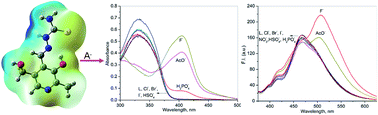
In this communication, we have developed a new Schiff base chemosensor (Z)-2-((3-hydroxy-5-(hydroxymethyl)-2-methylpyridin-4yl)methylene)hydrazinecarbothioamide (L) that comprises thiosemicarbazide as anion binding site coupled with a pyridoxal group acting as chromogenic/fluorescence unit for the selective sensing of bioactive anions (Scheme 1). The anion recognition ability of L towards F−, Cl−, Br−, I−, HSO4−, H2PO4− and AcO− was investigated by both spectroscopic (absorbance, fluorescence and 1H NMR) and density functional theory (DFT) methods. Finally, the sensor L was applied for the sensing of intracellular F− in live HeLa cells.
A stock solution of the receptor L (1.0 × 10⁻⁴ M) and anions (1.0 × 10⁻³ M) were prepared in DMSO and H2O. These solutions were used for different spectroscopic studies after appropriate dilution. For spectroscopic titrations, required amount of the receptor L (2 mL, CL = 5.0 × 10⁻⁵ M) was taken directly into cuvette and spectra were recorded after successive addition of anion by using micropipette. The 1H NMR titration study was performed in DMSO-d6 by adding different equivalents of TBAF into the solution receptor L (4 mM).
N), 8.28 and 8.05 (2H, s, –NH2), 7.92 (1H, s, Py–H), 5.20 (1H, s, Py–CH2–OH), 4.51 (2H, s, Py–CH2–OH), 2.34 (3H, Py–CH3).
![]() | ||
| Fig. 1 UV-Vis absorption spectral changes of L (1.0 × 10⁻⁵ M) upon addition of ten equivalents of different anions in DMSO. Inset shows the color change of vials. | ||
Given the selectivity of L for F− and AcO−, the range over which it could detect these anions was then determined by performing the absorption titrations upon successive incremental addition of F− and AcO−. As shown in Fig. 2 and S1,† similar spectral changes of L was observed upon addition of both the anions indicating the similar recognition modes. Upon incremental addition of F−/AcO− anions, the intensity of receptor band at 332 nm was decreased and concomitantly the charge transfer band at 405 nm was appeared with the formation of an isosbectic point at 369 nm. The isosbestic point indicates the equilibrium point between the receptor L and the new species (L·F−/AcO−) formed due to host–guest interaction with anions. The spectroscopic titrations data were examined by applying the Benesi–Hildebrand (B–H) equation to determine the binding constants (K) of the receptor–anion complexes.13 From the B–H plots (inset Fig. 2 and S2†), the binding constant of L for F− (2.27 × 10⁴ M−1) was found to be similar to that of the AcO− (1.20 × 10⁴ M−1). Also, the B–H plots along with the Job's plot (Fig. S3†) clearly delineated the formation of 1
:
1 host–guest complex between receptor L and F−/AcO−.
![]() | ||
| Fig. 2 Changes in the absorbance spectrum of L (5.0 × 10⁻⁵ M) upon addition of incremental amounts of TBAF (0 μL to 210 μL, 1.0 × 10⁻⁴ M) in DMSO. Inset showing the B–H plot. | ||
The host–guest interaction between L and anions was further established by 1H NMR titration of L in the absence and presence of different equivalents TBAF in DMSO-d6 (Fig. 3). The receptor peaks due to pyridoxal–OH (Py–OH) at 9.57 ppm and –NH– at 11.55 ppm were respectively disappeared and shifted downfield upon addition of 1 equivalent of TBAF with the appearance of a new peak at 14.44 ppm, which supported the deprotonation of L and formation of bifluoride (HFH−). The interaction of amine–NH2 with F− was also evidenced from the shifting of peaks from 8.28 and 8.05 ppm to 6.11 m and 8.61 ppm, respectively. Apparent structural changes in L upon interaction with F− can also be deduced from the shifting of the peaks due to imine–H, Py–H, Alc–OH and –CH2– protons. In addition, due to the presence of multiple polar–NH/OH groups, the hydrogen bonded host–guest interaction between L and F− appeared to be continued even after the deprotonation of the Py–OH and –NH– protons. To confirm the partial deprotonation of L, the absorption spectrum of L was recorded by adding ten equivalents of TBAOH in DMSO (Fig. S4†). Under similar condition, addition of TBAOH also generated an absorption band at 405 nm but the intensity was comparably lowered as observed with the fluoride anions. The above results clearly demonstrated that the sensing anions are functioning here as a base, giving rise to the partial deprotonation of the most acidic protons of L.
![]() | ||
| Fig. 3 1H NMR spectra of L in absence (a) and presence of one (b) and three (c) equivalents of TBAF in DMSO-d6. | ||
The structural optimization of L and its deprotonated form were performed at B3LYP/6-31G(d,p) level by using the computational code Gaussian 09W14 to complement the experimental evidences. Receptor L preferred an enolimine form with a strong intramolecular hydrogen bond of length 1.790 Å between the imine–N and Py–OH. The calculated Mulliken's atomic charges inferred that the protons of groups –NH2, –NH–, Py–OH and alc–OH possessed the most positive charges of 0.264, 0.259, 0.378 and 0.311, respectively. Also, the analysis of molecular electrostatic potential (MEP) map of L (Fig. 4a) indicates that the most positive region shown in blue color are located on the polar–OH/–NH groups, which can interact with the anions as verified by 1H NMR titrations. Furthermore, the changes in the electronic properties of L and its deprotonated form were compared. Upon deprotonation of the Py–OH group of L, the band gaps (ΔE = ELUMO − EHOMO) between the HOMO and LUMO of L was lowered from 0.146 eV to 0.118 eV. Also, the TDDFT results inferred that the receptor L gave maximum absorbance at 348 nm whereas the mono-deprotonated form of L had a maximum absorbance at 429 nm. The red-shifted absorbance of L upon deprotonation was analyzed from their HOMO and LUMO diagrams, which indicate the possible internal charge transfer process occurred due to the deprotonation of Py–OH group (Fig. 4b and c).
![]() | ||
| Fig. 4 DFT computed structure of the receptor L showing the (a) MEP and the frontier molecular orbitals (HOMO and LUMO) diagrams of (b) L and (c) its deprotonated form L1−. | ||
The anion sensing ability of the receptor L (1.0 × 10⁻⁵ M, DMSO) was also examined by fluorescence spectroscopy (Fig. 5). The free receptor L showed an emission band at 465 nm (λexc = 335 nm). The fluorescence of L was selectively and distinguishably enhanced at 506 nm in the presence of F− and AcO−. The fluorescence enhancement occurred due to the inhibition of the excited state intramolecular proton transfer (ESIPT) process due to the deprotonation of the py–OH group upon interaction with the most basic anions F−/AcO−. No noticeable changes in the fluorescence of L were observed with other examined anions such as Cl−, Br−, I−, HSO4− and H2PO4−. The competitive experiments of L were conducted in the presence of 1 equiv. of F−/AcO− mixed with 2 equiv. of other interfering anions. It was observed that the fluorescence profile of L was unaffected by other anions except F− and AcO− (Fig. S5 and S6†). These results indicate that the receptor L has a good selectivity and specificity towards F− and AcO−.
![]() | ||
| Fig. 5 Changes in the emission spectrum of L (1.0 × 10⁻⁵ M) on addition of equivalent amount of different anions in DMSO. Inset showing the color change under UV light, 365 nm. | ||
The limit of detection (LOD) was determined through fluorescence titrations of L with incremental addition of F− (Fig. 6) and AcO− (Fig. S7†) in DMSO. Upon progressive addition of F− (0–9 equivalents), the fluorescence emission intensity at 506 nm was gradually enhanced. From fluorescence titration data (Fig. 6 inset and Fig. S8†), the detection limit (3σ/S) of the receptor L as a fluorescent ‘turn-on’ sensor for the analysis of F− and AcO− was estimated to be 0.10 μM. The obtained detection limit was far better than the permissible limit of F− in drinking water according world health organization (WHO).15
The detection of inorganic anions by L in aqueous medium was also investigated, as most practical applications would require this probe to operate in this medium. For this experiment, the receptor L was again dissolved in DMSO but the anions were added from their pure aqueous solution. This involved addition of 100 μL of different anions (1.0 × 10⁻⁴ M) into the receptor L (2 mL, 1.0 × 10⁻⁵ M) solution which resulted in a naked-eye detectable color change under normal day light and UV irradiation (Fig. 7). The fluorescent ‘turn-on’ anions (F− and AcO−) of L in aqueous medium encouraged us to study the imaging ability of intracellular fluoride in live cells. In vitro cellular imaging experiments were performed using the cervical HeLa cancer cell line to examine the ability of L to detect intracellular F− ions (Fig. 8). Cells were first treated with the required concentration of F− ions (8.73 mM and 17.46 mM) in PBS, cells washed with PBS and then treated with L (0.44 mM). Cells were again washed and then imaged using a fluorescence microscope. Control cells treated with L only or F− ions only were used as comparison. The resulting images, shown in Fig. 8 reveal that cells treated with F− ions or L alone showed only background fluorescence while cells treated with both L and fluoride ions clearly showed cellular fluorescence, with the intensity greater for those treated with the higher concentration of F− ions. These results suggest that L showed potential to detect intracellular F− ions, however, the cellular fluorescence in imaging application of L in the presence of F− is influenced due to the competing nature of water.
![]() | ||
| Fig. 7 UV-Vis absorption spectral changes of L (1.0 × 10⁻⁵ M) upon addition of anions. Inset shows the colour change upon addition of equivalent amount of different anions and under UV lamp. | ||
From the MTT assay, it was revealed that the viability of the cells were unaffected by either L or L in the presence of F− ions. Even when viability was tested using twice the concentration of F− than that used in the imaging experiments only a minor reduction in viability was observed. Therefore, L demonstrates excellent biocompatibility in living cells and could potentially find use as an intracellular probe for F− ions (Fig. 9).
Footnote |
| † Electronic supplementary information (ESI) available. See DOI: 10.1039/c5ra05059f |
| This journal is © The Royal Society of Chemistry 2015 |