DOI:
10.1039/C5RA05014F
(Paper)
RSC Adv., 2015,
5, 45662-45667
Atmospheric-pressure-plasma-jet processed nanoporous TiO2 photoanodes and Pt counter-electrodes for dye-sensitized solar cells
Received
21st March 2015
, Accepted 15th May 2015
First published on 15th May 2015
Abstract
We demonstrate the rapid fabrication of dye-sensitized solar cells (DSSCs) with both TiO2 photoanodes and Pt counter-electrodes processed using atmospheric pressure plasma jets (APPJs). The rapid conversion of PtCl62− to Pt for the counter-electrode of DSSCs is achieved using a 1 min 360 °C air-quenched N2 APPJ. The APPJ-processed Pt counter-electrode is then used together with an APPJ-calcined nanoporous TiO2 photoanode to make DSSCs that exhibit comparable efficiencies to those of cells fabricated using conventional furnace-calcination processes. APPJs can reduce the calcination durations from 30 min to 4 min for the nanoporous TiO2 photoanode and from 15 min to 1 min for the Pt counter electrode. The ultra-short processes of DSSCs are benefited from the synergistic effects of the energetic nitrogen molecules and the heat of APPJs.
Introduction
Dye-sensitized solar cell (DSSCs) technology has attracted much research attention since O'Regan and Grätzel greatly improved the cell efficiency to 7.1% in 1991.1,2 The cell efficiency was then improved to 11% in 2005,3 11.5% in 2009,4 and 13.1% in 2011.5 A typical DSSC consists of a dye-anchored nanoporous photoanode, a catalyst-coated counter electrode, and an electrolyte;6–11 furnace-calcination is required for the preparations of TiO2 photoanodes and Pt counter-electrodes. For the fabrication of nanoporous TiO2 photoanodes, a furnace-calcination at 450–510 °C for 15–30 min excluding the heating and cooling times is required.12–14 Afterwards, TiCl4 immersion is performed and another furnace calcination is necessary.15,16 As for the typical non-vacuum fabrication process of a Pt catalyst-coated counter-electrode, a chloroplatinic acid (H2PtCl6) solution is first coated on the transparent conducting oxide glass substrate, followed by a furnace-calcination for 15–60 min to decompose PtCl62− to Pt.17,18 The thermal processing steps for fabricating a DSSC take place in a timescale ranging from several tens of minutes to hours with large thermal budgets. To reduce the cost and energy payback time for DSSCs, several alternative methods have been developed to replace the conventional thermal processes of TiO2 photoanodes and/or Pt counter-electrodes, including microwave radiation,19 UV treatment,20 near-infrared (NIR) heating,21 dielectric barrier discharge treatment22–24 and atmospheric pressure plasma jet (APPJ) technologies.25–27
Atmospheric pressure plasmas (APPs) have been applied extensively for the fabrication of energy harvesting and energy storage devices. One minute APPJ treatment on graphite felt electrodes improved the energy efficiency of all-vanadium redox flow battery significantly.28 APPJs were successfully used to directly synthesize Li4Ti5O12 (LTO) anodes of lithium ion batteries from precursor solutions.29 Another study uses post APPJ treatments on LTO anodes to improve the performance of lithium ion batteries.30 Cyclonic APPs have been applied to improve hydrophilicity and to implant functional groups of the microporous polymer separator of a lithium-ion battery.31 Downstream H2 APPs have been applied to reduce the surface layer of CuO to corresponding metals for increasing the rate performance of the battery.32 In regard to the applications of APPs to solar cells, APPJ-deposited organosilicon seeding layer can enhance the texturing of follow-up sputtered Ga-doped ZnO.33–36 A designated process together with APP treatment was used for the reduction of Pt counter electrodes of flexible dye-sensitized solar cells.24 APP post-treatments on TiO2 photoanodes demonstrate improved performance of DSSCs.37–40 DSSCs with TiO2 prepared by APPJs with substrates heated by external heaters have been successfully implemented.41,42 A 30 min rf-APP has been used for the preparation of TiO2 photoanodes of on-plastic DSSCs; strong oxidation effect of APP was found to efficiently eliminate the organic binders in the screen-printed TiO2 pastes.23 Our previous works have demonstrated an ultrafast (30 s to 2 min) APPJ sintering process on nanoporous TiO2 photoanodes of DSSCs; these DSSCs showed efficiency comparable to those fabricated by conventional furnace calcination process (510 °C × 15 min).25–27,43 11 s APPJ sintered reduced graphene oxides (rGOs) have been successfully used as the catalysts for the counter-electrodes of DSSCs.44
In this paper, we demonstrate a DSSC with both TiO2 photoanode and Pt counter electrode rapidly processed by APPJs for the first time. In addition to the rapid sintering of TiO2 developed previously,25–27,43 APPJ is further used to convert spin-coated chloroplatinic acid hydrate (H2PtCl6) precursor thin films into Pt. In comparison to the typical 15–60 min conversion process of PtCl62− to Pt, APPJ was successfully used to decompose PtCl62− into Pt in 1 min with a substrate temperature of 360 °C. The total thermal calcination time for photoanodes and counter-electrodes of DSSCs is thus reduced from 45 to 5 min. APPJ calcination techniques for TiO2 photoanodes and Pt counter-electrodes could be beneficial for a roll-to-roll fabrication process, in which the substrate feeding speed can be greatly improved owing to the ultrafast APPJ processes.
Experimental details
DSSC fabrication process
The conventional fabrication process of DSSCs is described as follows. A 0.075 M titanium isopropoxide solution (Acros Organics) was first spin-coated on a fluorine-doped tin oxide coated glass (FTO, TEC7, thickness: 2.2 mm, transmittance: >80%, sheet resistance: 8 Ω sq−1, Pilkington), and baked in air at 200 °C for 10 min. A compact TiO2 film was then formed. Next, the commercial TiO2 pastes (E-solar P300, Everlight Chemical Industrial Co.) was screen-printed on the FTO glass (with an area of 0.22 cm2) three times until the thickness of the nanoporous TiO2 layer reached ∼10 μm. After each screen-printing step, TiO2 was heated at 100 °C for 10 min to partially dry the film. The TiO2 pastes were calcined at 510 °C for 15 min using a tube-furnace, followed by immersion in a 0.05 M TiCl4 solution (Showa Chemical Co.) at 70 °C for 30 min. After rinsing with ethanol, the photoanodes were calcined at 510 °C for 15 min using a tube-furnace. Then the sintered TiO2 nanoporous films were immersed in a mixed solution of acetonitrile (99.9%, J. T. Baker) and tertiary butyl alcohol (99.9%, J. T. Baker) containing 3 × 10⁻⁴ M of N719 dye (Solaronix) for 24 h. The dye-adsorbed films were then rinsed with ethanol and dried in air. Chloroplatinic acid hydrate (99.95%, H2PtCl6, Uniregion Bio-tech) solution was spin-coated onto the FTO glass as a counter-electrode with an area of 0.8 × 0.8 cm2. The films were heated by furnace in air at 400 °C for 15 min. Finally, a commercial liquid electrolyte (E-Solar EL 100, Everlight Chemical Industrial Co.) consisting of I2, LiI, guanidinium thiocyanate (GuNCS) and acetonitrile was then injected into the assembled cells to complete the DSSC. The cell fabricated by this procedure is the reference sample.
APPJs were used to replace the furnace calcination processes for TiO2 photoanodes and/or Pt counter electrodes. The APPJ system is described in detail in literature;25,45,46 the schematic APPJ apparatus is shown in Fig. 1. A quartz tube with/without side hole is installed at the downstream of the APPJ to confine the convective flow and to control the quenching air from the ambient. In the first part of the experiment, the standard 15 min, 510 °C furnace-calcination process was used to fabricate TiO2 photoanodes. However, N2 APPJs were used to calcine the spin-coated H2PtCl6 solution at 360 °C for 20 s, 40 s, 1 min, and 2 min; a reference counterpart Pt counter-electrode was made using a 15 min, 400 °C tube-furnace calcination. The APPJ system was operated with a voltage of 275 V, an on/off duty cycle of 7/33 μs, and N2 carrier flow rate of 30 slm. A 2 cm-long quartz tube with a hole on the side (to introduce environmental air to quench the plasma jet) was used to lower the plasma gas temperature to 360 °C by air-quenching.
 |
| | Fig. 1 Schematic of APPJ setup. | |
In the second part of the experiment, TiO2 photoanodes and Pt counter-electrodes were calcined using either a furnace or APPJs. The APPJ system was operated with a voltage of 275 V; an on/off duty cycle of 7/33 μs; N2 carrier flow rates of 31 and 30 slm for TiO2 and Pt conversion processes, respectively. For the TiO2 calcination process, a 2.7 cm-long quartz tube (without a hole on the side) was used to isolate the plasma jet from the environment; each APPJ treatment time is 2 min. The plasma gas temperature is around 500 °C. For Pt counter-electrode calcination, a 2 cm-long quartz tube with hole on the side (to introduce environmental air to quench the plasma jet) was used to lower the plasma gas temperature to 360 °C; each APPJ treatment time was 1 min. The tube-furnace calcination conditions were the same as described previously. Four different combinations of experimental conditions are listed in Table 1. When APPJs were used for the calcination processes, the processing durations were reduced from 30 min (15 min for TiO2 sintering; 15 min for thermal treatment after TiCl4 processes) to 4 min (2 min for TiO2 sintering; 2 min for APPJ treatment after TiCl4 processes) for TiO2 photoanodes and from 15 min to 1 min for Pt counter-electrodes.
Table 1 Four samples for comparing the fabrication process differences between furnace-calcination and APPJ
| |
Sample 1 |
Sample 2 |
Sample 3 |
Sample 4 |
| TiO2 photoanode |
Furnace 510 °C 30 min |
Furnace 510 °C 30 min |
APPJ 500 °C 4 min |
APPJ 500 °C 4 min |
| Pt counter-electrode |
Furnace 400 °C 15 min |
APPJ 360 °C 1 min |
Furnace 400 °C 15 min |
APPJ 360 °C 1 min |
DSSC and material characterizations
The DSSCs were illuminated from the TiO2 photoanode side using a solar simulator (WACOM, WXS-155S-L2) with an AM1.5 filter, and the I–V characteristics were evaluated using an electrometer (Keithley 2400). The scanning rate is estimated to be ∼1/12 V s−1. During the measurement of the cell efficiency, the incident light was confined within a small area (0.16 cm2) by a stainless steel mask. A symmetrical dummy cell assembled by two identical counter-electrodes and filled with the electrolyte was used for an electrochemical impedance spectroscopy (EIS) experiment. EIS analysis was carried out using an electrochemical workstation (Zahner Zennium). The spectra were obtained by applying sinusoidal perturbations of ±10 mV with a frequency range of 0.1–106 Hz at bias voltage of −0.75 V. The EIS spectra were fitted by Z-view software to extract the series resistance and charge transfer resistance.
Results and discussion
First part of experiment: Pt counter-electrode calcined by APPJ
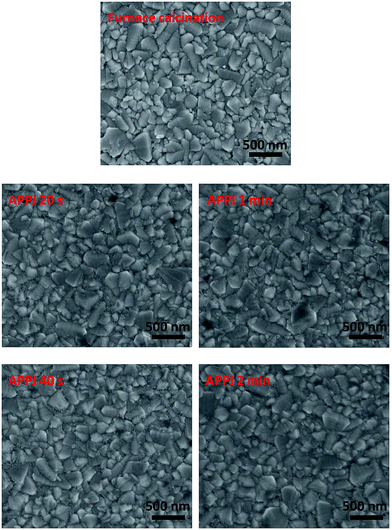
Fig. 2 shows SEM images of spin-coated Pt counter electrodes fabricated using furnace and APPJ calcinations. Although the durations of APPJ calcinations are generally much shorter than those of furnace calcination, no significance difference in surface morphology is noted. The heating processes, whether by a furnace or APPJs, induce the conversion route from PtCl62− to Pt, resulting in Pt clusters.
 |
| | Fig. 2 SEM images of furnace-calcined and APPJ converted Pt counter electrodes. | |
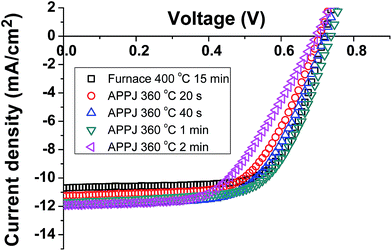
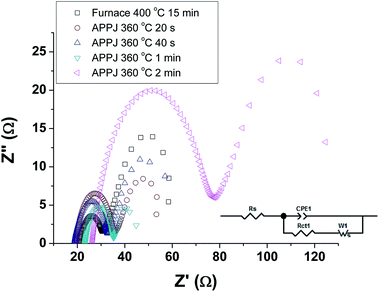
Fig. 3 shows the I–V characteristic curves of DSSCs under the illumination of a solar simulator, and the cell parameters extracted from Fig. 3 are tabulated in Table 2. These DSSCs have TiO2 photoanodes calcined using furnace and Pt counter electrodes calcined using furnace or APPJs for various durations. DSSCs with APPJ-calcined Pt counter electrodes show efficiencies comparable to that of furnace-calcined one. The cell efficiency increases and then decreases with the APPJ calcination duration. Except for the apparently degraded fill factor (FF) of the DSSC with 2 min APPJ-calcined Pt counter-electrode, all cells have comparable open circuit voltage (Voc), short circuit current density (Jsc), and FF. The best efficiency is achieved for the DSSC with a counter-electrode calcined by APPJ for 1 min. The electro-catalytic properties of Pt counter-electrodes are evaluated by EIS measurements. The Nyquist plots are shown in Fig. 4, and the equivalent model circuit is shown in the INSET. The EIS spectra were obtained using a dummy cell assembled by two identical Pt counter-electrodes with an electrolyte in between. The high-frequency intercept on the real axis represents Rs, the serial resistance that is influenced by both the sheet resistances of TCO and Pt, as well as the contact resistance between TCO and Pt. The first semicircle at the higher-frequency region corresponds to the charge transfer resistance (Rct1) and constant phase element at the interface between the counter electrode and the electrolyte, whereas that at the lower-frequency region corresponds to the Warburg diffusion impedance of the triiodide/iodide redox couple in the electrolyte. The fitting values of the EIS measurements are listed in Table 3. As shown in Table 3, the film calcined by a conventional furnace shows the lowest charge resistance. The counter-electrode calcined by APPJ for 1 min has Rct1 comparable to that of the furnace-calcined one. The Pt counter-electrode calcined by APPJ for 2 min also reveals an extremely high resistances, well correlated to the significant decreases in the FF and cell efficiency.
 |
| | Fig. 3 Typical I–V characteristics of DSSCs with furnace- and APPJ-calcined counter-electrodes. | |
Table 2 DSSC parameters extracted from Fig. 3
| |
Voc (V) |
Jsc (mA cm−2) |
FF (%) |
η (%) |
| Furnace calcination |
0.72 |
10.71 |
68.86 |
5.31 |
| APPJ 20 s |
0.71 |
11.26 |
62.17 |
4.97 |
| APPJ 40 s |
0.72 |
11.94 |
62.23 |
5.35 |
| APPJ 1 min |
0.74 |
11.69 |
64.62 |
5.59 |
| APPJ 2 min |
0.70 |
11.93 |
54.72 |
4.57 |
 |
| | Fig. 4 Nyquist plots of dummy cell with identical Pt counter-electrodes under the illumination of the solar simulator. INSET: model circuit for EIS. | |
Table 3 Series resistance Rs and impedance Rct1 extracted from Fig. 4
| |
Rs (Ω) |
Rct1 (Ω) |
| Furnace calcination |
20.9 |
9.4 |
| APPJ 20 s |
19.6 |
15.5 |
| APPJ 40 s |
19.0 |
13.4 |
| APPJ 1 min |
23.4 |
11.3 |
| APPJ 2 min |
26.7 |
48.3 |
Second part of experiment: DSSCs fabricated by ultra-short electrode calcinations using APPJs
To demonstrate that APPJ can be used to rapidly fabricate DSSCs, DSSCs with both TiO2 photoanodes and Pt counter-electrodes calcined by APPJs are investigated. Four different sample fabrication conditions are listed in Table 1. The photovoltaic performance of DSSCs is shown in Fig. 5 with extracted parameters summarized in Table 4. For all of these samples, the values of cell efficiencies are similar. The results strongly suggest that a rapid APPJ process, either for TiO2 photoanode or Pt counter-electrode, can be used to replace conventional furnace calcination. When APPJs are used to replace the conventional furnace calcination processes, the processing durations are reduced from 30 to 4 min for TiO2 photoanodes and from 15 min to 1 min for Pt counter-electrodes. The rapid removal of organic solvent in screen-printed TiO2 pastes and fast conversion of PtCl62− to Pt are achieved by the synergistic effect of the reactive plasma species and the heat generated by APPJs.25,26,46–49 N2 plasmas are known for their high reactivity because of the existing excited nitrogen molecules. The transitions of excited nitrogen molecules, N2 1st positive B3Πg → A3Σu+ and 2nd positive C3Πu→B3Πg, release over 6 eV of energy, as observed by optical emission spectroscopy.46,48 These highly energetic N2 molecules in APPJs can provide additional energy to assist the fast removal of organic solvent in TiO2 pastes in photoanodes and rapid conversion of PtCl62− to Pt in counter-electrodes. Furthermore, with the introduction of oxygen from the ambient air, the oxidizing capability of the APPJ can be significantly improved to facilitate the rapid reaction with the organic compounds.23,26,44,47 It has been shown that the addition of oxygen in atmospheric plasmas can accelerate the cleaning process of organics on ITO glass substrate,47 facilitate the oxidizing rate the organic compounds in the TiO2 pastes,23,26 and improve the oxidization speed of metal-like films.50,51
 |
| | Fig. 5 Typical I–V characteristics of DSSCs with photoanodes and counter-electrodes calcined by furnace and APPJs. | |
Table 4 DSSC parameters extracted from Fig. 5
| |
Voc (V) |
Jsc (mA cm−2) |
FF (%) |
η (%) |
| Sample 1 |
0.72 |
10.71 |
68.86 |
5.31 |
| Sample 2 |
0.74 |
11.69 |
64.62 |
5.59 |
| Sample 3 |
0.72 |
11.14 |
68.20 |
5.47 |
| Sample 4 |
0.71 |
11.35 |
64.90 |
5.23 |
Conclusion
We successfully demonstrated a rapid conversion process (1 min) of PtCl62− to Pt for the counter-electrode of DSSCs using a 360 °C air-quenched N2 APPJ. The efficiency of the DSSC with furnace-calcined TiO2 photoanodes and APPJ-calcined Pt counter-electrodes first increased and then decreased as the APPJ processing time increased. 1 min APPJ processing on Pt counter-electrode offered the best cell efficiency. This APPJ-calcined Pt counter-electrode was then used together with APPJ-calcined TiO2 photoanode for a DSSC. The calcination durations were reduced from 30 to 4 min for the TiO2 photoanode and from 15 min to 1 min for the Pt counter-electrode, thus enabling the rapid fabrication of DSSCs. DSSCs fabricated by APPJs reveal comparable efficiencies to those fabricated by conventional furnace calcinations. The ultrafast APPJ calcination processes for TiO2 photoanodes and Pt counter-electrodes can potentially be applied to roll-to-roll fabrication for a faster substrate feeding speed. The prolonged heating zone can therefore be eliminated.
Acknowledgements
Chia-Yun Chou, Haoming Chang, and Hsiao-Wei Liu contributed equally to this work. This research was funded by the Center for Emerging Material and Advanced Devices, National Taiwan University. The authors also gratefully acknowledge funding support from the Ministry of Science and Technology of Taiwan under grant nos. MOST 102-2221-E-002-060, MOST 103-2221-E-002-057, MOST 101-2628-E-002-020-MY3, and MOST 102-3113-P-002-027.
Notes and references
- B. O'regan and M. Grfitzeli, Nature, 1991, 353, 24 CrossRef PubMed.
- M. Grätzel, Prog. Photovoltaics, 2006, 14, 429–442 Search PubMed.
- M. Gratzel, Chem. Lett., 2005, 34, 8–13 CrossRef.
- C. Y. Chen, M. K. Wang, J. Y. Li, N. Pootrakulchote, L. Alibabaei, C. H. Ngoc-le, J. D. Decoppet, J. H. Tsai, C. Gratzel, C. G. Wu, S. M. Zakeeruddin and M. Gratzel, ACS Nano, 2009, 3, 3103–3109 CrossRef CAS PubMed.
- A. Yella, H. W. Lee, H. N. Tsao, C. Y. Yi, A. K. Chandiran, M. K. Nazeeruddin, E. W. G. Diau, C. Y. Yeh, S. M. Zakeeruddin and M. Gratzel, Science, 2011, 334, 629–634 CrossRef CAS PubMed.
- A. I. Maldonado-Valdivia, E. G. Galindo, M. J. Ariza and M. J. García-Salinas, Sol. Energy, 2013, 91, 263–272 CrossRef CAS PubMed.
- Y. H. Rhee, D. J. Ahn, M. J. Ko, H. Y. Jin, J. H. Jin and N. K. Min, Electrochim. Acta, 2014, 146, 68–72 CrossRef CAS PubMed.
- Y. L. Liu, Y. Q. Cheng, K. Q. Chen, G. J. Yang, Z. Y. Peng, Q. L. Bao, R. B. Wang and W. Chen, Electrochim. Acta, 2014, 146, 838–844 CrossRef CAS PubMed.
- X. Chen, J. W. Guo, Y. Hou, Y. H. Li, S. Yang, L. R. Zheng, B. Zhang, X. H. Yang and H. G. Yang, RSC Adv., 2015, 5, 8307–8310 RSC.
- Y. K. Zhang, Z. Sun, H. Wang, Y. D. Wang, M. Liang and S. Xue, RSC Adv., 2015, 5, 10430–10439 RSC.
- E. B. Bi, Y. J. Su, H. Chen, X. D. Yang, M. S. Yin, F. Ye, Z. L. Li and L. Y. Han, RSC Adv., 2015, 5, 9075–9078 RSC.
- L.-Y. Lin, C.-P. Lee, R. Vittal and K.-C. Ho, J. Power Sources, 2010, 195, 4344–4349 CrossRef CAS PubMed.
- D.-W. Liu, I. Cheng, J. Z. Chen, H.-W. Chen, K.-C. Ho and C.-C. Chiang, Opt. Express, 2012, 20, A168–A176 CrossRef CAS PubMed.
- X. Y. Wang, J. J. Tian, C. B. Fei, L. L. Lv, Y. J. Wang and G. Z. Cao, RSC Adv., 2015, 5, 8622–8629 RSC.
- J.-H. Park, J.-Y. Kim, J.-H. Kim, C.-J. Choi, H. Kim, Y.-E. Sung and K.-S. Ahn, J. Power Sources, 2011, 196, 8904–8908 CrossRef CAS PubMed.
- P. M. Sommeling, B. C. O'Regan, R. R. Haswell, H. J. P. Smit, N. J. Bakker, J. J. T. Smits, J. M. Kroon and J. A. M. van Roosmalen, J. Phys. Chem. B, 2006, 110, 19191–19197 CrossRef CAS PubMed.
- S. Ito, P. Chen, P. Comte, M. K. Nazeeruddin, P. Liska, P. Pechy and M. Grätzel, Prog. Photovoltaics, 2007, 15, 603–612 CAS.
- Q. Hu, C. Wu, L. Cao, B. Chi, J. Pu and L. Jian, J. Power Sources, 2013, 226, 8–15 CrossRef CAS PubMed.
- S. Uchida, M. Tomiha, N. Masaki, A. Miyazawa and H. Takizawa, Sol. Energy Mater. Sol. Cells, 2004, 81, 135–139 CrossRef CAS PubMed.
- L. N. Lewis, J. L. Spivack, S. Gasaway, E. D. Williams, J. Y. Gui, V. Manivannan and O. P. Siclovan, Sol. Energy Mater. Sol. Cells, 2006, 90, 1041–1051 CrossRef CAS PubMed.
- C. Charbonneau, K. Hooper, M. Carnie, J. Searle, B. Philip, D. Wragg, T. Watson and D. Worsley, Prog. Photovoltaics, 2013, 22, 1267–1272 Search PubMed.
- S. Zen, Y. Teramoto, R. Ono and T. Oda, Jpn. J. Appl. Phys., 2012, 51, 6201 CrossRef.
- H. Jung, J. Park, E. S. Yoo, G. S. Han, H. S. Jung, M. J. Ko, S. Park and W. Choe, Nanoscale, 2013, 5, 7825–7830 RSC.
- V. D. Dao, C. Q. Tran, S. H. Ko and H. S. Choi, J. Mater. Chem. A, 2013, 1, 4436–4443 CAS.
- H. Chang, Y. J. Yang, H. C. Li, C. C. Hsu, I. C. Cheng and J. Z. Chen, J. Power Sources, 2013, 234, 16–22 CrossRef CAS PubMed.
- H. Chang, C. M. Hsu, P. K. Kao, Y. J. Yang, C. C. Hsu, I. C. Cheng and J. Z. Chen, J. Power Sources, 2014, 251, 215–221 CrossRef CAS PubMed.
- H. Chang, Y. J. Yang, C. M. Hsu, C. C. Hsu, I. C. Cheng and J. Z. Chen, ECS J. Solid State Sci. Technol., 2014, 3, Q177–Q181 CrossRef CAS PubMed.
- J. Z. Chen, W. Y. Liao, W. Y. Hsieh, C. C. Hsu and Y. S. Chen, J. Power Sources, 2015, 274, 894–898 CrossRef CAS PubMed.
- S. M. Chang, E. F. Rodriguez Tolava, Y. J. Yang, H. C. Li, R. C. Lee, N. L. Wu and C. C. Hsu, J. Am. Ceram. Soc., 2014, 97, 708–712 CrossRef CAS PubMed.
- C. K. Lan, S. I. Chuang, Q. Bao, Y. T. Liao and J. G. Duh, J. Power Sources, 2015, 275, 660–667 CrossRef CAS PubMed.
- C. Huang, C. C. Lin, C. Y. Tsai and R. S. Juang, Plasma Processes Polym., 2013, 10, 407–415 CrossRef CAS PubMed.
- R. R. Wang, Z. Chen, H. Yu, X. L. Jia, L. Gao, J. Sun, R. F. Hicks and Y. F. Lu, Nanoscale, 2014, 6, 3791–3795 RSC.
- K. M. Chang, P. C. Ho, A. Ariyarit, K. H. Yang, J. M. Hsu, C. J. Wu and C. C. Chang, Thin Solid Films, 2013, 548, 460–464 CrossRef CAS PubMed.
- K. M. Chang, P. C. Ho, S. H. Yu, J. M. Hsu, K. H. Yang, C. J. Wu and C. C. Chang, Appl. Surf. Sci., 2013, 276, 756–760 CrossRef CAS PubMed.
- S. H. Yu, P. C. Ho, T. W. Yang, C. C. Bi, C. H. Yeh and C. Y. Chang, ECS Solid State Lett., 2012, 1, P48–P50 CrossRef CAS PubMed.
- S. H. Yu, P. C. Ho, C. L. Lee, C. C. Bi, C. H. Yeh and C. Y. Chang, Appl. Phys. Express, 2013, 6, 022301 CrossRef.
- V. D. Dao, L. L. Larina and H. S. Choi, J. Electrochem. Soc., 2014, 161, H896–H902 CrossRef CAS PubMed.
- T. Yuji, H. Akatsuka, N. Mungkung, B. W. Park and Y. M. Sung, Vacuum, 2008, 83, 124–127 CrossRef CAS PubMed.
- T. Yuji and Y. M. Sung, IEEE Trans. Plasma Sci., 2007, 35, 1010–1013 CrossRef CAS.
- S. Zen, Y. Teramoto, R. Ono and T. Oda, Jpn. J. Appl. Phys., 2012, 51, 056201 CrossRef.
- H. K. Seo, E. R. Fisher, C. M. Elliott and H. S. Shin, J. Nanosci. Nanotechnol., 2012, 12, 6276–6282 CrossRef CAS PubMed.
- H. K. Seo, C. M. Elliott and H. S. Shin, ACS Appl. Mater. Interfaces, 2010, 2, 3397–3400 CAS.
- W. Y. Liao, Y. J. Yang, C. M. Hsu, C. C. Hsu, I. C. Cheng and J. Z. Chen, J. Power Sources, 2015, 281, 252–257 CrossRef CAS PubMed.
- H. W. Liu, S. P. Liang, T. J. Wu, H. Chang, P. K. Kao, C. C. Hsu, J. Z. Chen, P. T. Chou and I. C. Cheng, ACS Appl. Mater. Interfaces, 2014, 6, 15105–15112 CAS.
- Y.-W. Hsu, H.-C. Li, Y.-J. Yang and C.-C. Hsu, Thin Solid Films, 2011, 519, 3095–3099 CrossRef CAS PubMed.
- C.-C. Hsu and Y.-J. Yang, IEEE Trans. Plasma Sci., 2010, 38, 496–499 CrossRef.
- M.-H. Chiang, K.-C. Liao, I.-M. Lin, C.-C. Lu, H.-Y. Huang, C.-L. Kuo, J.-S. Wu, C.-C. Hsu and S.-H. Chen, Plasma Chem. Plasma Process., 2010, 30, 553–563 CrossRef CAS.
- A. N. Wright and C. A. Wrinkler, Active Nigrogen, Academic Press Inc., New York, 1968 Search PubMed.
- S. T. Lien, H. C. Li, Y. J. Yang, C. C. Hsu, I. C. Cheng and J. Z. Chen, J. Phys. D: Appl. Phys., 2013, 46, 075202 CrossRef.
- W. Y. Liao, H. Chang, Y. J. Yang, C. C. Hsu, I. C. Cheng and J. Z. Chen, Appl. Surf. Sci., 2014, 292, 213–218 CrossRef CAS PubMed.
- G. W. Lin, Y. H. Jiang, P. K. Kao, I. C. Chiu, Y. H. Wu, C. C. Hsu, I. C. Cheng and J. Z. Chen, Mater. Res. Express, 2015, 2, 016504 CrossRef.
|
| This journal is © The Royal Society of Chemistry 2015 |
Click here to see how this site uses Cookies. View our privacy policy here. 


