
Thaís M. Barbosaa,
Renan V. Viessera,
Raymond J. Abrahamb,
Roberto Rittner*a and
Cláudio F. Tormenaa
aChemistry Institute, University of Campinas – UNICAMP, P. O. Box: 6154, 13083-970, Campinas, SP, Brazil. E-mail: rittner@iqm.unicamp.br
bDepartment of Chemistry, University of Liverpool, P. O. Box: 147, L69 3BX, Liverpool, UK
First published on 13th April 2015
Conformational isomerism in trans-3-X-2-hydroxy-tetrahydropyrans (X = F, Cl, Br, I) was investigated by NMR spectroscopy and electronic structure calculations. The compounds were synthesized, purified and identified by 1H, 13C and selective TOCSY NMR spectra and by HSQC, COSY and NOESY contour maps. The geometries and conformer energies for the most stable conformers in the isolated molecules were calculated using M06-2X hybrid functional (DFT) and MP2 (ab initio) methods with the aug-cc-pVTZ basis set. Theoretical calculations taking into account the solvent effect (CHCl3 and DMSO) were performed using the IEFPCM solvent model, M06-2X/aug-cc-pVTZ level of theory for C, H and O atoms and M06-2X/aug-cc-pVDZ-PP with pseudopotential for the iodine atom. NBO, QTAIM and NCI analyses were applied to identify which stereoelectronic interactions are responsible for their conformational preferences. The conformer stability changes in the presence of solvent. The anomeric effect does not appear to have a significant influence on the molecular conformations in these molecules.
The same controversy is found when dealing with the origin of the anomeric effect. This is a chemical phenomenon that refers to the observed stabilization of an electronegative substituent at C2 in a pyran ring to preferably assume the axial position, rather than the equatorial position. However, the real origin of the higher stability of the axial conformation of the substituent attached to the anomeric carbon has not been determined so far.11
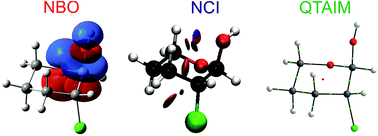
The present study intends to evaluate which are the stereoelectronic interactions responsible for the conformational preferences in trans-3-halo-2-hydroxy-tetrahydropyrans (Fig. 1). To assess the stereoelectronic interactions present in these systems it was necessary to analyse the results from NBO (Natural Bond Orbitals),12 QTAIM (Quantum Theory Atoms In Molecules)13 and NCI (Non-Covalent Interactions) topological analyses.14
:
3 hexane/ethyl acetate as eluent leading to a 41% of yield. Fluorohydrin cis: 1H NMR (600 MHz, CDCl3): δ (ppm) 4.93 (1H, dd, 3JH2H3 = 1.98 and 3JH2F = 10.92 Hz, H2); 4.56 (1H, dddd, 3JH3H4e = 3.06, 3JH3H4a = 7.44 and 2JH3F = 48.43 Hz, H3); 4.02–3.96 (1H, m, H6e); 3.59–3.53 (1H, m, H6a); 2.19–2.05 (1H, m, H4e); 1.88–1.78 (2H, m, H4a and H5e) and 1.58–1.49 (1H, m, H5a). 13C NMR (150 MHz, CDCl3): 92.35 (1C, d, 2JC2F = 19.62 Hz, C2); 87.97 (1C, d, 1JC3F = 178.98 Hz, C3); 62.76 (C6); 25.79 (1C, d, 2JC4F = 20.07 Hz, C4) and 21.63 (1C, d, 3JC5F = 4.53 Hz, C5). Fluorohydrin trans: 1H NMR (600 MHz, CDCl3): δ (ppm) 4.97 (1H, dd, 3JH2H3 = 3.72 and 3JH2F = 5.82 Hz, H2); 4.37 (1H, ddt, 3JH3H4e = 3.72, 3JH3H4a = 6.48 and 2JH3F = 48.19 Hz, H3); 4.02–3.96 (1H, m, H6e); 3.59–3.53 (1H, m, H6a); 2.19–2.05 (1H, m, H4e); 1.93–1.81 (2H, m, H4a and H5e) and 1.58–1.49 (1H, m, H5a). 13C NMR (150 MHz, CDCl3): 93.46 (1C, d, 2JC2F = 28.67 Hz, C2); 87.97 (1C, d, 1JC3F = 173.70 Hz, C3); 61.98 (C6); 25.46 (1C, d, 2JC4F = 19.62 Hz, C4) and 21.65 (1C, d, 3JC5F = 4.22 Hz, C5). HRMS EI+ (m/z): found 120.0589 [M − H+]; C5H9FO2 requires 120.0587 g mol−1.
:
3 hexane/ethyl acetate as eluent leading to a 33% of yield. Chlorohydrin cis: 1H NMR (600 MHz, CDCl3): δ (ppm) 4.91 (1H, d, 3JH2H3 = 2.04 Hz, H2); 4.13 (1H, ddd, 3JH3H4a = 6.78 and 3JH3H4e = 3.72 Hz, H3); 4.05–4.01 (1H, m, H6e); 3.61–3.55 (1H, m, H6a); 2.24–2.19 (1H, m, H4e); 2.06–2.01 (1H, m, H4a); 1.93–1.81 (1H, m, H5e) and 1.58–1.52 (1H, m, H5a). 13C NMR (150 MHz, CDCl3): 93.01 (C2); 63.46 (C6); 60.12 (C3); 29.44 (C4) and 22.13 (C5). Chlorohydrin trans: 1H NMR (600 MHz, CDCl3): δ (ppm) 4.79 (1H, d, 3JH2H3 = 5.82 Hz, H2); 4.05–4.01 (1H, m, H6e); 3.77 (1H, ddd, 3JH3H4a = 8.58 and 3JH3H4e = 4.32 Hz, H3); 3.61–3.55 (1H, m, H6a); 2.37–2.32 (1H, m, H4e); 1.87–1.81 (2H, m, H4a and H5e) and 1.67–1.59 (1H, m, H5a). 13C NMR (150 MHz, CDCl3): 97.24 (C2); 64.27 (C6); 58.59 (C3); 30.93 (C4) and 24.09 (C5). HRMS EI+ (m/z): found 136.0359 [M − H+]; C5H9ClO2 requires 136.0291 g mol−1.
:
3 hexane/ethyl acetate as eluent leading to a 53% of yield. Bromohydrin cis: 1H NMR (600 MHz, CDCl3): δ (ppm) 4.72 (1H, d, 3JH2H3 = 1.86 Hz, H2); 4.28 (1H, ddd, 3JH3H4a = 6.42 and 3JH3H4e = 3.78 Hz, H3); 4.08–4.04 (1H, m, H6e); 3.64–3.57 (1H, m, H6a); 2.35–2.29 (1H, m, H4e); 2.16–2.11 (1H, m, H4a); 2.01–1.89 (1H, m, H5e) and 1.60–1.54 (1H, m, H5a). 13C NMR (150 MHz, CDCl3): 92.83 (C2); 63.70 (C6); 54.69 (C3); 30.09 (C4) and 22.91 (C5). Bromohydrin trans: 1H NMR (600 MHz, CDCl3): δ (ppm) 4.86 (1H, d, 3JH2H3 = 6.30 Hz, H2); 4.08–4.04 (1H, m, H6e); 3.88 (1H, ddd, 3JH3H4a = 9.60 and 3JH3H4e = 4.44 Hz, H3); 3.64–3.57 (1H, m, H6a); 2.46–2.41 (1H, m, H4e); 2.01–1.89 (1H, m, H4a); 1.81–1.76 (1H, m, H5e) and 1.70–1.63 (1H, m, H5a). 13C NMR (150 MHz, CDCl3): 97.36 (C2); 64.78 (C6); 51.17 (C3); 32.13 (C4) and 25.41 (C5). HRMS EI+ (m/z): found 161.9682 [M − H+] with the loss of a water molecule; C5H9BrO2 requires 179.9786 g mol−1.
:
4 hexane/ethyl acetate as eluent leading to 18% of yield. Iodohydrin cis: 1H NMR (600 MHz, CDCl3): δ (ppm) 4.43 (1H, ddd, 3JH3H4a = 6.24, 3JH3H4e = 3.72 Hz and 3JH3H2 = 2.10, H3); 4.15 (1H, d, H2); 4.13–4.05 (1H, m, H6e); 3.66–3.60 (1H, m, H6a); 2.39–2.34 (1H, m, H4e); 2.15–2.08 (1H, m, H4a); 1.92–1.85 (1H, m, H5e) and 1.63–1.56 (1H, m, H5a). 13C NMR (150 MHz, CDCl3): 93.31 (C2); 63.95 (C6); 37.13 (C3); 31.59 (C4) and 24.29 (C5). Iodohydrin trans: 1H NMR (600 MHz, CDCl3): δ (ppm) 4.90 (1H, d, 3JH2H3 = 7.08 Hz, H2); 4.13–4.05 (1H, m, H6e); 3.99 (1H, ddd, 3JH3H4a = 10.68 and 3JH3H4e = 4.44 Hz, H3); 3.66–3.60 (1H, m, H6a); 2.49–2.44 (1H, m, H4e); 2.15–2.08 (1H, m, H4a); 1.72–1.65 (1H, m, H5e) and 1.63–1.56 (1H, m, H5a). 13C NMR (150 MHz, CDCl3): 98.39 (C2); 65.61 (C6); 34.78 (C4); 30.80 (C3) and 27.27 (C5). HRMS EI+ (m/z): found 209.9531 [M − H+] with loss of a water molecule; C5H9IO2 requires 227.9647 g mol−1.Theoretical values for the 3JHH coupling constants were obtained at B3LYP functional (with 25% HF exact-exchange) employing the EPR-III basis set for the hydrogen atom, 6-311G* basis set for the iodine atom and cc-pVDZ basis set for the other atoms using Gaussian 09 program.19
Hyperconjugative interactions were evaluated using Natural Bond Orbital (NBO 5.0)20 analysis as implemented in Gaussian 09, and the calculations were performed at the M06-2X/aug-cc-pVTZ level. QTAIM and NCI topological analyses were performed using the resulting wave functions obtained from the MP2/aug-cc-pVTZ optimizations. QTAIM and NCI topological analyses were carried out with the AIMALL21 and NCIPLOT22 programs, respectively.
The analyses of 1D 1H, 13C and selective TOCSY spectra together with 2D 1H–1H COSY, 1H–13C HSQC and 1H–1H NOESY contour plots were crucial to assign the entire molecule (Table 1).
| δH | F | Cl | Br | I |
|---|---|---|---|---|
| H2 | 4.97 | 4.79 | 4.86 | 4.90 |
| H3 | 4.37 | 3.77 | 3.88 | 3.99 |
| H4a | 1.93–1.81 | 1.87–1.81 | 1.97 | 2.12 |
| H4e | 2.10 | 2.34 | 2.43 | 2.37 |
| H5a | 1.52 | 1.63 | 1.66 | 1.59 |
| H5e | 1.93–1.81 | 1.87–1.81 | 1.78 | 1.88 |
| H6a | 3.57 | 3.59 | 3.62 | 3.64 |
| H6e | 4.00 | 4.03 | 4.06 | 4.11 |
Moreover, the 1H–1H NOESY contour plots suggested that the trans diastereoisomers are in conformational equilibrium, since the H2 shows a cross peaks (through space interaction) with H6a, H4a and H3, as exemplified for the chlorohydrin (Fig. 3). This conclusion comes from the observed correlation between H2 with H4a and H6a, which is expected to appear only in the eq–eq conformation, whereas the correlation between H3 and H2 is expected to appear only in the ax–ax conformation.
To evaluate the conformational equilibrium, 1H NMR spectra for compounds 1–4 were acquired in solvents of different permittivity constant (dielectric constant), and the vicinal 3JH3H2, 3JH3H4a and 3JH3H4e coupling constants were measured straightforwardly from the H3 signal, which is a first-order spin system (Table 2). The solvents used were CDCl3, C2D2Cl4, acetone-d6, CD3CN and DMSO-d6.
| Halogen | 3J | CDCl3 | C2D2Cl4 | Acetone-d6 | CD3CN | DMSO-d6 |
|---|---|---|---|---|---|---|
| Fluoro | H3H2 | 3.72 | 4.08 | 3.84 | 3.96 | 4.14 |
| H3H4e | 3.72 | 4.08 | 3.84 | 4.50 | 4.14 | |
| H3H4a | 6.48 | 6.84 | 6.54 | 6.60 | 6.78 | |
| Chloro | H3H2 | 5.82 | 6.12 | 5.64 | 6.18 | 6.06 |
| H3H4e | 4.32 | 4.32 | 4.26 | 4.32 | 4.32 | |
| H3H4a | 8.58 | 8.94 | 8.34 | 9.24 | 9.18 | |
| Bromo | H3H2 | 6.30 | 6.54 | 6.12 | 6.66 | 6.48 |
| H3H4e | 4.44 | 4.44 | 4.32 | 4.44 | 4.38 | |
| H3H4a | 9.60 | 9.90 | 9.36 | 10.02 | 9.78 | |
| Iodo | H3H2 | 7.08 | 7.26 | 6.96 | 7.26 | 7.20 |
| H3H4e | 4.44 | 4.44 | 4.38 | 4.44 | 4.38 | |
| H3H4a | 10.68 | 10.98 | 10.38 | 11.34 | 10.74 |
In the analyses of the observed coupling constant values, it has to be taken into account that they are averaged values of the conformers that participate in the conformational equilibrium. The data from Table 2 suggests the preference for the eq–eq conformer increases from fluorine to iodine derivatives, since 3JH3H4a changes from 6 Hz to 11 Hz. Also 3JH3H4a for each halogen shows only small changes for all solvents used (Table 2), suggesting that solvent polarity does not appreciably affect the conformational equilibrium. These results indicate that the conformation equilibrium for studied compounds is dictated by halogen, instead of solvent polarity.
The potential energy curves (Fig. 4) provide the angles and structures for the most stable conformers for each compound. The geometry for each local minimum was re-optimized at the MP2/aug-cc-pVTZ level and the results of the most stable conformer or the minimum global of energy, that is always the dihedral angle of 180°, are summarized in Table 3.
The energy values showed in Table 3 are related to the energy of the isolated molecule in vapour phase. Through these calculations the ax–ax conformer is more stable than the eq–eq by 1.6, 0.9, 0.8 and 0.5 kcal mol−1 for the fluorohydrin, chorohydrin, bromohydrin and iodohydrin, respectively.
The main stereoelectronic interactions responsible for the stability of the ax–ax conformer in the vapour phase of each compound under study were evaluated through NBO, QTAIM and NCI analyses. The NBO with deletion and NBO steric analysis gave the results showed in Table 4. The NBO steric analysis give a result that is similar to the concept of steric “contact” between occupied orbitals.
The first analysis from Tables 3 and 4 shows that the energy variation between the ax–ax and eq–eq conformers decreases in the order F > Cl > Br > I. These data indicate that the halogen size is related to the conformer stability as mentioned before. The steric repulsion energy (ΔEst) increases from fluorohydrin to iodohydrin leading to a destabilization of the ax–ax conformer.
However, it was not possible to appoint a specific repulsive interaction responsible for this effect since the observed result is due to the sum of all interactions. Thus, considering that the halogen size is involved in the conformational behavior the interaction involving a halogen can be used to explain the observed results. In this way the interactions between σC3–X → σC2O2 and σC3–X → σC4H4a are depicted in Fig. 5 and their energies are listed in Table 5.
![]() | ||
| Fig. 5 Representation of σC3–Cl → σC2–O2 and σC3–Cl → σC4H4a repulsion interaction for the ax–ax chlorohydrin (2), respectively. | ||
| Interaction | F | Cl | Br | I |
|---|---|---|---|---|
| σC3–X → σC2O2 | 1.0 | 3.8 | 4.3 | 5.2 |
| σC3–X → σC4H4a | 1.2 | 5.8 | 6.4 | 6.8 |
Table 4 also lists the hyperconjugative interaction energies (ΔEhyper) obtained from NBO analysis, where it is shown that the eq–eq conformer is more stabilized by this kind of interaction. Thus, both steric and hyperconjugative energy interactions should yield a destabilization of ax–ax conformer, but this conformer shows the lowest energy. At this stage, non-covalent interactions can be invoked to explain the stabilization of ax–ax conformer.
However, which atoms should be involved in this stabilization? The isosurfaces provided by the NCI topology (Fig. 6) show that an interaction between the oxygen lone pairs from OH group and the H4 and H6 in axial orientation, as well as, the halogens lone pair with the H5 in axial orientation are responsible for the ax–ax stabilization.
![]() | ||
| Fig. 6 Plot of the reduced density gradient s and sign(λ2)ρ; NCI isosurfaces and QTAIM image, respectively, for the compounds 1–4. | ||
It is important to highlight that hydrogen bond O–H–X is not present among the stabilizing interactions, since, theoretically analyses (NBO, NCI and QTAIM) did not show any evidence of its existence. A recent investigation24 compares the chemical shifts of the OH proton in DMSO vs. CDCl3 to predict hydrogen bond formation through eqn (1). When A < 0.1 there is intramolecular hydrogen bond formation. The value of A for the studied compounds was 0.5 which does not represent a hydrogen bond and this agrees with the above theoretical data.
![]() | (1) |
It is important to highlight that the graphics of reduced density gradients (Fig. 6) are similar in shape among ax–ax conformers and among eq–eq conformers for the halohydrins. It has been observed negative values for λ2 in RDG, indicating an attractive interaction in the NCI plot (Fig. 6) for the ax–ax and eq–eq conformers, however for the ax–ax conformer it is observed a higher intensity, resulting in a blue interaction in the NCI surfaces. These attractive interactions are not observed in the QTAIM image as a bond critical point (BCP), since the reduced density gradient (s) does not achieve (touch) the zero value.
The stabilization of the ax–ax conformer is due to the non-covalent interactions present in the vapour phase. However in solution these interactions are reduced or vanish due to solvation which is proportional to the conformer dipole moment. This may explain why the values of the observed coupling constants (3JH3H4a) increase from fluorine to iodine from 6 Hz to 11 Hz (Table 2), which can only be due to the preference for the eq–eq conformer. To confirm this idea, theoretical calculations, taking into account the solvent effect (CHCl3 and DMSO), were performed and the results are showed in Fig. 7.
Theoretical calculations with solvent effect were fundamental to prove the influence of solvent in conformer's stability. For all halohydrins the solvent favored the eq–eq conformer, for the fluorohydrin the stabilization of ax–ax conformer was 1.5 kcal mol−1 in vapor phase and this value was reduced to 0.5 kcal mol−1 when the solvent effect (DMSO) was included, whereas, for chloro-, bromo- and iodohydrin the eq–eq became more stable. The conformers energies taking into account the solvent effect explain the percentage obtained experimentally for the halohydrins (Table 6).
The proportion of the isomers (Table 6) present in the conformational equilibrium was calculated through the eqn (2) (Boltzmann equation) and eqn (3).
![]() | (2) |
NMR at low temperatures (−80 °C) were performed in order to determine the proportion of each conformer in the equilibrium, however even at low temperatures was not possible to separate the signals of each conformer. Eqn (3) was used to this propose.
![]() | (3) |
| Fluorohydrin | Chlorohydrin | Bromohydrin | Iodohydrin | |||||
|---|---|---|---|---|---|---|---|---|
| ax–ax | eq–eq | ax–ax | eq–eq | ax–ax | eq–eq | ax–ax | eq–eq | |
| 3JH3H2 | 1.91 | 7.07 | 1.75 | 7.96 | 2.02 | 8.51 | 1.48 | 8.66 |
| 3JH3H4e | 3.51 | 6.42 | 3.18 | 5.97 | 3.48 | 6.27 | 3.03 | 5.77 |
| 3JH3H4a | 3.09 | 11.51 | 4.35 | 12.65 | 4.83 | 13.22 | 4.69 | 13.30 |
Also a prevalence of the ax–ax conformation would be expected due to the anomeric effect, because for halohydrins under study the R–X–CH2–Z fragment, where X is an electronegative atom and Z is usually an oxygen, is present. Usually, molecules with this fragment are stabilized by a specific orbital interaction delocalization, dubbed anomeric effect.11a However, many controversies are found in the literature related to the real origin of anomeric effect. Some authors suggest that it is due to an electrostatic interaction, while others ascribe it to hyperconjugation involved in anomeric effect (Fig. 8).11
![]() | ||
| Fig. 8 (a) Orbital interactions known as endo- and exo-anomeric effect respectively; (b) dipole moments for the two conformers; X represents the oxygen of the molecules under study. | ||
Table 8 shows the energy values related to the endo- and exo-anomeric effect for the halohydrins under study (Fig. 1).
| Halohydrins | LP1O1 → *σC2–O2 endo | LP2O1 → *σC2–O2 endo | LP2O2 → *σC2–O1 exo |
|---|---|---|---|
| F-ax–ax | −1.1 | −16.5 | −14.0 |
| F-eq–eq | −4.2 | — | −14.8 |
| Cl-ax–ax | −1.2 | −16.6 | −13.7 |
| Cl-eq–eq | −4.6 | — | −13.7 |
| Br-ax–ax | −1.1 | −16.7 | −13.8 |
| Br-eq–eq | −4.7 | — | −13.4 |
| I-ax–ax | −1.2 | −16.3 | −13.9 |
| I-eq–eq | −4.3 | — | −13.1 |
The values shown in Table 8 suggest that the ax–ax conformer is more stabilized by the anomeric effect, presenting a high value for both the endo- and the exo-anomeric effects. However, it is important to remember that in the sum of all hyperconjugative interactions the eq–eq conformers have higher hyperconjugative interactions than the ax–ax conformers (Table 4). Thus, for the halohydrins under study the anomeric effect has no prevalence in the conformational stabilization.
Footnote |
| † Electronic supplementary information (ESI) available. See DOI: 10.1039/c5ra04968g |
| This journal is © The Royal Society of Chemistry 2015 |