P. Lasitha and
Edamana Prasad*
Department of Chemistry, IIT-Madras, Chennai-600036, India. E-mail: pre@iitm.ac.in
First published on 20th April 2015
Herein we report the synthesis, characterization and photophysical properties of novel naphthalene diimide (NDI) derivatives containing naphthalene units which are covalently attached to either end of the NDI. The self-assembly of such ‘Donor–Acceptor–Donor’ dendritic wedges shows aggregation induced emission (AIE), which in turn results in bright orange red emission from the NDI system, in aqueous medium and solid state. The structure of self-assembly has been analyzed using X-ray diffraction, variable temperature IR and NMR spectroscopy, scanning and transmission electron microscopy, steady state and time resolved emission spectroscopy. The results suggest that the emission quantum yields in the solid state vary inversely proportional to the number of donor units (naphthalene) attached to the NDI core. The NDI derivatives have been utilized to prepare organic nanoparticles (ONPs) in suitable solvent mixtures. Further, the ONPs as well as the solid thin film formed from the NDI derivative were utilized for the detection of picric aid through fluorescence quenching experiments, with a detection limit of 0.90 ppm.
While NDI based D–A systems are promising candidates for many optoelectronic applications,6 luminescence from such compounds are usually quenched in the solid state presumably due to the aggregation effect {commonly referred to as aggregation induced quenching (AIQ)}. Conversely, a handful of reports describe enhanced emission due to aggregation of NDI based D–A molecules. For example, Gujrati et al. has reported bright orange red luminescence from non-covalently bound binary charge transfer complexes between NDI and pyrene in solid state.7 Li et al. reported NDI molecules modified at shoulder position with electron donors such as thiophene and ferrocene with intense yellow emission (ϕf = 0.30) and optical waveguide properties in the aggregated state.8 Recently, a core substituted NDI with imidazole donor has been reported by Li et al. showing bright red luminescence in solid state.9 In such rare cases, aggregation can result in enhanced emission mainly due to aggregation induced emission (AIE) effect, where intramolecular motions of the fluorophore are restricted.10,11
Herein, we describe the design, synthesis and photophysical properties of three novel NDI derivatives which show AIE effect in solid state and solvent mixtures. The NDI derivatives contain naphthalene units which are covalently attached to either end of the NDI.12 The design of the NDI based D–A system was carried out by increasing the donor units from compound I to III by providing a dendritic branching from the core.
Our objective is to identify the structure–property relations in NDI derivatives which control the interplay between self-assembly and aggregation induced emission properties of the system. In the present study, we compare the luminescence from self-assembled NDI derivatives in solution and solid state. Solvent induced aggregation of the NDI derivatives leads to the formation of fluorescent organic nanoparticles (FONPs),13–17 which have been further used for detecting picric acid (PA).18 The NDI derivatives in the solid sate also exhibit the detection ability for PA. Even though there are many methods known for detection of PA19,20 easy and portable detection methods have been rarely reported.
The aggregation and luminance properties of the NDI systems are analysed by UV-Vis and photoluminescence (PL) spectroscopy measurement. TGA and XRD were carried out to understand the thermal stability and molecular arrangement in the solid state. Variable temperature based FT-IR and NMR measurement was performed to identify the mechanism of self-assembly. Detection of PA was studied through PL spectroscopy.
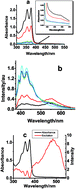
The major absorption peaks of compound I (Fig. 1a) are assigned to π–π* transitions between 0–2, 0–1 and 0–0 vibrational energy levels of naphthalene diimide. As the concentration of compound I increases from 10−6 M to 10−4 M, a decrease in the π–π* absorption of NDI has been observed, along with a concomitant increase of a new peak at 487 nm. While compounds II and III follow similar behavior, the new absorption peak for compound II was not prominent compared to that of compounds I and III (Fig. S1†). The highest absorption intensity for the concentration dependent new peak was observed for compound III. The spectral behaviour in the solution state indicates that inter-molecular interaction increases as concentration increases and the aggregation propensity increased in the following order: compound II < compound I < compound III.
The emission spectra corresponding to compounds I–III were recorded at different concentrations. As the concentration was increased from 10−6 M to 10−4 M, a new emission band started appearing at higher wavelength region with maxima at 552 nm (Fig. 1b). The emission features of compounds I, II and III were in agreement with their absorption properties (Fig. S1†). For example, the emission intensity from the compounds decreases in the following order: compound III > compound I > compound II.
The absorption spectrum of compound I (0.5 × 10⁻⁴ M) is compared with the excitation spectrum collected at 590 nm (Fig. 1c). It can be clearly seen from the spectra that the red shifted emission band for the NDI derivatives is originated by exciting the absorption peak which is assigned to aggregate formation. This suggests that the system can luminesce from its aggregated state.
Next, the UV-Vis and emission spectra of compounds I–III were recorded in DMSO, DMF, THF, DCM and CHCl3. Absorption spectra of compound I exhibits an absorption tail mainly in DCM (Fig. 2a). As observed earlier, compound II exhibits negligible tail absorption, while compound III was absorbing with better extinction coefficient than compound I (Fig. S2†).
![]() | ||
| Fig. 2 (a) Absorption and (b) emission spectra of compound I [2 × 10⁻⁵ M] in different solvents; λex = 350 nm. | ||
Upon excitation at 350 nm (monomer excitation), emission spectra of compound I shows a new peak in all solvents with maxima at 550 nm. Emission quantum yield (ϕf) values were determined (quinine sulphate in 0.05 N H2SO4 as standard) for compounds I–III in different solvents and the values are given, along with absorption and emission maxima, in Table S1.† The highest quantum yield was observed for compound III in DMSO, with a maximum value of 8.9 × 10⁻³ (±5%). As the values of emission quantum yields suggest, the emission intensity from the NDI derivatives was poor in solution phase.
The solvent dependent study, however, indicates that aggregation propensity of compounds I–III can be tuned by altering the polarity of the solvent milieu. It is, hence, hypothesized that addition of water to the system might lead to aggregation of the compounds due to the increased hydrophobic force of attraction by the aromatic rings in aqueous environment and this could lead to the formation of fluorescent organic nanoparticles (FONPs).
![]() | ||
| Fig. 3 (a) UV-Vis and (b) emission spectra of compound I [10−5 M] in THF in presence of different amount of water. | ||
Consistent with the absorption studies, as the water concentration increases, the emission intensity from the monomer species increases initially and decreases above 50% of water (Fig. 3b). At higher fraction of water, the emission from the aggregates results in a new emission band at 600 nm. The maximum intensity of the new emission band was obtained when the water content was 90%. Almost similar observations were found in the case of compound II (Fig. S3b†). However, the emission spectra of compound III show quenching (both monomer and aggregated state) as percentage of water increases in the system (Fig. S3d†). The compounds follow the following trend in their emission intensity from FONPs: compound III < compound I ∼ compound II. The quenched emission from compound III could be attributed to the enhanced photoinduced electron transfer rate between naphthalene and NDI since the donor and acceptor molecules might be close to each other in compound III.22
Interestingly, the compounds exhibit a unique emission pattern in the solid state. As shown in Fig. 4, the intensity maxima (lmax = 600 nm) was highest for compound I, and then for compound II followed by a very feeble emission from compound III. Since emission maxima was shifted to 600 nm, the emission from compound I was intense orange red. The corresponding photographs of the compounds I–III under UV and visible light is given in Fig. 4.
The emission intensity corresponding to compound I was ∼40 fold higher than compound III. Solid state emission quantum yield is measured using integrating sphere method and the values are summarized in Table 1. The quantum yield of compound I was 0.01.
The excitation spectra of compounds I–III were recorded between 310 and 550 nm and the emission was collected at 590 nm (Fig. S6†). The excitation spectra for compounds I–III suggest aggregate formation in all the three compounds and the observed orange red emission is from the aggregates of NDIs. Lifetime for compound I and II is monitored in thin film by exciting at 340 nm and collecting emission at 600 nm (Fig. 5). The decay for compound I was bi-exponential in nature with a short component (τ1 = 2.38 ns) and long component (τ2 = 12.7 ns). Compound II also exhibits similar pattern (τ1 = 1.78 ns, τ2 = 6.31 ns). The initial component is typically from aggregates,whereas the second component would be from pre-associated excimer (static in nature)25 or exciplex. Lifetime values and relative amplitude are summarized in Table 1.
![]() | ||
| Fig. 5 Lifetime plot for solid film of compound 1 (a) and compound II (b) λex; 340 nm, emission collected at 600 nm. | ||
:
1/21/2
:
1/31/2
:
1/41/2, which indicate tetragonal columnar arrangement. The peak corresponds to 6.99° represents the inter layer spacing with d value 12.63 Å. Using chemBio3D Ultra 11.0, the fully extended length of compound I has been calculated as 32.5 Å. Such a large difference in the theoretical and experimental values suggests that, there must be intercalation between naphthalene units within the π–π stacked NDI core. The molecules presumably will arrange in a slip-off fashion, resulting in the formation of J-type aggregates. The reflection peak of compound I was observed at 23.8°, which represents the π–π stacking distance of 3.7 Å. Compound II and III shows respective d-spacing of 20.24 Å (4.36°) and 14.71 Å (6°). The π–π stacking distance are 3.84 Å and 3.77 Å respectively. The d-spacing and π–π stacking distance indicates that NDI core units are in typically co-facial arrangement with peripheral naphthalene. The sharp reflections peaks observed for compound I compared II and III indicating increased crystallinity because of less steric hindrance in former case. A cartoon representation of the expected molecular arrangement is shown in Scheme 1. Further self-assembly of such an arrangement can form tetragonal columnar type geometry for the NDI derivative, as shown in Scheme 1.
At 30 °C, the compounds show single NH stretching (3200 cm−1) and multiple C
O stretching (1730 cm−1, 1690 cm−1 and 1680 cm−1) peaks. As temperature is increased to 100 °C, the NH band shows decrease in intensity and a slight shift to higher wave number. For example, compound II exhibits a NH band shift from 3198 to 3241 cm−1 as the temperature varies from 30 °C to 100 °C. Similar type of shift was observed for compound III (i.e., from 3213 to 3264 cm−1). The presence of inter-molecular hydrogen bonding is emphasized by the decrease in intensity of NH stretching band along with increase in temperature. Such intensity decrease with temperature and shift to the higher wave number is common with intermolecular hydrogen bonding.27
The VT-NMR of compound II in DMSO-d6 from 30–120 °C is shown in Fig. 7. The NH peak (δ = 11.45 ppm) for compound II appeared as doublet at lower temperature. As the temperature is increased, NH peak became singlet and shifted upfield to 11.1 ppm. Similarly, in compound III, a peak shift from 11.6 ppm to 11.30 ppm has been observed (Fig. S10†). As the temperature is increased, intensity of NH peak correspond to NDI core (at ≈δ 8.8 ppm) also increases.
![]() | ||
| Fig. 7 Variable temperature NMR spectra of compound II in DMSO-d6 from 30 °C to 120 °C (concentration = 3.5 × 10⁻² M). | ||
The existence of higher degree of molecular aggregation and intermolecular hydrogen bonding is clearly evident from spectral shift of NH proton to lower ppm with increase in temperature.26 Since, the exact co-facial arrangement is prevented, the NH protons may experience different environment at lower temperatures resulting in splitting, which is overcome at higher temperatures. The intermolecular hydrogen bonding decreases due to the disassembly of molecules which results in upfield shift with increase in temperature. We have recorded the VT-NMR for compound II (Fig. S10†) in CDCl3. The NMR spectra in CDCl3 was broad and unresolved. With variation in temperature from −40 °C to 50 °C peaks remain poorly resolved. These observations are in accordance with the finding from UV-Vis and PL measurements were the prominent aggregation is observed in non polar solvent such as CHCl3
The TEM images of compounds I–III in presence of 90% water clearly shows the formation of nano aggregates (Fig. S12†). More uniform spherical aggregates were observed in the case of compound II. We assume that the NDI core and naphthalene units are arranged in such a fashion that amide groups are exposed to the water in extreme interior and exterior of vesicle. The average particle size obtained for compounds I–III from DLS measurements are 290 nm, 530 nm and 400 nm, respectively (Fig. S12†). DLS study indicates that aggregation propensity in compound II is higher compared I and III. The difference in average size measured from SEM and DLS is likely to be due to the presence of the hydration sphere in the solution phase.
:
9), emission from the aggregated nanoparticles decreases (Fig. 9). With the addition of 30 equivalent of PA emission intensity quenched by 99%. The Stern–Volmer plot for the addition of PA was plotted, and Ksv (Stern–Volmer constant) was calculated using the initial linear part of the plot (below 0.8 μM). The value for Ksv was 9.6 × 10⁴ M−1 for the case of compound II. Selectivity of PA has been confirmed by quenching study with other nitro aromatic. The percentage of quenching and selectivity is shown in Fig. S13a.† The detection limit was calculated by performing fluorescence titration with addition of aliquots of PA and taking the inflection point where the sudden emission drop is observed (Fig. S13b†).18 The detection limit was found to be 0.90 ppm.
The quenching of emission from the aggregated nano system could be attributed to the interaction of hydroxyl group of the PA with amine moiety of NDI.18 The ground state complex formation between PA and NDI derivative leads to the breakdown of the nano-aggregates in the system, resulting in the emission quenching. The other nitro aromatics like TNT, ONT, DNT and NB were not able to quench the emission from the organic nanoparticles presumably due to the absence of a hydroxyl group. This indicates that hydroxyl group plays a crucial role in the present case. We believe that the hydroxyl group present in the PA tamper the hydrogen bonding network in the nano aggregates, leading to the luminescence quenching. The luminescence quenching experiment was also performed using TLC stripes where compound II (200 μl, 10−3 M) was drop casted in presence and absence of the analyte. The emission intensity was quenched to ∼50% in the presence of the analyte (PA) (60 μl, 10−3 M) (Fig. S14†).
![]() | ||
Fig. 9 (a) Emission response and (b) Stern–Volmer plot of compound II (9 × 10⁻⁶ M) in THF/water (1 : 9) with addition of different equivalent of PA (0–30 eq.), λex: 350 nm. | ||
The static nature of complex formation between NDI and PA was further confirmed by the lifetime measurement in solid film (Fig. S14†). Lifetime values of compound II was unaffected by the PA addition, which corroborates that the quenching is not dynamic in nature. We have recorded SEM images compound II (Fig. S15a and b†) before and after addition of PA. SEM images clearly indicate that the nano aggregates breaks into smaller aggregates upon addition of PA. These observations clearly corroborate the ground sate interaction and complex formation of PA with nano aggregates. The deviation in the Stern–Volmer plot at higher concentration of PA could be due to the collisional quenching, along with static quenching, resulting in a bi-model quenching mechanism.
Footnote |
| † Electronic supplementary information (ESI) available: Details of synthetic procedure, UV-Vis, PL, CV, spectroscopic characterization. See DOI: 10.1039/c5ra04857e |
| This journal is © The Royal Society of Chemistry 2015 |