
K. Velmurugana,
A. Ramanbc,
Derin Dona,
Lijun Tang*d,
S. Easwaramoorthi*bc and
R. Nandhakumar*a
aDepartment of Chemistry, Karunya University, Karunya Nagar, Coimbatore – 641 114, India. E-mail: nandhakumar@karunya.edu
bChemical Laboratory, CSIR-Central Leather Research Institute, Adyar, India. E-mail: moorthi@clri.res.in
cAcademy of Scientific and Innovative Research (AcSIR), Anusandhan Bhawan, 2 Rafi Marg, New Delhi – 110001, India
dCollege of Chemistry and Chemical Engineering, Liaoning Key Laboratory for the Synthesis and Application of Functional Compounds, Bohai University, Jinzhou 121013, P. R. China. E-mail: ljtang@bhu.edu.cn
First published on 11th May 2015
A quinoline benzimidazole-conjugate (QBC) has been synthesized for the highly selective detection of Zn(II) both by colorimetry and fluorimetry. Probe QBC senses Zn2+ over other cations as fluorescence ‘off–on’ behaviour in HEPES-buffered CH3CN–H2O (1
:
1, v/v, pH = 7.0) solution. A possible mechanism is proposed based on the inhibition of PET and intramolecular restricted torsional rotation through the C–C single bond between the quinoline benzimidazole-conjugate. The Chemosensor is utilized to detect Zn2+ in much real sample analysis.
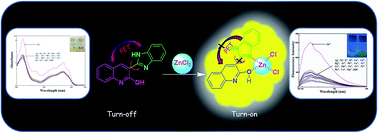
Owing to the importance of Zn2+ in biological systems, numerous fluorescent Zn2+ sensors based on fluorophores such as quinoline,8 naphthalimide,9 bipyridyl,10 bodipy,11 fluorescein,12 rhodamine,13 pyrene,14 benzoxazole,15 coumarin,16 and other chromophores17 have been reported. Among these, quinoline is one of the promising classes of fluorophore as it forms strong binding with metals and also reduces the molecular size by rigidification which becomes an important parameter to be used in probing the metal ions in biological systems.18 In general, the fluorescent properties of quinoline become quenched when substituted with amine due to photoinduced electron transfer (PET) processes. However, suppression of PET by the coordination between Zn2+ and amine would enhance the fluorescence, which in fact has been explored as a successful pathway for turn-on fluorescence sensing mechanism. Sensors that contain the quinoline group include those with amide amine ethers,19 hydroxyl quinolines,20,21 borondipyrromethane,22 fluorescein23 and spiropyrans.24 Nevertheless, the detection of zinc metal ion via dual chromogenic and fluorescence ‘off–on’ signalling mechanism has been less explored.25–28 As a consequence, the development of an efficient Zn2+ ion selective chromogenic and fluorescent sensor becomes important for the fundamental understanding about the role of Zn2+ in biological systems. Herein, we report the synthesis and ion recognition properties of a quinoline benzimidazole-conjugate (QBC), which exhibits highly sensitive and selective recognition of Zn2+ ion both by colorimetry and fluorimetry with a remarkable fluorescence turn-on response in a semi-aqueous media.
An elegant one step synthetic protocol for the synthesis of the receptor quinoline benzimidazole-conjugate (QBC) is shown in Scheme 1. Briefly, the reaction between 3-formyl-2-hydroxyquinoline29 and o-phenylenediamine in ethanol/TEA afforded the crude QBC which is then purified by recrystallization in DMF. The sensor was well characterized by the 1H, 13C NMR and mass spectral analysis (Fig. S1–S3†). UV-visible and fluorescence spectroscopic techniques were used to evaluate the selectivity and sensitivity of QBC towards the metal ions of biological and environmental significance such as Na+, K+, Al3+, Cu2+, Cd2+, Hg2+, Zr2+, Pb2+, Zn2+, Co2+, Ni2+, Ca2+, Mn2+, Cr3+, Ba2+, Ce3+, Mg2+, Fe2+, Fe3+ and Ag+. The metal ion titrations were carried out by adding the known concentration of various metal salts in CH3CN–H2O (1
:
1 (v/v), HEPES = 50 mM, pH = 7.0) to a fixed concentration of QBC in the same solvent.
The UV-visible absorption spectrum of QBC in CH3CN–H2O (1
:
1 (v/v), HEPES = 50 mM, pH = 7.0) show two intense bands with absorption maximum at 213 and 372 nm (Fig. 1 and S4†). Addition of Zn2+ to the sensor QBC solution induces a significant enhancement in the absorption bands at 213 and 372, which eventually led to the colour change from pale yellow to intense yellow colour as shown in Fig. 1. Further addition of different metal cations including Mn2+, Fe2+, Co2+, Ni2+, Cu2+, Cd2+, alkali and alkaline earth metal ions to QBC under the identical conditions does not yield any notable spectral and colour changes. This implies that Zn2+ can coordinate with QBC with exclusive selectivity and sensitivity and the change in colour allows the Zn2+ ion detection by the naked eye even without any spectroscopic techniques. The smaller red-shifted maxima of both high-energy and low-energy absorption ca. 12–15 nm suggests the possibility of enhanced π-conjugation within the sensor unit owing to the coordination of Zn2+ ions. To further understand the absorption behavior of the probe QBC and QBC–Zn2+ complex, we have carried out DFT calculations using Gaussian 03 program.30 The initial geometries were optimized at B3LYP/6-31G level of theory and are given in Fig. S5–S8.† The calculated absorption spectra of QBC shows three major transitions at 228, 261 and 333 nm. The oscillator strength of the peak at 264 and 330 nm increased after the coordination of QBC with Zn2+ ion. It can also be understood from the optimized geometries that the quinoline and benzimidazole moieties of QBC were not in a coplanar configuration and the dihedral angle of C
C–C–N of quinoline and benzimidazole ring was calculated for QBC to be 143.44. However upon Zn2+ coordination the dihedral angle becomes 154.22, and the QBC–Zn2+ complex was found to be in near coplanar configuration, which eventually enhances the π-conjugation pathway. Further, the charges on the N atom of QBC–Zn2+ complex is calculated to be −0.642 which is comparatively smaller than that of free QBC i.e. −0.792. This feature is ascribed to the involvement of nitrogen in the coordination of Zn2+ ion. As can be seen from Fig. 2, the absorbance at 213 and 372 nm of QBC gradually increases with the increase in the concentration of Zn2+ ion till 70 equivalents (Fig. S9†). Generally, transition metal cations with an open shell d-orbital often quench the fluorescence due to the electron or energy transfer processes between the metal cations and fluorophores, providing a very fast and efficient nonradiative decay pathway of the excited states. However, it is expected that metal ions such as Zn2+ with close shell d-orbitals do not induce any, new low-energy, metal-centered excited states so that the possibility of additional excited state deactivation pathway can be overruled.31
![]() | ||
Fig. 1 Absorption changes of QBC (4 × 10⁻⁶ M) solution (CH3CN–H2O, 1 : 1 v/v, HEPES = 50 mM, pH = 7.0) in the presence of Zn2+ metal ions (100 equiv.). | ||
![]() | ||
Fig. 2 Changes of absorption intensity of QBC (4 × 10⁻⁶ M) solution (CH3CN–H2O, 1 : 1 v/v, HEPES = 50 mM, pH = 7.0) upon addition of different amount of Zn2+ (0–70 equiv.). | ||
The metal ion recognition capability of QBC was systematically carried out for a variety of metal ions using the fluorescence technique. The fluorescence spectrum of QBC (4 μM) exhibited a weak, single emission band at ca. 425 nm at ambient temperature. This is due to intramolecular photoinduced electron transfer (PET) process and the unrestricted torsional rotation between the C–C single bond which covalently links the quinoline and the benzimidazole units. Fig. 3 shows the fluorescence spectra (λex = 380 nm) of QBC (4 μM) measured in CH3CN–H2O (1
:
1 (v/v), HEPES = 50 mM, pH = 7.0) with different metal ions (100 equiv.). Only the addition of Zn2+ (100 equiv.) causes a prominent emission enhancement with an intense yellowish-green fluorescence with the emission maxima at 425 nm. In contrast, addition of other cations (Na+, K+, Al3+, Cu2+, Cd2+, Hg2+, Zr2+, Pb2+, Co2+, Ni2+, Ca2+, Mn2+, Cr3+, Ba2+, Ce3+, Mg2+, Fe2+, Fe3+ and Ag+) to QBC, under identical conditions show almost no or little fluorescence enhancement. This indicates that QBC has a selective emission enhancement toward Zn2+ probably by (a) inhibiting the photoinduced electron transfer process between benzimidazole-conjugate and or (b) by restricting the rotation of C–C single bond that connects quinoline and benzimidazole ring.
![]() | ||
Fig. 3 Fluorescence changes of QBC (4 × 10⁻⁶ M) solution (CH3CN–H2O, 1 : 1 v/v, HEPES = 50 mM, pH = 7.0) in the presence of various metal ions (100 equiv. of each, excited at 380 nm). | ||
To further explore its practical applicability, the interference of other metal ions in the presence of Zn2+ on QBC was studied. Fig. 4 displays the fluorescence emission enhancement upon addition of Zn2+ to QBC, which are in fact not affected by the addition of other cations. These findings indicate that QBC detects Zn2+ selectively and the presence of other metal ions does not interfere with the detection of Zn2+ ions. Although this chemosensor did not overcome the influence, it is worth mentioning that many Zn2+ chemosensors suffer from low selectivity over Cd2+. However, this chemosensor eliminated the problem by inhibition of PET mechanism between quinoline benzimidazole-conjugates. This indicates that QBC coordinates with Zn2+ more strongly, as is observed for quinoline benzimidazole-linkage.
Fig. 5 shows the fluorescence titration spectra of QBC with the gradual increasing concentration of Zn2+ added. Stepwise, gradual addition of the Zn2+ to QBC led to an emission enhancement in the fluorescence intensity and becomes saturated when 75 equivalents of Zn2+ was added (Fig. S10†). The Job's continuous variation method is utilized to find out the stoichiometry between the Zinc chloride and QBC. As can be seen from Fig. 6, the maximum value was found at the mole fraction 0.52, which is indicative of the 1
:
1 binding stoichiometry between QBC and Zn2+.32
The fluorescence titration data obtained with Zn2+ (425 nm) is plotted by 1/(I − I0) vs. 1/[Zn2+] (Fig. 7). On the basis of titration profile, using the non-linear fitting of the titration curve of 1
:
1 binding model, the association constant (Ka) of QBC + Zn2+ was computed to be 1.53 × 10⁴ M−1, indicating that the probe can detect Zn2+ at the micromolar level. The detection limit of QBC calculated using the formula 3δ/S,33 where δ is the standard deviation of the blank signal, and S is the slope of the linear calibration plot is to be 1.5 × 10⁻⁵ M. Indeed, the detection limits of QBC towards Zn2+ cation are closer (drinking water = 5 mg L−1) to the regulation levels set by the US National Environmental Protection Agency (EPA).34
![]() | ||
Fig. 7 Benesi–Hildebrand plot (emission 425 nm) of QBC, assuming 1 : 1 stoichiometry for association between QBC and Zn2+. | ||
1H NMR analysis were performed to further support the coordination structures for Zn2+ complex with QBC in a D2O/DMSO mixture (1/2 v/v, pH = 7.0). Fig. 8 shows the partial 1H NMR spectra of QBC measured in a D2O/DMSO mixture (1/2 v/v, pH = 7.0) with and without Zn2+ (0–2 equiv.). All chemical shifts were identified by 1H–1H COSY analysis (Fig. S11–S13†). Addition of Zn2+ leads to the large downfield shift of the quinoline-benzimidazole protons (Ha, Hb, Hc, Hd, Hf, Hg, Hh, Hi). These changes in the chemical shift value of aromatic protons are due to the decrease in electron density of the quinoline-benzimidazole moieties by the benzimidazole ‘C
N’ and quinoline ‘O’ coordination.35 This indicates that Zn2+ is coordinated with the benzimidazole ‘C
N’ and quinoline ‘O’ as shown in Scheme 2. The SCF calculations for NMR studies also carried out for QBC and QBC–Zn2+ in TMS HF/6-31G(d) GIAO as a reference. The 1H NMR analysis shows that the aromatic protons (21, 24, 25, 23, 10, 11 and 7) shifts to downfield region after coordination with Zn2+ ion which further confirms the experimental evidences (Fig. S14–S17†).
For an effective chemosensor, the detection at the physiological pH is very important. Hence, the effect of pH of QBC in CH3CN–H2O (1
:
1 v/v) was investigated (Fig. S18†). The fluorescence emission of QBC was stable within the wide pH range. In the presence of Zn2+ the fluorescence intensity of QBC has been stable between the pH 6–9. However, when the pH is less than 6 the fluorescence intensity decreases due to the protonation of benzimidazole moiety and when the pH is more than 9, the fluorescence intensity again decreases due to the hydrolysis of metal ions. Therefore, the results suggest that QBC as an effective chemosensor and is very much suitable for the environmental, clinical and biological applications. The quick time response of QBC for the detection of Zn2+ in CH3CN–H2O (1
:
1 v/v, HEPES = 50 mM, pH = 7.0) was performed (Fig. S19†). It reveals that the QBC can complex with 100 equiv. of Zn2+ ion in almost 3 minutes, after which the fluorescence intensity becomes constant without any further changes.
The proposed signalling mechanism of QBC, illustrated in Scheme 2 is based on the inhibition of PET process and the rigidification of QBC through Zn2+ ion coordination. The receptor QBC exhibit weak fluorescence, owing to the photoinduced electron transfer process from imidazole moiety which is one of the predominant non-radiative relaxation pathways for the excited state molecule. Further, the C–C single bond rotation of the quinoline and benzimidazole moiety would also been responsible for the pronounced non-radiative decay pathway. Addition of divalent metal ion induces the chelation involving the benzimidazole imine ‘nitrogen’ and the quinoline amide or carbonyl oxygen moieties which would restrict the free C–C rotation and suppresses the non-radiative decay channel through C–C single bond rotation. Further, we have also examined the alternations in the photoinduced electron transfer process upon Zn2+ coordination. A close examination of the frontier orbitals calculated using Gaussian 03 programme at B3LYP/6-31G (d,p) level suggests that the highest occupied molecular orbital and lowest unoccupied molecular orbital does not show any significant difference before and after Zn2+ coordination (ESI, Fig. S6 and S8†). Hence, the contribution for the fluorescence enhancement is not only limited to the inhibition of photoinduced electron transfer but also due to the rigidification of QBC by arresting C–C single bond rotation. Therefore, in addition to colorimetric response, we can also anticipate chelation enhanced fluorescence (CHEF) upon metal ion binding. Thus, the probe QBC serves a selective Zn2+ sensor by the Fluorescence “turn off–on” process.
The scanning electron micrographs (SEM) of QBC and QBC + Zn2+ are displayed in Fig. 9. The SEM images show the surface topograpy of QBC is different from that of the complex QBC + Zn2+ which further advocates the selectivity of the probe QBC towards Zn2+.
We have examined the feasibility of QBC for the determination of the most abundant Zn2+ ion in different samples via fluorescence techniques. Five numbers of samples were analysed by this method and these include commercially available tablets, juice extracted from pomegranate and tap water (Table 1). As a result, the quantitative recoveries of non-spiked and spiked samples were satisfactory and confirmed with known standards. This indicates that QBC could potentially be used for the determination of Zn2+-ion in real samples without any other co-existing metal ion interferences.
| Sample | Amount of Zn2+ present in blank ppm (AAS) | Zn2+-ion spiked (ppm) | Zn2+-ion found (ppm) (fluorescence) (mean ± S.D.) | Recovery (%) |
|---|---|---|---|---|
| Tablet-1 | 61.8 | 0 | 61.82 ± 0.03 | 100 |
| Tablet-2 | 61.0 | 0 | 61.04 ± 0.08 | 100 |
| Pomegranate | 0.12 | 4 | 4.10 ± 0.15 | 99 |
| Tap water-1 | 0.24 | 6 | 6.22 ± 0.02 | 99 |
| Tap water-2 | 0.36 | 10 | 10.35 ± 0.04 | 99 |
Footnote |
| † Electronic supplementary information (ESI) available. See DOI: 10.1039/c5ra04523a |
| This journal is © The Royal Society of Chemistry 2015 |