
Application of aqueous Ag:ZnInSe quantum dots to non-toxic sensitized solar cells

Zhao-Chong Wang, Shu-Hong Xu*, Chun-lei Wang, Li Zhu, Fan Bo, Xiao-Yan Lin, Zhu-Yuan Wang and Yi-Ping Cui*
Advanced Photonics Center, School of Electronic Science and Engineering, Southeast University, Nanjing, 210096, China. E-mail: cyp@seu.edu.cn; xush@seu.edu.cn

Received 12th March 2015 , Accepted 7th May 2015

First published on 7th May 2015


Abstract

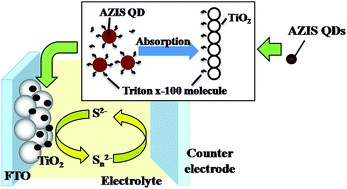
We report the assembly of non-toxic Ag-doped ZnInSe (AZIS) quantum dot (QD)-sensitized solar cells (QDSSC) with a conversion efficiency of 0.89% at 1 sun. The QDs were directly adsorbed on a TiO2 film with the addition of a surface-active agent (Triton X-100). ZnS treatment was performed on QDs by the successive ionic layer adsorption and reaction method to inhibit the recombination current in QDSSCs. The results demonstrated that Triton X-100 increased the QD loading on mesoporous TiO2. The conversion efficiency of an aqueous, non-toxic AZIS QDSSC containing Triton X-100, a ZnS passivating layer and a Cu2S counter electrode reached 0.89% at 1 sun.

1. Introduction

Quantum dot (QD)-sensitized solar cells (QDSSCs) have attracted much attention in recent decades as photo-stable inorganic materials with high molar extinction coefficients and facile tunability of band gaps. The use of QDs as sensitizers was proposed by Zaban et al. in 1998.1 In QDSSCs, excited sensitizer-generated electrons and holes are separated and injected into the semiconductor (e.g., TiO2) and the hole-transporter, respectively. Photoelectrons are transferred through the conductive glass and the external circuit, and recombine with holes at the cathode, forming a complete circuit. Recently, a Cd QD-sensitized solar cell reported by Wang et al.2 achieved a conversion efficiency of 6.76% at 1 sun.

Reported sensitizers of QDSSCs mostly contain cadmium chalcogenide compounds, such as CdS and CdSe,3 or lead chalcogenide compounds, such as PbS and PbSe.4 These kinds of QDSSCs have two main problems. First, the intrinsic toxicity of QDs containing Cd or Pb is a major problem for commercialization. Second, most QDSSCs are sensitized by QDs synthesized via organometallic methods,5 which require high synthesis temperatures and entail a ligand exchange process. QDs synthesized in water, which are simpler to prepare and more environmentally friendly, have not been widely used as sensitizers. The major obstacles to the application of aqueous QDs in solar cells are the low QD loading and the low conversion efficiency.

For aqueous QD-sensitized solar cells, there are two approaches for anchoring QDs on TiO2. The first is the in situ loading approach, including growth of QDs by chemical bath deposition (CBD),6,7 successive ionic layer adsorption and reaction (SILAR),8,9which achieved a high QD loading. However, it is difficult to control the size, chemical composition and surface properties of QDs with these methods. The second is the ex situ loading approach, which is the deposition of pre-synthesized colloidal QDs by linker-assisted adsorption.10,11 In this method band, the band gaps of the QDs can be accurately controlled. A full and even coverage of the sensitizer on mesoporous TiO2 is crucial for QDSSC performance. However, the loading of QDs on mesoporous TiO2 is generally poor, and many methods have been developed to enhance the QD loading. Our group has reported that the loading of linker-capped CdTe QDs on mesoporous TiO2 could be improved via pH-control and using a strong alkaline loading environment.12,13

In this paper, non-toxic aqueous AZIS QDs were adsorbed onto TiO2 via linker-assisted adsorption. The conversion efficiency of AZIS QDSSC containing a surface-active agent (Triton X-100), a ZnS passivating layer and a Cu2S counter electrode reached 0.89% at 1 sun. In addition, the fabrication process for AZIS QDSSCs was optimized and the effect of the ZnS layer was analyzed via its impedance spectrum.

2. Experimental section

2.1 Synthesis of Ag:ZnInSe QDs

The Ag:ZnInSe QD colloidal dispersion was prepared according to our previous work.14 A mixture of Zn(NO3)2, AgNO3, In(NO3)3 and MPA was adjusted to pH 8.0 by using NaOH solution. Freshly prepared NaHSe solution was injected into the mixture after the solution was bubbled with N2 for 30 min. The total concentration of Zn and In in the mixture was 0.01 M. The molar ratio of Zn[thin space (1/6-em)]:[thin space (1/6-em)]In[thin space (1/6-em)]:[thin space (1/6-em)]Ag[thin space (1/6-em)]:[thin space (1/6-em)]Se[thin space (1/6-em)]:[thin space (1/6-em)]MPA was 3[thin space (1/6-em)]:[thin space (1/6-em)]1[thin space (1/6-em)]:[thin space (1/6-em)]0.12[thin space (1/6-em)]:[thin space (1/6-em)]0.8[thin space (1/6-em)]:[thin space (1/6-em)]8. The solution was refluxed at 100 °C for 6 h. The as-prepared QD colloidal dispersion was concentrated 20-fold with a rotary evaporator.

2.2 Preparation of the TiO2 photoanode

Prior to the fabrication of the TiO2 photoanode, fluorine-doped tin oxide (FTO) glass was ultrasonically cleaned sequentially for 10 min in detergent, water, 2-propanol, and acetone. Mesoporous TiO2 films were prepared by screen printing an aqueous slurry of Degussa P25 nanoparticles on the FTO glass. A paste for the scattering layer containing anatase TiO2 particles was deposited by screen printing, forming a light scattering TiO2 film. The substrate was sintered at 450 °C for 30 min. The thickness of the TiO2 films was 20 μm, including the active layer (14 μm) and the scattering layer (6 μm). The area of the TiO2 films was approximately 0.36 cm2 (0.6 × 0.6 cm).

2.3 AZIS coating on TiO2 films and glass

The TiO2 samples were sensitized by direct adsorption of AZIS QDs by immersing the oxide films in the concentrated QD suspension (3.5 mL). Different amounts of Triton X-100 were added to improve the QD loading. The TiO2 film turned brown after immersion for 48 h, indicating the loading of AZIS QDs on TiO2.

2.4 Surface post-treatment: ZnS treatment

To reduce the recombination of photoelectrons further, the QD-loaded TiO2 electrode was coated with a thin ZnS layer by the SILAR method. Sensitized samples were dipped in an 0.1 M Zn(NO3)2 ethanolic solution, and then in a 0.1 M Na2S ethanolic solution for 1 min, washing thoroughly with water between immersions to remove the excess unadsorbed or unreacted ions. This procedure was repeated three times.

2.5 Assembly of the QDSSC

After coating with AZIS QDs, the TiO2 electrode was assembled by sandwiching it with a Pt counter electrode and sealing it with a silicone spacer (∼60 μm). A polysulfide electrolyte, consisting of 0.5 M Na2S, 2 M S and 0.2 M KCl in methanol–water (7[thin space (1/6-em)]:[thin space (1/6-em)]3 v/v), was used in this work.

2.6 Characterization

All optical measurements were performed at room temperature under ambient conditions. UV-vis absorption spectra (UV) were recorded with a Shimadzu 3600 UV-vis near-infrared spectrophotometer. The morphology and chemical composition of the photoanode were examined with a Hitachi S-4800 field-emission scanning electron microscope (SEM) equipped with an energy dispersive X-ray spectrometer (EDS) analyzer (Bruker). For JV curve measurement, a solar simulator (66902, Newport), which has a 450 W xenon lamp with an irradiance of 100 mW cm−2 (equivalent to one sun at AM 1.5) at the surface of the solar cell, was used. The incident photon-to-current conversion efficiency (IPCE) was measured with a 300 W xenon lamp and a lock-in amplifier (Oriel) in the wavelength range of 300–800 nm. Electrochemical impedance spectra (EIS) were measured by applying a 10 mV AC signal over a frequency range of 0.1 Hz to 100 kHz under dark conditions at various bias voltages with a CS350 electrochemical workstation (CorrTest).

3. Results and discussion

Water soluble, as-prepared Ag:ZnInSe quantum dots were directly adsorbed onto mesoporous TiO2. The Ag:ZnInSe QD colloidal dispersion was prepared by reflux at 100 °C for 6 h. TiO2 films were prepared by screen printing TiO2 particles on FTO and sintering at 450 °C. QDs were loaded on TiO2 via immersing the TiO2 film in an AZIS suspension. Low QD loading was obtained because of the effect of electrostatic repulsion and van der Waals forces between TiO2 and QDs.12 A surface-active agent was added to the QD suspension to increase the adsorption (Scheme 1). The TiO2 and QDs were coated with a ZnS passivation layer to reduce recombination in QDSSCs.
image file: c5ra04242a-s1.tif
Scheme 1 Structure and fabrication of AZIS QDSSCs. Non-toxic AZIS QDs were directly adsorbed onto the TiO2 film. Triton X-100 was used to increase the adsorption of AZIS QDs.

Fig. 1 shows the optical absorption spectrum of QD-sensitized photoanodes with different amounts of Triton X-100. All photoanodes were immersed in the QD suspension for 48 h. For the TiO2 and TiO2/QDs samples (black and green lines, respectively, Fig. 1), the absorbance of TiO2 was improved after being immersed in the QD suspension, indicating the effective QD loading on TiO2. Fig. 2 shows the absorption spectrum of the sample containing 30 mg Triton X-100, from which the absorption spectrum of TiO2 was subtracted. The results were consistent with the absorption spectrum of AZIS QDs reported by Wang et al.,14 which covered 400–700 nm. The IPCE spectrum is shown in the inset of Fig. 2. The quantum efficiency (QE) of AZIS QDSSC is clearly visible at 400–600 nm, which proved that AZIS QDs absorbed and converted photons into electrons in the region of 400–600 nm.


image file: c5ra04242a-f1.tif
Fig. 1 Absorption spectra of TiO2 and TiO2/QDs samples fabricated with 0, 15, 30, 45, and 60 mg Triton X-100. The corresponding Triton X-100 concentrations for these samples were 0, 0.16, 0.32, 0.48, and 0.64 mM, respectively. The inset shows absorption intensity of the TiO2/QDs samples at 450 nm.

image file: c5ra04242a-f2.tif
Fig. 2 Absorption spectrum of the TiO2/QDs sample fabricated with 30 mg Triton X-100. The absorption intensity of TiO2 was subtracted. The corresponding IPCE spectrum of the TiO2/QDs sample is shown in the inset. A Pt counter electrode and polysulfide electrolyte were used to form a sandwich-type configuration.

The absorption intensity at 450 nm of the samples with different amounts of Triton X-100 is shown in the inset of Fig. 1. The absorption intensity of TiO2 was subtracted. The absorption intensity of the sensitized photoanodes increased with the increase in the amount of Triton X-100 from 0 to 30 mg, and then the intensity decreased from 30 to 60 mg. The sample containing 30 mg Triton X-100 showed the largest absorbance. The trend in absorption intensity at 450 nm indicated that the weight of Triton X-100 added to the suspension affected the loading quantity of QDs on the photoanode. The maximum QD loading was achieved with 30 mg Triton X-100, resulting in the highest absorption intensity.

Liquid electrolyte-based solar cells were assembled by sandwiching an AZIS QD-sensitized TiO2 film and a Pt counter electrode, using a silicone spacer (thickness ∼60 μm), and a droplet (20 μL) of polysulfide electrolyte. The results of the photocurrent–voltage (JV) curves of AZIS QD-sensitized solar cells containing various amounts of Triton X-100 are shown in Fig. 3. Each TiO2 film was immersed in the concentrated QD colloidal dispersion for 48 h. Table 1 lists the photovoltaic parameters. The short-circuit current density (JSC) and the open-circuit voltage (VOC) increased as the amount of Triton X-100 increased, reaching a maximum value of 2.7 mA cm−2 and 0.48 V, respectively, at 30 mg. When more than 30 mg of Triton X-100 was added, JSC and VOC started to decrease. However, the fill factor (FF) increased from 0.37 to 0.40 when the amount of Triton X-100 increased from 0 to 15 mg. The FF remained relatively constant (0.39–0.40) in the range of 15–45 mg, and then it decreased to 0.35 when 60 mg Triton X-100 was added. As the amount of Triton X-100 increased, the conversion efficiency (η) initially increased and then decreased after reaching a maximum value of 0.50% at 30 mg. Consequently, the photovoltaic parameters of QDSSCs were optimal when 30 mg Triton X-100 was added. The conversion efficiency of QDSSCs with 30 mg Triton X-100 was improved by 32% compared with that of QDSSCs fabricated without Triton X-100.


image file: c5ra04242a-f3.tif
Fig. 3 JV curves of AZIS QDSSCs fabricated with 0, 30 (with and without ZnS passivating layer) and 60 mg of Triton X-100, corresponding to concentrations of 0, 0.32, and 0.64 mM, respectively.
Table 1 Photovoltaic parameters of AZIS QDSSCs fabricated with 0, 15, 30 (with and without ZnS passivating layer), 45, and 60 mg of Triton X-100, corresponding to concentrations of 0, 0.16, 0.32, 0.48, and 0.64 mM, respectively
Triton X-100 (mg) VOC (V) JSC (mA cm−2) FF η (%)
0 0.44 2.31 0.37 0.38
15 0.46 2.48 0.40 0.46
30 0.48 2.70 0.39 0.50
45 0.47 2.46 0.40 0.46
60 0.46 2.52 0.35 0.41
30 (with ZnS) 0.55 3.56 0.36 0.71


This analysis shows that QDSSCs with 30 mg Triton X-100 showed the maximum QD loading and the highest photocurrent. The highest QD loading resulted in the most compact QD layer on the TiO2 surface, which increased the VOC and FF.15 An energy dispersive spectrometer (EDS) was employed to test the QD loading. The Se/Ti atomic ratios at different depths in samples containing 0, 30, and 60 mg Triton X-100 were measured by EDS (Fig. 4). The thickness of the TiO2 films was determined as 20 μm from the SEM images shown as insets in Fig. 4. The Se/Ti ratio of the three samples remained relatively stable in the range 2–20 μm, indicating the uniform distribution of QDs in mesoporous TiO2. Cross-sectional SEM images of the TiO2 photoanode and an enlarged SEM image of the scattering layer are presented in Fig. S1. The QD loading on mesoporous TiO2 was closely related to the size of the TiO2 particles. The scattering layer was a mixture of large TiO2 spherical particles and smaller TiO2 nanoparticles. Therefore, the QD loading on the scattering layer (range of 2–6 μm) of the three samples was similar to that on the active layer. Similar observations of the mixed scattering layer were reported by Zhou et al.16


image file: c5ra04242a-f4.tif
Fig. 4 Se/Ti atomic ratio at different depths (from 2 to 20 μm) of QD-sensitized photoanodes with 0, 30, and 60 mg Triton X-100, corresponding to 0, 0.32, and 0.64 mM respectively. Inset map shows the SEM image for the corresponding average ratios.

Furthermore, the Se/Ti atomic ratio of the sample fabricated with 30 mg Triton X-100 was higher than those of other two samples were. The average atomic ratios at each depth were calculated and are illustrated in the inset maps (Fig. 4). The average Se/Ti atomic ratio increased when the amount of Triton X-100 increased from 0 to 30 mg, indicating the increase in QD loading in TiO2. However, the QD loading decreased for the sample containing 60 mg Triton X-100. This trend confirmed that 30 mg Triton X-100 improved the QD loading, whereas Triton X-100 concentrations of more than 0.32 mM reduced the loading.

Scheme 2 shows the loading process for QDs with Triton X-100. For 30 mg Triton X-100, the concentration in solution was 0.32 mM, which was close to the critical micelle concentration (cmc) of Triton X-100 (0.27 mM).17 As shown in Scheme 2a, Triton X-100 existed as single molecules when its concentration was below the cmc. Triton X-100 capped QDs were adsorbed on the surface of TiO2 through hydrophobic interactions, leading to the increase in QD loading on mesoporous TiO2. In comparison, Triton X-100 formed micelles when its concentration was above the cmc (Scheme 2b). The micelle-capped QDs tended to disperse in solution rather than adsorbing on the mesoporous TiO2. Consequently, the highest QD loading was achieved at a concentration close to the cmc (30 mg). The higher QD loading can also block the nanochannels in parts of the mesoporous TiO2, which may explain why the QD distribution in the sample containing 30 mg Triton X-100 was less uniform than in the other two samples.


image file: c5ra04242a-s2.tif
Scheme 2 AZIS QD loading on mesoporous TiO2 in solution with the concentration of Triton X-100 (a) below and (b) above the cmc.

The absorption intensity at 450 nm of AZIS QD-sensitized photoanodes for different absorption times is shown in Fig. 5. All samples were fabricated with 30 mg Triton X-100. The absorption intensity of the sensitized photoanode increased sharply during 0–24 h, and it increased slightly during 24–48 h. For adsorption times of more than 48 h, the absorption intensity remained almost unchanged, indicating that the adsorption process had reached equilibrium. Therefore, 48 h was considered sufficient for QDs to be adsorbed onto mesoporous TiO2.


image file: c5ra04242a-f5.tif
Fig. 5 Absorption intensity at 450 nm of QD-sensitized photoanodes with adsorption times ranging from 0 to 72 h. The adsorption solution contained 30 mg Triton X-100.

In addition, we measured the photovoltaic performance of QDSSC sensitized by ZnInSe (ZIS) QDs. The JV curves of ZIS and AZIS QDSSCs are shown in Fig. S2. VOC, JSC and conversion efficiency of ZIS QDSSCs were much lower than those of AZIS QDSSCs. Ag doping in the ZIS QDs introduced anion vacancies and provided an intermediate level between the conduction band of ZnInSe and TiO2.18 A gradient alignment of the energy levels, which was favorable for the transport of photoelectrons, was formed in the sensitized photoanode.19

The effect of ZnS surface treatment on AZIS QDSSCs has been investigated. A sensitized photoanode with 30 mg Triton X-100 was treated with ZnS three times by SILAR (assembled with Pt electrode), forming a sandwich-type configuration. Polysulfide electrolyte was used as the hole transporting medium. The JV curve of the ZnS-coated QDSSC is presented in Fig. 3 (blue line). The parameters of this QDSSC are listed in Table 1. JSC and VOC of the sample with 30 mg Triton X-100 increased considerably after ZnS coating. VOC increased from 0.48 to 0.55 V, and JSC increased from 2.70 to 3.56 mA. The conversion efficiency increased by 42%, reaching 0.71% after the ZnS coating. The ZnS layer effectively passivated the surface states of QDs and TiO2. Electron leakage at the TiO2/electrolyte interface was inhibited, which probably increased VOC and JSC.20 However, the FF of the coated sample decreased from 0.39 to 0.36, which was caused by the blockage of the mesoporous TiO2 and the inhibition of the electrolyte saturation by the ZnS coating, as reported by Shen et al.21

Recombination resistance (Rr) at the TiO2/electrolyte interface of AZIS QDSSCs was measured by EIS. Solar cells were assembled into a sandwich-type configuration and various biases were applied. The Rr of samples under different biases were extracted by fitting Nyquist plots with the equivalent circuit described by Gonzàlez-Pedro et al.22 Fig. 6 shows the Nyquist plots of samples with and without a ZnS layer under a bias of −0.4 V. Experimental data and the resulting fitting curves are shown as symbols and as solid lines, respectively. The fitting curves matched the experimental results well. The larger arc in the Nyquist plot, which represented the scale of Rr, increased after ZnS coating. The Rr of the samples as a function of the bias is presented in Fig. 7. The decrease in Rr with the increase in bias was caused by the upward shift of the TiO2 Fermi level under higher biases.20 Rr of the sample increased after ZnS coating under each bias, which indicated a lower recombination current at the TiO2/electrolyte interface.


image file: c5ra04242a-f6.tif
Fig. 6 Nyquist plots of AZIS QDSSCs with and without the ZnS passivating layer. Samples were fabricated with 30 mg Triton X-100 and 48 h adsorption time.

image file: c5ra04242a-f7.tif
Fig. 7 Rr of samples as a function of bias. Samples were fabricated with 30 mg Triton X-100 and 48 h adsorption time.

The FFs of the AZIS QDSSCs with a Pt counter electrode ranged from 0.35 to 0.40 (Table 1). The unfavorable FFs were attributed to resistance losses in the device, including losses at each interface and in the electrolyte. The Pt counter electrode is not an ideal catalyst for the polysulfide redox reaction, which contributed to the poor FF of the cell. To achieve a higher FF and conversion efficiency, the Pt electrode was replaced with a Cu2S counter electrode. Fig. 8 shows the JV curve and photovoltaic parameters of the AZIS QDSSC containing the Cu2S electrode and fabricated under optimal conditions. The FF was increased from 0.36 to 0.57. A higher conversion efficiency of 0.89% at 1 sun was also obtained.


image file: c5ra04242a-f8.tif
Fig. 8 JV curve of AZIS QDSSC fabricated with 30 mg Triton X-100, 48 h adsorption time and three ZnS coatings. A Cu2S counter electrode was used.

Compact coverage of QDs on a mesoporous TiO2 network, suppression of electron recombination and catalytic capability of counter electrode were crucial factors for improving the QDSSCs performance. The absorption spectrum and EDS showed that the maximum amount of AZIS QDs were loaded onto the TiO2 photoanode when 30 mg Triton X-100 was added to the QD suspension. EIS confirmed that recombination at the TiO2/electrolyte interface was reduced by ZnS treatment. With optimal fabrication (30 mg Triton X-100, 48 h adsorption, three ZnS coatings and Cu2S electrode), the highest efficiency achieved for the AZIS QDSSC was 0.89% at 1 sun. In addition, we avoided the ligand exchange process by synthesizing and loading MPA capped AZIS QDs in aqueous solution, which makes AZIS QDSSC a nontoxic, easily fabricated, efficient QDSSC.

4. Conclusion

Non-toxic Ag:ZnInSe QDSSCs were successfully assembled by linker-assisted direct adsorption. Triton X-100 was used to improve the QD loading on mesoporous TiO2, and optimal QD loading was achieved with 30 mg Triton X-100. The recombination current of QDSSC was inhibited by the ZnS passivating layer. Finally, immersing the TiO2 film in the QD suspension for 48 h, addition of 30 mg Triton X-100, three ZnS coatings, and using a Cu2S electrode resulted in a QDSSC efficiency of 0.89% at 1 sun. The QDSSC is non-toxic and our method of improving QD loading is convenient.

Acknowledgements

This work is supported by the National Key Basic Research Program of China (Grant no. 2015CB352002), National Natural Science Foundation of China (Grant nos 61475034, 21403034, 61177033), the Fundamental Research Funds for the Central Universities (no. 2242014R30006), and the natural science foundation of Jiangsu Province Youth Fund (no. BK20140650), China Postdoctoral Science Foundation (no. 2014M560370), Jiangsu Planned Projects for Postdoctoral Research Funds (no. 1401035B).

References

  1. A. Zaban, O. I. Micic, B. A. Gregg and A. J. Nozik, Langmuir, 1998, 14, 3153–3156 CrossRef CAS.
  2. J. Wang, I. Mora-Sero, Z. X. Pan, K. Zhao, H. Zhang, Y. Y. Feng, G. Yang, X. H. Zhong and J. Bisquert, J. Am. Chem. Soc., 2013, 135, 15913–15922 CrossRef CAS PubMed.
  3. J. Debgupta, S. Mandal, H. Kalita, M. Aslam, A. Patra and V. Pillai, RSC Adv., 2014, 4, 13788–13795 RSC.
  4. D. Ding, Y. L. Chen, P. Lv, H. Z. Yao, Y. N. Mu, S. Su, X. L. Zhang, L. Y. Zhou, W. Y. Fu and H. B. Yang, RSC Adv., 2015, 5, 6462–6469 RSC.
  5. J. H. Park, S. J. Kang, S. Kim, H. Lee and J. S. Lee, RSC Adv., 2014, 4, 51471–51476 RSC.
  6. Y. L. Lee and Y. S. Lo, Adv. Funct. Mater., 2009, 19, 604–609 CrossRef PubMed.
  7. C. S. Kim, S. H. Choi and J. H. Bang, ACS Appl. Mater. Interfaces, 2014, 6, 22078–22087 CAS.
  8. H. Lee, M. K. Wang, P. Chen, D. R. Gamelin, S. M. Zakeeruddin, M. Gratzel and M. K. Nazeeruddin, Nano Lett., 2009, 9, 4221–4227 CrossRef CAS PubMed.
  9. C. Chen, Q. L. Dai, C. Miao, L. Xu and H. W. Song, RSC Adv., 2015, 5, 4844–4852 RSC.
  10. N. Guijarro, T. Lana-Villarreal, I. Mora-Sero, J. Bisquert and R. Gomez, J. Phys. Chem. C, 2009, 113, 4208–4214 CAS.
  11. W. J. Li, Z. X. Pan and X. H. Zhong, J. Mater. Chem. A, 2015, 3, 1649–1655 CAS.
  12. X. Y. Lin, C. L. Wang, S. H. Xu and Y. P. Cui, J. Phys. D: Appl. Phys., 2014, 47, 015103 CrossRef.
  13. F. Bo, C. L. Wang, S. H. Xu, C. F. Zhang, Z. Y. Wang and Y. P. Cui, J. Phys. D: Appl. Phys., 2014, 47, 305101 CrossRef.
  14. C. L. Wang, S. H. Xu, Y. J. Shao, Z. Y. Wang, Q. Y. Xu and Y. P. Cui, J. Mater. Chem. C, 2014, 2, 5111–5115 RSC.
  15. K. Y. Yan, W. Chen and S. H. Yang, J. Phys. Chem. C, 2013, 117, 92–99 CAS.
  16. R. Zhou, Q. F. Zhang, E. Uchaker, L. Yang, N. Q. Yin, Y. H. Chen, M. Yin and G. Z. Cao, Electrochim. Acta, 2014, 135, 284–292 CrossRef CAS PubMed.
  17. C. U. Herrmann and M. Kahlweit, J. Phys. Chem., 1980, 84, 1536–1540 CrossRef CAS.
  18. E. Hao, Y. P. Sun, B. Yang, X. Zhang, J. M. Liu and J. C. Shen, J. Colloid Interface Sci., 1998, 204, 369–373 CrossRef CAS PubMed.
  19. L. Yang, R. Zhou, J. L. Lan, Q. F. Zhang, G. Z. Cao and J. G. Zhu, J. Mater. Chem. A, 2014, 2, 3669–3676 CAS.
  20. I. Mora-Sero, S. Gimenez, F. Fabregat-Santiago, R. Gomez, Q. Shen, T. Toyoda and J. Bisquert, Acc. Chem. Res., 2009, 42, 1848–1857 CrossRef CAS PubMed.
  21. Q. Shen, J. Kobayashi, L. J. Diguna and T. Toyoda, J. Appl. Phys., 2008, 103, 084304 CrossRef PubMed.
  22. V. Gonzalez-Pedro, X. Q. Xu, I. Mora-Sero and J. Bisquert, ACS Nano, 2010, 4, 5783–5790 CrossRef CAS PubMed.

Footnote

Electronic supplementary information (ESI) available. See DOI: 10.1039/c5ra04242a

This journal is © The Royal Society of Chemistry 2015
Click here to see how this site uses Cookies. View our privacy policy here.