

DDQ-mediated synthesis of functionalized unsymmetrical disulfanes†
Mateusz Musiejuk,
Tomasz Klucznik,
Janusz Rachon and
Dariusz Witt*
Department of Organic Chemistry, Chemical Faculty, Gdansk University of Technology, Narutowicza 11/12, 80-233 Gdansk, Poland. E-mail: chemwitt@pg.gda.pl
First published on 25th March 2015
Abstract
We developed a simple and efficient method for the synthesis of functionalized unsymmetrical disulfanes under mild conditions in good yields. The designed method is based on the reaction of bis(5,5-dimethyl-2-thioxo-1,3,2-dioxaphosphorinan-2-yl)disulfane with thiols in the presence of 2,3-dichloro-5,6-dicyanobenzoquinone (DDQ). The developed method allows the preparation of unsymmetrical disulfanes bearing additional hydroxy, carboxy, or amino functionalities.
Compounds with the structure R–S–S–R, where the R group can be alkyl, vinyl or aryl are termed symmetrical disulfides when the R groups are the same. The wide range of unsymmetrical disulfides in which the R groups are different is also well known. These compounds are often termed organic disulfides in the literature; however, the IUPAC recommended nomenclature is disulfanes.1 The name disulfide should only be applied to ionic compounds, such as sodium disulfide (Na2S2). Moreover, the term disulfane is more widely applicable than disulfide because it facilitates naming, even when the R groups are acyl and/or phosphoryl.
The synthesis of unsymmetrical disulfanes is an important transformation in organic synthesis and medicinal chemistry.2–5 Recent developments in disulfide bond formation have been reviewed.6–9 Although many different methods exist for the preparation of unsymmetrical disulfanes, the most prevalent approach involves substitution of a sulfenyl derivative with a thiol or its derivative. To date, the most commonly utilized sulfenyl derivatives are the following: sulfenyl chlorides,10–12 S-alkyl thiosulfates and S-aryl thiosulfates (Bunte salts),13,14 S-alkylsulfanyl-isothioureas,15 benzothiazol-2-yl disulfanes,16,17 benzotriazolyl-sulfanes,18 dithioperoxyesters,19 (alkylsulfanyl)dialkylsulfonium salts,20 2-pyridyl disulfanes and derivatives,21,22 N-alkyltetrazolyldisulfanes,23 sulfenamides,24 sulfenyldimesylamines,25 sulfenylthiocyanates,26 4-nitroarenesulfenanilides,27 thiolsulfinates and thiolsulfonates,28–31 sulfanylsulfinamidines,32 thionitrites,33 sulfenylthiocarbonates,34 thioimides,35–37 and thiophosphonium salts.38 Other practical procedures involve the reaction of a thiol with a sulfinylbenzimidazole,39 the rhodium-catalyzed disulfide exchange,40,41 an electrochemical method,42 ring opening of aziridines using tetrathiomolybdate in the presence of symmetrical disulfanes,43,44 and the use of diethyl azodicarboxylate (DEAD)45 or a solid support46 in a sequential coupling of two different thiol groups. Recently, the oxidation of a mixture of two different thiols by 2,3-dichloro-5,6-dicyanobenzoquinone (DDQ) to produce an unsymmetrical disulfane has also been reported.47,48
Disulfanes have been used for the preparation of self-assembled monolayers (SAMs)49,50 and monolayer-protected clusters (MPCs) with a number of versatile properties.51,52 Compounds containing the disulfide linkage have also been used for the preparation of dynamic combinatorial libraries,53 catenanes,54,55 macrocycles,5,56 carceplexes,57 dendrimers,58 rotaxanes, micelles,59,60 and a wide range of chemosensors and pro-drugs.61 These species illustrate the wide applications of disulfanes and show that the synthesis of the disulfide bond is a critical transformation in organic chemistry.6–9
We have previously demonstrated the preparation of functionalized unsymmetrical molecules, such as dialkyldisulfanes,62 alkyl–aryl disulfanes,63 ‘bioresistant’ disulfanes,64 the unsymmetrical disulfanes of L-cysteine and L-cystine,65 and diaryldisulfanes,66 based on the readily available 5,5-dimethyl-2-thioxo-1,3,2-dioxaphosphorinane-2-disulfanyl derivatives 1. These disulfanyl derivatives 1 of phosphorodithioic acid were also convenient for the preparation of α-sulfenylated carbonyl compounds,67 functionalized phosphorothioates,68 as well as symmetrical69,70 and unsymmetrical71,72 trisulfanes (Fig. 1).
 | ||
| Fig. 1 Synthetic applications of unsymmetrical disulfanes 1. | ||
As part of our continued interest in the preparation of functionalized unsymmetrical disulfanes, in this study, we report an efficient and convenient synthesis of unsymmetrical disulfanes 1 directly from phosphorodithioic acid disulfane 2a and functionalized thiols 3.
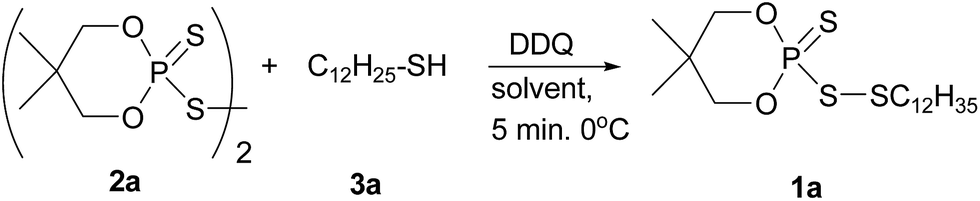
Wang and co-workers have developed a new method for the synthesis of unsymmetrical disulfanes from simple aliphatic and aromatic thiols using DDQ as the oxidant.47 This method is particularly interesting due to its apparent selectivity for the exclusive formation of unsymmetrical disulfanes, despite the presence of two different thiols in the reaction mixture in a 1![[thin space (1/6-em)]](https://www.rsc.org/images/entities/char_2009.gif) :1 ratio before the addition of DDQ. We expected that this method might also be applicable to the synthesis of unsymmetrical disulfanes 1. As a test reaction, 5,5-dimethyl-2-sulfanyl-2-thioxo-1,3,2-dioxaphosphorinane and dodecane-1-thiol 3a (1:1 ratio) were mixed and then treated with DDQ (0.5 equivalent) following Wang's procedure.47 Unfortunately, the yield of unsymmetrical disulfane 1a after separation was moderate, and the observed ratio of products (1a:2a:4) was typical for the oxidation of most thiol mixtures8 (Fig. 2).
:1 ratio before the addition of DDQ. We expected that this method might also be applicable to the synthesis of unsymmetrical disulfanes 1. As a test reaction, 5,5-dimethyl-2-sulfanyl-2-thioxo-1,3,2-dioxaphosphorinane and dodecane-1-thiol 3a (1:1 ratio) were mixed and then treated with DDQ (0.5 equivalent) following Wang's procedure.47 Unfortunately, the yield of unsymmetrical disulfane 1a after separation was moderate, and the observed ratio of products (1a:2a:4) was typical for the oxidation of most thiol mixtures8 (Fig. 2).
 | ||
| Fig. 2 Oxidation of phosphorodithioic acid and thiol 3a mixture by DDQ. | ||
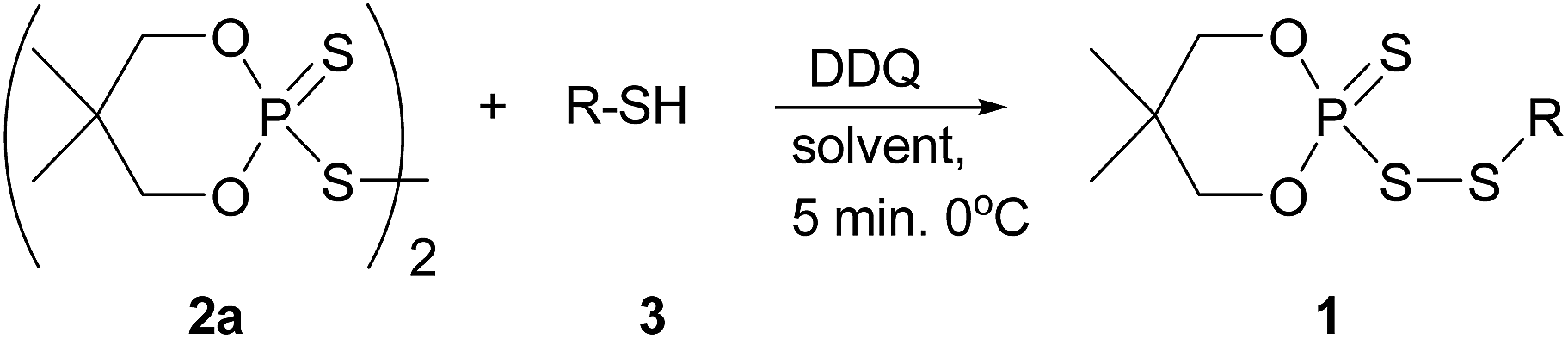
Although Wang and co-workers did not discuss the mechanism of the formation of the unsymmetrical disulfanes, it can be speculated that DDQ converts the more easily oxidized thiol to the symmetrical disulfane and the second thiol to the alkylthio radical (thiyl radical RS˙) which then reacts with symmetrical disulfane to produce the unsymmetrical product. To verify this hypothesis, we performed a reaction of bis-(5,5-dimethyl-2-thioxo-1,3,2-dioxaphosphorinan-2-yl) disulfane 2a (variable amount) and dodecane-1-thiol 3a (1 equivalent) in the presence of DDQ (0.5 equivalent) (Table 1).
As the data in Table 1 demonstrate, the excess symmetrical disulfane 2a improved the yield of unsymmetrical product 1a. The reactions using 1 equivalent of disulfane 2a in CH2Cl2 and CH3CN produced unsymmetrical product 1a in a 99% and 96% yield, respectively (entry 4). Further studies were performed with 1 equivalent of disulfane 2a because the yield of product 1a was high when the excess amount of 2a was acceptable.
Under the optimized conditions, the scope and limitations of this new unsymmetrical disulfane formation reaction were investigated, and the results are summarized in Table 2.
|
||||
|---|---|---|---|---|
| Entry | RSH | Product | Yieldb (%) | |
| CH2Cl2 | CH3CN | |||
| a Conditions: disulfane 2a (1 mmol), thiol 3 (1 mmol), DDQ (0.5 mmol), 4.0 mL of solvent.b Isolated yields. | ||||
| 1 | HS–(CH2)11CH3 3a | 1a | 99 | 96 |
| 2 | HS–(CH2)11OH 3b | 1b | 88 | 89 |
| 3 | HS–(CH2)10CO2H 3c | 1c | 77 | 82 |
| 4 | HS–(CH2)11N3 3d | 1d | 93 | 96 |
| 5 | HS–(CH2)10CONHS 3e | 1e | 88 | 89 |
| 6 | HS–(CH2)10CO–ferrocene 3f | 1f | 82 | 85 |
| 7 | HS–Ph 3g | 1g | 99 | 98 |
| 8 | HS–C6H4–4-CH3 3h | 1h | 98 | 97 |
| 9 | HS–C6H4–2-CO2H 3i | 1i | 96 | 95 |
| 10 | HS–(CH2)9–CH![[double bond, length as m-dash]](https://www.rsc.org/images/entities/char_e001.gif) CH2 3j CH2 3j |
1j | 87 | 92 |
| 11 | Ac–Cys–OH 3k | 1k | — | 89 |
| 12 | HS–(CH2)11NH2·HCl 3l | 1l | 0 | 0 |
A broad range of thiols reacted smoothly under the optimized reaction conditions. The reaction was tolerant of various functional groups, including the hydroxy, carboxy, azide, ferrocene, active ester and carbon–carbon double bond groups. Aromatic thiols (3g–i) underwent disulfide bond formation to furnish the desired products (1g–i) with excellent yields (95–99%, entries 7–9, Table 2). Steric hindrance does not appear to affect the progress of the reaction (entry 9, Table 2). The aliphatic thiols also provided unsymmetrical disulfanes 1 in high yields (77–99%, entries 1–6, Table 2). Note that the aliphatic thiol 3j underwent the reaction in the presence of a carbon–carbon double bond (entry 10, Table 2), and the hydroxy and carboxy groups did not require protection (entries 2–3, Table 2). In the case of N-acetyl-L-cysteine 3k, the reaction did not occur in CH2Cl2 due to the low solubility of the starting material in the solvent. However, using acetonitrile as the solvent allowed the preparation of the corresponding unsymmetrical disulfane 1k in high yield (89%, entry 11, Table 2).
Unfortunately, an unprotected amino group was not tolerated under the developed conditions. Although thiol 3l was consumed during the reaction, the unsymmetrical disulfane was not produced (entry 12, Table 2). DDQ most likely reacted with an amino group to produce a complex reaction mixture without the formation of unsymmetrical disulfane 1l. Similar unsuccessful results have also been observed by Wang and co-workers in the case of amine-substituted thiols.47 To overcome that limitation, we decided to use protected amino-thiols under the developed conditions (Table 3).

Our data show that the protection of the amino group plays a vital role in the yield of the unsymmetrical disulfanes 1m and 1n. When the amino group is protected by a single Boc group, the corresponding unsymmetrical disulfane 1m is produced in moderate yield (53–56%, entry 2, Table 3). However, using thiol 3n with a double-protected amino group provided unsymmetrical product 1n in high yields (94–96%, entry 3, Table 2). The appropriate protection of the amino group appears to facilitate the preparation of unsymmetrical disulfanes 1m and 1n under the developed reaction conditions.
We were curious to continue our investigation with other symmetrical disulfanes, such as 2,2′-dipyridyl disulfane 2b and diphenyldisulfane 2c (Table 4).


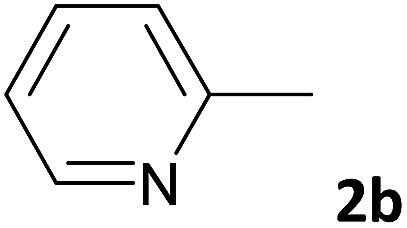
As demonstrated, the formation of unsymmetrical disulfanes 1 strongly depends on the structure of the starting material 2. In the case of disulfane 2a and 2b, the unsymmetrical product 1 was obtained in 99% and 23% yield, respectively. However, the reaction of diphenyldisulfane 2c with dodecane-1-thiol 3a in the presence of DDQ did not produce an unsymmetrical product, and exclusive formation of didodecyldisulfane 4 was observed. The determination of the scope of disulfanes 2 capable of producing unsymmetrical disulfanes under the developed conditions is under investigation.
The suggested mechanism to explain this transformation involves the initial formation of the thiyl radical (RS˙) through the oxidation of thiol RSH 3 by DDQ. The resulting thiyl radical reacts with the symmetrical disulfane 2a to yield the unsymmetrical product 1 and the phosphorodithioic acid radical, which undergoes recombination to produce symmetrical disulfane 2a (Fig. 3).
 | ||
| Fig. 3 Plausible reaction mechanism. | ||
The phosphorodithioic acid radical cannot extract hydrogen from the starting thiol because in this case, the catalytic amount of DDQ would be sufficient to produce unsymmetrical disulfane 1 in high yield. When a smaller amount of DDQ was used, a lower yield of product was obtained. In addition, we did not observe the formation of phosphorothioic acid in the reaction mixture. Moreover, the suggested mechanism explains why the excess of disulfane 2 improved the yield of the reaction. The initially formed thiyl radical (RS˙) can undergo either recombination or reaction with product 1 to produce symmetrical disulfane RSSR. These side reactions can be avoided when an excess of disulfane 2 is present in the reaction mixture. The reactivity of symmetrical disulfane 2 with the thiyl radical appears to play a vital role in the formation of unsymmetrical disulfane 1. Most likely, 2,2′-dipyridyl disulfane 2b and diphenyldisulfane 2c are less reactive toward thiyl radicals than the produced unsymmetrical disulfanes 1, which resulted in the formation of symmetrical disulfane 4 (entries 2–3, Table 4).
Conclusions
In summary, we developed an efficient and convenient method for the preparation of unsymmetrical disulfanes 1 directly from the disulfane of phosphorodithioic acid 2a and functionalized thiols 3 in the presence of DDQ. A wide range of functional groups is tolerated, including the hydroxy, carboxy, azido, ferrocene, protected amino, and carbon–carbon double bond groups. Reactions of 2a with a variety of functionalized thiols 3 in the presence of DDQ in CH2Cl2 or CH3CN at 0 °C were generally complete within 5 minutes and gave unsymmetrical disulfanes 1 exclusively in good or very good yield after isolation. The simplicity and good yields render this method one of the most attractive approaches to the preparation of functionalized unsymmetrical disulfanes, especially derivatives of phosphorodithioic acid with versatile synthetic applications.General procedure for the preparation of disulfanyl derivatives 1 and representative analytical data
A thiol 3 (1.0 mmol) and bis-(5,5-dimethyl-2-thioxo-1,3,2-dioxaphosphorinan-2-yl) disulfane 2a 394 mg (1.0 mmol) were dissolved in solvent (2.0 mL, dichloromethane or acetonitrile) and cooled to 0 °C in the ice bath. Then a solution of DDQ 114 mg (0.5 mmol) in solvent (2.0 mL, dichloromethane or acetonitrile) was added slowly to the reaction mixture and stirred for 5 min at 0 °C. The reaction was monitored by TLC analysis. Solvent was removed under reduced pressure and the residue was directly purified by column chromatography (SiO2) to afford the desired products (1a–1n).Acknowledgements
We gratefully acknowledge the National Science Centre (NCN) for financial support (grant no. 2013/09/B/ST5/01261).Notes and references
- R. Steudel, Chem. Rev., 2002, 102, 3905 CrossRef CAS PubMed.
- R. Cremlyn and J. An, Introduction to Organosulfur Chemistry, Wiley, New York, 1996 Search PubMed.
- S. Oae, Organic Sulfur Chemistry: Structure and Mechanism, CRC Press, Boca Raton FL, 1991 Search PubMed.
- V. M. Vrudhula, J. F. MacMaster, L. Zhengong, D. E. Kerr and P. D. Senter, Bioorg. Med. Chem. Lett., 2002, 12, 359 CrossRef.
- Y. Mu, M. Nodwell, J. L. Pace, J. P. Shaw and J. K. Judice, Bioorg. Med. Chem. Lett., 2004, 14, 735 CrossRef CAS PubMed.
- I. Shcherbakova and A. F. Pozharskii, in Comprehensive Organic Functional Group Transformations II, ed. A. R. Katritzky, R. Taylor and C. Ramsden, Pergamon, Oxford, 2004, vol. 2, pp. 177–187 Search PubMed.
- R. Sato and T. Kimura, in Science of Synthesis, ed. N. Kambe, J. Drabowicz and G. A. Molander, Thieme, Stuttgart-New York, 2007, vol. 39, pp. 573–588 Search PubMed.
- D. Witt, Synthesis, 2008, 2491 CrossRef CAS PubMed.
- B. Mandal and B. Basu, RSC Adv., 2014, 4, 13854 RSC.
- T. Endo, H. Tasai and T. Ishigami, Chem. Lett., 1975, 813 CrossRef CAS.
- D. N. Harpp, B. T. Friedlander, C. Larsen, K. Steliou and A. Stockton, J. Org. Chem., 1978, 43, 3481 CrossRef CAS.
- C. Brown and G. R. Evans, Tetrahedron Lett., 1996, 37, 9101 CrossRef CAS.
- J. M. Swan, Nature, 1957, 180, 643 CrossRef CAS.
- P. Hiver, A. Dicko and D. Paquer, Tetrahedron Lett., 1994, 35, 9569 CrossRef CAS.
- K. Sirakawa, O. Aki, T. Tsujikawa and T. Tsuda, Chem. Pharm. Bull., 1970, 18, 235 CrossRef CAS.
- A. L. Ternay, C. Cook and E. Brzezinska, Phosphorus, Sulfur Silicon Relat. Elem., 1994, 95, 351 CrossRef.
- A. L. Ternay and E. Brzezinska, J. Org. Chem., 1994, 59, 8239 CrossRef.
- R. Hunter, M. Caira and N. Stellenboom, J. Org. Chem., 2006, 71, 8268 CrossRef CAS PubMed.
- C. Leriverend and P. Metzner, Synthesis, 1994, 761 CrossRef CAS.
- P. Dubs and R. Stuessi, Helv. Chim. Acta, 1976, 59, 1307 CrossRef CAS.
- D. H. R. Barton, C. Chen and M. G. Wall, Tetrahedron, 1991, 47, 6127 CrossRef CAS.
- D. H. R. Barton, A. C. O'Sullivan and M. M. Pechet, J. Org. Chem., 1991, 56, 6697 CrossRef CAS.
- M. Ohtani and N. Narisada, J. Org. Chem., 1991, 56, 5475 CrossRef CAS.
- M. Bao and M. Shimizu, Tetrahedron, 2003, 59, 9655 CrossRef CAS PubMed.
- A. Blaschette and M. Naveke, Chem.-Ztg., 1991, 115, 61 CAS.
- R. G. Hiskey and B. F. Ward Jr, J. Org. Chem., 1970, 35, 1118 CrossRef CAS.
- L. Benati, P. C. Montevecchi and P. Spagnolo, Tetrahedron Lett., 1986, 27, 1739 CrossRef CAS.
- R. Cragg, J. P. N. Husband and A. F. Weston, J. Chem. Soc., Chem. Commun., 1970, 1701 RSC.
- D. A. Armitage, M. J. Clark and C. C. Tsao, J. Chem. Soc., Perkin Trans. 1, 1972, 680 RSC.
- G. Capozzi, A. Capperucci, A. Degl'Innocenti, R. DelDuce and S. Menichetti, Tetrahedron Lett., 1989, 30, 2995 CrossRef CAS.
- A. Rajca and M. Wiessler, Tetrahedron Lett., 1990, 31, 6075 CrossRef CAS.
- I. V. Koval, Russ. J. Org. Chem., 2002, 38, 232 CrossRef CAS.
- S. Oae, Y. H. Kim, D. Fukushima and K. Shinhama, J. Chem. Soc., Perkin Trans. 1, 1978, 913 RSC.
- S. J. Brois, J. F. Pilot and H. W. Barnum, J. Am. Chem. Soc., 1970, 92, 7629 CrossRef CAS.
- K. S. Boustang and A. B. Sullivan, Tetrahedron Lett., 1970, 11, 3547 CrossRef.
- D. H. Harpp, D. K. Ash, T. G. Beck, J. G. Gleason, B. A. Orwig, W. F. VanHorn and J. P. Snyder, Tetrahedron Lett., 1970, 11, 3551 CrossRef.
- J. Klose, C. B. Reese and Q. Song, Tetrahedron, 1997, 53, 14411 CrossRef CAS.
- M. Masui, Y. Mizuki, K. Sakai, C. Ueda and H. Ohmori, J. Chem. Soc., Chem. Commun., 1984, 843 RSC.
- D. R. Graber, R. A. Morge and J. C. Sih, J. Org. Chem., 1987, 52, 4620 CrossRef CAS.
- M. Arisawa and M. Yamaguchi, J. Am. Chem. Soc., 2003, 125, 6624 CrossRef CAS PubMed.
- K. Tanaka and K. Ajiki, Tetrahedron Lett., 2004, 45, 5677 CrossRef CAS PubMed.
- Q. T. Do, D. Elothmani, G. Le Guillanton and J. Simonet, Tetrahedron Lett., 1997, 38, 3383 CrossRef CAS.
- D. Sureshkumar, V. Ganesh, R. S. Vidyarini and S. Chandrasekaran, J. Org. Chem., 2009, 74, 7958 CrossRef CAS PubMed.
- D. Sureshkumar, S. M. Koutha and S. Chandrasekaran, J. Am. Chem. Soc., 2005, 127, 12760 CrossRef CAS PubMed.
- T. Mukaiyama and K. Takahashi, Tetrahedron Lett., 1968, 9, 5907 CrossRef.
- A. K. Galawde and A. F. Spatola, Org. Lett., 2003, 5, 3431 CrossRef PubMed.
- J. K. Vandavasi, W.-P. Hu, C.-Y. Chen and J.-J. Wang, Tetrahedron, 2011, 67, 8895 CrossRef CAS PubMed.
- R. Smith, X. Zeng, H. Müller-Bunz and X. Zhu, Tetrahedron Lett., 2013, 54, 5348 CrossRef CAS PubMed.
- A. Ulman, Chem. Rev., 1996, 96, 1533 CrossRef CAS PubMed.
- D. Witt, R. Klajn, P. Barski and B. A. Grzybowski, Curr. Org. Chem., 2004, 8, 1763 CrossRef CAS.
- L. A. Porter Jr, D. Ji, S. L. Westcott, M. Graupe, R. S. Czernuszewicz, N. J. Halas and T. R. Lee, Langmuir, 1998, 14, 7378 CrossRef.
- Y. S. Shon, C. Mazzitelli and R. W. Murray, Langmuir, 2001, 17, 7735 CrossRef CAS.
- K. R. West, K. D. Bake and S. Otto, Org. Lett., 2005, 7, 2615 CrossRef CAS PubMed.
- W. Wang, L. Q. Wang, B. J. Palmer, G. J. Exarhos and A. D. Q. Li, J. Am. Chem. Soc., 2006, 128, 11150 CrossRef CAS PubMed.
- L. Raehm, C. Hamann, J. M. Kern and J. P. Sauvage, Org. Lett., 2000, 2, 1991 CrossRef CAS PubMed.
- S. W. Tam-Chang, J. S. Stehouwer and J. Hao, J. Org. Chem., 1999, 64, 334 CrossRef CAS.
- C. Naumann, S. Place and J. C. Sherman, J. Am. Chem. Soc., 2002, 124, 16 CrossRef CAS PubMed.
- A. P. Umali and E. E. Simanek, Org. Lett., 2003, 5, 1245 CrossRef CAS PubMed.
- Y. Furusho, T. Oku, T. Hasegawa, A. Tsuboi, N. Kihara and T. Takata, Chem.–Eur. J., 2003, 9, 2895 CrossRef CAS PubMed.
- S. Ghosh, K. Irvin and S. Thayumanavan, Langmuir, 2007, 23, 7916 CrossRef CAS PubMed.
- M. H. Lee, Z. Yang, C. W. Lim, Y. H. Lee, S. Dongbang, C. Kang and J. S. Kim, Chem. Rev., 2013, 113, 5071 CrossRef CAS PubMed.
- S. Lach, S. Demkowicz and D. Witt, Tetrahedron Lett., 2013, 54, 7021 CrossRef CAS PubMed.
- S. Antoniow and D. Witt, Synthesis, 2007, 363 CAS.
- J. Kowalczyk, P. Barski, D. Witt and B. A. Grzybowski, Langmuir, 2007, 23, 2318 CrossRef CAS PubMed.
- M. Szymelfejnik, S. Demkowicz, J. Rachon and D. Witt, Synthesis, 2007, 3528 CAS.
- S. Demkowicz, J. Rachon and D. Witt, Synthesis, 2008, 2033 CAS.
- E. Okragla, S. Demkowicz, J. Rachon and D. Witt, Synthesis, 2009, 1720 CAS.
- S. Lach and D. Witt, Synthesis, 2011, 3975 CrossRef CAS PubMed.
- A. Kertmen, S. Lach, J. Rachon and D. Witt, Synthesis, 2009, 1459 CAS.
- S. Lach and D. Witt, Heteroat. Chem., 2014, 25, 10 CrossRef CAS.
- S. Lach, M. Sliwka-Kaszynska and D. Witt, Synlett, 2010, 2857 CAS.
- S. Lach and D. Witt, Synlett, 2013, 24, 1927 CrossRef CAS PubMed.
Footnote |
| † Electronic supplementary information (ESI) available: Experimental details and spectroscopic data for all new compounds 1. See DOI: 10.1039/c5ra04173b |
| This journal is © The Royal Society of Chemistry 2015 |