M. N. Feng,
Z. J. Pu,
P. L. Zheng,
K. Jia* and
X. B. Liu*
High Temperature Resistant Polymer and Functional Composites Key Laboratory of Sichuan Province, School of Microelectronics and Solid-States Electronics, University of Electronic Science and Technology of China, Chengdu 610054, China. E-mail: jiakun@uestc.edu.cn; liuxb@uestc.edu.cn; Tel: +86-28-83207326
First published on 8th April 2015
The addition of a small amount of sulfonated multi-walled carbon nanotubes (3 wt%) to a sulfonated polyarylene ether nitriles (SPEN) proton exchange membrane using an acyl chloride method was proved to be an effective way to improve the mechanical behaviour and proton conductivity performance.
Aromatic polyarylene ether nitriles (PEN), a fascinating material, have been widely investigated in the past decades because of their high thermal and thermo-oxidative stabilities, favourable dielectric, chemical inertia and excellent mechanical performance.10 It was reported that nitrile groups have been introduced into the polymer matrix to achieve the aim of decreasing swelling of membranes by enhancing intermolecular interactions,11 which is one of the foundations of better thermal stability and strength of membranes. Sulfonated polyarylene ether nitriles (SPEN), as a family of copolymers with different ratios of hydroquinonesulfonic acid potassium salt (SQH) and 4,4′-biphenol (BP), is expected to inherit the better performances of PEN. According to the previous research,12 SPEN possesses stable thermal property, excellent mechanical performance, better solubility and machinability, while relative low proton conductivity, which restrict the wide application. To address this issue, multi-walled carbon nanotubes (MWCNTs), as a kind of nanomaterials, have large aspect ratio and present a unique combination of mechanical and thermal properties, attracting extensive attention worldwide as an ideal filler to enhance the strength of composites.13 Liu et al. reported that the addition of CNTs into Nafion membranes could improve the mechanical properties of the composite membrane effectively.14 However, the method used for the dispersion of CNTs, i.e., a ball-milling method followed by solvent casting, is not appropriate for scaling up and has no significant improvement in performance.15,16 Joo et al. reported that sulfonic acid functionalized CNTs/sPAS composite membrane prepared for direct methanol fuel cell applications improved in ionic conductivity and decreased in permeability, while the tensile strength is still relatively low.15 In addition, many researches adopt the sulfonic acid,16 decomposing (NH4)2SO4,17 and sulfanilic acid18 to decorate CNTs and obtain the S-CNTs (S-SWCNTs or S-MWCNTs). Nevertheless, the harsh compounds were involved in these experiments and the reaction temperature was either too low (2 °C) or too high (235 °C) to control. On the contrary, acyl chloride method is readily controllable to fabricate MWCNTs-SO3H and this method has not yet been reported according our best knowledge.
Therefore, in the present work, the polymer of principal focus is the acid form of sulfonated PEN with a SQH/BP ratio of 7/3 via nucleophilic aromatic substitution reaction. The SPEN was successfully synthesized by control the degree of sulfonation to obtain the membranes of high heat resistance and mechanical performance. Meanwhile, the proton conductivity was also investigated in detail.
The SPEN was synthesized from BP, SQH and 2,6-difluorobenzonitrile (DFBN) via nucleophilic aromatic substitution reaction in N-methylpyrrolidone (NMP) with K2CO3 as catalyst, according to the similar procedure in literature.19 Furthermore, SPEN was purified several times by alcohol and deionized water to remove the unreacted bisphenol and inorganic salt.
The MWCNTs-SO3H powder is prepared by the acyl chloride method. In the typical experiment, 3 g of acidulated MWCNTs (MWCNTs-COOH), 96 mL SOCl2 and 5 mL N,N-dimethylformamide (DMF) were added in 250 mL round-bottom flask under nitrogen atmosphere to prevent SOCl2 decomposing or reacting with water. Then the mixture was refluxed with magnetic force stirring at 70 °C for 72 h. After removing the excess SOCl2 solvent by reduced pressure distillation, the blackish block was obtained. Then, the remaining solid was reacted with excessive acid potassium salt in NMP at room temperature, washed by deionized water several times and dried at a vacuum at 50 °C overnight. The MWCNTs-SO3H powder was finally obtained.
The MWCNTs-SO3H/PEN nanocomposites were prepared generally via solution-casting a mixture of SPEN resin and MWCNTs-SO3H powder, combining with ultrasonic dispersion technology. The weight-measure of MWCNTs-SO3H (0 wt%; 1 wt%; 3 wt%; 5 wt%; 8 wt%) was added in dimethylacetamide (DMAc) under sonication for 45 min to disperse completely. Meanwhile, a certain amount of SPEN was dissolved in DMAc with mechanical stirring. The mixture of SPEN resin and the previously-ultrasonicated MWCNTs-SO3H powder were heated for 1 h after the SPEN was totally dissolved and then, the mixture was put on a clean preheated glass plate and cast solvents using a sequential mode of temperature program at 80 °C, 100 °C, 120 °C, 140 °C, 160 °C for 2 h, respectively. Then it was cooled to room temperature naturally, the MWCNTs-SO3H/SPEN nanocomposites were obtained.
The FTIR spectra of MWCNTs-COOH and MWCNTs-SO3H powders are shown in Fig. 1 to evidence the forming of sulfonated MWCNTs. The absorption band at 3432 cm−1 belongs to the –OH stretching vibration on the surface of MWCNTs. Characteristic absorption band of the carbonyl can be observed at 1640 cm−1. The characteristic absorption bands at 1167 and 1136 cm−1 are assigned to the asymmetric and symmetric stretching vibrations of S
O in the sulfonic acid groups. Besides, the band at 1368 cm−1 is attributed to the SO2 telescopic absorption peak of sulfonate acid groups. All these can confirm successful incorporation of sulfonate acid groups into MWCNTs surface.
The cross-sectional SEM images of 3 wt% MWCNTs-SO3H/SPEN and 8 wt% MWCNTs-SO3H/SPEN nanocomposites at the scale bar of 10 μm and 3 μm, respectively are shown in Fig. 2. As shown in Fig. 2(a) and (b), the 3 wt% MWCNTs-SO3H powder has better dispersion and the phase interface between MWCNTs-SO3H and SPEN matrix is vague and has no obvious pullout phenomenon, verifying that MWCNTs-SO3H powder are embedded in the SPEN matrix finely. This may be caused by the fact that the sulfonic acid groups between surface of MWCNTs and SPEN matrix chain could form hydrogen bond, enhancing the compatibility of matrix and MWCNTs. Besides, sulfonated MWCNTs could reduce the surface polarity and intermolecular force of MWCNTs, ameliorating the dispersion state in polymer matrix. Nevertheless, the interface compatibility and dispersion state of 8 wt% MWCNTs-SO3H are obviously weak and bad, which can be seen from the Fig. 2(c) and (d). The aggregation of 8 wt% MWCNTs-SO3H is also very serious, which can affect the performance of the composite strongly. Therefore, the 3 wt% MWCNTs-SO3H/SPEN composite films present better dispersion and compatibility, which is the prerequisite for better performance and of vital importance to the further study and application.
![]() | ||
| Fig. 2 The SEM images of cross section morphology of the (a and b) 3 wt% MWCNTs-SO3H/SPEN and (c and d) 8 wt% MWCNTs-SO3H/SPEN nanocomposites at the scale bar of 10 μm and 3 μm, respectively. | ||
TGA was used to further confirm the successful forming of MWCNTs-SO3H powder. Fig. 3(a) presents the decomposition states of MWCNTs-SO3H and MWCNTs-COOH. The initial decomposition temperature of MWCNTs-COOH powder is about 150 °C (the decomposition temperature of oxhydryl group in the surface of MWCNTs-COOH), while the MWCNTs-COOH powder is about 230 °C, which is the decomposition temperature of sulfonic acid groups. Compared these two curves, the MWCNTs-SO3H powder has been successful forming via the acyl chloride method. The thermogravimetric analysis of composite membranes and neat SPEN membrane are illustrated in Fig. 3(b). All the composite membranes have better thermodynamic stability and the initial decomposition temperatures (>200 °C) are also higher than the neat SPEN membrane. Besides, the 3 wt% MWCNTs-SO3H/SPEN composite membrane presents the optimal thermal property compared with other content of composite membranes. This may be caused by the good compatibility between filler and matrix, which is accordant with the results of SEM images. Besides, the SPEN molecular possesses massive rigid aromatic ring structure and oxygen ether bond, establishing better foundation for the good thermodynamic stability of SPEN composite membrane.
![]() | ||
| Fig. 3 The TGA curves of (a) MWCNTs-COOH and MWCNTs-SO3H, (b) pure SPEN and MWCNTs-SO3H/SPEN composite membranes. | ||
Fig. 4 presents the representative curves of tensile test of the composite membranes (a: tensile strength, b: tensile modulus). It can be seen that both the tensile strength and modulus reach their highest values at the 3 wt% MWCNTs-SO3H loading (97.48 MPa, 2458 MPa), and then decrease with further addition of fillers. The effect of this phenomenon is related to the dispersion of filler in PEN matrix chains and the interfacial adhesion of the organic component and inorganic component. When the loading is low, the polymer solubility is affected by the penetration difficult degree of small molecules and the polymer movement. Besides, the dispersion state and interfacial adhesion are also gradually enhanced up to the threshold value. After that, the reunion phenomenon becomes serious and the SPEN matrix is broken by the fillers seriously. Even so, the mechanical properties of 8 wt% MWCNTs-SO3H/SPEN are still higher than that of neat SPEN membrane, demonstrating that grafting massive sulfonic acid groups could fully exert the excellent mechanical property of MWCNTs. It should be noted that the obtained MWCNTs-SO3H/SPEN membranes exhibit much larger tensile strength than the commercial Nafion 117 membrane (10 MPa).20 In this aspect, the composite can widen their potential application in many special engineering areas.
![]() | ||
| Fig. 4 Tensile strength of neat SPEN membrane and MWCNTs-SO3H/SPEN composite membranes prepared in different conditions. | ||
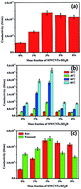
Fig. 5(a) shows the conductivity of neat SPEN and MWCNTs-SO3H/SPEN composite membranes immersed in deionized water for 24 h at the room temperature. The proton conductivity reaches the highest value for the loading content of 3 wt% MWCNTs-SO3H sample, indicating that MWCNTs-SO3H could form ion cluster structure and enhance the proton transfer efficiency. With the addition of MWCNTs-SO3H, the local agglomeration becomes more and more serious and interfere the proton transfer to a certain degree, which is corresponding with the morphology characteristics. This shows that the continuous network structure may form when the MWCNTs-SO3H in SPEN matrix reach a certain number, resulting in the rapid increase of proton transfer channel and giving full play the electrical properties of carbon nanotubes. The results display that the filler is a better intensifier to SPEN membrane and also prove that acyl chloride method modified MWCNTs is a successful technique to enhance proton conductivity of SPEN membrane.
Fig. 5(b) presents the variation of proton conductivity with the MWCNTs-SO3H loading content at different temperature. In general, proton conductivities increases with temperature, which is attributed to the increased motion transmissibility of water molecular and form more hydronium ion, resulting in the increased transmission rate. According to previous report,21 though the proton conductivity of commercial Nafion membranes in 100% RH at different temperatures is slightly higher than that of MWCNTs-SO3H/SPEN composite membranes, the real values are approximate, which is attributed to the large rigidity of SPEN backbone and relatively weak proton carrying capacity.
In order to investigate the effect of shift state of sulfonic acid groups onto the proton transfer, the SPEN membranes were firstly incubated in water at room temperature for 24 h, followed by drying in the oven for 12 h and another round water incubation for 24 h. The proton conductivity of raw and processed SPEN membranes with different content of filler was shown in Fig. 5(c). In low filler content, the proton conductivity of second time water processed SPEN membranes is higher than the original SPEN, suggesting that more sulfonic acid groups expose to the surface of SPEN membranes, which is the contribution of loose and incremental excess proton transfer channel. In contrast, the conductivity decreases as the water uptake time in the higher filler loading, owing to inseparable and untidy proton transfer channel, which block the transfer of sulfonic acid groups. Besides, the minimum change of proton conductivity is 3 wt% MWCNTs-SO3H, displaying that the SPEN composite membranes contained 3 wt% MWCNTs-SO3H has optimal stability and possess enormous potential applications in the field of new energy.
| This journal is © The Royal Society of Chemistry 2015 |