Influence of side-chain interactions on the self-assembly of discotic tricarboxyamides: a crystallographic insight

Arpita Paikar, Apurba Pramanik and Debasish Haldar*
Department of Chemical Sciences, Indian Institute of Science Education and Research Kolkata, Mohanpur, West Bengal 741246, India. E-mail: deba_h76@yahoo.com; deba_h76@iiserkol.ac.in; Fax: +91 3325873020; Tel: +91 3325873119

Received 4th March 2015 , Accepted 27th March 2015

First published on 27th March 2015


Abstract

Different assembly and behaviour of homologous discotic tricarboxyamides containing β-alanine and γ-aminobutyric acid have been investigated. From UV/Vis and FT-IR spectroscopy the tricarboxyamides have similar self-assembly patterns. But, the tricarboxyamide 2 containing γ-aminobutyric acid residues forms a gel in aromatic solvents after heating, cooling and ageing. However, the β-alanine analogue 1 failed to form a gel under the same conditions. From FE-SEM studies the tricarboxyamide 1 shows unbranched rod like morphology but the tricarboxyamide 2 exhibits an entangled fiber network. Finally, the X-ray crystallography reveals that both the tricarboxyamides 1 and 2 adopt 3-fold intermolecular H-bonded helical columnar structures. Detailed structural analysis shows that the individual helical columnar structures of tricarboxyamide 2 are themselves self-assembled through multiple hydrophobic interactions between side chains and thereby form a supramolecular network structure. However, the tricarboxyamide 1 columns are self-assembled into a supramolecular bundle-like structure. The result indicates that side chain interactions have a drastic effect on quaternary structure and function.

Introduction

Side-chain/side-chain interactions1 within and between different secondary structures are key to the stabilization of the tertiary and quaternary structures of peptides and proteins.2 The 20 natural amino acids differ by only side-chain structures.3 Side-chain/side-chain interactions have a dominant role in folded protein structures.4 But the role of side-chain interactions in the peptide mimetic is largely unexplored.5–7 Hence, the design and synthesis of building blocks with side chains having tuneable functionality is highly important for this bottom-up approach.8 Moreover, the building blocks need a delicate balance of the intramolecular and intermolecular non-covalent interactions.9 Various building blocks with π-systems as core have been discussed in a recent review.10 In this context, the use of 1,3,5-benzenetricarboxamide derivatives to direct the self-assembly has opened up a new window for material science.11 Generally, 1,3,5-benzenetricarboxamide derivatives formed a columnar structure due to the co-operative three fold helical hydrogen bonds among the consecutive amide groups between neighbour molecules.11 Versatile tricarboxyamide derivatives have been synthesized by incorporating diverse functional groups such as alkyl,12 aryl,13 pyridyl,14 bipyridyl,15 porphyrinyl,16 triphenylyl,17 oligo(p-phenylenevinylene),18 amino acid,19 dipeptide,20 oligopeptide,21 oligo-(ethyleneoxy),22 and benzocrown ethers.23 Meijer and co-workers have used 1,3,5-benzenetricarboxamide derivatives as MRI contrast reagents.24 Matsunaga et al. have reported the development of liquid crystals from 1,3,5-benzenetricarboxamide.25 Gelinsky et al. have used 1,3,5-benzenetricarboxamide derivatives as metal complexation agents.26 Broaders et al. have developed a drug delivery vehicle exploiting 1,3,5-benzenetricarboxamide derivatives.27 Recently, we have reported the fabrication of porous material from discotic tricarboxyamide containing tyrosine residues, through side chain–core interactions.28

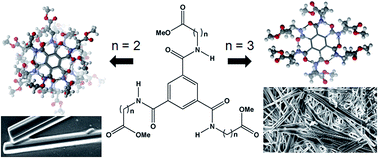
Intrigued by the previous knowledge, we wanted to investigate the assembly of discotic tricarboxyamides with flexible hydrophobic side chains. Herein we present influence of side chain interactions on quaternary structure and function of tricarboxyamides. The tricarboxyamides 1 and 2 contain 1,3,5-benzene tricarboxylic acid and β-alanine and γ-aminobutyric acid. From UV/Vis, FT-IR and NMR spectroscopic studies the tricarboxyamides 1 and 2 have same self-assembly pattern. Interestingly the tricarboxyamide 2 containing γ-aminobutyric acid residues form organogel in aromatic solvents after heating, cooling and ageing. But the β-alanine analogue 1 failed to form gel under same condition. FE-SEM images show that the tricarboxyamide 1 has unbranched rod like morphology but the tricarboxyamide 2 has entangled fibers network. Single crystal X-ray diffraction studies exhibit that both the tricarboxyamide 1 and 2 adopts 3-fold intermolecular H-bonded helical columnar structure. In higher order, the tricarboxyamide 1 columns are self-assembled to form bundle-like structure. But, the individual helical columnar structure of tricarboxyamide 2 self-assembled through multiple hydrophobic interactions between side chains to form a supramolecular network structure.

Results and discussion

The discotic tricarboxyamides were designed with assumption that the rigid aromatic core leads to the threefold hydrogen bonded helical column and the achiral conformationally flexible β-alanine and γ-aminobutyric acids residues should adjust itself accordingly to help the process (Scheme 1). In this context the folding and interactions of hydrophobic groups will be interesting. Target tricarboxyamides 1 and 2 were synthesized by coupling benzene-1,3,5-tricarboxylic acid with β-alanine and γ-aminobutyric acids methyl ester. The synthesized compounds were purified and characterized by 1H-NMR, 13C-NMR, FT-IR and mass spectrometry (MS) analysis.
image file: c5ra03864b-s1.tif
Scheme 1 The schematic presentation of tricarboxyamides 1 and 2.

To investigate the self-assembly behaviour of tricarboxyamide 1 and 2, a wide variety of different spectroscopic techniques have been used. The typical UV/Vis absorption spectra of tricarboxyamide 1 in methanol (0.023 mM) show an absorption band at 208 nm for π to π* transition (Fig. 1a). However, increasing the concentration of tricarboxyamide 1 induces stacking interactions between the molecules. The bathochromic shift of 17 nm of the absorption band with increasing concentration indicates J-type aggregation of tricarboxyamide 1.29 The absorption spectra of tricarboxyamide 2 in methanol also show an absorption band at 208 nm and bathochromic shift of 17 nm with increasing concentration (Fig. 1b). These results show that the tricarboxyamides 1 and 2 have similar aggregation pattern.


image file: c5ra03864b-f1.tif
Fig. 1 Concentration dependent UV/Vis spectra of (a) tricarboxyamide 1 and (b) tricarboxyamide 2 showing J-type aggregation in methanol.

Solid state FT-IR spectroscopy is an excellent method to investigate the self-assembly propensity of the reported tricarboxyamides. In FT-IR, the region of 3500–3200 cm−1 is important for the N–H stretching vibrations however the range 1800–1500 cm−1 is assigned for the stretching band of amide I and the bending peak of amide II and ester groups. The FT-IR spectra of tricarboxyamide 1 (Fig. 2a) exhibits N–H stretching frequency at 3246 cm−1 for non hydrogen bonded N–H and amide peaks at 1637 and 1559 cm−1 indicating the presence of threefold intermolecular H-bonding between neighbouring molecules within the columnar structures.30 The peak around 1741 cm−1 is responsible for the non hydrogen bonded ester carbonyls. The tricarboxyamide 2 exhibits peak at 3237 cm−1 for N–H stretching frequency. The amide and methyl ester have appeared at 1742, 1636 and 1562 cm−1 (Fig. 2b). These results indicate that the tricarboxyamides 1 and 2 have similar self-assembly propensity.


image file: c5ra03864b-f2.tif
Fig. 2 Solid state FT-IR spectra of tricarboxyamides (a) 1 and (b) 2.

But, the tricarboxyamides exhibits different gelation behavior in aromatic solvents. The gelation propensities of tricarboxyamides 1 and 2 have been studied in a wide variety of organic solvents using conventional heating-cooling techniques.31 However, the tricarboxyamides 1 did not form gel in aromatic hydrocarbon like toluene, o-xylene, m-xylene, p-xylene, 1,2-dichlorobenzene. But when solutions of the reported tricarboxyamides 2 in various organic solvents (ESI Table 1) were subjected to heating-cooling techniques, homogeneous gelation in aromatic hydrocarbon like toluene, o-xylene, m-xylene, p-xylene was observed. The gelation has been confirmed by the inverted vial method.32 The opaque gels of tricarboxyamides 2 are stable for 2–3 months at room temperature and the gels are thermoreversible (ESI).

The information about the type of network (tertiary structure) responsible for the observed gelation of tricarboxyamide 2 in toluene was obtained from rheology. The storage modulus (G′, a measure of the elastic response of the material) of the gel (10 wt%) was found to be larger than the loss modulus (G′′, a measure of the viscous response), indicative of an elastic rather than viscous material (Fig. 3).13 Such rheological behaviour is a characteristic of physically cross-linked gel via weak interactions.13


image file: c5ra03864b-f3.tif
Fig. 3 Mechanical response of tricarboxyamide 2 gel in toluene at 20 °C with small oscillatory shear in the linear viscoelastic regime.

Further, to investigate the self-assembly behaviour of tricarboxyamide 2 in organogel, variable temperature 1H NMR spectroscopic experiments have been performed. The experiments started with tricarboxyamide 2 gel in toluene-D8. From the stack plot, the downfield shifts of amide protons upon heating suggest that the intermolecular three fold hydrogen bonds are broken with increasing temperature. Whereas the 1,3,5-benzene tricarboxylic acid protons exhibit upfield shifts up to 85 °C (gel melting temperature) and show downfield shifts at higher temperature (Fig. 4). Moreover, α, β and γ protons of γ-amino butyric acid residues exhibit significant downfield shifts upon heating which suggest that the intermolecular hydrophobic interactions are also changed with increasing temperature. The tricarboxyamide 1 does not form gel in toluene-D8. Under same variable temperature 1H NMR spectroscopic experiments, the tricarboxyamide 1 does not exhibit any significant shift of α and β protons of β-alanine residues (ESI Fig. S1). Hence, not only the hydrogen bonding and π–π stacking interactions but also the hydrophobic interactions plays an important role in self-assembly and gelation of tricarboxyamide 2.


image file: c5ra03864b-f4.tif
Fig. 4 Part of the 1H NMR spectra of tricarboxyamide 2 gel in toluene-D8 with increasing temperature.

The field emission scanning electron microscope (FE-SEM) has been used to study the morphology of the reported tricarboxyamide 2 xerogel obtained from various aromatic solvents. The FE-SEM micrographs of the corresponding xerogels from toluene, o-xylene, m-xylene and p-xylene exhibit the entangled networks of unbranched fibers with 1 μm average diameter and several micrometers in length (Fig. 5).


image file: c5ra03864b-f5.tif
Fig. 5 FE-SEM images showing entangled networks of fibers of tricarboxyamide 2 xerogel from (a) toluene, (b) o-xylene, (c) m-xylene and (d) p-xylene. (Inset: the picture of the organogels).

To examine the difference in morphology, we have also studied the solution of tricarboxyamides 1 or 2 in 1,2-dichloro benzene by field emission scanning electron microscope (FE-SEM). For FE-SEM, The freshly prepared solution of tricarboxyamides in 1,2-dichloro benzene (5 mg mL−1) was drop-casted onto a silicon wafer and dried by slow evaporation. The material was then allowed to dry in a vacuum at 30 °C for two days. From FE-SEM image (Fig. 6a) the tricarboxyamide 1 exhibits unbranched polydisperse crystalline morphology. The crystals are very rigid and several micrometer in length. However, FE-SEM image of the tricarboxyamide 2 shows the entangled fibers network morphology (Fig. 6b). This three dimensional network of entangled fibers (physical crosslinks) helps to entrap solvent molecules and forms organogel.33


image file: c5ra03864b-f6.tif
Fig. 6 (a) FE-SEM image of tricarboxyamide 1 showing unbranched polydisperse crystalline morphology. (b) FE-SEM image of tricarboxyamide 2 showing entangled fibers network. (Inset: multipoint entangled fibers).

Clear evidence of inter column interactions between side chains has confirmed by X-ray crystallography.34 Tricarboxyamide 1 crystallizes with three molecules in the asymmetric unit (ESI Fig. S2). The ORTEP diagram (ESI Fig. S2) of tricarboxyamide 1 shows that the amide groups in a molecule are out of the central ring plane though two amides are tilted toward the same direction and third one in opposite direction. Two β-alanine residues adopt gauche conformation and third one adopts anti conformation (Fig. 7a). The torsion angles around the central benzene core and the β-alanine residues appears to play a critical role in dictating the overall structural features of tricarboxyamide 1. Moreover, structure of 1 exhibit that the two β-alanine residues are in the same face and the third one is in the opposite face of the central benzene ring (Fig. 7a). From X-ray crystallography, it is evident that the asymmetric unit contains one molecule of tricarboxyamide 2. The ORTEP diagram (ESI Fig. S3) of tricarboxyamide 2 shows that two γ-aminoburytic acid residues adopt gauchegauche conformation and third one adopts gaucheanti conformation (Fig. 7b). The amide groups are out of the central ring plane. However, aromatic amides prefer coplanarity of the carbonyl functional group with the aryl system to optimize conjugation, in tricarboxyamide 2 the amides are tilted toward the same direction (Fig. 7b). This is because of the competition between the demand of conjugation (amide and aryl) and that of intermolecular NH⋯O[double bond, length as m-dash]C hydrogen bonding. The solid state structure of 2 exhibits that the two γ-amino butyric acids are in the same face and the third one is in the opposite face of the central benzene ring (Fig. 7b).


image file: c5ra03864b-f7.tif
Fig. 7 The solid state structures of tricarboxyamides (a) 1 and (b) 2.

The crystal structure further reveals that the individual tricarboxyamide 1 subunits are stacked on top of another by threefold intermolecular H-bonding interaction between neighbouring molecules and generate a supramolecular column like structure (Fig. 8a) about crystallographic c direction.35 The hydrogen bonding parameters of tricarboxyamides are listed in Table 1. The columnar arrangement also stabilized by strong π–π stacking interactions. The center-to-center distance between the benzene rings in columnar assembly is about 3.541 Å. The J-type aggregation of the tricarboxyamide 1 molecules helps to place the β-alanine residues in a regular helical manner outside of the columnar central aromatic core (Fig. 8a). Hence, the tricarboxyamide 1 column looks like a circular block on top view (Fig. 8b). The tricarboxyamide 2 also exhibits supramolecular columnar structure stabilized by 3-fold intermolecular H-bonding interactions in solid state.35 The individual discotic tricarboxyamide 2 molecules are themselves stack one top of another and regularly interlinked through intermolecular hydrogen bonding interactions (N1–H1⋯O5, N2–H2⋯O6, and N3–H3⋯O8) to form the helical columnar assembly along crystallographic b direction (Fig. 8c). There also exist a strong π–π interaction between adjacent aromatic ring. The centre-to-centre distance between the benzene rings in columnar assembly is about 3.486 Å. Outside of the columnar central aromatic core, the γ-amino butyric acid residues are hanging in linear fashion (Fig. 8c). Hence, the tricarboxyamide 2 column looks like a star on top view (Fig. 8d).


image file: c5ra03864b-f8.tif
Fig. 8 (a) Side view and (b) top view packing presentation of the supramolecular column of tricarboxyamide 1. (c) Side view and (d) top view of the supramolecular column of tricarboxyamide 2. The intermolecular hydrogen bonds are presented as black dotted line.
Table 1 Hydrogen bonding parameters of tricarboxyamides 1 and 2a
  D–H⋯A D⋯H (Å) H⋯A (Å) D⋯A (Å) D–H⋯A (°)
a Symmetry equivalent a: 1 − x + y, 1 − x, 1/3 + z, b = 1 − y, xy, −1/3 + z, c = xy, x, −1/6 + z, d = y, −x + y, 1/6 + z, e = 1/2 − x, −1/2 + y, 1/2 − z.
1 N1–H1⋯O12 0.86 2.08 2.920(6) 165
N2–H2⋯O16 0.86 2.18 3.021(6) 167
N3–H3⋯O13a 0.86 1.95 2.800(6) 168
N4–H4⋯O3b 0.86 2.09 2.906(7) 158
N5–H5⋯O7 0.86 1.96 2.796(6) 165
N6–H6⋯O4b 0.86 2.09 2.945(7) 172
N7–H7A⋯O21c 0.86 2.05 2.869(6) 159
N8–H8⋯O22d 0.86 2.02 2.858(7) 166
N9–H9⋯O25c 0.86 2.11 2.963(6) 171
2 N1–H1⋯O5e 0.86 2.04 2.861(3) 158
N2–H2⋯O6e 0.86 2.06 2.873(3) 157
N3–H3⋯O8e 0.86 2.02 2.856(3) 165


The packing diagram further reveals that the individual tricarboxyamide 1 columns are self-assembled and generate a supramolecular bundle-like framework along crystallographic a and b directions (Fig. 9). This type of packing leads to unbranched rod-like morphology for tricarboxyamide 1. From X-ray crystallography, in higher order packing, the individual helical columnar structure of tricarboxyamide 2 are themselves self-assembled through multiple hydrophobic interactions (between γ-amino butyric acid's β methylenes and between ester methyl groups), and thereby form a supramolecular structure along the crystallographic a and c direction (Fig. 10). The intermolecular C–H⋯O hydrogen bonds36 (C16–H16B⋯O7, 2.54 Å, 3.48 Å, 166°, −1 + x, y, z) also help to stabilized the supramolecular structure. For tricarboxyamide 2, the side-chains interactions (physical crosslinks) help to develop entangled fibers network morphology which entrap solvent molecules and forms organogel.


image file: c5ra03864b-f9.tif
Fig. 9 The top view packing diagram of tricarboxyamide 1 showing honeycomb-like structure.

image file: c5ra03864b-f10.tif
Fig. 10 Top view packing presentation of the supramolecular frameworks of tricarboxyamide 2 along crystallographic a and b directions. The circles and triangles are mark for hydrophobic interactions between side chains.

Conclusions

In conclusion, the self-assembly propensities of a series of discotic tricarboxyamides containing β-alanine and γ-aminobutyric acid has been reported. The tricarboxyamide with γ-aminobutyric acid residues form entangled fibers network and thermo responsive gel in aromatic solvents but the β-alanine analogue failed to form gel under same conditions. The X-ray crystallography reveals that the both the tricarboxyamide 1 and 2 adopts 3-fold intermolecular H-bonded helical columnar structure. The individual helical columnar structure of tricarboxyamide 2 is further self-assembled through multiple hydrophobic interactions between side chains and forms a supramolecular network structure. But the tricarboxyamide 1 columns are self-assembled to form bundle-like structure. The result presented here may foster new studies on side chain interactions for diverse applications.

Experimental

General

All amino acids were purchased from Sigma chemicals. HOBt (1-hydroxybenzotriazole) and DCC (dicyclohexylcarbodiimide) were purchased from SRL.

Tricarboxyamides synthesis

The tricarboxyamide were synthesized by conventional solution-phase methods. The C-terminus of amino acids was protected as a methyl ester. The products were purified by column chromatography using silica (100–200 mesh size) gel as a stationary phase and an n-hexane–ethyl acetate mixture as an eluent. The intermediates and final compounds were fully characterized by 500 MHz and 400 MHz 1H NMR spectroscopy, 100 MHz 13C NMR spectroscopy, FT-IR spectroscopy and mass spectrometry. The tricarboxyamides 1 and 2 were also characterized by X-ray crystallography.
Tricarboxyamide (1). Dry triethylamine (NEt3; 0.76 mL, 5.44 mmol) was added to an ice-cooled solution of β-Ala-OMe·HCl (0.345 g, 2.4705 mmol) in dry CH2Cl2 (20 mL) and the mixture was stirred for 20 min. Benzene-1,3,5-tricarbonyl trichloride (0.145 g, 0.549 mmol) dissolved in dry CH2Cl2 (25 mL) was added dropwise for 15 min and left to stir for 24 h under nitrogen atmosphere. After completion of reaction CH2Cl2 was evaporated under reduced pressure and the residue was dissolved in ethyl acetate (60 mL). The organic layer was washed with 2 M HCl (3 × 50 mL), brine (2 × 50 mL), 1 M sodium carbonate (3 × 50 mL) and brine (2 × 50 mL) and dried over anhydrous sodium sulfate. It was evaporated under a vacuum to yield tricarboxyamide 1 as a off-white solid. Chromatographic purification by 100–200 mesh using 1[thin space (1/6-em)]:[thin space (1/6-em)]2 (EtOAc[thin space (1/6-em)]:[thin space (1/6-em)]hexane) as eluent of the crude product yielded 0.326 g of 1. Yield 31.46%.

1H NMR (400 MHz, CDCl3, δ in ppm): 8.331 (s, 3H, aromatic ring proton), 7.763–7.734 (t, 3H, J = 5.8 Hz, NH), 3.649–3.633 (d, 6H, J = 6.4 Hz, CβH of β-Ala), 3.614 (s, 9H, OCH3), 2.624–2.593 (t, 6H, J = 6.2 Hz CαH of β-Ala). 13C NMR (100 MHz, CDCl3, δ in ppm): 173.172, 166.793, 134.881, 129.246, 52.292, 36.360, 33.948. Mass spectra: m/z 488.1751, [M + Na]+; M calcd 465.2.

Tricarboxyamide (2). Dry triethylamine (NEt3; 0.76 mL, 5.44 mmol) was added to an ice-cooled solution of Gaba-OMe·HCl (0.379 g, 2.4705 mmol) in dry CH2Cl2 (20 mL) and the mixture was stirred for 20 min. Benzene-1,3,5-tricarbonyl trichloride (0.145 g, 0.549 mmol) dissolved in dry CH2Cl2 (25 mL) was added dropwise for 15 min and left to stir for 24 h under nitrogen. After completion of reaction CH2Cl2 was evaporated under reduced pressure and the residue was dissolved in ethyl acetate (60 mL). The organic layer was washed with 2 M HCl (3 × 50 mL), brine (2 × 50 mL), 1 M sodium carbonate (3 × 50 mL) and brine (2 × 50 mL) and dried over anhydrous sodium sulfate. It was evaporated in a vacuum to yield tricarboxyamide 2 as a off-white solid. Chromatographic purification by 100–200 mesh using 1[thin space (1/6-em)]:[thin space (1/6-em)]2 (EtOAc[thin space (1/6-em)]:[thin space (1/6-em)]hexane) as eluent of the crude product yielded 0.4166 g of 2. Yield 33.27%.

1H NMR (500 MHz, CDCl3, δ in ppm): 8.007 (s, 3H, aromatic ring proton), 7.842–7.821 (t, 3H, J = 5.25 Hz, NH), 3.561 (s, 9H, OCH3), 3.330–3.292 (q, 6H, J = 6.33 Hz, CγH of Gaba), 2.317–2.288 (t, 6H, J = 7.25 Hz CαH of Gaba), 1.808–1.1780 (t, 6H, J = 7 Hz CβH of Gaba). 13C NMR (100 MHz, CDCl3, δ in ppm): 173.595, 166.697, 134.920, 128.097, 51.481, 39.357, 31.175, 24.257. Mass spectra: m/z 530.1033, [M + Na]+; M calcd 507.2.

NMR experiments

All NMR studies were carried out on a Brüker AVANCE 500 MHz spectrometer at 278 K. Compound concentrations were in the range 1–10 mM in CDCl3.

FT-IR spectroscopy

All reported solid-state FT-IR spectra were obtained with a Perkin Elmer Spectrum RX1 spectrophotometer with the KBr disk technique.

UV/Vis spectroscopy

UV/Vis absorption spectra were recorded on a UV/Vis spectrophotometer (Hitachi).

Mass spectrometry

Mass spectra were recorded on a Q-Tof Micro YA263 high-resolution (Waters Corporation) mass spectrometer by positive-mode electrospray ionization.

Field emission scanning electron microscopy

Morphologies of all reported compounds were investigated using field emission-scanning electron microscopy (FE-SEM). A small amount of gel/solution of the corresponding compound was placed on a clean silicon wafer and then dried by slow evaporation. The material was then allowed to dry under vacuum at 30 °C for two days. The materials were gold-coated, and the micrographs were taken in an FE-SEM apparatus (Jeol Scanning Microscope-JSM-6700F).

Single crystal X-ray diffraction study

Intensity data of tricarboxyamides 1 and 2 crystals were collected with MoKα radiation using Bruker APEX-2 CCD diffractometer. Data were processed using the Bruker SAINT package and the structure solution and refinement procedures were performed using SHELX97.37

Acknowledgements

We acknowledge the CSIR, India, for financial assistance (Project no. 01/2507/11-EMR-II). A. Paikar acknowledges the UGC, India for research fellowship. A. Pramanik thanks CSIR, India for fellowship.

Notes and references

  1. M. M. Cox and D. L. Nelson, Principles of Biochemistry, W. H. Freeman and Company, New York, 5th edn, 2008 Search PubMed.
  2. (a) K. Berka, R. Laskowski, K. E. Riley, P. Hobza and J. Vondrášek, J. Chem. Theory Comput., 2009, 5, 982–992 CrossRef CAS; (b) C. Zehe, M. Schmidt, R. Siegel, K. Kreger, V. Daebel, S. Ganzleben, H. W. Schmidt and J. Senker, CrystEngComm, 2014, 16, 9273–9283 RSC; (c) A. Thomas, R. Meurisse, B. Charloteaux and R. Brasseur, Proteins, 2002, 48, 628–634 CrossRef CAS PubMed; (d) J. Gsponer, U. Haberthür and A. Caflisch, Proc. Natl. Acad. Sci. U. S. A., 2003, 100, 5154–5159 CrossRef CAS PubMed.
  3. V. Z. Spassov, L. Yan and P. K. Flook, Protein Sci., 2007, 16, 494–506 CrossRef CAS PubMed.
  4. (a) A. F. Pereira de Araujo, T. C. Pochapsky and B. Joughin, Biophys. J., 1999, 76, 2319–2328 CrossRef CAS; (b) K. Berka, R. A. Laskowski, P. Hobza and J. Vondrášek, J. Chem. Theory Comput., 2010, 6, 2191–2203 CrossRef CAS.
  5. S. V. Jadhav, A. Bandyopadhyaya and H. N. Gopi, Org. Biomol. Chem., 2013, 11, 509–514 CAS.
  6. V. Azzarito, K. Long, N. S. Murphy and A. J. Wilson, Nat. Chem., 2013, 5, 161–173 CrossRef CAS PubMed.
  7. W. A. Loughlin, J. D. A. Tyndall, M. P. Glenn and D. P. Fairlie, Chem. Rev., 2004, 104, 6085–6118 CrossRef CAS PubMed.
  8. (a) D. Haldar, H. Jiang, J. M. Léger and I. Huc, Angew. Chem., Int. Ed., 2006, 45, 5483–5486 CrossRef CAS PubMed; (b) J. Yan, W. Li and A. Zhang, Chem. Commun., 2014, 50, 12221–12233 RSC.
  9. (a) D. J. Hill, M. J. Mio, R. B. Prince, T. S. Hughes and J. S. Moore, Chem. Rev., 2001, 101, 3893–4012 CrossRef CAS PubMed; (b) L. G. Milroy, T. N. Grossmann, S. Hennig, L. Brunsveld and C. Ottmann, Chem. Rev., 2014, 114, 4695–4748 CrossRef CAS PubMed; (c) J. Pal, S. Sanwaria, R. Srivastava, B. Nandan, A. Horechyy, M. Stammb and H. L. Chen, J. Mater. Chem., 2012, 22, 25102–25107 RSC.
  10. S. S. Babu, V. K. Praveen and A. Ajayaghosh, Chem. Rev., 2014, 114, 1973–2129 CrossRef CAS PubMed.
  11. (a) S. Cantekin, T. F. A. de Greefab and A. R. A. Palmans, Chem. Soc. Rev., 2012, 41, 6125–6137 RSC; (b) Y. Ishioka, N. Minakuchi, M. Mizuhata and T. Maruyama, Soft Matter, 2014, 10, 965–971 RSC.
  12. P. J. M. Stals, J. C. Everts, R. de Bruijn, I. A. W. Filot, M. M. J. Smulders, R. Martín-Rapún, E. A. Pidko, T. F. A. de Greef, A. R. A. Palmans and E. W. Meijer, Chem.–Eur. J., 2010, 16, 810–821 CrossRef CAS PubMed.
  13. A. Bernet, R. Q. Albuquerque, M. Behr, S. T. Hoffmann and H.-W. Schmidt, Soft Matter, 2012, 8, 66–69 RSC.
  14. A. R. A. Palmans, J. A. J. M. Vekemans, E. W. Meijer, H. Kooijmans and A. L. Spek, Chem. Commun., 1997, 2247–2248 RSC.
  15. L. Brunsveld, H. Zhang, M. Glasbeek, J. A. J. M. Vekemans and E. W. Meijer, J. Am. Chem. Soc., 2000, 122, 6175–6182 CrossRef CAS.
  16. R. van Hameren, P. Schö, A. M. van Buul, J. Hoogboom, S. V. Lazarenko, J. W. Gerritsen, H. Engelkamp, P. C. M. Christianen, H. A. Heus, J. C. Maan, T. Rasing, S. Speller, A. E. Rowan, J. A. A. W. Elemans and R. J. M. Nolte, Science, 2006, 314, 1430–1433 CrossRef PubMed.
  17. I. Paraschiv, M. Giesbers, B. van Lagen, F. C. Grozema, R. D. Abellon, L. D. A. Siebbeles, A. T. M. Marcelis, H. Zuilhof and E. J. R. Sudhölter, Chem. Mater., 2006, 18, 968–974 CrossRef CAS.
  18. J. van Herrikhuyzen, P. Jonkheijm, A. P. H. J. Schenning and E. W. Meijer, Org. Biomol. Chem., 2006, 4, 1539–1545 CAS.
  19. P. P. Bose, M. G. B. Drew, A. K. Das and A. Banerjee, Chem. Commun., 2006, 3196–3198 RSC.
  20. K. P. van den Hout, R. Martín-Rapún, J. A. J. M. Vekemans and E. W. Meijer, Chem.–Eur. J., 2007, 13, 8111–8123 CrossRef CAS PubMed.
  21. K. Matsuura, K. Murasato and N. Kimisuka, J. Am. Chem. Soc., 2005, 127, 10148–10149 CrossRef CAS PubMed.
  22. P. J. M. Stals, J. F. Haveman, R. Martín-Rapún, C. F. C. Fitié, A. R. A. Palmans and E. W. Meijer, J. Mater. Chem., 2009, 19, 124–130 RSC.
  23. S. Lee, J.-S. Lee, C. H. Lee, Y.-S. Jung and J.-M. Kim, Langmuir, 2011, 27, 1560–1564 CrossRef CAS PubMed.
  24. P. Besenius, J. L. M. Heynens, R. Straathof, M. M. L. Nieuwenhuizen, P. H. H. Bomans, E. Terreno, S. Aime, G. J. Strijkers, K. Nicolay and E. W. Meijer, Contrast Media Mol. Imaging, 2012, 7, 356–361 CrossRef CAS PubMed.
  25. Y. Matsunaga, N. Miyajima, Y. Nakayasu, S. Sakai and M. Yonenaga, Bull. Chem. Soc. Jpn., 1988, 61, 207–210 CrossRef CAS.
  26. M. Gelinsky, R. Vogler and H. Vahrenkamp, Inorg. Chem., 2002, 41, 2560–2564 CrossRef CAS PubMed.
  27. K. E. Broaders, S. J. Pastine, S. Grandhe and J. M. J. Fréchet, Chem. Commun., 2011, 47, 665–667 RSC.
  28. P. Jana, A. Paikar, S. Bera, S. K. Maity and D. Haldar, Org. Lett., 2014, 16, 38–41 CrossRef CAS PubMed.
  29. H. Wu, L. Xue, Y. Shi, Y. Chen and X. Li, Langmuir, 2011, 27, 3074–3082 CrossRef CAS PubMed.
  30. T. F. A. de Greef, M. M. L. Nieuwenhuizen, P. J. M. Stals, C. F. C. Fitié, A. R. A. Palmans, R. P. Sijbesma and E. W. Meijer, Chem. Commun., 2008, 4306–4308 RSC.
  31. K. J. C. van Bommel, C. van der Pol, I. Muizebelt, A. Friggeri, A. Heeres, A. Meetsma, B. L. Feringa and J. van Esch, Angew. Chem., Int. Ed., 2004, 43, 1663–1667 CrossRef CAS PubMed.
  32. S. Maity, P. Jana and D. Haldar, CrystEngComm, 2011, 13, 3064–3071 RSC.
  33. (a) S. J. George, A. Ajayaghosh, P. Jonkheijm, A. P. H. J. Schenning and E. W. Meijer, Angew. Chem., Int. Ed., 2004, 43, 3422–3425 CrossRef CAS PubMed; (b) S. E. Paramonov, H. W. Jun and J. D. Hartgerink, J. Am. Chem. Soc., 2006, 128, 7291–7298 CrossRef CAS PubMed.
  34. ESI..
  35. V. Nagarajan and V. R. Pedireddi, Cryst. Growth Des., 2014, 14, 1895–1901 CAS.
  36. G. R. Desiraju and T. Steiner, The Weak Hydrogen Bond, Oxford Science Publication, 1999 Search PubMed.
  37. G. M. Sheldrick, SHELX 97, University of Göttingen, Germany, 1997 Search PubMed.

Footnote

Electronic supplementary information (ESI) available: Synthesis and characterization of trisamides, 1H NMR, 13C NMR, Fig. S1–S10. CCDC 1051708 and 1011367. For ESI and crystallographic data in CIF or other electronic format see DOI: 10.1039/c5ra03864b

This journal is © The Royal Society of Chemistry 2015
Click here to see how this site uses Cookies. View our privacy policy here.