Kang Yang,
Xiaoliang Shi*,
Wenzheng Zhai,
Long Chen,
Ao Zhang and
Qiaoxin Zhang
School of Mechanical and Electronic Engineering, Wuhan University of Technology, 122 Luoshi Road, Wuhan 430070, China. E-mail: sxl@whut.edu.cn; Fax: +86-27-87651793; Tel: +86-27-87651793
First published on 28th April 2015
The tribological performance of multilayer graphene-reinforced TiAl matrix self-lubricating composites (GTMSC) is significantly influenced by elastic and plastic deformation during sliding wear. The primary purpose of this study is to investigate the dry tribological behaviors of GTMSC at different applied loads. The sliding tribology tests are carried out at 4, 8, 12 and 16 N, respectively. The friction coefficients and wear rates are analyzed under the condition of elastic or plastic deformation. The elastic or plastic deformation is determined by comparing the yield stress with the von Mises stress obtained by the numerical simulation method. The results show that GTMSC exhibits different tribological behaviors under the condition of elastic or plastic deformation. It is found that GTMSC shows excellent tribological performances at 12 N for the elastic deformation, resulting in the formation of anti-friction films. Nevertheless, GTMSC exhibits poor tribological behaviors at 16 N due to the plastic deformation, leading to the destruction of anti-friction films and the formation of cracks.
From a tribological point of view, the tribological properties of TiAl matrix self-lubricating composites (TMC) are mainly evaluated by the friction coefficients and wear rates. X. L. Shi et al.8 investigated the tribological behaviors of TMC containing 5 wt% silver at room temperature, and found that the mean friction coefficient and wear rate were approximately 0.28 and 2.7 × 10⁻⁴ mm3 N−1 m−1 at 10 N respectively. Z. S. Xu et al.9 reported the tribological properties of TMC containing 3.5 wt% multilayer graphene (MLG) at room temperature, and found that the mean friction coefficient and wear rate were 0.32 and 0.73 × 10⁻⁴ mm3 N−1 m−1 at 10 N. Compared with TiAl alloys, the friction coefficient and wear rate of TMC containing 3.5 wt% MLG were significantly reduced by almost 4 and 7 times magnitude. The tribological properties are much better for 3.5 wt% MLG, if compared to TMC containing 5 wt% silver. Simultaneously, it has been demonstrated that the tribological properties of composite materials are significantly improved by adding the MLG.10,11 Moreover, D. Berman et al.12 reported the tribological behaviors of 440C steel containing graphene, and found that the low friction coefficient and wear rate were obtained in the initial sliding stage at low applied loads. L. Y. Lin et al.13 studied the frictional forces of multilayer graphene using atomic force microscopy, and found that the frictional forces of graphene films increased from 0.36 to 0.62 nanometer Newton (nN) at the applied loads of 3–30 nN. H. Lee et al.14 reported the wear mechanism of graphene, and found that when the frictional forces exceeded the interlaminar binding force, the interlaminar structure of graphene is laminately destroyed during the sliding process. Simultaneously, the friction and wear properties were continually improved with the increase of graphene layers. To the best of our knowledge, the effect of applied loads on the tribological properties of TMC containing MLG is rarely reported by investigating the elastic or plastic deformation of TMC. Hence, the tribological properties of multilayer graphene-reinforced TiAl matrix self-lubricating composites (GTMSC) will be discussed under the condition of elastic or plastic deformation of TMC.
The numerical simulation, which is an effective method to study the von Mises stress of materials, is proposed to be applicable in the tribological field by constructing finite element models.15,16 J. M. Jungk et al.17 reported the transition between elastic and plastic deformation of metallic substrate with the increase of applied loads using the numerical simulation method. J. P. Song et al.18 constructed a finite element model in order to predict the thickness of a self-lubricating layer during dry sliding. Hence, the finite element method could be adopted to investigate the tribological properties of materials at different von Mises stresses.19–21
In this study, the disk GTMSC rotate against GCr15 balls of 6 mm diameter at a sliding speed of 0.234 m s−1. The analysis system (ANSYS) of finite element analysis software is adopted in order to obtain the von Mises stresses at applied loads of 4, 8, 12 and 16 N, respectively. The elastic or plastic deformation of GTMSC is determined by making a comparison between the von Mises stress and yield stress. The tribological properties are discussed in detail under the condition of the elastic or plastic deformation of GTMSC.
| W = V/(PS) | (1) |
![]() | ||
| Fig. 2 (a) Typical FESEM image of MLG in the cross-section of GTMSC/MLG; (b) molecular structure of MLG; (c) XRD pattern of GTMSC fabricated by SPS. | ||
Fig. 3 shows the microstructure and elemental distributions of GTMSC. As shown in Fig. 3(c), it could be seen from the distribution of C element that MLG is uniformly distributed in GTMSC.
Fig. 4 shows the variation of friction coefficients and wear rates of GTMSC/TiAl alloys after 80 min tests at different applied loads. As can be clearly seen from Fig. 4, the tribological performances of GTMSC are dramatically improved by the excellent mechanical properties and tribological performances of MLG, compared to those of TiAl alloys. During the sliding wear, the multilayer structure of graphene is separated layer by layer, and then spread out on the wear scar to hinder the direct contact of GCr15 balls and GTMSC disks, resulting in the lower friction coefficient and wear rate. During the sliding process, the MLG with a high hardness could protect from the destruction of GTMSC to further improve the tribological properties by dissipating the stress and preventing the crack propagation.9 Hence, the fracture toughness of GTMSC is reinforced by the laminar structure MLG. The tribological properties of GTMSC are respectively obtained at the applied loads of 4, 8, 12 and 16 N as follows.
![]() | ||
| Fig. 4 Variation of friction coefficients and wear rates of GTMSC/TiAl alloys after 80 min tests at the different applied loads: friction coefficients (a) and wear rates (b). | ||
• 4 N: The mean friction coefficient and wear rate are 0.61 and 2.71 × 10⁻⁴ mm3 N−1 m−1 respectively.
• 8 N: The friction coefficient reduces down to 0.52, while the wear rate increases up to 2.97 × 10⁻⁴ mm3 N−1 m−1 with the increase of applied loads from 4 to 8 N.
• 12 N: A lower friction coefficient (0.37) and smaller wear rate (2.35 × 10⁻⁴ mm3 N−1 m−1) are attained at the applied loads of 12 N.
• 16 N: The friction coefficient (0.42) and wear rate (3.52 × 10⁻⁴ mm3 N−1 m−1) significantly increase at 16 N, compared to the friction coefficient of 0.37 and wear rate of 2.35 × 10⁻⁴ mm3 N−1 m−1 at 12 N.
Fig. 5 shows the von Mises stresses of GTMSC at different applied loads. As shown in Fig. 5, it could be obviously seen that the von Mises stress is significantly increscent and its influenced zones are continuously enlarged with the increasing of applied loads from 4 to 16 N. GTMSC has a low von Mises stress (268 MPa) at 4 N. When the applied load increases up to 8 N, the von Mises stress is 539 MPa. The applied load of 12 N is chosen to obtain a von Mises stress of 917 MPa. The von Mises stress (1209 MPa) of GTMSC is higher than the yield stress (1165 MPa) at the applied load of 16 N. Based on above discussion, the elastic deformation of GTMSC appears at applied loads of 4, 8 and 12 N, while the plastic deformation happens at 16 N.
![]() | ||
| Fig. 5 Von Mises stresses of GTMSC at different applied loads: 4 N (a), 8 N (b), 12 N (c) and 16 N (d). | ||
![]() | ||
| Fig. 6 Typical EPMA morphologies of wear scars of GTMSC after 80 min tests at the different applied loads of 4 (a), 8 (b), 12 (c) and 16 N (d). | ||
| Area | Ti | Al | Cr | Nb | B | C | O |
|---|---|---|---|---|---|---|---|
| A (4 N) | 53.6 | 30.4 | 2.2 | 4.2 | 0.5 | 2.2 | 6.9 |
| B (12 N) | 49.5 | 30.5 | 2.1 | 4.3 | 0.4 | 5.3 | 7.9 |
As shown in Fig. 6(b), at the applied load of 8 N, the worn surface becomes much smoother, and the grooves become fine and shallow. Y. J. Yu et al.27 studyied the tribological behaviors of NiAl intermetallic compound coatings, and found that the worn surface becomes much smoother with the increase of applied loads. The main wear mechanisms should be furrow and delamination at 8 N. Hence, it may be concluded from the EPMA morphology of the wear scar that the morphology of the wear scar is improved at the von Mises stress of 528 MPa (at 8 N), while the smooth wear scar is not obtained for the poor reparation abilities.
As shown in Fig. 6(c), with the increasing of applied loads from 8 to 12 N, a few shallow peeling pits and anti-friction films (tribo-films) appear on the smooth worn surface. It is apparent that the primary wear mechanism is slight peeling. As shown in Table 1, the existence of oxygen and carbon elements (O and C) of the marked area B in Fig. 6(c) demonstrates that the anti-friction films contain massive oxides and MLG with the lubricating property. It may be concluded that the von Mises stress of 917 MPa (at 12 N) could refine wear debris, repair the wear scar and be beneficial to the formation of tribo-films. S. Y. Zhu et al.28 reported that the smooth tribo-film is beneficial to friction-reduction and anti-wear properties. Hence, a lower friction coefficient (0.37) and wear rate (2.35 × 10⁻⁴ mm3 N−1 m−1) are obtained at 12 N for the existence of tribo-films.
When the applied load increases up to 16 N, as shown in Fig. 6(d), deep grooves, obvious cracks, abundant wear debris and severe delamination appear on the rough wear scar. It is obvious that the main wear mechanisms are fracture and plough. The high von Mises stress (1209 MPa) obtained at 16 N exceeds the yield stress (1165 MPa) of GTMSC. Consequently, it could be believed that the plastic deformation results in the high wear rate (3.52 × 10⁻⁴ mm3 N−1 m−1) and obvious cracks of GTMSC. F. Akhtar et al.29 investigated the microstructure evolution and wear properties of steel matrix composites reinforced by TiB2 and TiC, and found that the cracks and weight loss significantly increase for the plastic deformation of steel matrix composites. A. R. Rastkar et al.7 studied the sliding wear behaviors of TiAl alloys, and found that a great many fine debris appear on the wear scar for the interlamellar cracks and plastic deformation. Hence, it could be reasonably concluded that the formation of the cracks are caused by the plastic deformation of GTMSC. During the dry wear, the cracks gradually peel off from GTMSC and spread out to the worn surface at the applied load of 16 N, and then the big crack debris is crushed into massive wear particles at the high pressures of the asperity contact zone. Although the action of third body of wear debris is beneficial to the reduction of friction coefficients and wear rates, the friction coefficients (0.42) and wear rates (3.52 × 10⁻⁴ mm3 N−1 m−1) significantly increase for the destruction of the tribo-film at 16 N, compared to the friction coefficient (0.37) and wear rate (2.35 × 10⁻⁴ mm3 N−1 m−1) at 12 N.
Based on the aforementioned discussions about the friction coefficient, wear rate, von Mises stress and wear scar of GTMSC, some results can be obtained. (1) The von Mises stresses continually increase with the increase of applied loads from 4 to 16 N. (2) Fewer wear debris appear on the smoother wear scar with an increase in applied loads ranging from 4 to 12 N, while the massive wear debris exist on the rough worn surface at 16 N for the cracks and plastic deformation of GTMSC. (3) The wear rates are smaller under the condition of elastic deformation of GTMSC, compared to the plastic deformation. The friction coefficients constantly reduce with the increase of applied loads of 4–12 N, and then slightly increase at 12–16 N. (4) Excellent tribological properties are obtained for the formation of anti-friction films at 12 N.
To further investigate the formation of anti-friction films at 12 N, as shown in Fig. 7, a typical EPMA micrograph and elemental distribution of the cross-section of the wear scar of GTMSC after 80 min tests at 12 N are observed. The position of the cross-section of the wear scar at 12 N is marked by a straight line (see Fig. 6(c)). The significant stratification morphologies are marked as three layers of A, B and C, as shown in Fig. 7(a). It could be found that layer A, for the primary wear mechanisms of slight peeling, is an intact anti-friction film. Layer B shows the thin compacted layer consisting of submicron grains, while layer C is composed of large grains. Fig. 7(b)–(e) show the elemental distributions of the cross-section of the wear scar. As is clear in Fig. 7(e), the C element is mainly distributed in the zones marked by A and B in Fig. 7(a). Consequently, it could be believed that the tribological properties of GTMSC at 12 N are significantly improved by the anti-friction film and thin compacted layer containing massive MLG. Z. S. Xu et al.9 also found that the formation of the tribo-film composed of MLG contributed to the decrease of friction coefficient and wear rate. D. Berman et al.30 also considered that during the sliding process, the wear debris containing MLG are spread out on the wear scar to form an anti-friction film, resulting in the lower friction coefficient and wear rate.
![]() | ||
| Fig. 7 EPMA micrograph and elemental distribution of cross-section of wear scar of GTMSC after 80 min tests at 12 N. | ||
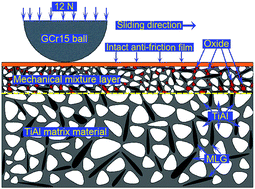
Fig. 8 shows schematic diagrams of the microstructures of cross-sections of the wear scars at the different applied loads. As can be seen from Fig. 8(a) and (b), the thickness of mechanical mixture layers constantly increases with the increase of applied loads from 4 to 8 N. As shown in Fig. 8(c), the significant stratification morphologies of the anti-friction film, mechanical mixture layer and TiAl matrix material, which are corresponding to the layers A, B and C in Fig. 7(a), are clearly observed after 80 min sliding at 12 N. As can be seen from Fig. 8(d) (at 16 N), the anti-friction film with the friction-reduction and anti-wear properties is dramatically destroyed for the plastic deformation and cracks of GTMSC at the von Mises stress of 1209 MPa. Consequently, based on above-mentioned discussion, it could be concluded that the formation of anti-friction film is in close relation with the von Mises stresses generated at the applied loads of 4, 8, 12 and 16 N. The small von Mises stresses of 268 and 528 MPa (at 4 and 8 N) are not able to form anti-friction films for the poor reparation ability, while the high stress (1209 MPa) destroys the formed anti-friction films for the plastic deformation and cracks of GTMSC at 16 N. The von Mises stress of 917 MPa (at 12 N) is beneficial to the formation of anti-friction film, resulting in the lower friction coefficient and wear rate.
![]() | ||
| Fig. 8 Schematic diagrams of the microstructures of cross-sections of wear scars at the different applied loads: 4 N (a), 8 N (b), 12 N (c) and 16 N (d). | ||
In this study, in order to investigate the tribological behaviors of multilayer graphene-reinforced TiAl matrix self-lubricating composites (GTMSC) at room temperature, the numerical simulations and experiments are carried out at the applied loads of 4, 8, 12 and 16 N, respectively. The wear rates of GTMSC under the condition of elastic deformation (4–12 N) are smaller than those under plastic deformation (16 N). The friction coefficients continually reduce with an increase in applied loads from 4 to 12 N, and then slightly increase at 12–16 N. Excellent tribological properties are attained for the formation of anti-friction films at 12 N. The formation of anti-friction films is closely related with the von Mises stress. The small von Mises stress is not able to form anti-friction films at 4–8 N, while the high stress destroys the formed anti-friction films at 16 N.
| This journal is © The Royal Society of Chemistry 2015 |