
Hugo A. Lara-Garcíaa,
Brenda Alcántar-Vázqueza,
Yuhua Duanb and
Heriberto Pfeiffer*a
aInstituto de Investigaciones en Materiales, Universidad Nacional Autónoma de México, Circuito Exterior s/n Cd. Universitaria, Del. Coyoacán, CP 04510, México DF, Mexico. E-mail: pfeiffer@iim.unam.mx; Fax: +52 (55) 5616 1371; Tel: +52 (55) 5622 46 27
bNational Energy Technology Laboratory, United States Department of Energy, 626 Cochrans Mill Road, Pittsburgh, Pennsylvania 15236, USA
First published on 7th April 2015
Li2CuO2 was evaluated as a CO2 captor at moderate temperatures, using water vapor in the gas flow. Different water vapor sorption experiments were performed using N2 or CO2 as carrier gases. If N2 was used as carrier gas, it was evidenced that Li2CuO2 is able to trap water physically and chemically, producing in the second case Li–OH superficial species. Moreover, when CO2 was used as carrier gas, Li2CuO2 continued trapping water, as in the previous case, but in this case CO2 was mainly trapped, forming Li2CO3 and CuO phases. Additionally, the microstructure changes importantly when CO2 and H2O are chemically trapped in Li2CuO2. Li2CO3 and CuO seemed to segregate changing the morphology and the specific surface area. The Li2CuO2 sample was able to capture up to 6.7 mmoles of CO2 per gram of ceramic at 80 °C, a considerably high CO2 amount. Furthermore, all these experiments were theoretically supported by different thermodynamic calculations. Experimental and theoretical results show that H2O acts as a catalytic intermediate, diminishing the activation energy of the whole CO2 chemisorption process. Therefore, the presence of water vapor strongly favored the CO2 chemisorption on Li2CuO2 at moderate temperatures (30–80 °C).
Many studies have been focused on the development of solid CO2 sorbents with high CO2 sorption capacity and kinetics, good selectivity at low (30–200 °C), moderate (200–400 °C) or high temperature (>400 °C) and excellent regeneration ability.2 In that way, some materials have been tested as CO2 captors at low and moderate temperatures, such as carbon-based adsorbents, zeolites, hydrotalcites-like materials, metal–organic frameworks (MOFs), CaO-based sorbents and alkaline ceramics, among others.2,4,5 Among alkaline ceramics, lithium and sodium ceramics are the most studied at a wide temperature range (30–800 °C), for example zirconates, aluminates and silicates.6–34
In addition, typical flow gas composition post-combustion contain approximately 65–75% N2, 7–15% CO2, 2–12% O2, 5–15% H2O, and smaller concentrations of other polluting species.3 Since water vapor is present in the flue gas post-combustion some works have been performed to understand the capture of CO2 in different CO2–H2O compositions. Particularly, among alkaline and earth alkaline ceramics, there are a few papers showing the effects of water vapor during de CO2 absorption at low temperatures (30–80 °C).34–40 Most of these works mention that water vapor improve the CO2 chemisorption due to the superficial hydroxylation processes. For example, it was recently published that CO2 capture in Li4SiO4 is improved under the water vapor presence because the presence of steam enhances Li1+ diffusion and reactivity between Li4SiO4 and CO2.40
On the other hand, lithium cuprate (Li2CuO2) presents interesting electronic and magnetic properties, so it has been used for different electrical applications such as cathodes for lithium-ion batteries and as a superconductor material, owing to the excellent lithium diffusion.41–44 Some of these diffusion properties have been attributed to the Li2CuO2 layered crystalline structure, where the lithium atoms are located between the layers (Fig. 1).45 The Li2CuO2 presents an orthorhombic phase with the following unit cell parameters: a = 3.655 Å, b = 2.860 Å, c = 9.377 Å and Z = 2.
![]() | ||
| Fig. 1 Crystal structure of Li2CuO2 in space group Immm (no. 71). Red stands for oxygen, purple stands for lithium, and orange stands for copper. | ||
Recently, it has been reported that the Li2CuO2 is able to trap CO2 in a wide range of temperatures (120–650 °C).46–49 These papers show that Li2CuO2 is able to chemisorb CO2, where the maximum theoretical CO2 chemisorption capacity is 9.11 mmoles of CO2 per gram of Li2CuO2 (0.401 gCO2 per gceramic). These reports show that Li2CuO2 begins to react with CO2 at around 120 °C in dry conditions. Thus, the presence of water vapor may improve the CO2 chemisorption at low temperatures in this lithium ceramic. Therefore, the aim of the work reported here was to study the CO2–H2O capture process in Li2CuO2 at a low temperature range (30–80 °C).
A diffractometer (Siemens D-5000) coupled to an X-ray tube was used to identify the phases obtained. The phase was identified using the Joint Committee Powder Diffraction Standards (JCPDS) files. The microstructural characteristics of the Li2CuO2 sample was determined via N2 adsorption–desorption and scanning electron microscopy (SEM). N2 adsorption (Bel-Japan Minisorp II) was used to determine the sample surface area using the BET model. Then, the sample morphology was analyzed by SEM, which was performed on a JEOL JMS-7600F.
The CO2–H2O sorption process was evaluated dynamic and isothermally in a humidity-controlled thermobalance (TA Instruments, model Q5000SA) at different temperatures and relative humidity (RH). The experiments were performed using distilled water and two different flow gases: nitrogen (N2, Praxair grade 4.8) or carbon dioxide (CO2, Praxair grade 3.0). The total flow gas used in all the experiments was 100 mL min−1 and the RH percentages were controlled automatically by the Q5000SA equipment. Dynamic water vapor sorption/desorption experiments were generated at different temperatures (between 30 and 80 °C), varying the RH from 0 to 80% (sorption) and then from 80 to 0% (desorption) at a rate of 0.5% per min, using 100 mL of N2 or CO2 as flow gas during the entire experiment. Additionally, different isothermal experiments were performed at specific temperatures (20, 40, 60 and 80 °C) setting the RH at different values (20, 40, 60 and 80%) for 180 min, using CO2 as carrier gases.
Afterwards, the CO2 isothermal products (∼40 mg) were characterized to identify and quantify the products. The samples were analyzed using XRD, infrared spectroscopy (FTIR), and thermogravimetric analysis (TGA). XRD characterization was performed as described above. For FTIR spectroscopy samples were analyzed in an Alpha-Platinum spectrometer from Bruker, using the ATR mode. The TG measurements were performed under a nitrogen atmosphere using a TA Instruments model Q500HR thermobalance from 30 to 930 °C at a rate of 5 °C min−1. Additionally, to elucidate if these products presented changes in their microstructural characteristics, the isothermal products were analyzed via N2 adsorption–desorption and scanning electron microscopy (SEM) using the same methods described above.
Since the thermodynamic properties of the Li2CuO2 are not available in the literature, we performed the ab initio thermodynamics calculations on these CO2 capture reactions by Li2CuO2 based on combining density functional theory (DFT) with lattice phonon dynamics. The detailed descriptions of the calculation method can be found in previous studies.50–52 The CO2 and/or H2O capture reactions of Li2CuO2 can be expressed generically in the form (for convenient description, we normalized the reaction to 1 mole of CO2 or H2O):
![]() | (1) |
![]() | (2) |
| ΔG0(T) ≈ ΔEDFT + ΔEZP + ΔFPH(T) − G0gas(T) | (3) |
Here, ΔEDFT is the DFT energy difference between the reactants and products of the reaction (1), ΔEZP is the zero point energy difference between the reactants and products and can be obtained directly from phonon calculations. ΔFPH is the phonon free energy change excluding zero-point energy (which is already counted into the ΔEZP term) between the solids of products and reactants. Pgas is the partial pressure of CO2 or H2O in the gas phase and P0 is the standard state reference pressure taken to be 1 bar. The heat of reaction (ΔHcal(T)) can be evaluated through the following equation:
| ΔHcal(T) = ΔG0(T) + T[ΔSPH(T) − Sgas(T)] | (4) |
Experimentally, Li2CuO2–N2–H2O and Li2CuO2–CO2–H2O systems were evaluated at different temperatures (30–80 °C). The Li2CuO2–N2–H2O system was analyzed seeking for any possible reaction between lithium cuprate and water vapor. Fig. 4 shows water vapor sorption–desorption isotherms. It is clearly evident that all of the sorption isotherms corresponded to type III according to the IUPAC classification.59 Water sorption varied as a function of the temperature, and it was not completed or limited to the increasing relative humidity section ramp (0–80% RH) because during some part of the decreasing RH section ramp (80–0% RH), the samples continued gaining weight. This effect was highly evidenced in the isotherm performed at 80 °C. Therefore, as these curves are dynamic experiments the water sorption equilibrium has not been reached. Final weight increments into the N2–H2O flow did not vary importantly. While the Li2CuO2 sample treated at 40 °C gained 10.3 wt%, the final weight increment at 80 °C was 15.5 wt%. However, the sorption process began at a much lower RH when temperature was increased. At 40 °C, the weight increased at around 38% of RH, while the sorption process began with 14% of RH at 80 °C. It must be mentioned that the weight decrement observed in the sample thermally treated at 80 °C during the desorption process between 35 and 14 wt% must be attributed to water evaporation. In previous works, the final weight increments observed during the N2–H2O flow experiments has been attributed to a surface hydroxylation process, where different species are produced.35–39
![]() | ||
| Fig. 4 Li2CuO2–N2–H2O sorption–desorption curves where different weight increments are shown as a function temperatures (40–80 °C). | ||
Fig. 5 shows the Li2CuO2–CO2–H2O sorption–desorption curves. Again, the sorption curves were type III, as in the previous case, but the water desorption process and the final weight increments were noticeably different. In all these cases, the weight gain increased as a function of the temperature, from 4.9 to 30.2 wt% at 30 and 80 °C, respectively. It means that the final weight gained is twice larger in the CO2–H2O system (at 80 °C) in comparison to the N2–H2O case. Therefore, the CO2–H2O system produces different reactions than N2–H2O, where hydration, hydroxylation, and carbonation processes must be performed.
![]() | ||
| Fig. 5 Li2CuO2–CO2–H2O sorption–desorption curves where different weight increments are shown as a function temperatures (30–80 °C). | ||
Table 1, Fig. 6 and 7 show the calculated thermodynamic properties of CO2 reactions with Li2CuO2 and LiOH (reactions (5) and (7)), as well as the Li2CuO2 hydroxylation reaction (reaction (6)), because lithium hydroxide seems to be the real responsible of the CO2 capture under humidity conditions.
| Li2CuO2 + CO2 → Li2CO3 + CuO | (5) |
| Li2CuO2 + H2O → 2LiOH + CuO | (6) |
| 2LiOH + CO2 → Li2CO3 + H2O | (7) |
| Reactions | CO2 wt% | ΔEDFT (kJ mol−1) | ΔH (kJ mol−1) | ΔG (kJ mol−1) | T1 (K) | T2 (K) |
|---|---|---|---|---|---|---|
| a Ht stands for the temperature out of the range of 1500 K.b Taken from ref. 51 and 63. | ||||||
| Li2CuO2 + CO2 = Li2CO3 + CuO | 59.99 | −190.052 | −184.516 | −135.359 | 1005 | 1335 |
| 2LiOH + CO2 = Li2CO3 + H2O | 91.88 | −76.659 | −98.623 | −97.134 | Hta | Ht |
| Li2CuO2 + H2O = 2LiOH + CuO | — | −113.393 | −85.893 | −38.225 | — | — |
| Li2O + CO2 = Li2CO3b | 142.52 | −204.786 | −226.731 | −179.261 | 1295 | Ht |
As shown in Fig. 6A, the heat of reactions (ΔH) involved in these three reactions, obey the Hess's law, and all of them are exothermic reactions. For example at 27 °C, the Li2CuO2 carbonation reaction (reaction (5)) has a ΔH value of −185 kJ mol−1, whilst the Li2CuO2 hydroxylation and subsequent carbonation processes (reactions (6) and (7)) have ΔH values equal to −86 and −98 kJ mol−1, respectively. In other words, the total ΔH value of reactions (6) and (7) is −184 kJ mol−1, the alike energy required in reaction (5). The same tendency is observed in the whole temperature range. On the other hand, and according the ΔG values (Fig. 6B), the Li2CuO2 hydroxylation and LiOH carbonation reactions (reactions (6) and (7)) are less stable than Li2CuO2 direct carbonation. Thus, ΔG values indicate that Li2CuO2–CO2–H2O reaction system is stabilized as Li2CO3 and CuO, where H2O simply acts as a catalytic intermediate. In other words, these thermodynamic data confirm that water acts as intermediate specie in the Li2CuO2–CO2–H2O system diminishing the activation energy of the whole reaction process.
Moreover, Fig. 7 shows T and P graphs describing where the chemical potential is equal to zero for the reactions (5)–(7), where ΔG = 0. Around Li2CuO2–CO2 and LiOH–CO2 reaction lines are determined the chemisorption and desorption regions with optimal conditions because of the minimum energy costs at the respective temperature and pressure conditions. Additionally, in the Li2CuO2–H2O reaction curve, the hydroxylation and dehydroxylation regions are determined. All these reactions are thermodynamically favorable over a certain range of temperatures and PCO2 or PH2O, which means that under such conditions CO2 and H2O are thermodynamically favored to be reacted with Li2CuO2 or LiOH. However, it is evident that the CO2 capture is more favored than the dehydroxylation process under the experimental conditions of temperature and CO2 pressure. Based in the theoretical and experimental results, the most feasible reaction mechanism is the Li2CuO2 hydroxylation process subsequently followed by the LiOH carbonation process. Nevertheless, at standard pressures the CO2 chemisorption in both materials (Li2CuO2 or LiOH) is favored over the Li2CuO2 hydroxylation process.
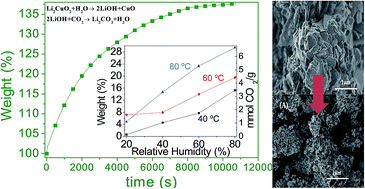
To further understand and analyze the influence of water during the CO2 capture in Li2CuO2, different kinetic experiments are presented in Fig. 8, and these isothermal products were re-characterized to determine and quantify the species produced. Isothermal experiments were performed between 40 and 80 °C at different RH (20, 40, 60, and 80%). Weight increment rates and amounts increased as a function of the RH, as it could be expected. At 40 °C the samples treated with 20 and 40% of RH only increased their weights in 0.2 and 1.2 wt% after 3 h, respectively. When the RH was increased to 60 and 80%, the final weights were 9.2 and 20.5 wt%, respectively. Similar trends were observed at 60 and 80 °C. Nevertheless, the final weight increments increased as a function of temperature and RH. It can be well represented if the isotherms with 80% of RH are compared at different temperatures. The final weights in these cases were 20.5, 24.1 and 37.6 wt% at 40, 60 and 80 °C, respectively. It must be mentioned that after the experimental times none of these isothermal conditions reached the equilibrium. So the CO2 capture must continue at longer times.
![]() | ||
| Fig. 8 Li2CuO2–CO2–H2O thermogravimetric kinetic isotherms performed at different temperatures (40, 60 and 80 °C) and RH (20, 40, 60 and 80%). | ||
To confirm the CO2 chemical capture and to quantify the CO2 through the Li2CO3 formation under the different thermal and RH conditions, all the isothermal products were characterized using XRD and TGA, through decomposition thermograms. Fig. 9 shows the XRD pattern of one specific isothermal product as an example (80 °C and 80% of RH), where the CO2 chemical capture was confirmed by the Li2CO3 and CuO formation (see reactions (5)–(7)). In this XRD pattern LiOH was not identified. This result strongly suggest that most of the LiOH reacted with CO2, producing Li2CO3. In fact, this qualitative evidence was corroborated by the TG decomposition analysis described now. Fig. 10 shows the TG and DTG decomposition curves of isothermal products treated at 80 °C with different RH. These thermograms show three different decomposition processes. Initially, between room temperature and 120 °C, the samples lost small quantities of weight (around 1 and 2.5 wt%), which could be attributed to dehydration processes. The second weight decrement was observed between 350 and 470 °C, and it can be attributed to the dehydroxylation process. In fact, the samples treated at lower RH presented lower dehydroxylations than those observed at high HR. Additionally, the DTG dehydroxylation peaks were shifted to higher temperatures as a function of the RH, which may be related to the carbonation process. If the Li2CO3 shell amounts are higher, the dehydroxylation may become slower due to diffusion processes. In fact, this assumption is in good agreement with the decarbonation process, which was produced at T ≥ 600 °C. The decarbonation process was produced in two steps between 610 and 760 °C and between 760 and 925 °C. These two processes can be described as superficial and bulk decarbonation processes. Based in these results the amounts of CO2, trapped as Li2CO3 (weight lost at T ≥ 600 °C), were quantified and plotted in Fig. 11. From these curves it is obvious that when the RH increased from 20 to 80%, the CO2 chemisorbed increased, independently of the temperature, although the CO2 chemisorptions at 80 °C presented the best results, where the maximum weight increment (29.5 wt%) was obtained at 80 °C and 80% of RH. This weight increment corresponds to a 72.2% of the total efficiency, although the equilibrium was not reached. So the CO2 chemisorption may be increased as a function of time. The efficiency obtained after 3 hours corresponds to 6.7 mmoles of CO2 per gram of Li2CuO2. In addition, it could be mentioned that if Li2CuO2 reacted totally with CO2, the maximum theoretical CO2 capture value would correspond to 9.13 mmoles g−1 (see reaction (5)).
![]() | ||
| Fig. 10 TG and DTG decomposition curves of Li2CuO2–CO2–H2O products treated isothermally at 80 °C and different RH (20–80%). | ||
![]() | ||
| Fig. 11 Quantification of the CO2 desorbed during the TG analyses from Li2CO3 by Li2CuO2 varying temperature and RH. | ||
Li2CuO2 and other alkaline ceramics have shown good CO2 capture properties at moderate temperatures in the presence of water steam; in comparison to dry conditions.35–40 The explanation given for this effect has been associated to the ceramic hydroxylation process, which promotes the CO2 reactivity. On the other hand, different microstructural characteristics may have been modified during the CO2 chemisorption process. So, the Li2CuO2–CO2–H2O isothermal products were analyzed by SEM and N2 adsorption. Fig. 12 show some secondary and backscattered electron images (BSEI) of the Li2CuO2–CO2–H2O isothermal products treated at 80 °C with 80% of RH. The morphology of the sample changed importantly in comparison to the Li2CuO2 initial appearance (see Fig. 3). The particles seem to be still agglomerated but the polyhedral particles decreased in size importantly, from 15 μm to 200 nm. Additionally, BSEI analysis evidenced the presence of two different phases by the particle contrasts observed in the corresponding image. These two phases must correspond to Li2CO3 and CuO, because they are the main Li2CuO2 carbonation products (excluding the possible hydroxide formation). Thus, the contrast differences arise from the differences in mean atomic number (
) of Li2CO3 and CuO, 6 and 18.5, respectively. Therefore, the backscattered electron coefficient (η)60 of these phases increases from 0.064 to 0.212 for Li2CO3 (dark phase) and CuO (light phase), respectively. From this backscattered electron image, it can be observed that CuO nanoparticles (≤200 nm) seem to be dispersed over the Li2CO3 phase. Finally, the N2 adsorption–desorption isotherm of the pristine Li2CuO2 sample and the isothermal product treated at 80 °C and 80% of RH are presented in the Fig. 13. Both samples are isotherms type II, to the IUPAC classification,59 but only the isothermal product presented hysteresis, H3 type. The presence of hysteresis and the large difference in the N2 adsorbed volume clearly indicate high variations in the textural properties of these samples. Additionally, the surface areas of these samples were determined using the BET model. While the surface area of the pristine Li2CuO2 sample was 0.2 m2 g−1, the isothermal product had a surface area of 11.3 m2 g−1. The large difference observed between these samples may be associated Li2CO3–CuO external shell, which resulted to have porous and the formation of CuO nanoparticles, determined by SEM. Similar results have been published for other alkaline ceramics during the CO2 capture.6–34 Nevertheless, these textural modifications have been observed at much higher temperatures (450–550 °C) during the CO2 capture process under dry conditions. In any case, the presence of porosity and/or the nanoparticles formation allows CO2 or CO2–H2O diffusion, favoring the CO2 chemisorption without the necessity of intercrystalline processes. All these results are in good agreement with the SEM and isothermal results.
![]() | ||
| Fig. 12 Secondary (A) and backscattered (B) electron images of the Li2CuO2–CO2–H2O isothermal products treated at 80 °C with 80% of RH. | ||
![]() | ||
| Fig. 13 N2 adsorption–desorption isotherm of the pristine Li2CuO2 sample and the Li2CuO2–CO2–H2O isothermal product treated at 80 °C and 80% of RH. | ||
All these results clearly show that CO2 chemisorption in Li2CuO2 is importantly improved by the presence of water vapor in moderate temperatures (30–80 °C), in comparison to the dry conditions, as Li2CuO2 only chemisorbs CO2 at higher temperatures than 250 °C under dry conditions.46–49 If these amounts of CO2 trapped are compared with other materials, the results seem to be highly encouraging. For example, several materials including activated carbons, zeolites, hydrotalcites, and amines, are able to trap, physically or chemically, around 4–6 mmoles per g in the same temperature range.4,5,61,62 In addition, other alkaline ceramics (Li5AlO4 and Na2ZrO3, among others) tested as CO2 captors in similar thermal and humid conditions have shown similar properties.35–39 Nevertheless, the Li
:
Al molar ratio on Li5AlO4 is importantly higher (5
:
1) than those of Na2ZrO3 and Li2CuO2 (2
:
1). Hence, the high CO2 chemisorption in Li5AlO4 at low temperatures may be attributed to the high lithium content, while in the Li2CuO2 case could be attributed to the high lithium accessibility presented due to its layered crystalline structure. In fact the Na2ZrO3 has the same alkaline
:
metal atomic molar ratio as well as the layered crystalline structure. Consequently, it seems that layered crystalline structures highly favor the CO2 reactivity with Li2CuO2. Thus, this kind of ceramics may be considered as feasible materials for the CO2 capture at moderate temperatures.
Additionally, all previous results were corroborated based on the theoretical thermodynamic data for the Li2CuO2–CO2, Li2CuO2–H2O and LiOH–CO2 reaction systems. ΔH and ΔG values clearly showed the different thermal stability of each reaction process at different temperature ranges, but lithium cuprate carbonation is the most plausible process at moderate temperatures. All the experimental and theoretical results showed that H2O acts as catalytic intermediate specie, which must diminish the activation energy of the whole CO2 chemisorption process. Thus, Li2CuO2 must be considered as a possible option for the CO2 capture process at moderated or environmental temperatures.
| This journal is © The Royal Society of Chemistry 2015 |