Qian Lia,
Jianyun Wangab,
Miao Zhangac,
Quan Li*ab and
Yanming Maa
aState Key Laboratory of Superhard Materials, Jilin University, Changchun 130012, China. E-mail: liquan777@jlu.edu.cn; Tel: +86-431-85167557
bCollege of Materials Science and Engineering, Jilin University, Changchun 130012, China
cCollege of Physics, Beihua University, Jilin 132013, China
First published on 31st March 2015
The search for new superhard materials with a Vickers hardness larger than 40 GPa remains a considerable experimental and theoretical challenge. Here, we perform a superhard-driven search using an unbiased structure search method based on the CALYPSO method in the ternary B–N–O system, B3NO, which is isoelectronic with diamond. A variety of newly predicted structures of the B3NO compound with short, strong, and three-dimensional covalent bonds were designed. Among them, two newly predicted orthorhombic structures with Imm2 (oI20) and Pmn21 (oP20) space groups were found to be superhard and energetically stable. After examining the dynamical stabilities, we found that these two structures are energetically more preferable. Further hardness calculations showed that the two structures are superhard materials with a Vickers hardness above 45 GPa, exceeding the criterion of superhard materials. The electronic results show that the oI20 and oP20 structures are semiconductor materials with an optimal band gap of 0.87 and 0.12 eV, respectively. The present results reveal that the B3NO compounds can be used as superhard materials or narrow band-gap semiconductor materials, and therefore have broad prospects in industrial applications, and also provide insights for exploring other functional compounds with a functionality-driven design.
The search for candidate structures is critical to understand the hardness and related physical properties of B3NO. In this work, we have predicted various structures for B3NO under 0–100 GPa with the superhard-driven CALYPSO method, which is a developed methodology for designing superhard materials for given chemical systems under high pressure. It is in contrast to the traditional ground-state prediction method where the total energy is solely used as the fitness function. We adopted hardness as the fitness function in combination with the first-principles method to construct the hardness vs. energy map by seeking a proper balance between hardness and energy for a better mechanical description of given chemical systems. We predicted a variety of structures with high hardness and relatively low energy. Two energetically stable structures were uncovered in our structure searches consisting of strong covalent B–B, B–N and B–O bonds. The calculations show that they are superhard materials with a Vickers hardness above 45 GPa. Our current work significantly improves the understanding of superhard-driven predictions and also reveals that B3NO compounds behave as both superhard and photocatalytic materials, which have wide potential for industrial applications.
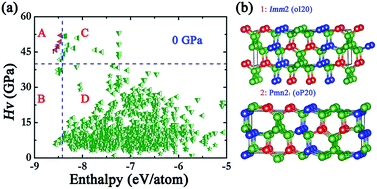
m2)10 and c-BN7 for the vertical reference line, which have been experimentally synthesized. Our target area is area A, which possesses desirable hardness and competitive low energies. Energetically, all the structures in area A are most likely to be synthesizable and might be potential superhard materials. The structures in area B are not good candidates for superhard materials, but they might also be synthesizable. Structures in C and D are energetically very unfavorable and thus should be ruled out. In this work, we chose four typical structures with negative formation enthalpies (in area A), which possess the lowest enthalpy, and the highest hardness. As shown in Fig. 1, the most stable structure is an orthorhombic structure with an Imm2 space group and contains 20 atoms, which is marked as oI20 (orthorhombic, Imm2, 20 atoms per f.u.) and the structure with the highest hardness is an orthorhombic structure Pmm2 (oP5). The second most stable one (orthorhombic structure with a Pmn21 space group, oP20) and the one with the second-highest hardness value (hexagonal structure with a P3m1 space group, hP5) were also studied for comparison. The enthalpy curves for these structures relative to the c-BN and B2O structure are plotted in Fig. 2. The formation enthalpy (ΔE) is defined as ΔE = E(B3NO) − E(B2O) − E(BN). It is clearly seen that these structures are energetically more stable than B2O10 and c-BN7 at pressures ranging from 0 to about 83 GPa. The oI20 structure is 45.3 meV per atom lower in energy than the oP20 structure at 0 GPa.
![]() | ||
| Fig. 1 The hardness vs. enthalpy map of B3NO constructed by superhard-driven calculations based on the CALYPSO method. All the predicted structures are shown at 0 GPa (a) and 100 GPa (b). The four areas indicated by A, B, C and D are divided by taking Hv = 40 GPa as the horizontal reference line and the total enthalpy (−8.42 eV and −4.87 eV for 0 and 100 GPa, respectively) of B2O10 and c-BN7 for the vertical reference line. | ||
![]() | ||
| Fig. 2 Calculated enthalpy versus pressure for these representative structures relative to that of the c-BN7 and B2O.10 | ||
All four structures stabilize in a three-dimensional network with typically strong covalent B–B, B–N, and B–O bonds (Fig. 3). It was found that all these structures are made up of rings with different atom numbers. The most stable oI20 structure comprises irregular 6-member rings, while oP20 is formed by 4-numbered, 6-numbered, and 8-numbered rings. Both hP5 and oP5 are made up by 6- and 8-numbered rings. At zero pressure, for the oI20 structure, the lattice parameters take a = 11.5486 Å, b = 2.5757 Å, and c = 4.1712 Å, with atomic positions of B1 at Wyckoff 2a (0, 0, 0.1567), B2 at 2b (0, 0.5, 0.4433), B3 at 4c (0.2210, 0, 0.0802), B4 at 4c (0.0899, 0, 0.5845), N at 4c (0.2165, 0, 0.4535), and O at 4c (0.3974, 0.5, 0.4440); for oP5, the lattice parameters are a = 2.5394 Å, b = 2.4362 Å, and c = 5.2887 Å, with atomic positions of B1 at 1a (0, 0, 0.0863), B2 at 1b (0, 0.5, 0.6477), B3 at 1d (0.5, 0.5, 0.4267), N at 1c (0.5, 0, 0.2500), and O at 1b (0, 0.5, 0.9224); for oP20, the lattice parameters are a = 2.5746 Å, b = 11.5431 Å, and c = 4.2533 Å, with atomic positions of B1 at 2a (0, 0.7500, 0.0747), B2 at 2a (0, 0.0243, 0.0974), B3 at 2a (0, 0.4710, 0.9354), B4 at 2a (0, 0.1646, 0.4300), B5 at 2a (0, 0.3402, 0.4297), B6 at 2a (0.5, 0.7501, 0.3605), N1 at 2a (0, 0.0271, 0.4616), N2 at 2a (0, 0.4662, 0.5619), O1 at 2a (0.5, 0.8464, 0.5768), and O2 at 2a (0.5, 0.6467, 0.5720); for hP5, the lattice parameters are a = b = 2.5915 Å, and c = 5.7107 Å, with atomic positions of B1 at 1a (0, 0, 0.8670), B2 at 1a (0, 0, 0.3382), B3 at 1b (0.3333, 0.6667, 0.6954), N at 1b (0.3333, 0.6667, 0.4373), and O at 1a (0, 0, 0.0961).
As potential candidates for superhard materials, the mechanical properties of the four structures are important for industrial applications. The calculated bond length, density (ρ), bulk modulus (B), shear modulus (G) and hardness (Hv) of these four typical structures are given in Table 1. For the orthogonal and hexagonal structures, the mechanical stability requires the elastic constants to satisfy the following conditions: Cii > 0 (i = 1–6), C11 + C22 + C33 + 2(C12 + C13 + C23) > 0, C11 + C22 − C12 > 0, C11 + C33 − 2C13 > 0, C22 + C33 − C23 > 0, and C44 > 0, C11 > C12, (C11 + 2C12) × C33 > 0, respectively. It is clear from Table 2 that the whole set of elastic constants of these four structures satisfy the above conditions, indicating mechanical stability. The structures listed in Table 1 exhibit high bulk moduli of 284–332 GPa, indicating the structures are difficult to compress near their respective equilibrium volumes. The values have been significantly enlarged when compared to B2O (∼240 GPa). From the analysis of the bonding environment of these crystal structures, both the B3NO and B2O structures adopt clear sp3 hybridizations, but B3NO forms additional B–N bonds besides the B–B and B–O bonds. For comparison, here we give the bond lengths of referenced B2O10 and c-BN7 of 1.670 Å (B–B), 1.565 Å (B–N), 1.503, and 1.488 Å (B–O). Obviously, the B–N bond in B3NO is much shorter than the B–B and B–O bonds in B2O, giving stronger covalent bonds in B3NO. The ratio between the bulk modulus (B) and shear modulus (G) can be used to predict the brittle or ductile behavior of materials. The calculated B/G for these structures reaches 1.07–1.27, which is smaller than the criteria of 1.75 (ref. 40) (ductile behavior is predicted when B/G > 1.75, otherwise the material behaves in a brittle manner). It is imperative to check the phonon spectra of all four structures, since they provide crucial information on the structural stabilities. No imaginary frequency in the whole first Brillouin zone is a necessary condition to ensure the predicted structure can physically exist. From the calculated phonon dispersions, oI20 and oP20 [shown in Fig. 4(a) and (b), respectively] are dynamically stable at 0 GPa. However, hP5 and oP5 are dynamically unstable [shown in Fig. 4(c) and (d), respectively], thereby ruling out the possibility of being synthesized.
| Structure | Bond length (Å) | ρ (g cm−3) | B (GPa) | G (GPa) | Hv (GPa) | ||
|---|---|---|---|---|---|---|---|
| B–O | B–N | B–B | |||||
| oI20 | 1.480, 1.507 | 1.558, 1.560, 1.568 | 1.756, 1.757 | 3.342 | 332 | 310 | 45.9 |
| oP5 | 1.453, 1.495 | 1.535, 1.537 | 1.725 | 3.169 | 303 | 245 | 52.1 |
| oP20 | 1.443, 1.477, 1.495, 1.508, 1.529 | 1.530, 1.549, 1.560, 1.572, 1.589, 1.593 | 1.734, 1.766, 1.770 | 3.281 | 326 | 296 | 47.4 |
| hP5 | 1.308, 1.383 | 1.474, 1.600 | 1.789 | 3.122 | 284 | 223 | 49.4 |
| Structure | C11 | C22 | C33 | C44 | C55 | C66 | C12 | C13 | C23 |
|---|---|---|---|---|---|---|---|---|---|
| oI20 | 878 | 642 | 743 | 352 | 311 | 287 | 99 | 129 | 152 |
| oP5 | 536 | 779 | 869 | 333 | 284 | 139 | 37 | 145 | 148 |
| oP20 | 835 | 833 | 699 | 241 | 255 | 312 | 174 | 77 | 46 |
| hP5 | 1422 | 435 | 140 | 49 |
To further understand the electronic properties, we performed simulations on the electronic band structure and partial density of states (PDOS) of oI20 and oP20, as shown in Fig. 5. The calculated results reveal the semiconductor features of these two structures with indirect band gaps of 0.87 and 0.12 eV, respectively. Since density functional calculations typically underestimate the gap by 30–50%, the true band gap might be in the range of 1.24–1.74 eV and 0.17–0.24 eV, respectively. The electronic states near the Fermi level are mainly contributed by B-2p and a few N-2p, and O-2p states. The partial DOS profiles for B-2p, N-2p and O-2p are very similar from −12 to −4 eV, reflecting the significant hybridizations between these orbitals and strong covalent interactions in both the B–N and B–O bonds.
![]() | ||
| Fig. 5 Band structure (left) and the partial density of states (right) of the oI20 (a), and oP20 (b) structures at ambient pressure. | ||
Finally, we examined the charge density distribution and the ELF that enables an effective and reliable analysis of the nature of the covalent bonding. It is useful in distinguishing ionic, covalent, and metallic bonding. Here, we used the isosurface value of 0.83 as a high ELF (≥0.8) indicates the formation of strong covalent bonds.41,42 High electron localization can be seen in the region between adjacent B–B, B–N, and B–O bonds, indicative of strong covalent bonding (Fig. 6). Also the calculated overlap population of the B–B, B–N, and B–O bonds as shown in Table 3 is high, indicating that oI20 and oP20 are strong covalent solids. The calculated ELF shows that the O atoms in oI20 and oP20 structures are threefold coordinated with three near-neighbor B atoms and a lone pair of electrons. It is clearly seen that the electronic state is actually characterized by the 3D tetrahedral-like electronic state similar to that of the nitrogen atoms in bct-CN2.43 The N atoms are four fold-coordinated and form a stable sp3 bonding state. However, the bonding environment of the boron atoms is more complex. Boron has three valence electrons, and is electron deficient compared with carbon. The 2D ELF, 3D ELF, and the coordination numbers of the B atoms are given in order to show a clear point of view. The B1 atoms in oI20 and B3 atoms in oP20 are six fold-coordinated with six neighboring boron atoms. Other boron atoms are four fold-coordinated and form a stable sp3 bonding state with boron, nitrogen and oxygen atoms. The bonding states of oI20 are similar to that of oP20 as clearly shown in the 2D ELF. These strong three-dimensional covalent bonds could reasonably explain the superhardness properties of the oI20 and oP20 structures. Our current research reveals that B3NO simultaneously belongs to superhard and semiconductor materials and, therefore, may have wide application prospects in industry, such as in cutting tools, coating materials, photocatalytic materials, and so on. In addition, the present work has opened up a new route to search for functional materials.
![]() | ||
| Fig. 6 Contours of the ELF of oI20 (a), (b) and oP20 (c), (d) with the isosurface = 0.83. The coordination numbers of the boron atoms are given for better observation. | ||
| oI20 | oP20 | ||||
|---|---|---|---|---|---|
| Bond | Population | Length (Å) | Bond | Population | Length (Å) |
| B–O | 0.59 | 1.4802 | B–O | 0.64 | 1.4429 |
| 0.61 | 1.4807 | 0.61 | 1.4774 | ||
| 0.40 | 1.5067 | 0.58 | 1.4947 | ||
| 0.53 | 1.4957 | ||||
| 0.38 | 1.5077 | ||||
| 0.42 | 1.5292 | ||||
| B–N | 0.55 | 1.5580 | B–N | 0.79 | 1.5304 |
| 0.58 | 1.5608 | 0.47 | 1.5492 | ||
| 0.75 | 1.5681 | 0.58 | 1.5599 | ||
| 0.75 | 1.5723 | ||||
| 0.55 | 1.5895 | ||||
| 0.44 | 1.5933 | ||||
| B–B | 0.62 | 1.7560 | B–B | 0.64 | 1.7341 |
| 0.54 | 1.7572 | 0.61 | 1.7664 | ||
| 0.53 | 1.7706 | ||||
| This journal is © The Royal Society of Chemistry 2015 |