Controlled coalescence of two immiscible droplets for Janus emulsions in a microfluidic device

Ming-Yu Zhang, Hong Zhao, Jian-Hong Xu* and Guang-Sheng Luo
The State Key Lab of Chemical Engineering, Department of Chemical Engineering, Tsinghua University, Beijing 100084, China. E-mail: xujianhong@tsinghua.edu.cn; Fax: +86-10-62773017; Tel: +86-10-62773017

Received 28th January 2015 , Accepted 19th March 2015

First published on 19th March 2015


Abstract

We developed a simple microfluidic device to prepare Janus emulsions by the controlled coalescence of two immiscible droplets. We could prepare Janus emulsions with different sizes and structures by changing three phase flow rates and the concentration of additives in different phases, and by controlling the equilibrium contact angle θAB in the range of 120° to 190°. Furthermore, we firstly found that the coalescence process of two immiscible droplets would be quicker when the equilibrium structure of the Janus emulsion tends to be ‘complete engulfing’. The results will be helpful for preparing Janus emulsions with controlled structures in a microfluidic device.

Introduction

Multiple emulsions such as O/W/O double emulsions,1 G/W/O double emulsions,2 and Janus emulsions,3 have been widely used in the fields of biomedicine,4,5 food science6,7 and cosmetics.8 Janus emulsions have attracted considerable attention because of their unique anisotropy properties. According to a previous study,9 the equilibrium structure of three phase fluids is determined by three interfacial tensions. Defining the two immiscible dispersed phases as phase 1 and phase 2, and the continuous phase as phase 3, we can determine the equilibrium structure of the emulsion by the relationship between the different interfacial tensions σij(ijk = 1, 2, 3). Researchers defined the spreading coefficient S to judge the structure of equilibrium based on an interfacial energy minimization principle9
 
Si = σjk − (σij + σik) (1)
When the spreading coefficient S is more or less than 0, there are three different equilibrium conditions that will exist: (I) complete engulfing, (II) partial engulfing (Janus) and (III) non-engulfing. Among them, the Janus structure can be formed only if all three spreading coefficients are less than 0.

The traditional method of preparing Janus emulsions is by agitation. Hasinovic et al.3 obtained water–vegetable oil Janus emulsions in silicone oil by using a mini vortexer to mix the samples. Ge et al.10 mixed certain weight fractions of silicone oil (SO), tripropyleneglycol diacrylate (TPGDA) and Tween 80 aqueous solution with an Ultra-Turrax, then attained the Janus emulsions of TPGDA/SO in water. The traditional agitation method to prepare Janus emulsions has many disadvantages, such as poor monodispersity of the Janus emulsions, and difficulties in controlling the structure and repeating the product.

Microfluidic technology11–17 has enabled the formation of complex multiple emulsions with good monodispersity, controlled structures and droplet size in microchannels, which solves the problems of the traditional method. Hence microfluidic technology has become a promising method to prepare Janus emulsions in the past decade. Typical approaches to prepare Janus emulsions in microfluidic devices are dewetting, laminar shear-rupturing and phase separation.

Nie et al.11 used hydraulics focusing microchannels to prepare double emulsions and Janus emulsions. When the three liquid fluids flowed into a narrow orifice, the continuous water phase surrounded the monomer–oil thread. The coaxial jet extended into the downstream channel and broke up into core–shell double emulsions. For some systems, dewetting of the emulsions would form a Janus emulsion with thermodynamic properties. Xu et al.12,13 used the co-flowing coaxial microfluidic device to prepare double emulsions with different cores. The inner phase broke out because of their thermodynamic properties and the emulsion formed a Janus structure. They investigated the structure evolution of the double emulsions for different systems. These methods are called dewetting approaches.

Nisisako et al.14 firstly used a laminar microfluidic system to produce biphasic Janus droplets. They chose 1,6-hexanediol diacrylate (HDDA) and silicone oil as the dispersed phase fluids, and sodium dodecyl sulfate (SDS) 0.3 wt% aqueous phase as the continuous phase fluid. Then they prepared biphasic Janus droplets of two immiscible organic fluids by a shear-rupturing method. Lan et al.15 chose the same systems in a coaxial microfluidic device. As the dispersed phase flowed through the shrink tip of the glass capillary, monodispersed Janus droplets were produced by the shearing force of the continuous phase flow. The Janus droplets were then photopolymerized by exposing them to UV light. Based on the mechanism of shear force-driven break-off, Prasad et al.16 also prepared shape-controlled Janus droplets and successfully synthesized monodispersed inorganic–organic Janus microparticles.

Ono et al.17 prepared Janus particles by using a phase separation method. They prepared droplets of polymer molecules (PS and PMMA) that were dissolved in the polar solvent at concentrations of 1.0–5.0% (w/v) firstly using hydraulics focusing microchannels. The external phase fluid was distilled water containing 2.5% (w/v) PVA. Then the solvent in the droplets was rapidly diffused and dissolved into the continuous phase during the flowing process, whereas water-insoluble polymers were precipitated to form monodispersed polymeric Janus microparticles.

However, there are many problems with the existing approaches to prepare Janus emulsions in microfluidic devices, such as complex fabrication of microfluidic devices, high requests to control flow and a narrow operation range. So it is desirable to develop a simple and convenient approach to prepare Janus emulsions with controlled structures in microfluidic devices.

Learning from the coalescence of two droplets with same phase, we developed a new microfluidic approach to prepare Janus emulsions by coalescing two immiscible droplets combined with changing interfacial tensions. During the coalescence of two droplets with the same phase, there are three distinct stages:18 approach and deformation by collision, lubricating film drainage, and coalescence by rupture of the film. When the contact time of droplets is longer than the film drainage time, coalescence occurs. On the contrary, the two droplets will never coalesce.19 For the coalescing two immiscible droplets, after lubricating film drainage and rupturing of the film, one droplet will partly spread on the surface of another droplet and form a Janus structure. To the best of our knowledge, the spreading process and thermodynamic principle during the coalescence of two immiscible droplets has not been studied. So we changed the experimental systems and systematically investigated the influence of interfacial tensions on the spreading dynamics and thermodynamic equilibrium structures of Janus emulsions.

Materials and methods

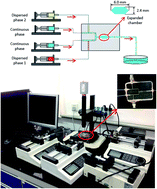
The microfluidic device was fabricated on a polymethyl methacrylate (PMMA) plate using a Computerized Numerical Control (CNC) machine tool with an end mill (Φ = 0.4 mm), as shown in Fig. 1. The width and the depth of the microchannels were both 400 μm. Two dispersed phase fluid flows (red and yellow fluids in the figure) were driven into the microchannel separately from both sides through two microneedles with inside diameters of 160 μm, then sheared by continuous phase fluids (blue fluids) to form monodispersed droplets. The droplets of the two dispersed phases met at the subsequent T junction, and flowed into an expanded chamber where two immiscible droplets tend to collide and coalesce. The size of that expanded chamber was 6.0 mm (length) × 2.4 mm (width) × 0.4 mm (depth).
image file: c5ra01718a-f1.tif
Fig. 1 The structure and snapshot of the microfluidic device.

To prepare the Janus emulsions, we chose soybean oil (Yihai Kerry Food Company) and deionic water as the dispersed phases, and silicone oil (10cs, XIAMETER) as the continuous phase. Based on previous results,20–22 to vary interfacial tensions, we added 1.5 wt% PGPR (polyglycerol polyricinoleate) and 0–40 vol% 1-octanol (Tianjin Yongda Chemical Reagent Company Limited) into the soybean oil, and dyed the soybean oil with Sudan III (Tianjin Fuchen Chemical Reagents Factory). 0–1.0 wt% SDS (Tianjin Fuchen Chemical Reagents Factory) was added into water, and 0–10 wt% Dow-Corning 749 (Dow Corning Co. Ltd.) was added into the silicone oil.

We observed the formation and coalescence processes of emulsions in the microchannel by an optical microscope (Olympus, Japan) equipped with a camera (A742, Pixelink, Canada) with a frequency of 200 images per second. The interfacial tensions were measured by an interfacial tension meter using the pendant drop technique (OCAH200, GmbH, Germany). All the experiments were carried out at room temperature.

Results and discussion

Preparation of Janus emulsions by the coalescence method

Firstly, we attempted to prepare the Janus emulsions of two different structures controllably. We added 1.5 wt% PGPR into the soybean oil (52.8 mPa s) and 0.5 wt% Dow-Corning 749 (DC 749) into the silicone oil (9.67 mPa s). When a soybean oil droplet meets a water (0.95 mPa s) droplet at the expanded chamber, the soybean oil droplet will spread out on the surface of water droplet partly and form a typical Janus emulsion. By changing the phase flow rates of the dispersed phases and the continuous phase, we successfully prepared typical Janus emulsions with different volume ratios of the soybean oil droplet to the water droplet in the range of 0.5–2. We could also prepare Janus emulsions with the number of water droplets to soybean oil droplets ratio of 1[thin space (1/6-em)]:[thin space (1/6-em)]1 or 1[thin space (1/6-em)]:[thin space (1/6-em)]2 separately. The micrographs of different Janus emulsions are shown in Fig. 2 and the videos showing the generation of the different Janus emulsions can be seen in the ESI (Movies S1–S4).
image file: c5ra01718a-f2.tif
Fig. 2 Preparation of typical Janus emulsions with different structures. (a–c) Structure of typical Janus emulsions with volume ratios of 1[thin space (1/6-em)]:[thin space (1/6-em)]1, 1[thin space (1/6-em)]:[thin space (1/6-em)]2 and 2[thin space (1/6-em)]:[thin space (1/6-em)]1; (d) structure of typical Janus emulsions of two water droplets to one soybean oil droplet. DP1 and DP2 are the flow rates of dispersed phase 1 and dispersed phase 2 respectively. CP1 and CP2 are the flow rates of the continuous phase from the side of dispersed phase 1 and dispersed phase 2 respectively. The units of flow rate are μL min−1.

We then changed the experimental system by adding 1.0 wt% SDS into the water phase (0.99 mPa s). We found obvious differences in the structure of the Janus emulsions. The soybean oil droplet almost engulfed the water droplet, as shown in Fig. 3. We successfully prepared approximate-engulfed Janus emulsions with different structures by changing the dispersed phases and continuous phase flow rates. The videos showing the generation of different Janus emulsions can be seen in the ESI (Movies S5 & S6).


image file: c5ra01718a-f3.tif
Fig. 3 Preparation of approximate-engulfed Janus emulsions with different structures. (a) Structure of approximate-engulfed Janus emulsions; (b) structure of approximate-engulfed Janus emulsions of two water droplets to one soybean oil droplet; (c) structure of approximate-engulfed Janus emulsions with volume ratios of 2[thin space (1/6-em)]:[thin space (1/6-em)]1, 1[thin space (1/6-em)]:[thin space (1/6-em)]1 and 1[thin space (1/6-em)]:[thin space (1/6-em)]2. DP1 and DP2 are the flow rates of dispersed phase 1 and dispersed phase 2 respectively. CP1 and CP2 are the flow rates of the continuous phase from the side of dispersed phase 1 and dispersed phase 2 respectively. The units of flow rate are μL min−1.

We calculated the spreading coefficients using eqn (1) in Tables 1 and 2. According to the spreading coefficients of the systems in Tables 1 and 2, we predicted that the three phases would form a Janus structure and a structure between Janus and engulfing respectively. The experimental results of the equilibrium structures matched the predictions well.

Table 1 The interfacial tensions and spreading coefficients of typical Janus emulsions
Phase 1 Soybean oil with 1.5 wt% PGPR σ12/mN m−1 11.24 S1 −1.76
Phase 2 Water σ13/mN m−1 3.28 S2 −20.72
Phase 3 Silicone oil with 0.5 wt% DC 749 σ23/mN m−1 12.76 S3 −4.80


Table 2 The interfacial tensions and spreading coefficients of approximate-engulfed Janus emulsions
Phase 1 Soybean oil with 1.5 wt% PGPR σ12/mN m−1 4.27 S1 0
Phase 2 Water with 1 wt% SDS σ13/mN m−1 3.28 S2 −8.65
Phase 3 Silicone oil with 0.5 wt% DC 749 σ23/mN m−1 7.66 S3 −6.67


From the results above, we successfully prepared Janus emulsions by coalescing two immiscible droplets, and we could control the structure and size of Janus emulsions by changing the experimental systems and flow rates of the continuous phase and the two dispersed phase fluids. The experiments we did proved that it is feasible to prepare Janus emulsions by a coalescing method in microfluidic devices. To the best of our knowledge, the spreading process and thermodynamic principle during the coalescence of two immiscible droplets has not been studied. We therefore changed the experimental systems and systematically investigated the influences of interfacial tensions on the coalescence dynamics and thermodynamic equilibrium structures in the following section.

The coalescence dynamics and control of Janus emulsion equilibrium structures

From ref. 23–25, we can define three contact angles of a Janus emulsion droplet, as shown in Fig. 4. The interfacial tension between phase A/B and an external phase is γA/γB, whose direction is depicted in Fig. 4. γAB is the interfacial tension between phase A and phase B. From the force balance between these three interfacial tensions, three contact angles of θA, θB and θAB for the equilibrium Janus emulsion droplet can be determined. The angle between γA and γB is θAB and indicates the engulfing extent of two immiscible droplets. The smaller θAB is, the more separated the two immiscible droplets are. On the contrary, the bigger θAB is, the more one droplet engulfs another.
image file: c5ra01718a-f4.tif
Fig. 4 A sketch of the three contact angles of a Janus emulsion droplet.

From the above analysis we can see that the interfacial tensions between any two phases affect the Janus emulsion structure greatly. As the surfactant in the water phase, SDS decreases the interfacial tensions between the water phase and the other phases. So does DC 749 in silicone oil. From ref. 20 we learned that adding octanol into soybean oil decreases the interfacial tensions between the soybean oil phase and the other phases. So we changed the concentration of the additive in one phase, with the other phases staying the same, to investigate the effect of additive concentration on the coalescence dynamics and equilibrium structure of the Janus emulsions. In the following experiments, we fixed the flow rates of both dispersed phase 1 and dispersed phase 2 at about 1 μL min−1, and the flow rates of the continuous phase from the side of dispersed phase 1 and dispersed phase 2 at about 20 μL min−1 and 25 μL min−1 respectively.

Firstly, we fixed deionized water as phase B and silicone oil that contained 0.5 wt% DC 749 as the external phase, and changed phase A as soybean oil containing 1.5 wt% PGPR with different concentrations of octanol. The typical dynamic process of coalescence is shown in Fig. 5a. When two immiscible droplets contacted, we started the time. The two droplets maintained the contact state for a while. Then one droplet began to engulf another and reached equilibrium at the end, at which point, we stopped the timer. The time recorded was the coalescence time. We recorded each experiment ten times and obtained an average coalescence time. We recorded a lot of videos, selected the very moment when the interface between phase A and phase B in the Janus emulsion was perpendicular to the plane of the microchannels, and measured the contact angle correctly. When the octanol concentration in phase A increased from 0 to 25 vol%, we found the interfacial tension γA decreased from 1.12 mN m−1 to 0.63 mN m−1, and γAB decreased from 23.17 mN m−1 to 11.08 mN m−1, as shown in Table 3. We can see that the interface between phase A and phase B tended to be smaller than that between phase A and the external phase. So the water droplet was gradually more engulfed by the soybean oil droplet to reach the smallest interfacial energy, and the contact angle θAB of the Janus emulsion droplet increased, as shown in Fig. 5b. Furthermore, the effect of θAB on the coalescence time of the two immiscible droplets is shown in Fig. 5c. The results demonstrated that the coalescence time decreased with the increase of θAB, which means that the coalescence of two immiscible droplets happened more quickly when the equilibrium structure of the Janus emulsion tends to be ‘complete engulfing’. This may be due to the increase of the interfacial driving force with the increase of θAB.


image file: c5ra01718a-f5.tif
Fig. 5 (a) Typical dynamic process of coalescence at different times after the contact of two immiscible droplets. The equilibrium contact angle θAB is 142° and the coalescence time is 1.94 s for this system; (b) the effect of the octanol concentration in phase A on the equilibrium Janus emulsion structure; (c) the effect of the contact angle on the coalescence time of two immiscible droplets.
Table 3 The interfacial tensions of the Janus emulsions with different concentrations of octanol in soybean oil
Concentration of octanol in soybean oil/vol% 0 3 10 25
γA/mN m−1 1.67 1.65 1.07 0.64
γAB/mN m−1 23.17 21.84 13.6 11.08


Then, we fixed soybean oil containing 1.5 wt% PGPR as phase A and silicone oil containing 0.5 wt% DC 749 as the external phase, and changed phase B to deionized water with different concentrations of SDS. When the SDS concentration in phase B increased from 0 to 1.0 wt%, we found that the interfacial tension γAB decreased more than γB (Table 4), so the water droplet was gradually more engulfed by the soybean oil droplet and the contact angle θAB of the Janus emulsion droplet increased, as shown in Fig. 6a. The coalescence time of the two immiscible droplets decreased, as shown in Fig. 6b. The results are similar to that of the changing octanol concentrations in phase A.


image file: c5ra01718a-f6.tif
Fig. 6 (a) The effect of the SDS concentration in phase B on the Janus emulsion structure; (b) the effect of the contact angle on the coalescence time of two immiscible droplets.
Table 4 The interfacial tensions of Janus emulsions with different concentrations of SDS in water
Concentration of SDS in water/wt% 0 0.1 0.5 1
γB/mN m−1 30.36 9.35 7.93 7.35
γAB/mN m−1 21.82 1.40 1.00 0.94


Finally, we fixed the soybean oil containing 1.5 wt% PGPR as phase A and deionized water containing 0.1 wt% SDS as phase B, and the changing external phase as silicone oil with different concentrations of DC 749. When the DC 749 concentration in the external phase increased from 1.0 wt% to 10.0 wt%, we found that the interfacial tensions γA and γB both decreased with fixed γAB (Table 5), so the water droplet and the soybean oil droplet separated gradually and the contact angle θAB of the Janus emulsion decreased, as shown in Fig. 7a. Furthermore, the coalescence time of two immiscible droplets increased, as shown in Fig. 7b. The results demonstrated that the coalescence of the two immiscible droplets happened more slowly when the equilibrium structure of the Janus emulsion tends to be ‘non-engulfing’.


image file: c5ra01718a-f7.tif
Fig. 7 (a) The effect of the DC 749 concentration in the external phase on Janus emulsion structure; (b) the effect of the contact angle on the coalescence time of two immiscible droplets.
Table 5 The interfacial tensions of the Janus emulsions with different concentrations of DC 749 in silicone oil
Concentration of DC 749 in silicone oil/wt% 1 2 5 10
γA/mN m−1 0.58 0.53 0.36 0.27
γB/mN m−1 8.58 8.43 6.88 4.52


From all the above results, by changing the concentration of additive in one phase with the other two phases fixed, we found that the concentration of octanol in the soybean oil, SDS in water and DC 749 in the silicone oil affected the Janus emulsion equilibrium structure and coalescence time, which is very helpful for the controlled preparation of Janus emulsions with different structures. We could control the equilibrium contact angle θAB in the range of 120° to 190° under the experimental conditions, as shown in Fig. 8. Furthermore, we investigated the relationship between the thermodynamic equilibrium state of the Janus emulsion and coalescence time of two immiscible droplets to form a Janus emulsion at equilibrium, as shown in Fig. 9. We firstly found that the coalescence process of two immiscible droplets would be quicker when the equilibrium structure of the Janus emulsion tends to be ‘complete engulfing’. The results will be helpful for preparing Janus emulsions with controlled structures by coalescing two immiscible drops in a microfluidic device.


image file: c5ra01718a-f8.tif
Fig. 8 The equilibrium structures of different Janus emulsions under different experimental conditions.

image file: c5ra01718a-f9.tif
Fig. 9 The relationship between the contact angle of the Janus emulsion and the coalescence time.

Conclusions

In this paper, we developed a simple microfluidic device to prepare Janus emulsions by controlled coalescence of two immiscible drops. We could easily control the number of immiscible drops and their size in a Janus emulsion by changing the three phase flow rates. Then we changed the experimental systems and systematically investigated the influence of interfacial tensions on the coalescence dynamics and the thermodynamic equilibrium structures. We found that the concentration of n-octanol in the soybean oil, SDS in water and DC 749 in the silicone oil affected the coalescence time and equilibrium structure of the Janus emulsion. We could control the equilibrium contact angle θAB in the range of 120° to 190° under the experimental conditions. Finally, we firstly found that the coalescence process of two immiscible droplets would be quicker when the equilibrium structure of Janus emulsion tends to be ‘complete engulfing’. The results will be helpful for preparing Janus emulsions with controlled structures by coalescing two immiscible droplets in a microfluidic device.

Acknowledgements

The authors gratefully acknowledge the support of the National Natural Science Foundation of China (21322604, 21136006, 21476121).

Notes and references

  1. X. Ge, J. Huang, J. Xu and G. Luo, Lab Chip, 2014, 14, 4451–4454 RSC.
  2. W.-T. Wang, R. Chen, J.-H. Xu, Y.-D. Wang and G.-S. Luo, RSC Adv., 2014, 4, 16444–16448 RSC.
  3. H. Hasinovic, S. E. Friberg and G. Rong, J. Colloid Interface Sci., 2011, 354, 424–426 CrossRef CAS PubMed.
  4. R. H. Engel, S. J. Riggi and M. J. Fahrenbach, Nature, 1968, 219, 856–857 CrossRef CAS.
  5. M. Nakano, Adv. Drug Delivery Rev., 2000, 45, 1–4 CrossRef CAS.
  6. D. J. McClements and Y. Li, Adv. Colloid Interface Sci., 2010, 159, 213–228 CrossRef CAS PubMed.
  7. G. Muschiolik, Curr. Opin. Colloid Interface Sci., 2007, 12, 213–220 CrossRef CAS PubMed.
  8. M. H. Lee, S. G. Oh, S. K. Moon and S. Y. Bae, J. Colloid Interface Sci., 2001, 240, 83–89 CrossRef CAS PubMed.
  9. S. Torza and S. G. Mason, Science, 1969, 163, 813–814 CrossRef CAS PubMed.
  10. L. L. Ge, S. H. Lu and R. Guo, J. Colloid Interface Sci., 2014, 423, 108–112 CrossRef CAS PubMed.
  11. Z. H. Nie, S. Q. Xu, M. Seo, P. C. Lewis and E. Kumacheva, J. Am. Chem. Soc., 2005, 127, 8058–8063 CrossRef CAS PubMed.
  12. J.-H. Xu, X.-H. Ge, R. Chen and G.-S. Luo, RSC Adv., 2014, 4, 1900–1906 RSC.
  13. K. Xu, J.-H. Xu, Y.-c. Lu and G.-S. Luo, Cryst. Growth Des., 2014, 14, 401–405 CAS.
  14. T. Nisisako and T. Torii, Adv. Mater., 2007, 19, 1489–1493 CrossRef CAS.
  15. W. Lan, S. Li, J. Xu and G. Luo, Microfluid. Nanofluid., 2012, 13, 491–498 CrossRef CAS.
  16. N. Prasad, J. Perumal, C.-H. Choi, C.-S. Lee and D.-P. Kim, Adv. Funct. Mater., 2009, 19, 1656–1662 CrossRef CAS.
  17. T. Ono, M. Yamada, Y. Suzuki, T. Taniguchi and M. Seki, RSC Adv., 2014, 4, 13557–13564 RSC.
  18. D. Z. Gunes, X. Clain, O. Breton, G. Mayor and A. S. Burbidge, J. Colloid Interface Sci., 2010, 343, 79–86 CrossRef CAS PubMed.
  19. K. Wang, Y. Lu, L. Yang and G. Luo, AIChE J., 2013, 59, 643–649 CrossRef CAS.
  20. N. N. Deng, W. Wang, X. J. Ju, R. Xie, D. A. Weitz and L. Y. Chu, Lab Chip, 2013, 13, 4047–4052 RSC.
  21. N. Pannacci, H. Bruus, D. Bartolo, I. Etchart, T. Lockhart, Y. Hennequin, H. Willaime and P. Tabeling, Phys. Rev. Lett., 2008, 101, 4 Search PubMed.
  22. J. Guzowski and P. Garstecki, Lab Chip, 2014, 14, 1477–1478 RSC.
  23. J. Guzowski, P. M. Korczyk, S. Jakiela and P. Garstecki, Soft Matter, 2012, 8, 7269–7278 RSC.
  24. S. E. Friberg, I. Kovach and J. Koetz, ChemPhysChem, 2013, 14, 3772–3776 CrossRef CAS PubMed.
  25. H. Hasinovic, S. E. Friberg, I. Kovach and J. Koetz, J. Dispersion Sci. Technol., 2013, 34, 1683–1689 CrossRef CAS.

Footnote

Electronic supplementary information (ESI) available. See DOI: 10.1039/c5ra01718a

This journal is © The Royal Society of Chemistry 2015
Click here to see how this site uses Cookies. View our privacy policy here.