Youngmin Kim‡
a,
Chang-Hyun Song‡ab,
Min-Gi Kwaka,
Byeong-Kwon Ju*b and
Jong-Woong Kim*a
aDisplay Components & Materials Research Center, Korea Electronics Technology Institute, 68 Yatap-dong, Bundang-gu, Seongnam 463-816, South Korea. E-mail: wyjd@keti.re.kr
bDisplay and Nanosystem Laboratory, College of Engineering, Korea University, Seoul 136-713, South Korea. E-mail: bkju@korea.ac.kr
First published on 1st May 2015
Transparent electrodes based on percolated networks of silver nanowires (AgNWs) are known for their good conductivity, transparency, and flexibility. Owing to these intrinsic properties, AgNWs are gaining much attention and are considered potential electrode materials in large-area and flexible devices. However, a major drawback of the AgNWs—poor adhesion to polymers—is holding back their practical usage. The weak bond of AgNWs to polymers limits their fine-pitch patternability, which is one of the most important requirements in the electronics industry. In the study reported here, we irradiated nanowires, attached to the polymer during photolithography and metal etching, with intense pulsed light to improve the adhesion. As a result, a complicated pattern of nanowires was fabricated without any form of damage. For better flexibility, we transferred the patterned AgNWs to the surface of a colorless polyimide film to produce a highly stable electrode under repeated bending cycles. As a result of these developments, a flexible touch panel based on a capacitive sensor was successfully fabricated.
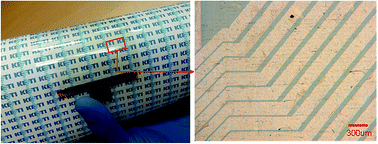
In a bid to resolve this issue, several methods to enhance the adhesion of AgNWs to polymers have been reported so far: (1) employing a transparent adhesive to attach AgNWs to a polymer substrate;11 (2) adding transparent binding materials to the AgNW-dispersed liquid;12 (3) overcoating AgNWs with a transparent polymer;13 (4) mechanically pressing AgNWs onto a polymer to enlarge the contact areas;14 (5) embedding nanowires in the polymer surface.15–17 Methods (1) to (3) are the most applicable and convenient ways to remarkably enhance adhesion, but the coating of additive layers or addition of binders lowers the transmittance of the film. In severe cases, the neutral color of the film could also be altered. In method (4), although the adhesion and stability of the AgNW electrodes can be enhanced without any drops in optical properties, there is the practical issue of physical damages on the film surface or the need to use an ultra-smooth roller. It should be considered that the surface of a pressing roller needs to be smoother than the roughness of the AgNW networks. Method (5) is known to be an efficient way to enhance adhesion, but the buried nanowires cannot be patterned by conventional etching techniques.
In our previous study, we showed that the adhesion of AgNWs to polymers could be largely enhanced by a simple and short irradiation of high-energy pulsed light.18 One such method, namely intense pulsed light (IPL) irradiation, has been reported to be a powerful tool for enhancing adhesion by partially melting regions of a polymer substrate that are immediately adjacent to AgNWs.19,20 Only a very short irradiation duration of high-energy pulsed light is needed to induce the localized heating required to activate the interface between the metal and polymer, without any severe deterioration of the optical properties. Building on this experience, we used the improved interfacial adhesion to fabricate fine patterns of AgNWs on polymers, which could be used to make flexible touch sensors. In the current study, we elaborated the processing parameters so that the technique could be utilized to transfer the patterned AgNWs onto the surface of target polymers. For this, we employed Kapton film for a mother substrate, which is optimal for balancing the improvement of nanowire adhesion for photolithography and its capability for a successful transference to the target polymer. This produced finely patterned AgNW networks embedded in a transparent polymer with ultra-flexibility and outstanding stability. The feasibility of this new approach is tested by applying it to the fabrication of a flexible touch sensor.
![]() | ||
| Fig. 1 Improved patterning procedure for AgNW networks and fabrication of AgNW–cPI composite electrode. | ||
Fig. 2 shows the effect of IPL irradiation on the patternability of the AgNWs coated on a Kapton film. The patterning consisted of a conventional photolithography process followed by chemical etching of the AgNWs in the following order: spin coating of the PR on an AgNW electrode that was coated on a Kapton film; light exposure with a chromium patterned mask; PR development; etching of AgNWs by immersing in a metal etchant; and finally, removal of the PR by dipping in a PR remover. As shown in Fig. 2(a) and (b), several spots of stripped networks of AgNWs could be easily found. Those detachments occurred during the development of the PR to form barriers for protecting the AgNWs from the etchant and the removal of PR residue. In general, when a AgNW electrode is immersed in a liquid, the nanowires are under a mixed state of shear and tensile stresses that causes them to detach from the substrate by buoyancy. An upward and lateral movement of the liquid pulls the AgNWs in multiple directions, and if they are loosely adhered to the substrate, the nanowires can also be stripped. However, as shown in Fig. 2(c) and (d), if the AgNWs were treated by IPL under the proper irradiation conditions, the AgNW networks could be perfectly patterned without forming any types of defects. We also fabricated AgNW-based lines with various widths as shown in Fig. S2.† We could make the line width smaller than 20 μm by this approach, and the resistance of the lines linearly increased with decreasing width. One thing we need to notice is that some un-percolated areas could be formed when the width is smaller than 35 μm (see Fig. S3†), but it could be possibly resolved by an increase of nanowire density. From an engineering perspective, this is very important because there was no need for additional materials and only a simple and extremely short pulse of light irradiation was required to enhance the adhesion of AgNWs. It was also noted that the value of Rs of the percolated AgNW networks decreased by about 20%, which is presumably due to the decrease of contact resistance between individual nanowires.21
![]() | ||
| Fig. 2 AgNW lines patterned by photolithography and Ag etching: (a and b) patterned without IPL treatment, (c and d) patterned with IPL treatment. | ||
In order to determine the mechanism for the enhancement of adhesion, we analyzed the surface topography by SEM and AFM, as shown in Fig. 3 and S4.† As shown in Fig. 3(a), the as-deposited pristine AgNWs are just placed on a Kapton film, with visible gaps between the nanowires and the film mainly because of the low surface energy of the latter. The untreated non-polar surface of the Kapton film generally have adverse problems in adhesion, coating, colloid stabilization, and lamination with other materials, resulting in poor coating and adhesion of AgNWs. To overcome this weakness, a transparent adhesive or binding materials are commonly added, but side effects such as decrease in transmittance, increase in haziness, and deterioration of color neutrality are unavoidable. In Fig. 3(b), the powerful effect of IPL irradiation to enhance the adhesion of AgNWs to Kapton is shown: the gap between the wires and the substrate is not discernable, and the gaps at the intersections of AgNWs are also no longer visible. This means that the surface of the wires fused to form a solid network, which would explain the observed reduction in Rs.
![]() | ||
| Fig. 3 Micrographs of AgNW networks investigated by SEM: (a) AgNWs coated on a Kapton film; (b) AgNWs on a Kapton film with IPL treatment; (c) embedded AgNWs on the surface of a cPI film. | ||
The microstructural evolution of the AgNW electrode during IPL irradiation can be explained by the plasmonic heating and its effect. First, the highly intensive photonic energy is delivered to AgNWs within a few hundred or thousand microseconds, thus instantly increasing the temperature of AgNWs because of the photothermal effect.22 Then, the absorption of heat by AgNWs increased the temperature of AgNWs nearby, and the polymer underneath the nanowires was activated to react with the surface of AgNWs. In our earlier study, we discovered that a further round of IPL irradiation would have sufficiently intensified the fusion of the polymer and resulted in partial embedment of AgNWs in the surface of the polymer.18 Once the AgNWs were partially buried in the polymer surface, it was difficult to tear them off from the polymer. Given that one of the goals of using IPL irradiation was to obtain robust AgNW networks on a polymer during photolithography and etching of the metal, but not holding the AgNWs afterwards, the fusion of the polymer was not necessary: the microstructural state in the initial stage was sufficient to improve the adhesion and prevent any loss of nanowires when immersed in liquids. Therefore, we applied only four rounds of irradiation for a pulse duration of 500 μs each at 2 kV. An examination of the microstructure showed no evidence of partial embedment of nanowires on any part of the sample fabricated under these conditions.
An interesting outcome was that the roughness of the AgNW film was decreased by the IPL irradiation. A comparison of Fig. S4(a) and (b)† shows that the root-mean-square roughness (RRMS) of a pristine AgNW film decreased from 13.4 to 10.8 nm after it was irradiated four times. As the heated nanowires seeped into the surface of the Kapton film, the gaps between them disappeared, as shown in Fig. 3(b). A liquid polymer, cPI varnish, was then coated on the AgNW networks on the Kapton film, after which the coated AgNWs were thermally annealed and then peeled off from the mother substrate (Kapton). Fig. 3(c) shows a mix of fully and partially embedded AgNWs in the matrix of cPI. Most of the AgNWs were embedded in the cPI, while some of them were still exposed to air and thus provided sufficient contact with overlying materials such as the conductive adhesive or electrodes. As shown in Fig. 3, the sheet resistance was a bit increased by the transfer process, but it is not conspicuous. The value of RRMS was further reduced to 5.6 nm because most of the nanowire bundles were buried beneath the surface of the cured polymer. This suppressed the protrusion of the nanowires, and simultaneously enhanced the stability of the electrode. Furthermore, given that the nanowire bundles are buried inside the cPI, most of them are not in direct contact with air, which implies that the oxidation could be possibly somewhat retarded.
The mechanical stability of the AgNW networks on the Kapton film and those embedded in the cPI film was assessed in a bending-endurance test, as shown in Fig. 4(a). A machine for automatic bend testing was employed, which enabled the electrode to experience alternate outward bending (tensile stress) and inward bending (compressive stress) repeatedly, resulting in cyclic fatigue failure. This test used a bending radius of 0.5 mm, producing about 2% tensile and compressive strains. The resistance of the AgNW networks without IPL irradiation was sharply increased just after several hundred cycles of repeated bending, while the resistance of IPL-irradiated AgNW networks did not vary until after 10
000 bending cycles. The resistance of the IPL-irradiated samples continued to increase until a catastrophic failure occurred after 20
000 cycles. This enhancement of bending stability was caused by the activated interfacial binding of the nanowires and the Kapton film. Further improvement of the mechanical stability was attained by the embedment of AgNWs at the cPI surface. In Fig. 4(a), the repeated bending left the resistance of the nanowires embedded in cPI virtually unchanged for at least 50
000 cycles. This high mechanical stability can be attributed to the following factors: low thickness of the composite electrode, high strength of cPI, and good adhesion of AgNWs to cPI. Because the film was fabricated to have a thickness of 20 μm, the strain at the surface of the composite electrode was suppressed to 2% or less. The small strain formed at the electrode was the first factor that enhanced the mechanical stability of the film. The high modulus (6 GPa) and ultimate tensile strength (300 MPa) were the second factor to delay the catastrophic failure of the samples. However, the most important factor to be noted was the exceptionally high adhesion of AgNWs to cPI. Among the various polymers that we tested in this study, including polymerized urethane, ethylene, silicone, and imide, cPI was best matched with the AgNWs from this point of view. The good adhesion between AgNWs and cPI prevented the sliding of the wires at the interfaces.
The transmittance of the fabricated composite film is presented in Fig. 4(b), with a photograph of the film shown in the inset. The transmittance was measured with a UV-visible spectrometer using air as a reference. In a visible range of wavelength from 400 to 700 nm, the transmittance spectrum is flat and has a value of over 80% for a sheet resistance of around 24 ohm sq−1. Transmittance spectrums for the fabricated electrodes with various sheet resistance are shown in Fig. S5.† This trait is relevant from a technological perspective as it leads to high transparency and neutral coloration, which are favorable for most applications.
Based on our experience with AgNW–cPI composite electrodes, we fabricated a touch sensor with a single-layered patterned AgNW electrode consisting of transmitter and receiver patterns. The nanowires were embedded in cPI in order to obtain a sensor with ultra-flexibility. The narrowest line width and spacing were 100 and 20 μm, respectively, in the sensor design. For interconnection with the driving module, an ACF was successfully employed without incurring a large increase in the contact resistance between the exposed AgNWs and conductive particles in the ACF. The photo of the fabricated touch sensor bonded to a FPCB in Fig. 5(a) shows a very clear sensor area, with the FPCB firmly attached when bent to a curved shape. The functionality of the fabricated touch panel was successfully demonstrated by a two-point touch test, as shown in Fig. 5(b). Since the primary goal of using an AgNW electrode in flexible touch sensors is to achieve highly reliable performance under continuous mechanical deformation, mechanical-stability tests were carried out on the touch devices fabricated as part of this study. Like the earlier tests with bare AgNW–cPI composite electrodes, the flexible sensors were subjected to bending tests at a radius of 0.5 mm. After a hundred repetitions, the capacitance variations before and after touching were not largely altered, as illustrated in Fig. 5(c), which means that the capability for sensing touch was not deteriorated by the bending.
![]() | ||
| Fig. 5 (a) Fabricated touch panel. (b) Demonstration of touch panel with AgNW-based electrode. (c) Measured capacitance before and after bending test (bending radius: 500 μm; 100 cycles). | ||
Footnotes |
| † Electronic supplementary information (ESI) available. See DOI: 10.1039/c5ra01657f |
| ‡ These authors contributed equally to this study. |
| This journal is © The Royal Society of Chemistry 2015 |