Yongke Heab,
Yan Yana,
Junbiao Wua and
Xiaowei Song*a
aState Key Laboratory of Inorganic Synthesis and Preparative Chemistry, College of Chemistry, Jilin University, Changchun 130012, P. R. China. E-mail: xiaoweisong@jlu.edu.cn; Fax: +86-431-85168582; Tel: +86-431-85168582
bLaboratory of Coordination Chemistry, Shenyang University of Chemical Technology, Shenyang, 110142, P. R. China
First published on 16th February 2015
A new manganese phosphate |H3N(CH2)2NH3|[Mn2P2O8] (denoted as JIS-14), has been ionothermally synthesized by using eutectic mixtures as the solvent and template-delivery agent, which in situ yields ethylene diammonium cations (en2+) acting as the template. JIS-14 is the first example of manganese phosphate with 4-connected zeolite topology and exhibits a DFT-zeotype framework built up from the strict alternation of MnO4 and PO4 tetrahedra forming 3D 8-ring channels. Protonated en2+ cations locate in the channels compensate the negative charges of the inorganic framework. Magnetic measurements reveal that weak antiferromagnetic interaction exists in JIS-14.
Ionothermal synthesis, as a new synthetic method for the preparation of aluminophosphate molecular sieves and other open-framework materials, was developed by Morris and co-workers in 2004.9 This exploration of new synthetic methods has opened up many new opportunities in the employment of previously unseen materials, for example, 5H3O·[Ni8(HPO3)9Cl3]·1.5H2O (JIS-3),10 an open-framework nickel phosphite with extra-large 18-ring channels; DNL-1 (-CLO framework type), the first aluminophoshate molecular sieve with 20-ring pore openings.11 Up to now, the solvents used for ionothermal synthesis are the ionic liquids containing dialkyl imidazolium cation or one class of deep eutectic solvents (DESs) which is composed of organic halide salts and organic compounds with hydrogen-bond donors, such as amides, amines, alcohols, and carboxylic acids.12 The DESs exhibit similar solvent properties to the conventional ionic liquids.13 In contrast to ionic liquids, the DESs are easily prepared as pure phases from easily available components, and they are relatively nonreactive with atmospheric moisture. In the case of the DESs composed of organic halide salts and urea or urea derivatives, which is unstable at high temperatures as the media for ionothermal synthesis, herein, the organic template is not added directly to the reaction mixture, but is in situ generated by the breakdown of urea or urea derivatives component of the DESs themselves.14 The synthetic strategy by using this class of unstable DESs as template-delivery agents has been found in the ionothermal synthesis of aluminophosphates,14 zincphosphate15 and germanium phosphate.16 Recently, to extend the possibility of application of this synthetic strategy for the synthesis of novel inorganic open-framework materials, we have used this class of DESs to in situ generate ethylene diammonium cations for the preparation of manganese diphosphate.17
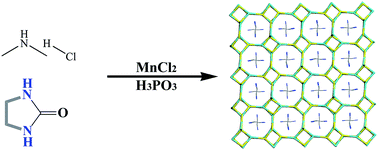
Herein, we firstly report the synthesis of a new manganese phosphate with DFT-zeotype structure (JIS-14) under ionothermal conditions.18 JIS-14 was ionothermally synthesized by using a eutectic mixture of dimethylamine hydrochloride and 2-imidazolidone as the solvent and template-delivery agent, which in situ yielded ethylene diammonium cations (en2+) acting as the template. Compared with the synthesis of [NH3(CH2)2NH3][MnP2O7] (JIS-13),17 H3PO3 was used for the synthesis of JIS-14 instead of H3PO4. JIS-14 exhibits the different structures from JIS-13 with the same organic cations (en2+) acting as the template. Although several examples of manganese phosphates with different structures were synthesized with ethylene diammonium cations as the template by the conventional approach,19 JIS-14 exhibits a distinct structure. JIS-14 cannot be obtained with ethylene diammonium added directly to the reaction mixture. The successful synthesis of JIS-14 further proves that ionothermal synthesis provides a feasible strategy for the synthesis of novel inorganic open-framework materials. The phase purity of JIS-14 was confirmed by the agreement between the experimental powder X-ray diffraction (PXRD) pattern and the simulated pattern based on structure analysis (Fig. S1†).
Structural analysis shows that JIS-14 crystallizes in the tetragonal space group P42 (no. 77).20 The structure of JIS-14 is based on the strict alternation of MnO4 and PO4 tetrahedra to form an anionic [Mn2P2O8]2− framework. Charge neutrality is achieved by extra-framework diprotonated en2+ cations. As shown in Fig. 1, the TO4 (T = Mn, P) tetrahedra occupy eight independent crystallographic positions: four of these sites are occupied by P atoms, and the others by Mn atoms. The Mn–O bond lengths are in the range of 1.990(4) Å to 2.068(4) Å (Table S1†), and the O–Mn–O angles are lying between 95.88(19)° and 123.0(2)°. The P–O bond distances are in the range between 1.514(4) Å and 1.540(4) Å, and the angles of O–P–O lying between 103.9(3)° and 112.3(3)° (Table S1†). The valence sum calculations show that the empirical valence of crystallographically distinct Mn atom is +2, which is consistent with the result of XPS analysis (Fig. S3†).
The 3-D framework of JIS-14 can be viewed as built up from single 4-ring with apices pointing up (U) and down (D) alternatively. These UDUD single 4-rings form infinite chains along the crystallographic c axis. Along the chain, each pair of 4-rings are joined so that two 6-rings having four common T-atoms are created (Fig. 2). This type of chain has been classified as a bifurcated hexagonal-square chain (bhs) and is also called a narsarsukite chain. Each bhs chain is connected directly to two other bhs chains to form a sheet (Fig. 2). The formation of such a sheet leads to the creation of 4-rings of a new type between bhs chains in addition to the creation of 8-rings (Fig. 2). The framework of JIS-14 possesses 8-ring channels running along the [001] direction (Fig. 3). The diprotonated en2+ cations are found perfectly arranged in the middle region of the 8-ring channels (Fig. 3), as the counterions to balance the overall negative charges of the 3-D open framework. It is very hard to removal or exchange the en2+-template. The framework of JIS-14 exhibits a zeo-type structure with DFT topology. Up to now, the metal phosphates with DFT topology include DAF-2 (CoPO4),21 ACP-3 (CoAlPO4),22 UiO-20 (MgPO4),23 ZCP-DFT (ZnCoPO4),24 ZFP-DFT (FeZnPO4)25 and ZnPO4-EU1 (ZnPO4).15 All of these compounds are templated by ethylenediamine and constructed by bhs chains. To the best of our knowledge, JIS-14 is the first example of manganese phosphates with a zeolite topology.
![]() | ||
| Fig. 2 A bifurcated hexagonal-square chain (bhs) in JIS-14 and a two-dimensional sheet viewed from the [110] direction. | ||
![]() | ||
| Fig. 3 The open-framework structure of JIS-18 viewed along the [001] direction showing the 8-ring channels. Color code: yellow, Mn; blue, P. | ||
The result of XPS analysis shows that the empirical valence of crystallographically distinct Mn atom is +2 (Fig. S3†). Thermogravimetric (TG) analysis of the powder sample of JIS-14 was performed in a flow of air with the heating rate of 10 K min−1. As shown in Fig. S4,† JIS-14 started to lose weight from 350 °C to 375 °C. On further heating, JIS-14 underwent a two-step weight-loss (20.8 wt%) process in which the organic amines in its structure started to decompose.
As shown in Fig. 4, the variable-temperature magnetic susceptibility of JIS-14 was measured at an applied magnetic field of 1000 Oe over the temperature from 2 to 300 K. At room temperature, the χMT value is 4.35 emu K mol−1, as expected for one isolated Mn2+ ion (4.375 emu K mol−1 for S = 5/2, assuming g = 2.00). Upon lowering the temperature, the χMT value shows a continuous steady decrease, falling to 0.79 emu K mol−1 at 2 K. This corresponds to the antiferromagnetic (AF) interaction between the paramagnetic centers. The magnetic data obey the Curie–Weiss law well, giving the Curie constant (C) = 4.43 emu K mol−1 and Weiss constant (θ) = −16.2 K. The negative θ value also indicates the existence of weak AF interaction in JIS-14.
In conclusion, JIS-14, a manganese phosphate |H3N(CH2)2NH3|[Mn2P2O8] was firstly synthesized from the deep eutectic solvents consisting of 2-imidazolidone and dimethylamine hydrochloride. JIS-14 possesses a 3D DFT-zeotype structure, and is the first manganese phosphate with zeolite structure. The successful synthesis of JIS-14 under ionothermal conditions further extends the possible application of this synthetic strategy for the synthesis of novel inorganic open-framework materials.
Footnote |
| † Electronic supplementary information (ESI) available: Synthesis, additional structural plots, power XRD, TG, EDS, XPS. CCDC 1010176. For ESI and crystallographic data in CIF or other electronic format see DOI: 10.1039/c5ra01350j |
| This journal is © The Royal Society of Chemistry 2015 |