
DOI:
10.1039/C5RA01300C
(Paper)
RSC Adv., 2015,
5, 31255-31261
Effect of a solid solution of AlN on the crystal structure and optical properties of LiSi2N3:Eu phosphors
Received
22nd January 2015
, Accepted 16th March 2015
First published on 17th March 2015
Abstract
The solid solutions of nitridosilicate phosphors LiSi2N3:Eu-xAlN (0 ≤ x ≤ 0.35) were synthesized using a gas-pressed sintering in this work. The effects of a solid solution of AlN on crystal structure, morphology, thermal stability and luminescence properties were studied. The luminescence intensity of LiSi2N3:Eu phosphor is significantly improved by the solution of AlN, but the emission position is unchanged. The emission intensity of LiSi2N3:Eu0.01-0.30AlN is about 2.17 times that of LiSi2N3:Eu0.01. The results show that these solid solutions could be the most useful way to improve the luminescence intensity of LiSi2N3:Eu phosphors.
1. Introduction
In recent years, white light-emitting diodes (W-LEDs) are revolutionizing an increasing number of applications due to their high efficiency, energy saving qualities, and environmentally friendliness.1–7 In phosphor converted W-LED technologies, the emission of LED chips (blue or near-ultraviolet (n-UV) light) is down-converted into useful green, yellow, or red light by phosphors. Therefore, phosphors are one of the key materials in solid state lighting. Among the phosphors used to combine with blue or n-UV LEDs, nitride/oxynitride have received remarkable attention as host lattices for phosphors due to their high chemical stability and good thermal quenching, and they exhibit intense luminescence when activated with Ce3+/Eu2+ such as in M2Si5N8 (M = Ca, Sr, Ba),8–10 CaAlSiN3 (ref. 11) Ca-α-SiAlON,12,13 and MSi2N2O2 (M = Ca, Sr, Ba).14–16
Although a large number of phosphors have been discovered or developed for use in solid state lighting, a very limited number of them can be applied to W-LEDs practically. Therefore, it is necessary to research on unexplored compositional regions beyond the traditional phosphor materials.
Recently, there has been a growing focus on research into lithium nitrides for use as luminescent materials such as Sr[LiAl3N4],17 Ca[LiAl3N4],18 and LiSi2N3.19 Li and Si (Al) can be combined with N to form [LiSi(Al)xNy] frameworks, which have a high density.17,20 The higher degree of condensation leads not only to increased stability of the materials, but also to high rigidity of the host lattice and thus to limited local structural relaxation of the Eu2+/Ce3+ site in its excited state – a prerequisite for the desired small stokes-shifted, narrow-band emission.21
Among Li3N–Si3N4 systems, LiSi2N3 is a thermostable compound with a well-defined crystal structure. The photoluminescent properties of LiSi2N3:Eu phosphor were first reported by Y. Q. Li et al.22 and they exhibit yellow emission (550–595 nm) upon excitation in the UV to blue spectral region (300–450 nm). However, the emission intensity of LiSi2N3:Eu must be further improved. Moreover, in the previous report,23 we find that LiSi2N3 and AlN can form a solid solution as both AlN and LiSi2N3 have the wurtzite-type crystal structure. The second-phase dispersions (AlN) are introduced into a host matrix (LiSi2N3), allowing a fine tuning of the crystal structure, the grains size, surface defect and provides higher uniformity of their distribution. The photoluminescence properties of phosphors included in white LEDs are correlated with the crystal structure, the morphology and grain size of the phosphor powder. In this case, the solid solutions seem to be the most promising way to improve the luminescence intensity of LiSi2N3:Eu. Therefore, in this work, we report the effect of a solid solution of AlN on the crystal structure and optical properties of LiSi2N3:Eu phosphors. The morphology and thermal stability were also investigated in this study. The results indicate that the solid solutions could possibly improve the luminescence intensity of LiSi2N3:Eu.
2. Experimental section
2.1 Materials and synthesis
A series of nitridosilicate phosphors, LiSi2N3:Eu0.01-xAlN (0 ≤ x ≤ 0.35), was prepared by gas-pressed sintering. Stoichiometric amounts of powdered Li3N (Aldrich, >99.50%), Si3N4 (Aldrich, 99.90%), AlN (Aldrich, >98.0%) and EuCl3 (Aldrich, 99.999%) were ground in an agate mortar for 30 min in a glovebox to form a homogeneous mixture. The concentrations of both moisture and oxygen in the glovebox were <1 ppm. Thereafter, the powder mixtures were transferred into BN crucibles and heated at 1500 °C for 2 h in high purity nitrogen (99.9995%) atmosphere at a pressure of 0.5 MPa. Before nitrogen was imported into the furnace, the pressure condition was changed to a 10−2 Pa vacuum state. The sintered products were ground again, yielding crystalline powder.
2.2 Characterization
All measurements were made using finely ground powders. The phase purity of samples was analyzed by X-ray powder diffraction (XRD) (D2 PHASER X-ray diffractometer, Germany) with a graphite monochromator using Cu Kα radiation (λ = 1.54056 Å), operating at 30 kV and 15 mA. The crystal structure was refined by the Rietveld method using the GSAS (General Structure Analysis System) program.24 Photoluminescence (PL) and excitation (PLE) spectra were measured at room temperature using a FLS-920T fluorescence spectrophotometer equipped with a 450 W Xe light source and double excitation monochromators. Diffuse reflectance ultraviolet-visible (UV-vis) absorption spectra were measured using a Perkin-Elmer 950 spectrometer, whereas BaSO4 was used as a reference. The quantum efficiency (QE) was measured using a spectrofluorometer (HORIBA JOBIN YVON Fluorlog-3) equipped with a 450 W xenon lamp. High temperature luminescence intensity measurements were carried out using an aluminum plaque with cartridge heaters; the temperature was measured by thermocouples inside the plaque and controlled by a standard TAP-02 high temperature fluorescence controller. The powder morphology was investigated by scanning electron microscopy (SEM; S-3400, Hitachi, Japan). The particle size distribution was measured using the Nano Measurer program based on the SEM micrographs. Chemical composition was determined with a scanning electron microscope (SEM; S-4800, Hitachi, Japan) equipped with an energy dispersive spectrometer (EDS) system.
3. Results and discussion
3.1 Phase identification
Fig. 1 shows the Rietveld refinement for the LiSi2N3:Eu0.01-xAlN (x = 0, 0.10) phosphors. All of the observed XRD peaks are obtained with the goodness of fit parameters (shown in Table 1). These results indicate that the LiSi2N3:Eu0.01-xAlN (x = 0, 0.10) host is a single-phase structure. The crystal structure data of LiSi2N3:Eu0.01-xAlN (x = 0, 0.10) are also shown in Table 1. LiSi2N3 has a wurtzite-type structure, which is isostructural with Si2N2O and Li2SiO3. Similar to Li2SiO3, the framework of [Si2N3] in LiSi2N3 is built up by two-dimensional, infinite, parallel layers of condensed [Si6N6] twelve-membered rings formed by the corner sharing of the nitrogen atoms of the tetrahedral SiN4. Li+ occupies the 4a site and directly connects with five nitrogen atoms, as shown in Fig. 2.
 |
| | Fig. 1 Rietveld refinement of LiSi2N3:Eu0.01-xAlN (a) x = 0 and (b) x = 0.10. (Bragg reflections are indicated with tick marks). | |
Table 1 Crystal structure data of LiSi2N3:Eu0.01-xAlN (x = 0, 0.10)
| Crystal system: orthorhombic; spacegroup: Cmc21(36); Z = 4 |
| Formula: LiSi2N3:Eu0.01 |
| Lattice parameters: a = 9.1670(4) Å, b = 5.2918(1) Å, c = 4.7733(1) Å, V = 231.56(4) Å3 |
| Rwp: 8.81% |
| Rp: 5.92% |
| χ2: 1.414 |
| Formula: LiSi2N3:Eu0.01-0.10AlN |
| Lattice parameters: a = 9.1963(4) Å, b = 5.3120(2) Å, c = 4.7871(2) Å, V = 233.85(2) Å3 |
| Rwp: 8.58% |
| Rp: 5.82% |
| χ2: 1.733 |
 |
| | Fig. 2 (a) The crystallographic structure of LiSi2N3 and (b) the local coordination of Li with nitrogen atoms (N). | |
For LiSi2N3:Eu0.01-xAlN (0 ≤ x ≤ 0.30), there is no detectable impurity phase presented. This result indicates that the LiSi2N3:Eu0.01-xAlN (0 ≤ x ≤ 0.30) retains a single phase with the addition of AlN, as shown in Fig. 3. When x > 0.30, the phases of AlN and Si3N4 were also identified. The intensity of the diffraction peaks of LiSi2N3:Eu0.01-xAlN (0.05 ≤ x ≤ 0.30) is gradually increased with the increase of AlN, which indicates the enhancement of the crystallinity of the grain. Moreover, the diffraction peaks of LiSi2N3:Eu0.01-xAlN (0.05 ≤ x ≤ 0.30) slightly shifted to lower angles with respect to the position of LiSi2N3:Eu0.01 due to the lattice expansion. The solution of AlN makes the LiSi2N3 lattice expand. As shown in Fig. 4, the lattice constants of a, b, c and V increase with increasing AlN. A consistent shift of the lattice parameters, with increasing AlN content, confirms the formation of solid solutions.
 |
| | Fig. 3 XRD patterns of LiSi2N3:Eu0.01-xAlN (0 ≤ x ≤ 0.35). | |
 |
| | Fig. 4 Lattice constants of LiSi2N3:Eu0.01-xAlN (0 ≤ x ≤ 0.30) (the I represents the error bars). | |
A typical low-magnification TEM image and a HRTEM image are shown in Fig. 5a–d. The interplanar spacing was measured to be 4.50 Å and 4.66 Å for LiSi2N3:Eu0.01 and LiSi2N3:Eu0.01-0.10AlN, respectively, which matches well with the (110) interplanar distance of orthorhombic LiSi2N3. The larger interplanar spacing of LiSi2N3:Eu0.01-0.10AlN is due to the lattice expansion, which is consistent with the shift of XRD. The corresponding EDS spectrum analysis (Fig. 5e and f) indicates that LiSi2N3:Eu0.01 and LiSi2N3:Eu0.01-0.10AlN both have a chemical composition of Li, Si, Eu and N and that no impurity elements are present. The EDS spectrum of LiSi2N3:Eu0.01-0.10AlN more than the LiSi2N3:Eu0.01 of an aluminum element.
 |
| | Fig. 5 TEM image, HRTEM image and EDX spectrum of LiSi2N3:Eu0.01 (a), (b), (e) and LiSi2N3:Eu0.01-0.10AlN (c), (d), (f). | |
3.2 Photoluminescence properties
Fig. 6 shows the reflection spectra, PLE and PL spectra of the as-prepared LiSi2N3:Eu0.01 powders. The undoped sample has a white body color and has an absorption in the range of 200–230 nm. For the Eu2+-doped samples, strong absorption bands are presented in the region from 230 to 450 nm. The PLE spectrum shows a broadband profile covering the range from the near-UV to visible part centered at ∼355 nm, which is assigned to the 4f–5d transition of Eu2+. The emission band is located in the range of 475–800 nm, resulting in a yellow emission centered at ∼595 nm.
 |
| | Fig. 6 Reflection spectra, PLE and PL spectra of the as-prepared LiSi2N3:Eu0.01. | |
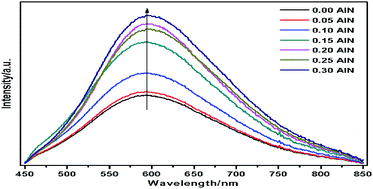
The emission spectra of LiSi2N3:Eu0.01-xAlN (0 ≤ x ≤ 0.30) with varied AlN concentrations under excitation at 355 nm is given in Fig. 7. With the doping of AlN, the PL intensity significantly improves, and the PL intensity gradually improves with increasing AlN concentration. However, the peak positions and peak shapes are unchanged with doping AlN. These indicate that the local environment of Eu2+ is almost unchanged with the addition of AlN. When the AlN concentration is x = 0.30, the emission intensity is about 2.17 times that of the undoped AlN sample. The increase in the intensity of the emission due to the addition of AlN can be attributed to the growth of the particle size, the narrowing of the particle-size distribution, and the increase of crystallinity.
 |
| | Fig. 7 Emission spectra of LiSi2N3:Eu0.01-xAlN (0 ≤ x ≤ 0.30) with varied AlN concentrations under excitation at 355 nm. | |
Observation of the microstructure, presented in the SEM images in Fig. 8, supports the abovementioned discussion of increasing crystallinity. The powder produced without AlN (Fig. 8a) consists of small particles whose loose edges suggest poor crystallization. The addition of AlN apparently favors the production of uniform particles, generally bigger in size (compared to those shown in Fig. 8a) and with compact edges (suggesting high crystallinity, which is in accordance with the previously discussed XRD results in Section 3.1), as shown in Fig. 8b and c. Fig. 9 shows the particle size distribution of LiSi2N3:Eu0.01-xAlN (x = 0, 0.1, and 0.3). The particle size of the synthesized sample without AlN is 4.96 μm (Fig. 9a), whereas the particle sizes of the samples with x = 0.1 and x = 0.3 are 8.63 μm (Fig. 9b) and 11.86 μm (Fig. 9c), respectively. These confirm that the solution of AlN could promote grain growth, narrow grain size distribution and improve crystallinity, resulting in an improvement in the emission intensity.
 |
| | Fig. 8 SEM micrographs of LiSi2N3:Eu0.01-xAlN (a) x = 0, (b) x = 0.1, and (c) x = 0.3. | |
 |
| | Fig. 9 Particle size distribution of LiSi2N3:Eu0.01-xAlN (a) x = 0, (b) 0.1, and (c) 0.3. | |
Fig. 10 shows the reflection spectra of LiSi2N3:Eu0.01-xAlN (x = 0, 0.1, 0.2, and 0.3). With increasing AlN concentration, the absorption becomes stronger and the QE of LiSi2N3:Eu0.01-xAlN (x = 0, 0.1, 0.2, and 0.3) become larger. The QE of LiSi2N3:Eu0.01-xAlN (x = 0, 0.1, 0.2, and 0.3) was 23%, 28%, 30% and 33%, respectively. The high crystallinity would decrease the light scattering by small particles, reduce the defects in the lattice and surface as well as decrease the nonradiative transition probability,25 resulting in enhanced absorption and quantum efficiency. Thus, the reflection spectra and the QE could further demonstrate that the solution of AlN could enhance the crystallinity of LiSi2N3:Eu.
 |
| | Fig. 10 The reflection spectra of LiSi2N3:Eu0.01-xAlN (x = 0, 0.1, 0.2, and 0.3). | |
3.3 Temperature-dependent PL properties
Thermal quenching is one of the important technological parameters for phosphors used in W-LEDs. The temperature dependence of the PL spectra of LiSi2N3:Eu0.01-xAlN (x = 0 and 0.3) under excitation at 355 nm is shown in Fig. 11, which show a relatively poor thermal stability. The quenching temperature, Tq, (the temperature at which the emission intensity is half of the initial intensity at room temperature, ∼25 °C) is about 100 °C. It is believed that thermal ionization is mainly responsible for the quenching of the luminescence of Eu2+ at high temperatures in the LiSi2N3 host,26 because the excited 5d electrons are easily ionized by the absorption of thermal energy and entrance into the bottom of the conduction band of the host through the top of the Eu2+ excitation levels. Moreover, the emission exhibits a blue-shift with increasing temperature, and it could be considered that thermally active phonon-assisted tunneling from the excited states of low-energy emission band to the excited states of high-energy emission band in the configuration coordinate diagram occurs.27,28 The thermal quenching of LiSi2N3:Eu0.01 and LiSi2N3:Eu0.01-0.30AlN is at the same rate, as shown in Fig. 11c. This suggests that the solution of AlN is unchanged the local environment of Eu2+, which is consistent with the emission spectra.
 |
| | Fig. 11 The temperature dependence of the emission spectra ofLiSi2N3:Eu0.01-xAlN (a) x = 0, (b) x = 0.30. | |
4. Conclusions
In summary, solid solutions of nitridosilicate phosphors LiSi2N3:Eu-xAlN (0 ≤ x ≤ 0.30) were successfully prepared by gas-pressed sintering. The expansion of the host lattice indicates the formation of LiSi2N3:Eu-xAlN solid solutions. With the addition of AlN, the emission intensity of LiSi2N3:Eu is significantly improved. The emission intensity of LiSi2N3:Eu0.01-0.30AlN is about 2.17 times than that of LiSi2N3:Eu0.01. The increase in the intensity of the emission due to the addition of AlN can be attributed to the growth of the particle size, the narrowing of the particle-size distribution, and the increase of crystallinity. These results indicate that the formed solid solution could be a useful method to improve the luminescence intensity of phosphors.
Acknowledgements
This work is supported by Specialized Research Fund for the Doctoral Program of Higher Education (no. 20120211130003) and the National Natural Science Funds of China (Grant no. 51372105).
Notes and references
- X. Yu, L. Zhang, X. Xu, T. Wang, H. Yu, T. Jiang, Q. Jiao, Z. Yang, D. Zhou and J. Qiu, J. Lumin., 2014, 145, 114–118 CrossRef CAS PubMed
. - C. Wang, Z. Y. Zhao, Q. S. Wu, S. Y. Xin and Y. H. Wang, CrystEngComm, 2014, 16, 9651–9656 RSC
. - Q. S. Wu, Z. G. Yang, Z. Y. Zhao, M. D. Que, X. C. Wang and Y. H. Wang, J. Mater. Chem. C, 2014, 2, 4967 RSC
. - X. Yu, T. Wang, X. Xu, T. Jiang, H. Yu, Q. Jiao, D. Zhou and J. Qiu, RSC Adv., 2014, 4(2), 963–968 RSC
. - A. Escudero, E. Moretti and M. Ocaña, CrystEngComm, 2014, 16, 3274–3283 RSC
. - X. Yu, X. Xu, T. Jiang, H. Yu, P. Yang, Q. Jiao and J. Qiu, Mater. Chem. Phys., 2013, 139(1), 314–318 CrossRef CAS PubMed
. - P. P. Dai, X. T. Zhang, L. L. Bian, S. Lu, Y. C. Liu and X. J. Wang, J. Mater. Chem. C, 2013, 1, 4570–4576 RSC
. - W. T. Chen, H. S. Sheu, R. S. Liu and J. P. Attfield, J. Am. Chem. Soc., 2012, 134, 8022–8025 CrossRef CAS PubMed
. - C. Wang, Z. Y. Zhao, X. C. Wang, Y. Y. Li, Q. S. Wu and Y. H. Wang, RSC Adv., 2014, 4, 55388–55393 RSC
. - X. Piao, K. Machida and T. Horikawa, et al., Appl. Phys. Lett., 2007, 91(4), 041908 CrossRef PubMed
. - S. S. Wang, W. T. Chen, Y. Li, J. Wang, H. S. Sheu and R. S. Liu, J. Am. Chem. Soc., 2013, 135, 12504–12507 CrossRef CAS PubMed
. - Q. S. Wu, Y. H. Wang, Z. G. Yang, M. D. Que, Y. Y. Li and C. Wang, J. Mater. Chem. C, 2014, 2, 829 RSC
. - Q. S. Wu, X. C. Wang, Z. Y. Zhao, C. Wang, Y. Y. Li, A. J. Mao and Y. H. Wang, J. Mater. Chem. C, 2014, 2, 7731 RSC
. - W. B. Park, S. P. Singh, C. Yoon and K. S. Sohn, J. Mater. Chem. C, 2013, 1, 1832–1839 RSC
. - M. Seibald, T. Rosenthal, O. Oeckler, C. Maak, A. Tücks, P. J. Schmidt, D. Wiechert and W. Schnick, Chem. Mater., 2013, 25(9), 1852–1857 CrossRef CAS
. - Y. Gu, Q. Zhang, H. Wang and Y. Li, J. Mater. Chem., 2011, 21, 17790–17797 RSC
. - P. Pust, V. Weiler, C. Hecht, A. Tücks, A. S. Wochnik, A.-K. Henß, D. Wiechert, C. Scheu, P. J. Schmidt and W. Schnick, Nat. Mater., 2014, 13, 891–896 CrossRef CAS PubMed
. - P. Pust, A. S. Wochnik, E. Baumann, P. J. Schmidt, D. Wiechert, C. Scheu and W. Schnick, Chem. Mater., 2014, 26(11), 3544–3549 CrossRef CAS
. - Q. S. Wu, Y. Y. Li, X. C. Wang, Z. Y. Zhao, C. Wang, H. Li, A. J. Mao and Y. H. Wang, RSC Adv., 2014, 4, 39030 RSC
. - M. Zeuner, S. Pagano and W. Schnick, Nitridosilicates and Oxonitridosilicates: From Ceramic Materials to Structural and Functional Diversity, Angew. Chem., Int. Ed., 2011, 50, 7754–7775 CrossRef CAS PubMed
. - G. Blasse and A. Bril, Philips Tech. Rev., 1970, 31, 314–323 CAS
. - Y. Q. Li, N. Hirosaki, R. J. Xie, T. Takeka and M. Mitomo, J. Solid State Chem., 2009, 182, 301–311 CrossRef CAS PubMed
. - V. Ischenko, L. Kienle and M. Jansen, J. Mater. Sci., 2002, 37, 5305–5317 CrossRef CAS
. - A. C. Larson, and R. B. V. Dreele, General Structure Analysis System (GSAS) program. Rep. No. LA-UR-86748, Los Alamos National Laboratory, Los Alamos, CA, 1994 Search PubMed
. - R.-J. Xie, N. Hirosaki, H. L. Li, Y. Q. Li and M. Mitomo, J. Electrochem. Soc., 2007, 154, J314 CrossRef CAS PubMed
. - S. Shionoya and W. M. Yen, Phosphor Handbook, CRC Press, New York, 1998 Search PubMed
. - J. S. Kim, Y. H. Park, S. M. Kim, J. C. Choi and H. L. Park, Solid State Commun., 2005, 133, 445–448 CrossRef CAS PubMed
. - G. Blasse and B. C. Grabmaier, Luminescent Materials, Springer, 1994 Search PubMed
.
|
| This journal is © The Royal Society of Chemistry 2015 |
Click here to see how this site uses Cookies. View our privacy policy here.