Yong Liua,
Xingtao Xua,
Ting Lua,
Zhuo Suna,
Daniel H. C. Chuab and
Likun Pan*a
aEngineering Research Center for Nanophotonics & Advanced Instrument, Ministry of Education, Shanghai Key Laboratory of Magnetic Resonance, Department of Physics, East China Normal University, Shanghai 200062, China. E-mail: lkpan@phy.ecnu.edu.cn; Fax: +86 21 62234321; Tel: +86 21 62234132
bDepartment of Materials Science and Engineering, National University of Singapore, 117574, Singapore
First published on 8th April 2015
A nitrogen-doped electrospun reduced graphene oxide–carbon nanofiber composite (NG–CNF) was fabricated via electrospinning by adding graphite oxide into a precursor solution and subsequent thermal treatment under an ammonia atmosphere. The morphology, structure and electrochemical performance of the composite were characterized by scanning electron microscopy, nitrogen adsorption–desorption, cyclic voltammetry and electrochemical impedance spectroscopy, and their capacitive and electrosorption performances in NaCl solution were studied. The NG–CNF composite electrode shows excellent specific capacitance (337.85 F g−1) and electrosorption capacity (3.91 mg g−1), much higher than those of pure carbon nanofibers (171.28 F g−1 and 3.13 mg g−1) and the reduced graphene oxide–carbon nanofiber composite (264.32 F g−1 and 3.60 mg g−1). The enhanced performance of the NG–CNF is ascribed to the nitrogen doping and the formation of an effective “plane-to-line” conducting network in the composite, which facilitates the electron transfer and ion transport as well as increases the specific surface area.
Conventionally, the CNFs were fabricated from natural fiber or synthetic fiber through carbonization treatment.32,33 However, the diameters of these conventional CNFs are large and their specific surface areas are relatively low. Recently, electrospinning as a simple and low-cost method was used to produce nanofibers with diameters from a few tens of nanometers to a few micrometers in different forms such as nonwoven mats and yarns from various polymers. Particularly, the electrospinning of polyacrylonitrile (PAN) precursor followed by stabilization and carbonization can get the CNFs. The diameter of the CNFs obtained by this method is much finer and more controllable. And also the electrospun CNFs can be freestanding, which makes them free from binders as the electrodes of supercapacitor or CDI.4,36 Wang et al.12 found that the activated CNFs prepared from electrospinning possessed a good electrosorption performance with an electrosorption capacity of 3.2 mg g−1. El-Deen et al.37 prepared multi-channel CNFs through electrospinning for CDI electrode and they achieved an electrosorption capacity of 2.21 mg g−1.
Currently, two dimensional reduced graphene oxide (RGO), as another form of carbon material, carries high electrical conductivity, superior mechanical property, large specific surface area and has applied widely in supercapacitor38,39 and CDI.40–42 In our previous works,24,39,43,44 it was found that RGO in the composites not only provided the vacancies to accommodate ions but also enhanced the bulk conductivity of the composites to promote the ion adsorption. Thus, the combination of CNFs and RGO (G–CNFs) should be promising composite material with excellent capacitive performance since in this composite the graphene nanosheets should be attached on the grid intervals between CNFs, which can form a “plane-to-line” network, as shown in Fig. 1. The formation of such a network structure would be beneficial to the enhancement of the bulk conductivity and ion transport.43,45 Yan46 reported the synthesis and electrochemical performance of G–CNFs composite paper for supercapacitor and a specific capacitance of 197 F g−1 was achieved. Dong et al.47 developed an ultrasound-assisted electrospun G–CNFs composite for supercapacitor with a specific capacitance of 183 F g−1. Dong et al.48 studied the G–CNFs composites for CDI and an electrosorption capacity of 7.2 mg g−1 was achieved in NaCl solution with an initial concentration of 400 mg l−1. However, further exploration on the G–CNFs composite electrodes for CDI is still necessary because their current performance is to be further improved for the practical application.
Recently, nitrogen doping has attracted wide attention as an effective method to improve the electrochemical performance of carbon materials. Doping of nitrogen atoms into graphitic networks is considered as one of the best approaches to produce n-type conductive materials with improved conductivity.49–52 Moreover, nitrogen doping can induce a large number of defects in the carbon structure.53,54 The presence of defects can generate more accessible surface area and cause an increase in the ability for accumulation of charges, which is beneficial for the charge transfer. Up to now, different kinds of nitrogen-doped carbon materials, such as nitrogen-doped AC, CNFs and graphene, have been developed to show an improved performance as compared with their undoped counterparts.53–55 Therefore, nitrogen doping should enhance the CDI performance of G–CNFs. Unfortunately, so far little attention has been focused on the CDI application of nitrogen-doped G–CNFs (NG–CNFs).
In this work, NG–CNFs composite was fabricated via electrospinning by adding GO into a precursor solution and subsequent thermal treatment under an ammonia atmosphere. The electrochemical performance of NG–CNFs was studied. The NG–CNFs composite electrode shows better capacitive and desalination performances than those of pure CNFs and G–CNFs electrodes due to the nitrogen doping and the formation of an effective “plane-to-line” conducting network.
In a typical process, 1 g PAN (average MW 150
000, Aldrich) and 0.2 g GO were dissolved in 8.8 g N,N-dimethylformamide to form a homogeneous solution by stirring at 60 °C for 10 h. Then, the polymer solution was transferred into a 10 ml syringe connected to a stainless steel needle. Electrospinning was carried out by applying a positive voltage of 22 kV to the needle via a copper collector plate. The distance between the needle tip and the collector was 15 cm and the flow rate of the solution was set at 1 ml h−1. The as-collected fibers were stabilized at 280 °C for 2 h in air at a heating rate of 2 °C min−1. Finally, G–CNFs or NG–CNFs were obtained via carbonization of the stabilized fibers at 800 °C for 2 h under nitrogen or ammonia atmosphere. After the carbonization process, GO was reported to be transferred to RGO.46,47 Pure CNFs was also prepared by electrospinning from a precursor solution of 10% PAN and consecutive carbonization at 800 °C for 2 h under nitrogen atmosphere for comparison.
![]() | (1) |
In our experiment, the electrosorption capacity is defined as follows:
![]() | (2) |
![]() | ||
| Fig. 3 FESEM images of (a) CNFs, (b) G–CNFs and (c) NG–CNFs; TEM images of (d) CNFs, (e) G–CNFs and (f) NG–CNFs. | ||
An XPS analysis was performed to study the composition of G–CNFs and NG–CNFs, as shown in Fig. 4(a). The carbon, oxygen and nitrogen contents (at%) in G–CNFs and NG–CNFs are listed in Table 1. The oxygen content (1.6%) is lower while the nitrogen content (8.3%) is higher in NG–CNFs compared to those in G–CNFs (5.1% and 4.9%), which indicates that: (i) the reduction of GO is more complete in NG–CNFs; (ii) the heteroatoms has successfully incorporated into the carbon networks through the ammonia treatment. It is worth mentioning that the nitrogen content of G–CNFs is derived from the nitrile group of its precursor (PAN).
| Samples | C (%) | N (%) | O (%) |
|---|---|---|---|
| G–CNFs | 90.0 | 4.9 | 5.1 |
| NG–CNFs | 90.1 | 8.3 | 1.6 |
As shown in Fig. 4(b) and (c), the XPS N1s spectra of G–CNFs and NG–CNFs can be deconvoluted into four components located at around 398.2, 399.5, 401.1, and 402.6 eV. The peaks with lower binding energy at about 398.2 and 399.5 eV, correspond to pyridine-like and pyrrole-like nitrogen, respectively. When carbon atoms within the carbon networks are substituted by nitrogen atoms in the form of “graphitic” nitrogen, the peak at around 401.1 eV appears. The high energy peak at around 402.6 eV is commonly attributed to oxidized nitrogen. The percentages of pyridinic, pyrrolic, graphitic and oxidized nitrogen are determined from the relative areas of the corresponding deconvoluted components, as summarized in Table 2. Clearly, the percentage of graphitic nitrogen is higher in NG–CNFs (0.41 at%) compared to that in G–CNFs (0.16 at%), indicating that the nitrogen atoms have been incorporated into the carbon networks, which can improve the conductivity49–52 and induce a large number of defects,53,54 while the presence of the defects can generate more accessible surface area and cause an increase in the ability for accumulation of charges.
| Samples | Pyridinic N (at%) | Pyrrolic N (at%) | Graphitic N (at%) | Oxidized N (at%) |
|---|---|---|---|---|
| G–CNFs | 0.40 | 0.20 | 0.16 | 0.24 |
| NG–CNFs | 0.22 | 0.06 | 0.41 | 0.31 |
Fig. 5 shows the CV curves of CNFs, G–CNFs and NG–CNFs electrodes obtained at a potential sweep rate of 1 mV s−1 within a potential range of −0.5 to 0.5 V. The current increases and decreases steadily with the electric potential, indicating that no faradaic reaction happens and ions are adsorbed on the electrode surface by forming an electric double layer. The CV curves of NG–CNFs and G–CNFs electrodes exhibit nearly rectangle shape while that of pure CNFs is relatively distorted. The specific capacitances of the CNFs, G–CNFs and NG–CNFs are 171.28, 264.32 and 337.85 F g−1, respectively, as shown in Table 3. The enhanced specific capacitance of NG–CNFs electrode should be attributed to the nitrogen doping and the synergistic effect of CNFs and RGO as follows: (i) with the addition of RGO the electrical resistance of CNFs is reduced and the charge transfer is improved, which can be proved by EIS measurement carried out at a frequency range of 0.1 Hz to 100 kHz and an AC amplitude of 5 mV. Fig. 6 shows the Nyquist diagrams of CNFs, G–CNFs and NG–CNFs electrodes. A semicircle arc and a straight line have been observed. The high-frequency arc corresponds to the charge transfer limiting process and is ascribed to the double-layer capacitance (Cdl) in parallel with the charge transfer resistance (Rct) at the contact interface between the electrode and electrolyte solution. The Rct can be directly obtained from the semicircle diameter and the values for CNFs, G–CNFs and NG–CNFs are 2.35, 1.72 and 1.14 Ω, respectively. Compared to pure CNFs and G–CNFs, the Rct of NG–CNFs is reduced, which confirms that both of the RGO incorporation and nitrogen doping can reduce the electrical resistance and improve the electron transfer and ion transport. (ii) The specific surface area is improved with the addition of RGO. Fig. 7 displays the N2 adsorption–desorption isotherms of CNFs, G–CNFs and NG–CNFs. It is clearly observed that all isotherms show typical type IV behavior. As shown in Table 3, G–CNFs exhibits a higher specific surface area SBET (506.13 m2 g−1) than that of CNFs (410.03 m2 g−1). After the ammonia treatment the specific surface area of NG–CNFs is greatly improved to 864.10 m2 g−1, which is beneficial to the capacitance of electrical double layer.
![]() | ||
| Fig. 5 CV curves of CNFs, G–CNFs and NG–CNFs electrodes in 1 M NaCl solution at a scan rate of 1 mV s−1. | ||
| Samples | SBET (m2 g−1) | Csp (F g−1) | Rct (Ω) |
|---|---|---|---|
| CNFs | 410.03 | 171.28 | 2.35 ± 0.02 |
| G–CNFs | 506.13 | 264.32 | 1.72 ± 0.02 |
| NG–CNFs | 864.10 | 337.85 | 1.14 ± 0.01 |
The electrosorption experiments of CNFs, G–CNFs and NG–CNFs electrodes were carried out in NaCl aqueous solution. The initial conductivity was around 100 μS cm−1 and the voltage was set at 1.2 V. It can be observed from Fig. 8 that once the voltage is imposed, ions are driven onto the electrodes and the conductivity decreases dramatically. The electrosorption capacities of CNFs, G–CNFs and NG–CNFs are 3.13, 3.60 and 3.92 mg g−1, respectively. Similar to the enhanced specific capacitance the improvement in the electrosorption capacity of NG–CNFs is also attributed to the reduced electrical resistance and the improved specific surface area.
To investigate the recycle of electrosorption process of CNFs, G–CNFs and NG–CNFs, repeating charge–discharge experiments were carried out. The initial solution conductivity was around 100 μS cm−1. Fig. 9 shows the conductivity transient over 6 charge–discharge cycles. When the conductivity gets back to the initial value in the first discharge process the second charge process starts. Obviously, the repeatability of electrosorption process can be realized in this unit cell. In the practical experiment, electrosorption capacity declination has not been observed in this unit cell after over 30 charge–discharge experiments.
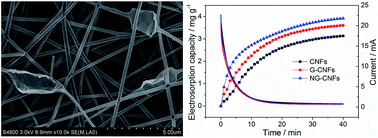
Charge efficiency (Λ)60–64 is a functional tool to gain insight into the double layer formed at the interface between the electrode and solution. Fig. 10 shows the electrosorption capacity and current response for CNFs, G–CNFs and NG–CNFs electrodes over 40 minutes in NaCl solution with an initial conductivity of 100 μS cm−1. The Λ is obtained according to the following equation:
![]() | (3) |
485 C mol−1), Γ is the electrosorption capacity (mol g−1) and Σ (charge, C g−1) is obtained by integrating the corresponding current. The Λ of the CNFs, G–CNFs and NG–CNFs electrodes are calculated to be 0.41, 0.53 and 0.53, respectively, As seen the Λ of CNFs, G–CNFs and NG–CNFs are far from ideal value, which is mainly caused by the following reasons: (i) the co-ions are expelled from the double layer when counter-ions present in the pore volume are adsorbed onto the electrodes.60,62–65 (ii) The weak adhesion between the porous electrode and substrate and the blocking effect of the binder will also account for the low Λ. Fortunately, an effective method has been proposed to solve this problem by introducing charge barrier membrane into CDI.16,63,66–69
![]() | ||
| Fig. 10 Electrosorption capacity and current transient for CNFs, G–CNFs and NG–CNFs electrodes over 40 minutes in NaCl solution with an initial conductivity of 100 μS cm−1. | ||
In order to further evaluate the electrosorption performance of NG–CNFs in relatively high salinity, electrosorption experiments using NG–CNFs electrode in NaCl solution with different initial concentrations at 1.2 V were carried out, as shown in Fig. 11. The electrosorption capacities are 5.71, 8.30, 11.55 and 14.79 mg g−1 for initial NaCl concentrations of 100, 200, 500, 1000 mg l−1, respectively. Compared with the electrosorption capacity (7.2 mg g−1 for an initial NaCl concentration of 400 mg l−1) reported in the previous work.48 It is found that nitrogen doping can improve the electrosorption capacity obviously even in a lower NaCl concentration (8.3 mg g−1 for an initial NaCl concentration of 200 mg l−1). The electrosorption performance of NG–CNFs is further compared with other CNFs-based electrode materials from the literatures, as shown in Table S1.† It can be seen that NG–CNFs exhibit an excellent electrosorption performance compared with other CNFs-based electrode materials in the similar experimental conditions. The superb electrosorption performance enables NG–CNFs to be a very promising candidate as electrode material for CDI applications.
![]() | ||
| Fig. 11 Electrosorption capacity of NG–CNFs electrode over 40 minutes in NaCl solution with different initial concentrations. | ||
Footnote |
| † Electronic supplementary information (ESI) available. See DOI: 10.1039/c5ra00620a |
| This journal is © The Royal Society of Chemistry 2015 |