

Thermal intumescent behavior of a gel containing silica†
Wei Liu*,
Xinguo Ge,
Xiaoyong Zhou and
Yong Tang
Sichuan Fire Research Institute of Ministry of Public Security, Chengdu 610036, China. E-mail: weiliu20141202@126.com; Fax: +86 028 87510972; Tel: +86 028 87510972
First published on 24th March 2015
Abstract
A transparent gel containing silica as a fire proof interlayer has been used to impart thermal insulation to laminated glazing. A thermal intumescent mechanism of the gel at high temperature has been proposed to explain the greatly enhanced fire resistance of the glazing sample.
According to the reports from the National Fire Protection Association (NFPA), fire departments responded to 370
![[thin space (1/6-em)]](https://www.rsc.org/images/entities/char_2009.gif) 000 home structure fires in 2011, which resulted in 13910 civilian injuries, 2520 deaths and direct property loss estimated at %12.5 billion. Fire-related issues drive the development of fire resistant materials used in constructions, which could reduce the fire risk to save lives and protect property. Fire resistant glass as a kind of special glass can be used in construction to separate the flame and block the smoke in a fire. It has been widely applied in partition wall, fire door, fire window, escape route and stairway due to its high light transmittance and safety properties. There are two types of fire resistant glass: monolithic fire resistant glass and laminated fire resistant glazing. Compared to monolithic fire resistant glass, laminated fire resistant glazing has thermal insulation during the fire due to the introduction of the fire resistant interlayer, which prevents the transmission of the intense heat radiation to the area beyond the glazing and protect people from the danger of heat in a fire (Fig. S1, ESI†).
000 home structure fires in 2011, which resulted in 13910 civilian injuries, 2520 deaths and direct property loss estimated at %12.5 billion. Fire-related issues drive the development of fire resistant materials used in constructions, which could reduce the fire risk to save lives and protect property. Fire resistant glass as a kind of special glass can be used in construction to separate the flame and block the smoke in a fire. It has been widely applied in partition wall, fire door, fire window, escape route and stairway due to its high light transmittance and safety properties. There are two types of fire resistant glass: monolithic fire resistant glass and laminated fire resistant glazing. Compared to monolithic fire resistant glass, laminated fire resistant glazing has thermal insulation during the fire due to the introduction of the fire resistant interlayer, which prevents the transmission of the intense heat radiation to the area beyond the glazing and protect people from the danger of heat in a fire (Fig. S1, ESI†).
In previous study, polyacrylamide mixed with some compounds containing phosphorus, aluminium, potassium and magnesium has been prepared as a fire proof interlayer between two sheets of glass. However, it demonstrates that acrylamide used as a monomer has known toxic effects on the nervous system and on fertility. Therefore, there is an urgent need to prepare a non-toxic, low-cost, effective material used as the interlayer in the laminated fire resistant glazing.
Intumescent system used for flame retardant materials has been studied initially by G. Camino.1 It indicates that the intumescent behavior of flame retardants could not only improve the thermal stability of materials at high temperature but also inhibit its thermal degradation during combustion.2–4 Traditional intumescent flame retardant system usually contains phosphorus compounds and nitrogen compounds. Silica has been tested on different polymers as flame retardants. Results show that the use of silica could lead to a significant reduction in the heat release rate (HRR) and contribute to the catalytic effect on the formation of the efficient protective char layer.5 However, thermal intumescent behavior of the gel containing silica during combustion has not been reported yet. In this study, a transparent gel containing silica was prepared by using the casting in place method. The gel laminated with two sheets of glass could be used as the fire proof interlayer to impart the fire resistance and thermal insulation to the laminated glazing. Effect of the molar ratio of SiO2 and Na2O in the gel on the thermal insulation has been examined. And here we report our studies of the thermal intumescent behavior of the fire resistant gel containing silica at a high temperature range and demonstrate its detailed mechanism.
In this experiment, colloidal silica was purchased from Snowtex Japan. The experimental procedure is shown in Scheme 1. The detailed procedure is described in Experimental section (ESI†).
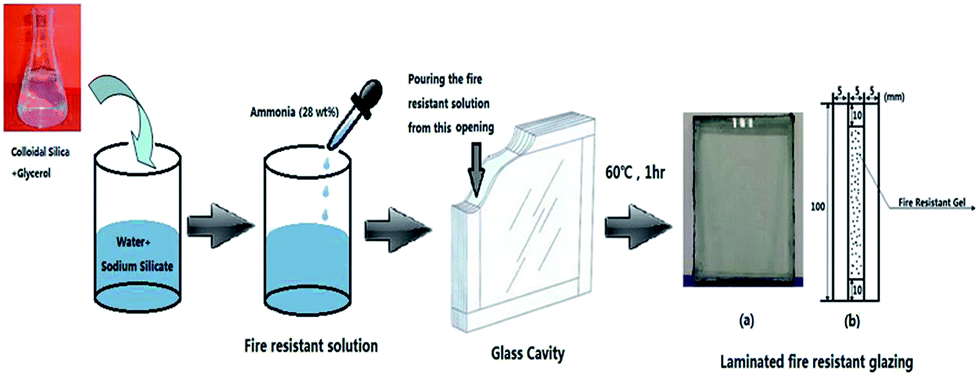 | ||
| Scheme 1 Preparation of the laminated fire resistant glazing. | ||
Thermal insulation of the fire resistant gel samples with different silica contents was evaluated in a fire test based on the average temperature rise of the laminated glazing surface which is not exposed to the fire (ESI†). When the average temperature rise is lower than 140 °C, thermal insulation of the glazing can be achieved. And the time for its average temperature rise below 140 °C can be used to characterize the thermal insulation rating of the glazing sample. The results are shown in Fig. 1(b). And formula of the fire resistant gel is listed in Fig. 1(a). Float glass without the fire resistant gel could shatter rapidly in the fire test, suggesting the absence of fire resistance and thermal insulation. The average temperature rise is less than 140 °C before the fire test of 13 min when the molar ratio of SiO2 and Na2O in the gel is 2.0 (Formula 1), indicating that the thermal insulation rating of Formula 1 is 13 min. The higher the molar ratio of SiO2 and Na2O in the gel is, the higher the thermal insulation rating of the glazing sample is. Thermal insulation rating reaches its maximum value of 40 min when the molar ratio of SiO2 and Na2O is 4.0 (Formula 3). It can be inferred that the silica content in the gel plays a key role in the improvement of thermal insulation of the laminated fire resistant glazing.
 | ||
| Fig. 1 (a) Formula of the fire resistant gel. (b) Time–temperature curves of the fire resistant glazing and (c) TG curves of the fire resistant gel samples. | ||
The influence of silica content on the thermal stability of the fire resistant gel is presented in Fig. 1(c). Starting decomposition temperature of the gel samples is around 100 °C, which may be due to the evaporation of H2O and the release of volatile compounds from the gel. And the higher the molar ratio of SiO2 and Na2O is, the higher the starting decomposition temperature is. Moreover, the residue at 800 °C increases with the silica content in the fire resistant gel. Formula 3 with the molar ratio of 4.0 has the highest starting decomposition temperature of 127.1 °C and the highest residue of 79.2%. It is clear from these results that the thermal stability of the fire resistant gel at high temperature could be enhanced due to the increasing silica content. And TG curves of Formula 2 and 3 at a constant temperature in Fig. S2 (ESI†) show that there is almost no change in weight loss at the temperature of 980 °C for 60 min, indicating that the excellent thermal stability of the fire resistant gel at a higher temperature range for a longer time. Meanwhile, the transformation of the transparent gel to an intumescent residual layer can be observed between two sheets of glass in the fire test and the thickness of the layer increases with the burning time (Fig. S3, ESI†). The intumescent layer can act as a barrier between fire and the glazing during combustion, which retards the transmission of heat, inhibits the flame spread and protects the glass not exposed to fire from further breakage.6–9 Therefore, the excellent thermal insulation of the laminated glazing could be attributed to the thermal intumescent behavior of the gel at high temperature.
In order to investigate the thermal intumescent behaviour of the fire resistant gel containing silica and to explore its detailed mechanism, morphology of the intumescent residual layer has been characterized by SEM analysis. SEM photographs show that three types of the residue can be observed from the intumescent residual layer, which are classified into Residue (I), Residue (II) and Residue (III). Some frothy and swollen structures formed at the initial stage of combustion can be observed from Residue (I) (Fig. 2a). This could be due to the evaporation of H2O and the release of some volatile compounds such as NH3 from the gel, which is in accordance with the initial stage of TG curves presented in Fig. 1(c).10 Microstructure of Residue (II) (Fig. 2b) is much different from that of Residue (I), which can be obtained by the transformation of Residue (I) at a relative high temperature range. Residue (II) has microconvexity structure, indicating the compactness of the residue.11 This may be attributed to the removal of the structurally bonded water from the cross-linked structure of the gel during burning.12 The enlarged cross-sectional photo (Fig. 2d) shows that Residue (II) has a honeycomb-like structure, which could act as the effective thermal insulated structure to slow down the mass and heat transfer during the fire. Therefore, compared to the other residue types, Residue (II) is the dominant thermal insulated structure in the intumescent residual layer. Residue (III) (Fig. 2c), which mainly consists of melted compounds, has a relatively flat and smooth surface. However, some voids can be observed on the cross-sectional surface of Residue (III) (Fig. 2e). This is because the release of H2O and other volatile decomposition products may be inhibited due to the high viscosity of the melted compounds in this stage. As shown in Fig. 2, Residue (I) adheres to the glass which is not exposed to fire. Residue (II) can be formed between Residue (I) and (II). Residue (III) covering Residue (II) is close to fire.
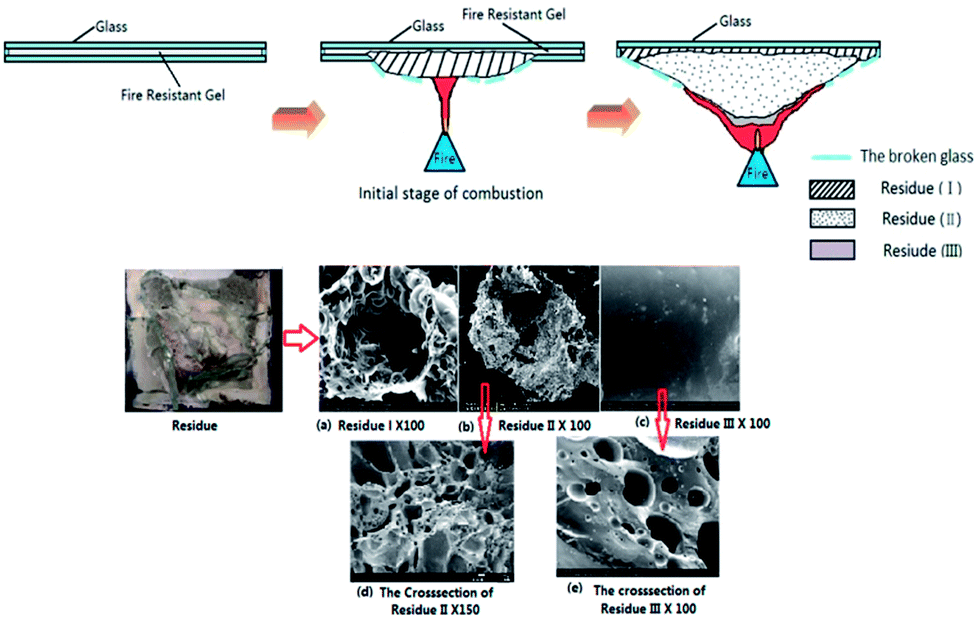 | ||
| Fig. 2 SEM photographs of microstructures of the residual layer (Formula 3): (a) Residue (I) × 100; (b) Residue (II) × 100; (c) Residue (III) × 100; (d) the cross-section of Residue (II) × 150, and (e) the cross-section of Residue (III) × 10. | ||
It can be seen that Residue (I), Residue (II) and Residue (III) could be formed in the intumescent residual layer at the different temperature range. During the formation of residue (I), the temperature rise of the glazing sample can be controlled by the evaporation of H2O from the gel through the cracks on the surface of the glass exposed to fire. Residue (II) has a compact, honeycomb-like residual structure. It could slow down the heat transfer from flame to the glass not exposed to fire and inhibit the transmission of flame, energy and O2 which are essential for the thermal degradation of materials in the fire. The melted structure with some voids inside from Residue (III) covers the intumescent residual layer, which could inhibit the transformation of Residue (II) to Residue (III) and further prevent the heat transfer and flame spreading. It is suggested that thermal intumescent mechanism of the gel during combustion can be attributed to the different thermal behavior of Residue (I), (II) and (III) from the residual layer in high temperature.
Further support for our hypothesis was obtained by characterizing the chemical structure of Residue (I), Residue (II) and Residue (III). As shown in Fig. 3, the relative intensity of the peak at 1651 cm−1/the peak at 1397 cm−1 decreases in Residue (II) spectrum (b). This could be attributed to the weakened bending vibration of H–O–H, which is due to the removal of the structurally bonded water from the gel in a high temperature range.13,14 And these results reveal that there are some physical changes during the transformation of Residue (I) to Residue (II), and it mainly includes the dehydration behavior of the gel at high temperature, which is also supported by the result from SEM presented in Fig. 2b. In spectrum (c) of Residue (III), the peak of Si–OH around 856 cm−1 has disappeared and the increased absorption peak of Si–O–Si at 1093 cm−1 can be observed.15,16 This phenomenon could be explained by the condensation of silanol group at a higher temperature range,17 which makes it possible for the formation of the melted Residue (III) covering the intumescent residual layer. The broad band between 3000 and 3500 cm−1 in spectrum (c) can be assigned to the O–H stretching vibrations of water.18–20 Water from the silanol condensation reaction and the gel can act as a gas source to form some closed voids in the melted residual layer during the formation of Residue (III). However, combined to the relatively flat and smooth surface in Fig. 2(c) and the cross-sectional microstructure of Residue (III) in SEM analysis, parts of the water could be remained in the closed voids due to the high viscosity of the melted Residue (III). Therefore, the stronger peak absorption of water in the 3000–3500 cm−1 can be observed in the spectrum of Residue (III) compared to the spectrum (a) and (b).
 | ||
| Fig. 3 FTIR analyses of Residue (I), Residue (II) and Residue (III). | ||
Conclusions
In summary, a transparent gel containing silica has been prepared between two sheets of glass to impart the fire resistance and thermal insulation to the laminated glazing. Thermal insulation of the glazing sample increases with the silica content in the gel. And the gel exhibits interesting intumescent behavior during combustion. We have provided a systematic investigation into the thermal intumescent behavior of the gel and its related fire resistant mechanism at high temperature. The results show that the excellent thermal insulation of the gel containing silica could be attributed to its intumescemt behavior in high temperature. And thermal behaviour of Residue (I), Residue (II) and Residue (III) from the intumescent residual layer can enhance the thermal insulation with the different mechanism. To the best of our knowledge, this is the first time to study the thermal intumescent behavior of the gel containing silica. This study will open up a new potential application of the environmentally-friendly gel containing silica in the fire resistant and flame retardant areas.Acknowledgements
The authors are grateful to the National Research Program of China (973 Program) (2012CB719701), the program of sichuan fire research institute of ministry of public security (20148806Z) and the Project-sponsored by SRF for ROCS, SEM (2012-JYB-01) for financial support and to Dr Dong Liang for his kind help during this investigation. And we are very grateful to Zejiang Zhang for his advise throughout our work and during the revision of this manuscript.Notes and references
- G. Camino, L. Costa and L. Trossarelli, Polym. Degrad. Stab., 1985, 12, 203 CrossRef CAS.
- S. Zhang and A. R. Horrocks, Prog. Polym. Sci., 2003, 28, 1517 CrossRef CAS PubMed.
- B. K. Kandola, M. H. Akonda and A. R. Horrocks, Polym. Degrad. Stab., 2005, 88, 123 CrossRef CAS PubMed.
- D. Y. Wang, A. Leuteritz, Y. Z. Wang, U. Wagenknecht and G. Heinrich, Polym. Degrad. Stab., 2010, 95, 2474 CrossRef CAS PubMed.
- A. B. Morgan and C. A. Wilkie, Thermal intumescent behavior of a gel containing silica, Scrivener Publishing, USA, 2014, p. 176 Search PubMed.
- L. Y. Li, G. H. Chen and W. Liu, Polym. Degrad. Stab., 2009, 94, 996 CrossRef CAS PubMed.
- W. Liu, D. Q. Chen and Y. Z. Wang, Polym. Degrad. Stab., 2007, 92, 1046 CrossRef CAS PubMed.
- S. Bourbigot, M. L. Bras, S. Duquesne and M. Rochery, Macromol. Mater. Eng., 2004, 289, 499 CrossRef CAS.
- Y. C. Li, S. Mannen, A. B. Morgan, S. C. Chang, Y. H. Yang, B. Condon and J. C. Grunlan, Adv. Mater., 2011, 23, 926 CrossRef.
- W. Liu, S. Zhang, X. S. Chen, L. H. Yu, X. J. Zhu and Q. L. Feng, Polym. Degrad. Stab., 2010, 95, 1842 CrossRef CAS PubMed.
- W. Liu, S. Zhang, S. Bourbigot, J. Sun, L. H. Yu, Q. L. Feng, X. S. Chen and X. J. Zhu, Polym. Adv. Technol., 2012, 23, 1550 CrossRef CAS.
- Y. Bereznitski and M. Jaroniec, J. Chromatogr. A, 1998, 828, 51 CrossRef CAS.
- N. Pijarn, A. Jaroenworaluck, W. Sunsaneeyametha and R. Stevens, Powder Technol., 2010, 203, 462 CrossRef CAS PubMed.
- Y. T. Fang, T. Liu, Z. C. Zhang and X. N. Gao, Renewable Energy, 2014, 63, 755 CrossRef CAS PubMed.
- J. Zeglinski, G. P. Piotrowski and R. Piekos, J. Mol. Struct., 2006, 794, 83 CrossRef CAS PubMed.
- A. O. Rami and E. R. Houssam, J. Mol. Struct., 2009, 919, 140 CrossRef PubMed.
- A. M. Seco, M. C. Goncalves and R. M. Almeida, Mater. Sci. Eng., B, 2000, 76, 193 CrossRef.
- J. F. Li, Y. F. Huang, S. Duan, R. Pang, D. Y. Wu, B. Ren, X. Xu and Z. Q. Tian, Phys. Chem. Chem. Phys., 2010, 12, 2493 RSC.
- G. Szakonyia and R. Zelkób, J. Pharm. Biomed. Sci., 2012, 63, 106 CrossRef PubMed.
- P. R. Filgueiras, C. M. S. Sad, A. R. Loureiro, M. F. P. Santos, E. V. R. Castro, J. C. M. Dias and R. J. Poppi, Fuel, 2014, 116, 123 CrossRef CAS PubMed.
Footnote |
| † Electronic supplementary information (ESI) available: Experimental section and calculation of temperature rise and average temperature rise. Figure: difference between monolithic fire resistant glazing and laminated fire resistant glazing; TG curves of the fire resistant gel samples at 980 °C for 60 min; fire resistant glazing during the fire test. See DOI: 10.1039/c5ra00558b |
| This journal is © The Royal Society of Chemistry 2015 |