Ruoyu Zhanga,
Ryan T. K. Kwokb,
Ben Zhong Tang*bc and
Bin Liu*ad
aDepartment of Chemical and Biomolecular Engineering, National University of Singapore, 4 Engineering Drive 4, 117585, Singapore. E-mail: cheliub@nus.edu.sg; Fax: +65-6778-1936; Tel: +65-6516-8409
bDepartment of Chemistry, Division of Biomedical Engineering, The Hong Kong University of Science and Technology, Clear Water Bay, Kowloon, Hong Kong, China
cSCUT-HKUST Joint Research Laboratory, Guangdong Innovative Research Team, State Key Laboratory of Luminescent Materials & Devices, South China University of Technology, Guangzhou 510640, China
dInstitute of Materials Research and Engineering (A*STAR), 3 Research Link, 117602, Singapore
First published on 10th March 2015
A bisazide functionalized fluorogen with aggregation-induced emission characteristics (AIEgen) was conjugated to single-stranded oligonucleotides to yield two-armed AIE probes for specific DNA detection. The probes show low emission in aqueous media, which become highly emissive upon hybridization with their complementary strands. The probes are suitable for homogenous sequence-specific DNA detection and are able to discriminate target sequences with even one-base mutation. The signal output can be further enhanced when two probes hybridize to each other to restrict the free rotation of the incorporated AIEgen.
In various real-time nucleic acid detections, sequence-specific probes show superior performance due to their ability to discriminate perfectly complementary strands from those with mutation points. These probes are generally based on the separation of a fluorophore from a quencher or forbidden energy transfer between a donor and an acceptor to generate significant changes in fluorescence.6,7 Fluorescent signal changes result from the complementary hybridization between oligonucleotide probe and the target sequence. Molecular beacon8,9 and binary probes are the two most common designs of hybridization probes, which are very efficient in based mutation detection.10,11 A variety of probes are developed based on further extension of these principles.10,12 Besides these organic fluorogens, DNA-like polyaromatic derivatives,13,14 conjugated polymers,15,16 and inorganic NPs17,18 have also been used for sequence-specific nucleic acid detection.
A series of fluorogens with unique aggregation-induced emission (AIE) characteristics have been reported in the past few years, which are non-emissive when molecularly dissolved but highly emissive when aggregated.19,20 The underlying light-emitting mechanism is ascribed to the restriction of intramolecular motions (RIM) in aggregates which blocks non-radiative decay channel for the excited states to deactivate.21 Unlike conventional organic fluorogens, the AIE fluorophore are free of aggregation-caused quenching effect and show higher photobleaching resistance.22 The nature of AIE fluorogens facilitates the development of turn-on bioprobes by taking advantages of aggregation and a wealth of AIE bioprobes have been developed for the detection of proteins,23–26 DNA27–29 and other important biomolecules.30 Previously, AIE-based DNA detections rely on the hydrophobic and electrostatic interactions between anionic DNA and cationic AIE molecules. This mechanism simplifies the development of probes by providing a label-free platform but suffers from interferents with similar electrical properties because of the non-specific nature of electrostatic interactions.
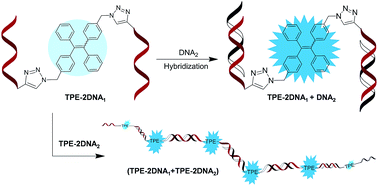
Recently, we have reported a light-up fluorescent probe for homogeneous DNA detection based on an AIE–oligonucleotide conjugate.31 With one 20-mer oligonucleotide conjugated to a tetraphenylethylene (TPE) derivative, a light-up DNA probe was developed for sequence-specific detection of its complementary strand. The fluorescence of probe is lit up upon hybridization with a perfectly matched strand. The signal-to-background ratio (I/I0) is ∼3.6, which requires further improvement to realize sensitive and specific nucleic acid detection. In this contribution, by tagging two oligonucleotides to one AIE fluorogen, a two-armed DNA probe (AIE–2DNA) is developed, which shows 6.1-fold brighter fluorescence in the presence of the perfect target strand. Furthermore, two AIE–2DNA probes with complementary DNA strands are designed, which can form a longer duplex to further restrict the motions of TPE with enhanced fluorescence, which verifies the fluorescence turn-on mechanism.
Bis[4-(azidomethyl)phenyl]-1,2-diphenylethene (TPE–2N3) was synthesized following our previous report.32 TPE–2DNA1 conjugates were synthesized by a click reaction using CuSO4–sodium ascorbate as the catalyst in 1 mL of deionized water and dimethyl sulfoxide (v/v = 1/1). First, freshly prepared sodium ascorbate and copper(II) sulphate aqueous solution were mixed and added into the solvent mixture. The stock solutions of oligonucleotide 5′-alkyne–DNA1 and TPE–2N3 were added subsequently. To optimize the reaction conditions, different amount of CuSO4 (from 100 μM to 1 mM) and sodium ascorbate (from 200 μM to 2 mM) were used and their reaction yields were monitored using HPLC as shown in the Experimental section. It was found that in the presence of 500 μM CuSO4 and 1 mM sodium ascorbate, reaction between 100 μM TPE–2N3 and 250 μM 5′-alkyne–DNA1 led to the maximum yield of around 85%. The retention time of TPE–2DNA1 was measured to be 13.9 min (with absorbance at both 260 nm and 318 nm). Similarly, by conjugation of alkyne–DNA2 and TPE–2N3, TPE–2DNA2 was obtained with a similar retention time of 14.1 min. The m/z peaks at 12
908.911 and 13
059.224 in MALDI-TOF spectra correspond to the probes of TPE–2DNA1 and TPE–2DNA2, respectively. In this work, both probes were designed to work independently as a sequence-specific DNA probe with AIE characteristics. It is also noteworthy that the two probes TPE–2DNA1 and TPE–2DNA2 consists complementary oligonucleotide DNA1 and DNA2 that can hybridize with each other to form longer stand with tandem repeated units.
We randomly selected TPE–2DNA1 as a representative to study the optical properties and AIE characteristics of the probes. Fig. 1 shows the UV absorption and photoluminescence (PL) spectra of TPE–2N3 and TPE–2DNA1 in DMSO/H2O solution (v/v = 1/199). Both TPE–2N3 and TPE–2DNA1 have an absorption peak at 318 nm, while TPE–2DNA1 has an additional peak at 260 nm, which corresponds to oligonucleotide absorption. The emission maxima of TPE–2N3 and TPE–2DNA1 are located at 480 nm and 460 nm, respectively. Most importantly, TPE–2DNA1 is almost non-emissive, whereas TPE–2N3 fluoresces strongly (inset of Fig. 1A). As the emission of AIE fluorogens are closely related to the status of molecules, laser light scattering was used to check whether they are dissolved as molecular species or aggregated in aqueous media. As a very hydrophobic AIE fluorogen, TPE–2N3 aggregated with a hydrodynamic diameter around 125 nm, in accordance with its intense fluorescence in aqueous media (Fig. 1B). In contrast, no obvious LLS signal can be detected from the solution of TPE–2DNA1, indicating that the probe is well dispersed in aqueous media. Due to the free intramolecular motion of phenyl rings and the flexibility of oligonucleotide chains, the TPE–2DNA1 shows very weak fluorescence.
It is known that TPE is an iconic AIE fluorogen, which shows weak fluorescence in molecular state but emits strong fluorescence in aggregated state. There have been mechanism studies showing that the excited state energy is consumed through non-radiative pathway to quench the emission by the free rotation of propeller-shaped structures (e.g. phenylene rings in TPE).33,34 On the other hand, when the molecules are aggregated, the radiative decay pathway is activated and strong fluorescence is generated. As the solvent viscosity could affect the intramolecular motion, we used DMSO/glycerol solvents with different volume ratios to study the effect of viscosity on TPE emission. Glycerol is a very viscous liquid having viscosity of 934 cP, which is about 470-fold higher than that of DMSO (1.99 cP) at 25 °C. By varying the ratio of DMSO and glycerol, solvents with different viscosities were obtained. The fluorescence spectra of 10 μM TPE–2N3 in the mixed solvents were collected and the results are shown in Fig. 1C. The peak fluorescence intensities at 480 nm after background removal were found to increase on the semi-log scale with increasing fractions of glycerol from 0% to 99%.
As biosensing is often conducted in buffers and ionic strength can affect the binding behaviour of DNA,35–37 the effect of ionic strength on the fluorescence of TPE–2DNA1 was studied. The PL spectra of the probe were measured in aqueous solution with different concentrations of NaCl (0–600 mM). As shown in Fig. 1D, the fluorescence intensity of the probe does not change obviously with increasing ionic strength. The result suggests that the probe can be applied to a broad range of ionic strength environment.
The capability of the probe to recognize complementary DNA sequence is examined. Specifically, TPE–2DNA1 hybridized with its complementary strand DNA2 and other strands containing one-base mismatch (DNAM1: 5′-ATG TTG ACT ATG TGG GTG CT-3′), two-base mismatches (DNAM2: 5′-ATG TTG ACT ATC TGG GTG CT-3′) and a random 20 base pair non-complementary sequence (DNAM3: 5′-AGC ATT CAG ATA GTC AAT GT-3′) in PBS buffer and their PL spectra are shown in Fig. 2A. The perfectly matched duplex (TPE–2DNA1 + DNA2) gives much stronger fluorescence over those from mismatched sequences. The duplex (TPE–2DNA1 + DNA2) is about 6.1-fold brighter than that of the probe TPE–2DNA1 alone, showing obvious improvement compared with to one-armed AIE–DNA probe (2.6-fold brighter).31 In addition, the fluorescence intensities of (TPE–2DNA1 + DNAM1) and (TPE–2DNA1 + DNAM2) with one or two-base mismatch only increase to 2.1 and 1.8 fold compared to the probe TPE–2DNA1 alone. The fluorescence of the TPE–2DNA1 only shows very small increase towards the random sequence DNAM3.
The ability of both probes (TPE–DNA1 and TPE–2DNA1) to differentiate mutation points was also studied and compared. If we let IT stand for the PL intensity of the probe upon hybridization with the fully complementary strand while IM1, IM2 and IM3 represent the PL intensities of the probe hybridized with DNA sequences containing 1, 2 mutation points as well as a random strand. Then (IT − I0)/(IM1 − I0) shows the ratio of PL intensity increment of the probe in the presence of the perfect complementary strand over the one-point-mutated sequence. The same calculation was also applied to two-point-mutated sequence and the random sequence and the results are summarized in Table 1. The one-armed probe TPE–DNA1 shows 3.2-fold PL intensity increment upon hybridization with the perfect target sequences over that with one mutation31 while the ratio becomes 5.5 when the two-armed probe TPE–2DNA1 was employed. The ratios increase to 4.1 and 7.2 for one-armed and two-armed probes in the presence of DNA sequence with two mutation points, respectively. In general, with two oligonucleotides conjugated with TPE core, the probe TPE–2DNA1 becomes more selective to the target sequence.
| (IT − I0)/(IM1 − I0) | (IT − I0)/(IM2 − I0) | (IT − I0)/(IM3 − I0) | |
|---|---|---|---|
| a I0: PL intensity of the probe alone; IT: PL intensity of the probe upon hybridization with fully complementary strand; IM1, IM2 and IM3: PL intensities of the probe hybridized with DNA sequences containing 1, 2 mutation points as well as a random strand. | |||
| TPE–DNA1 | 3.2 | 4.1 | 29.0 |
| TPE–2DNA1 | 5.5 | 7.2 | 38.1 |
These results prove that the AIE–oligonucleotide conjugation probe has good promise for homogenous sequence-specific detection of DNA and is able to discriminate mutation up to one base. As the double helix structure formed after hybridization could act as a semi-flexible rod-like damper, it restricts the motions of the phenyl structures in TPE and turns on its fluorescence.
To demonstrate the potential of the probe for DNA quantification, 0.5 μM TPE–2DNA1 was titrated with increasing amounts of DNA2 from 0.05 μM to 1.5 μM in PBS buffer. The fluorescence response was recorded in Fig. 3. In the absence of DNA2, the probe TPE–2DNA1 was weakly emissive. With the addition of DNA2 to the probe TPE–2DNA1, the fluorescence increased linearly and it was saturated when DNA2 concentration reached 1.0 μM, showing that the stoichiometric relationship between the probe TPE–2DNA1 and DNA2 is 1
:
2. The detection limit is calculated to be 120 nM.
![]() | ||
| Fig. 3 Fluorescence intensity of TPE–2DNA1 (0.5 μM) in response to different amount of DNA2 (0.05–1.5 μM) in PBS buffer. Error bars are standard deviations of the mean from triplicate measurements. | ||
As illustrated above, the optical property of AIE–2DNA probe is greatly affected by the extent of RIM which results from DNA self-organization. Previously, we have mentioned that the DNA1 and DNA2 are complementary to each other. As a consequence, the mixture of the probe TPE–2DNA1 and TPE–2DNA2 will lead to the formation of a self-assembled duplex (TPE–2DNA1 + TPE–2DNA2), which can further restrict the free motion of TPE as illustrated in Scheme 2.
To investigate AIE fluorescence enhancement contributed by DNA self-assembly, the PL spectra of TPE–2DNA1, duplex (TPE–2DNA1 + DNA2) and duplex (TPE–2DNA1 + TPE–2DNA2) were measured in PBS buffer solution. Duplex (TPE–2DNA1 + DNA2) and duplex (TPE–2DNA1 + TPE–2DNA2) were prepared containing the same concentration of DNA. Specifically, three samples are (1) 1.0 μM TPE–2DNA1; (2) 1.0 μM TPE–2DNA1 and 2.0 μM DNA2; (3) 1.0 μM TPE–2DNA1 and 1.0 μM TPE–2DNA2, respectively. As shown in Fig. 4, the fluorescence intensity of duplex (TPE–2DNA1 + TPE–2DNA2) is about 2.6 times of the duplex (TPE–2DNA1 + DNA2), although the former only contains 2-fold of TPE as the latter, indicating an obvious increase of fluorescence by controlled AIE through self-assembly of DNA strands. The length of self-assembled duplex (TPE–2DNA1 + TPE–2DNA2) and duplex (TPE–2DNA1 + DNA2) were characterized by agarose (4.0%) gel electrophoresis using a 25 bp DNA ladder as standard size marker in lane 1 (Fig. 4B). The first and second bands from the bottom in lane 1 represent DNA with size of 25 bp and 50 bp, in accordance with the size of 20 bp double-stranded DNA (a reference sample) and the duplex (TPE–2DNA1 + DNA2) (40 bp). The band in the middle of the lane 1 which exhibits brighter illumination stands for the DNA band with size of 125 bp, indicating that the self-assembled duplex (TPE–2DNA1 + TPE–2DNA2, lane 4) consists of about six units of duplex (DNA1–DNA2).
:
1) as eluent to give TPE–2N3 as a white solid (0.54 g, 82% yield). The final product was characterized by NMR and HRMS. 1H NMR (400 MHz, CDCl3) δ (TMS, ppm): 7.12 (m, 6H), 7.04 (m, 12H), 4.26 (s, 4H). 13C NMR (100 MHz, CDCl3) δ (TMS, ppm): 144.4, 143.9, 141.4, 134.0, 132.4, 131.9, 128.5, 128.4, 128.3, 127.3, 55.2. HRMS (MALDI-TOF), m/z 442.1914 (M+, calcd 442.1906).
| Entry | DNA (μM) | TPE (μM) | CuSO4 (μM) | Sodium ascorbate (μM) | Yield (%) |
|---|---|---|---|---|---|
| A | 250 | 100 | 100 | 200 | 25.7 |
| B | 250 | 100 | 200 | 400 | 56.9 |
| C | 250 | 100 | 500 | 1000 | 85.0 |
| D | 250 | 100 | 1000 | 2000 | 42.4 |
| Detection limit = 3σ/k |
Footnote |
| † Electronic supplementary information (ESI) available. See DOI: 10.1039/c5ra00322a |
| This journal is © The Royal Society of Chemistry 2015 |