
Si Chen,
Guodong Tang,
Bozhen Wu,
Meng Ma and
Xu Wang*
College of Materials Science and Engineering, Zhejiang University of Technology, Hangzhou 310014, China. E-mail: wangxu@zjut.edu.cn; Fax: +86-571-88320855; Tel: +86-571-88320855
First published on 26th March 2015
The key effect of the self-assembly mechanism of dendritic gelators is researched by a comprehensive investigation of the gelation behavior of L-lysine dendritic gelators with different structures of three generations in 20 different solvents. The solvents investigation, 1H NMR, tube inversion method, DSC, rheology, FTIR and rheological measurements show that the reported dendritic gelators self-assemble through the main driving force of hydrogen bonds and the second driving force of π–π stackings. So the key effect of the self-assembling mechanism is that these factors can influence the driving force of the self-assembly process. This is the reason that L-lysine dendritic gelators tend to gelate in solvents with low α and β parameter values, which have less influence on the formation of hydrogen bonds between the gelators. Higher generations provide a much greater hydrogen bond density in the gelators, which makes them have a higher gelation ability. The benzyl terminal groups provide the second driving force of π–π stacking, making the Bzl-Gly-Lys gelators have much stronger gelation ability. This research reports a comprehensive insight into the precise ways in which the solubility parameters of the solvents, the gelator generation and the terminal group effects can influence the self-assembly and gelation of dendritic gelators. Gaining this type of fundamental understanding is essential if the key effect of this important class of self-assembling soft materials is to be truly understood.
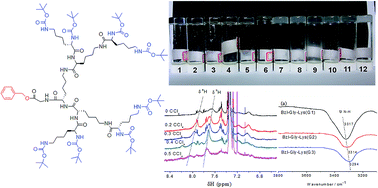
In this paper, the influence of dendritic gelators' structure and generation, and solubility parameters of solvents on self-assembling processes is researched by comparing the gelation behavior of the first, second, third generation gelators Bzl-Gly- Lys(G1), Bzl-Gly-Lys(G2) and Bzl-Gly-Lys(G3) that contain a 65 focus group of benzyl, a link unit of glycine, a branching of Llysine unit, and HO-Gly-Lys(G1), HO-Gly-Lys(G2) and HO-Gly-Lys(G3) gelators that have a focus group of carboxyl obtained via hydrogenation reaction in 20 kinds of different solvents. The results show that the higher the generation, the greater the strength of hydrogen bonding formed between the gelator molecules, the better the thermal stability of the gel, and the higher the mechanical strength. 1H NMR verifies that the main driving force is the formation of hydrogen bonds between gelators. Fluorescence spectra show that benzyl provides a π–π stacking force in the self-assembly process of the gel. The key effect of the self-assembly mechanism is that these factors can influence the driving force of the self-assembly process. That is the reason that the L-lysine dendritic gelators tend to gelate in solvents with low α and β parameter values, which have less influence on the formation of hydrogen bonds between gelators. A higher generation provides an increased hydrogen bond density in the gelators, which makes them have a higher gelation ability. The benzyl terminal groups provide the second driving force of π–π stacking that makes Bzl-Gly-Lys gelators have a much stronger gelation ability. This research attempts to gain a comprehensive insight into the precise ways in which solubility parameters of the solvents, generation and the terminal effects of the dendrons can influence self-assembly and gelation. Gaining this type of fundamental understanding is essential if the key effect of this important class of self-assembled soft materials is to be truly understood.
Rheological measurements were carried out on freshly prepared gels using a controlled-stress rheometer (MCR302, Anton Paar, Austria). These gels were obtained by a heating–cooling process and sonication irradiation. A parallel-plate geometry of 25 mm diameter and a 1 mm gap were employed throughout the dynamic oscillatory work. The tests were performed as followed: the sample was submitted to this parallel-plate very quickly to minimize solvent evaporation, and then the amplitude of oscillation was increased up to a certain apparent strain shear (kept at a frequency of 1 rad s−1) at 25 °C.
FESEM measurements are taken on a Hitachi S-4700 field emission scanning electron microscope (FESEM, Hitachi, Japan) for the morphological analysis. The samples were prepared as follows: the gel was formed in a glass vial by a heating–cooling process. The prepared gels were then allowed to dry under vacuum to a constant weight. Then the resulting xerogel was coated with a thin layer of gold before investigation.
Fourier transform infrared (FTIR) spectra were recorded on a Nicolet 6700. The gel samples were respectively placed on a surface of glass sheet and the solvent of the samples was evaporated at room temperature before measurement.
The thermal behavior of the samples was studied by a DSC instrument (Q-100, TA, USA) under a dry nitrogen atmosphere. The heating and cooling rates were both 10 °C min−1.
The fluorescence spectra are recorded using a F-4600 fluorescence spectrophotometer (HITACHI Corp., Japan) with an excitation wavelength of 335 nm.
The tube inversion method was operated with the following procedure. The gelator sample was mixed with certain solvents in a sealed test tube and the mixture was heated to a certain temperature until the solid was completely dissolved. Then the solution was cooled to room temperature in air, and finally the test tube was inverted to observe whether the solution inside could still flow. Gelation was considered to occur when a homogeneous “gel-like” material was obtained that exhibited no gravitational flow. The gel–sol transition temperature (Tgel) was measured with the “tube inversion” method in a water bath which was heated slowly.
The minimal gel concentration (MGC) is the lowest possible gelator concentration needed to form a stable gel in certain solvents at room temperature. It was tested as follows: a certain amount of the gelator was put into a sealed test tube and the volume of a certain solvent was gradually increased until a stable gel could not be obtained anymore. At this moment, the concentration of the solvent was recorded as the MGC (mg mL−1).
WAXD diffraction patterns of the samples were recorded in an X-ray diffractometer (X’Pert PRO, PANalytical, Holland) with Cu Kα radiation (λ = 1.54 Å). It was operated at a voltage of 40 kV and with a filament current of 35 mA. The spectra were recorded in the 2θ range of 5–40°, at a scanning rate of 4° min−1.
Bzl-Gly-Lys(G1) was synthesized as follows: 5.2 g (15.0 mmol) BOC-Lys(BOC)-OH was dissolved in 50 mL ethyl acetate, then 3.4 g (18.0 mmol) EDCI, 2.4 g (18.0 mmol) HOBt and 3.6 g (36.0 mmol) NMM were added in an ice bath. After 30 min, 3.1 g (15.0 mmol) glycine benzyl ester hydrochloride was added. The reaction mixture was allowed to warm to room temperature and then stirred for 24 h, it was then filtered to get the yellow filtrate. The filtrate was then treated with NaHCO3 aqueous saturated solution (50 mL × 3) and NaHSO4 aqueous saturated solution (8.0 g/50 mL, 50 mL × 3) 3 times, separately. After drying with anhydrous magnesium sulfate, the concentrated filtrate was purified by column chromatography (silica, ethyl acetate
:
petroleum ether = 3
:
2) to give a transparent product with a yield of 5.9 g (80%). Rf = 0.35 (ethyl acetate
:
petroleum ether = 3
:
2). 1H NMR δH (500 MHz, CDCl3): 7.38 (5H, s, C6H5), 5.20 (2H, s, C6H5CH2), 4.20 (1H, q, CH), 4.16 (2H, d, COCH2), 3.18 (2H, q, CH2CH2NH), 1.79 (2H, q, CHCH2CH2), 1.55 (2H, q, CH2CH2NH), 1.38 (18H, s, CH3), 1.25 (2H, q, CHCH2CH2); 6.7, 4.6, 4.1 (3H, s, NH). ESI-MS (m/z, [M + H]+): the calculated mass was 494.3 and the tested result was also 494.3.
Bzl-Gly-Lys(G2) was synthesized as follows: 1.0 g (4.1 mmol) Bzl-Gly-Lys(G1) was dissolved in 5 mL CH2Cl2, then 5 mL TFA was added and stirred at room temperature for 60 min to remove the BOC group. After the de-protection reaction was finished, the CH2Cl2 and TFA were removed by a vacuum rotatory evaporator. The raw product was dissolved in 50 mL ethyl acetate after vacuum drying. Then 1.8 g (17.8 mmol) NMM and 3.4 g (9.7 mmol) BOC-Lys(BOC)-OH were added and stirred for 5 min. After that, 1.8 g (9.7 mmol) EDCI and 1.3 g (9.7 mmol) HOBt were added in an ice bath and it was allowed to warm to room temperature and then stirred for 48 h. After that, the reaction mixture was filtered to get a yellow filtrate. The filtrate was then treated with NaHCO3 aqueous saturated solution (50 mL × 3) and NaHSO4 aqueous saturated solution (8.0 g/50 mL, 50 mL × 3). After drying with anhydrous magnesium sulfate, the concentrated filtrate was purified by column chromatography (silica, ethyl acetate) to give a transparent crystal with the yield of 1.2 g (60%). Rf = 0.5 (ethyl acetate
:
petroleum ether = 3
:
1). 1H NMR δH (500 MHz, CDCl3): 1H NMR δH (500 MHz, CDCl3): 7.42, 7.17, 7.06 (3H, br, CONH); 5.93, 5.57, 4.96, 4.79 (4H, br, NHBOC); 7.33–7.36 (5H, m, ArH), 5.18 (2H, s, Ar-CH2), 4.33–4.39 (2H, d, COCH2NH); 4.05–4.12 (3H, m, COCH(R)NH); 3.00–3.10 (6H, m, CH2NHCO); 1.23–1.79 (54H, m, CH2, CH3). ESI-MS (m/z, [M + H]+): the calculated mass was 950.6 and the tested result was 950.6.
MeO-Lys(G2) was synthesized as follows: 3.5 g BOC-Lys(BOC)-OH (10.0 mmol) was dissolved in 10 mL ethyl acetate, then 2.4 g (23.0 mmol) NMM, 3.8 g (10.0 mmol) TBTU and 1.5 g (11.0 mmol) HOBt were added and stirred for 5 min. After that, 1.0 g (4.3 mmol) L-lysine methyl ester dihydrochloride was added, the mixture was stirred for 16 h, and then filtered to get a yellow filtrate. The filtrate was then treated with NaHCO3 aqueous saturated solution (50 mL × 3) and NaHSO4 aqueous saturated solution (8.0 g/50 mL, 50 mL × 3). After drying with anhydrous magnesium sulfate, the concentrated filtrate was purified by column chromatography (silica, DCM
:
MeOH = 20
:
1) to give a white crystal with a yield of 6.5 g (80%). Rf = 0.62 (DCM
:
MeOH = 20
:
1). 1H NMR δH (500 MHz, CDCl3, ppm): 7.42 (brs, 1H; CONH), 6.97 (brs, 1H; CONH), 5.94 (brs, 1H; NHBoc), 5.58 (brs, 1H; NHBoc), 4.90 (brs, 1H; NHBoc), 4.75 (brs, 1H; NHBoc), 4.40 (brm, 1H; OCH(R)NH), 4.32 (brm, 1H; COCH(R)NH), 4.11 (brm, 1H; COCH(R)NH), 3.73 (s, 3H; CO2CH3), 3.12 (m, 6H; CH2NH), 1.84–1.31 (m, 54H; CH2, CH3). ESI-MS (m/z, [M + H]+): the calculated mass was 839.5 and the tested result was also 839.5.
HO-Lys(G2) was synthesized as follows: 2.9 g (3.6 mmol) MeO-Lys(G2) was dissolved in 10 mL MeOH, then the mixture was added to aqueous sodium hydroxide (1 M, 0.4 g, 10.7 mmol, 3 eq.) to react for 24 h in an ice bath. MeOH was removed by a vacuum rotatory evaporator. The pH value of the mixture was adjusted to 3 with NaHSO4 and then extracted with ethyl acetate. Then ethyl acetate was removed by a vacuum rotatory evaporator to get a white crystal with a yield of 2.8 g (96.5%). 1H NMR δH (500 MHz, CDCl3, ppm): 7.42 (brs, 1H; CONH), 6.97 (brs, 1H; CONH), 5.94 (brs, 1H; NHBoc), 5.58 (brs, 1H; NHBoc), 4.90 (brs, 1H; NHBoc), 4.75 (brs, 1H; NHBoc), 4.40 (brm, 1H; COCH(R)NH), 4.32 (brm, 1H; COCH(R)NH), 4.11 (brm, 1H; COCH(R)NH), 3.73 (s, 3H; CO2CH3), 3.12 (m, 6H; CH2NH), 1.84–1.31 (m, 54H; CH2, CH3). ESI-MS (m/z, [M + H]+): the calculated mass was 825.5 and the tested result was 825.5.
Bzl-Gly-Lys(G3) was synthesized as follows: 1.0 g (2.0 mmol) Bzl-Gly-Lys(G1) was de-protected of BOC and dissolved in 10 mL ethyl acetate. The solvent was modulated to neutral with NMM and named mixture A. 4.6 g (5.7 mmol) HO-Lys(G2) was dissolved in 50 mL ethyl acetate, then 2.4 g (5.7 mmol) HBTU, 0.9 g (5.7 mmol) HOBt and 1.2 g (11.5 mmol) NMM were added. Mixture A was then added, stirred at room temperature for 24 h, and then filtered to get a yellow precipitate. This precipitate was dissolved in MeOH and purified by column chromatography (silica, DCM
:
MeOH = 15
:
1) to give a transparent crystal with a yield of 3.2 g (85%). Rf = 0.4 (DCM
:
MeOH = 15
:
1). ESI-MS (m/z, [M + H]+): the calculated mass of C91H160N15O25 [M + H]+ was 1864.2 and the tested result was 1864.2.
HO-Gly-Lys(G2) was synthesized as follows: 1.0 g (1.1 mmol) Bzl-Gly-Lys(G2) was dissolved in 30 mL MeOH, and 0.1 g 10% Pd/C catalyst was added. The pressure of H2 was kept at 5 Bar for 5 h at room temperature. After the reaction was finished, H2 was removed and the catalyst was removed by filtration. A white crystal was obtained by vacuum rotatory evaporation with a yield of 8.7 g (99%). 1H NMR δH (500 MHz, DMSO-d6): 12.56 (1H, br, COOH); 4.27 (2H, m, COCH2NH); 3.69–3.87 (3H, COCHNH(R)); 8.21 (1H, t, COCH2NH); 7.74 (2H, m, NHCO); 6.70–6.90 (4H, m, NHBOC); 2.87–2.99 (6H, m, CH2CH2NH); 1.09–1.63 (54H, m, CH2, CH3). ESI-MS (m/z, [M + H]+): the calculated mass of C40H73N7O13Na [M + Na]+ was 1771.1 and the tested result was 1770.7.
| Solvent | Bzl-Gly-Lys(G1) | Bzl-Gly-Lys(G2) (MGC) | Bzl-Gly-Lys(G3) (MGC) |
|---|---|---|---|
| a Transparent gel (marked as TG), opaque gel (marked as OG), partial gelation (marked as PG) and clear solutions (marked as S). MGC values have units of mg mL−1. | |||
| Toluene | S | TG (3.0) | TG (1.0) |
| Dimethylbenzene | S | TG (3.0) | TG (1.0) |
| Chlorobenzene | S | TG (5.0) | TG (1.0) |
| Orthodichlorobenzene (DCB) | S | TG (5.0) | TG (1.5) |
| Styrene | S | TG (6.0) | TG (3.0) |
| Ethyl acetate | S | OG (20.0) | OG (3.0) |
| Butyl acetate | S | OG (10.0) | OG (1.5) |
| Methyl methacrylate (MMA) | S | OG (20.0) | OG (1.5) |
| Dimethoxyethane (DME) | S | S | OG (3.0) |
| Acetone | S | S | OG (10.0) |
| Tetrahydrofuran (THF) | S | S | TG (20.0) |
| Dimethyl formamide (DMF) | S | S | S |
| Dimethyl sulfoxide (DMSO) | S | S | S |
| n-Hexane | Ins | Ins | Ins |
| Cyclohexane | Ins | PG | Ins |
| Chloroform | S | S | S |
| Dichloromethane | S | S | OG (13.0) |
| Methanol | S | S | S |
| Ethanol | S | S | S |
| n-Octyl alcohol | S | S | OG (8.0) |
The Kamlet–Taft model is used to better understand the effect of the solvent on gelation. All the Kamlet–Taft parameters are listed in Table 2, in which the value of the α parameter represents the hydrogen bond donating ability, the value of the β parameter represents the hydrogen bond accepting ability, and the value of the π* parameter represents the polarity of the solvents.18,19 That is to say, the higher the value of the α/β/π* parameters, the stronger the hydrogen bond donating ability/hydrogen bond accepting ability/polarity of the solvents, respectively. From the results in Tables 1 and 2, we can take Bzl-Gly-Lys(G3) as an example to discuss the effect of the solvent on gelation. Bzl-Gly-Lys(G3) can form gels in the solvents with α = 0, including aromatic solvents like toluene, dimethylbenzene, chlorobenzene, DCB, styrene and esters and ketones like ethyl acetate, butyl acetate, MMA, DME and acetone. Most of the aromatic solvents have small β parameter values (close to zero), so when gels are formed in such solvents, the minimal gel concentration (MGC) is as low as 1 mg mL−1 (0.1% w/v), which indicates a really strong ability of Bzl-Gly-Lys(G3) to obtain gels in these kinds of solvents. In other solvents with a much larger β parameter value (0.4–0.6), accordingly, the MGC value is subsequently higher. The MGC value in ethyl acetate is 3 mg mL−1, in acetone it is 10 mg mL−1 and in THF it is 20 mg mL−1. This indicates that the gelation ability of gelators becomes weaker with increases of the β parameter values. Bzl-Gly-Lys(G3) could not gel in the solvents with β parameter values higher than a certain value (>0.60 in this case), such as DMSO and DMF, and a transparent solution is obtained as a result even when the concentration increases to 20 mg mL−1. In the situation that β = 0, Bzl-Gly-Lys(G3) could only gel in solvents with a low α parameter value and has a high MGC value, such as in dichloromethane (α = 0.30) with a MGC value as high as 13 mg mL−1. When the solvent changes from dichloromethane (α = 0.30) to chloroform (α = 0.44), although these two solvents have similar structures, Bzl-Gly-Lys(G3) could not gelate in chloroform, indicating that the gelation ability is sensitive to the α parameter values of the solvents. However, the π* (polarizability parameter) values had no significant influence on the gelation ability of Bzl-Gly-Lys(G3). Whether in high π* value solvents, like DCB (π* = 0.8), or in medium π* value solvents, like toluene (π* = 0.54) and ethyl acetate (π* = 0.55), stable gels could all be obtained. However, in the solvents with π* = 0, like hexane and cyclohexane, Bzl-Gly-Lys(G3) would not dissolve, even when heated to the boiling point. This can be explained with the similarity-intermiscibility theory that Bzl-Gly-Lys(G3) with polar groups in its structure could not dissolve in nonpolar solvents with π* = 0.
| Solvent | α | β | π* |
|---|---|---|---|
| a The α parameter represents the hydrogen bond donating ability, the β parameter represents the hydrogen bond accepting ability, and the π* parameter represents the polarizability of the solvents.18,19 | |||
| Toluene | 0.00 | 0.11 | 0.54 |
| Dimethylbenzene | 0.00 | N/A | 0.43 |
| Chlorobenzene | 0.00 | 0.07 | 0.71 |
| DCB | 0.00 | 0.03 | 0.80 |
| Styrene | 0.00 | N/A | N/A |
| Ethyl acetate | 0.00 | 0.45 | 0.55 |
| Butyl acetate | 0.00 | N/A | 0.46 |
| MMA | 0.00 | N/A | N/A |
| DME | 0.00 | 0.41 | 0.53 |
| Acetone | 0.08 | 0.48 | 0.71 |
| THF | 0.00 | 0.53 | 0.58 |
| DMF | 0.00 | 0.69 | 0.88 |
| DMSO | 0.00 | 0.76 | 1.00 |
| n-Hexane | 0.00 | 0.00 | −0.08 |
| Cyclohexane | 0.00 | 0.00 | 0.00 |
| Chloroform | 0.44 | 0.00 | 0.69 |
| Dichloromethane | 0.30 | 0.00 | 0.73 |
| Methanol | 0.93 | 0.62 | 0.60 |
| Ethanol | 0.83 | 0.77 | 0.54 |
| n-Octyl alcohol | N/A | N/A | N/A |
The hydrogen bond donating ability of the solvents increases with the α parameter value and the hydrogen bond accepting ability increases with the β parameter value.20 Both of these two abilities of the solvents compete with the self-assembly of gelators, and the α parameter value has a more significant influence. This research of the relationship between the solvents and the gelators gives us an opportunity to predict the gelation ability. For instance, if we have a solvent with α = 0, β = 0 and π* > 0, we could deduce that such a solvent could be gelated by similar kinds of gelators as Bzl-Gly-Lys(G3), and the MGC values should be quite low.
From Fig. 1 we can see that the chemical shift of H in the N–H bond moves to a lower field gradually with the increase in the volume fraction of CCl4. Take aH and bH for example, when the volume fraction of CCl4 increases from 0 to 0.5, the chemical shift of aH moves to a lower field by as much as 0.17 and bH moves by 0.10, which indicates that the interaction between the gelators increases with the increasing of the volume fraction of CCl4. The D atoms in the CDCl3 molecules have a hydrogen bond donating ability which can form a hydrogen bond of C
O⋯D–C with the C
O in the gelators. This could weaken the hydrogen bonds between the gelators. When the volume fraction of CCl4 increases, the above weakening effects diminish so that the N–H band of the gelators can contribute more to the formation of the hydrogen bonds between the gelators. The relationship of the chemical shift of H in the N–H bonds and the volume fraction of CCl4 in the mixtures is shown in Fig. S1 in the ESI.† The result of 1H NMR spectra confirmed that hydrogen bonds are the driving force of the gel formation process for such kinds of gelators. Actually, when the volume fraction of CCl4 increases to 0.5, the formation of gels can be observed clearly with the naked eye.
![]() | ||
| Fig. 4 SEM images of Bzl-Gly-Lys(G3) xerogel obtained from (a) dimethylbenzene, (b) toluene and (c) MMA with a gel concentration of 8 mg mL−1. | ||
The above conclusion could also be confirmed by the phase diagram of Bzl-Gly-Lys(G2) and Bzl-Gly-Lys(G3) in toluene and DCB, as shown in Fig. 5. From Fig. 5 we can observe that the changes of the Tgel of Bzl-Gly-Lys(G2) are not obvious with the increase in concentration, while the Tgel of Bzl-Gly-Lys(G3) has a steep increase at low concentration and it is always higher than the Tgel of Bzl-Gly-Lys(G2). When the concentration is 20 mg mL−1, the Tgel of Bzl-Gly-Lys(G3) is 60 °C higher than the Tgel of Bzl-Gly-Lys(G2) in toluene, and 57 °C higher in DCB.
The FTIR spectra of the xerogels are shown in Fig. 6. To have a clear comparison, Bzl-Gly-Lys (G1) was also dissolved in methylbenzene at a concentration of 20 mg mL−1 without gelation and dried to obtain the sample for the FTIR test. The N–H stretching vibration absorption peak (υ(N–H)) for the amide A band is red-shifted with the increasing generation, as shown in Fig. 6a, indicating that the N–H bond changes from a free state to an associated state gradually. Meanwhile, as shown in Fig. 6b, the C
O stretching vibration absorption peak υ(C
O) for amide I is red-shifted and the N–H in-plane bending vibration absorption peak δ(N–H) for amide II is blue-shifted with the increase in generation. The results of the FTIR experiment show that the intensity of the hydrogen bonds between the gelators increases with the increase in generation.
![]() | ||
| Fig. 6 The FTIR spectra of the L-lysine based dendritic xerogels at a concentration of 20 mg mL−1. (a) Amide A; (b) amide I and amide II. | ||
Rheological measurements were further taken to investigate the mechanical properties of the resultant gels with different generations of gelators. The dynamic frequency sweep between 0.1 and 100 rad s−1 (as shown in Fig. 7) confirms that the gel with the higher generation gelators has stronger mechanical properties, in which the gel with Bzl-Gly-Lys (G3) has a much higher storage modulus (G′ = 10
000 Pa) than the gel with Bzl-Gly-Lys (G2) (G′ = 3000 Pa). The G′ value of each kind of gel is nearly 10 times higher than the G′′ value, indicating that a kind of “elastic” gel is formed from the addition of the Bzl-Gly-Lys (G2) or Bzl-Gly-Lys (G3) gelators. The elasticity of the gel is further evident from the fact that the G′ and G′′ values are minimally sensitive to frequency, with a slight increase with increasing frequency, which indicates that the gel system forms a stable gel network.
| Solvent | HO-Gly-Lys(G1) | HO-Gly-Lys(G2) | HO-Gly-Lys(G3) |
|---|---|---|---|
| a Transparent gel (marked as TG), opaque gel (marked as OG), partial gelation (marked as PG) and clear solutions (marked as S). MGC values have units of mg mL−1. | |||
| Toluene | S | PG | TG (8.0) |
| Dimethylbenzene | S | PG | TG (8.0) |
| Chlorobenzene | S | TG (15) | TG (6.5) |
| DCB | S | OG (10) | TG (6.5) |
| Styrene | S | OG (20) | TG (8.0) |
| Ethyl acetate | S | S | OG (8.0) |
| Butyl acetate | S | PG | OG (20.0) |
| MMA | S | S | OG (8.0) |
| DME | S | S | OG (13.5) |
| Acetone | S | S | OG (20) |
| THF | S | S | S |
| DMF | S | S | S |
| DMSO | S | S | S |
| n-Hexane | Ins | Ins | Ins |
| Cyclohexane | Ins | Ins | Ins |
| Chloroform | S | S | S |
| Dichloromethane | S | S | S |
| Methanol | S | S | S |
| Ethanol | S | S | S |
| n-Octyl alcohol | S | S | S |
To confirm that the terminal benzyl group truly provides a π–π stacking interaction, pyrene was chosen as a fluorescence probe to study the relationship between the fluorescence emission spectra and the concentration of gelators, which are shown in Fig. S2 in the ESI.† As is well known, pyrene tends to get into hydrophobic regions (low polarity regions) in macromolecular aggregation systems like micelles etc.21 When being excited by 335 nm light, the fluorescence emission spectra of pyrene was quenched, where the ratio (I1/I3) of the intensity of first peak (λmax = 374 nm) and third peak (λmax = 394 nm) in Fig. S2† was quite sensitive to the microenvironment around the pyrene molecules. That is to say, the value of I1/I3 decreased with the decrease in polarity of the microenvironment around the pyrene molecules, as shown in Fig. 8. From Fig. 8 we found that when the concentration of Bzl-Gly-Lys(G3) increased from 0 to 10 mg mL−1, the value of I1/I3 decreased quickly, while when the concentration increased from 10 mg mL−1 to 15 mg mL−1, the value of I1/I3 fell slowly. This indicates that pyrene entered into a hydrophobic region, and that the polarity of this region decreased quickly at first and then slowly with the increase in concentration of the gelators. Considering the data in Table 1, Bzl-Gly-Lys(G3) could gelate in dichloromethane with a MGC of 13 mg mL−1. When the concentration of Bzl-Gly-Lys(G3) was lower than that, the gelator formed pre-self-assemblies by hydrophilic hydrogen bonds and hydrophobic π–π stacking interactions.
![]() | ||
| Fig. 8 The relationship of the I1/I3 ratio with the concentration of Bzl-Gly-Lys(G3) using a pyrene fluorescence probe. The solvent is CH2Cl2 and the pyrene concentration is 5 × 10⁻⁶ mol L−1. | ||
The entry process of pyrene into these pre-self-assemblies will cause a quick decrease of polarity in the micro-environment. Then, when the concentration of Bzl-Gly-Lys(G3) was increased, only the number and scale of the pre-self-assemblies increased while the polarity of the microenvironment had no clear decreases. This is the reason why the value of I1/I3 decreased slowly, which is similar to the report of Suzuki.22 This fluorescence probe method proves that the benzyl group provides a π–π stacking interaction during the self-assembly process.
The thermal stability of the gels obtained from the de-protected gelators still has strong generation dependence. By comparing the thermal stability of the gels obtained from HO-Gly-Lys(G2) and HO-Gly-Lys(G3), shown in Fig. 9a, we found that the Tgel of the HO-Gly-Lys(G3) gel is 80 °C higher than HO-Gly-Lys(G2), indicating that the hydrogen bonds play a critical role in the thermal stability of the gels. Fig. 9b and c show the influence of the terminal group on the thermal stability of gels from L-lysine based Bzl-Gly-Lys(G2) and Bzl-Gly-Lys(G3), separately. After being de-protected of the benzyl group, the Tgel of Bzl-Gly-Lys(G2) gel decreases significantly while the Tgel of Bzl-Gly-Lys(G3) does not. From this we can see that the hydrogen bond is the primary driving force for gelation and the π–π stacking interaction is the auxiliary driving force. For the second generation gelator with a low density of hydrogen bonds, the missing auxiliary driving force has a significant influence, but for the third generation with enough hydrogen bonds, it has little effect. The SEM of the HO-Gly-Lys(G3) xerogel in Fig. S3 in the ESI† shows that the networks of the self-assembled HO-Gly-Lys(G3) also have a “fish scale” morphology, with a scale of 2 μm, which indicates that the change of terminal groups does not change the way the gelator assembles. This is also confirmed by XRD, as shown in Fig. S4 in the ESI.†
Footnote |
| † Electronic supplementary information (ESI) available. See DOI: 10.1039/c4ra17339b |
| This journal is © The Royal Society of Chemistry 2015 |