Ting Wu,
Luyan Wang*,
Yue Zhang,
Sen Du,
Wenjuan Guo and
Meishan Pei
School of Chemistry and Chemical Engineering, University of Jinan, Jinan 250022, China. E-mail: chm_wangly@ujn.edu.cn; Fax: +86-531-87161600; Tel: +86-531-89736800
First published on 29th January 2015
Poly(3-thiophene acetic acid) (PTAA) nanowires are synthesized in a high yield by electrochemical polymerization, with diameters of about 200 nm and lengths of tens of micrometres. In the reaction systems, the water soluble macromolecules hydroxyethylcellulose (HEC), chitosan (Cs) and polyacrylamide (PAM) are added respectively as templates through a dip-coating process, where the macromolecules are spread on an indium tin oxide glass which is used as the working electrode. However, when polyethylene glycol (PEG) is used, only a PTAA film can be obtained. Therefore the interactions between template macromolecules and TAA monomers play a key role in the formation of PTAA nanowires and the dip-coating process presents an effective way to produce 1D conductive polymer materials with controllable shape. The optical, electrochemical and surface properties are also studied respectively to compare the performances of PTAA film and nanowires, where the latter indicates good electrochemical responsiveness and evidently increased hydrophobicity.
Up to now, a number of techniques have been developed for nanostructures of CPs, such as template-assisted polymerization,9–17 lithography, interfacial polymerization,18 electrospinning19,20 and seeding polymerization.21–25 Recently, the “soft templates” method is well-known in the preparation of organic nanostructures, which usually utilizes molecular assemblies as templates, such as micelles, microemulsions or liquid crystalline phases, to guide the growth of the structures of conducting polymers.16–19,26 For instance, Wu et al.16 reported recently a mechanistic study on the nucleation of polyaniline nanotubes by in situ solution-state 1H NMR experiments. Their results showed that loosely packed anilinium composed micelles is one of key factors for the generation of tubular structures. Zhang and Manohar et al.21–25 described an extremely simple “nanofiber seeding” method to synthesize bulk quantities of nanofibers of the conducting polymers (polyaniline, polyppyrole, polythiophene), where the seed nanofibers acting as the template initiated fibrillar polymer growth and resulted in bulk polymer nanofibers. Hamaguchi et al. obtained poly(N-methylpyrrole) tubes with nanoscaled inner holes and walls by using a self-assembly process,19 where the self-assembled local structures in the solvent ionic liquid are likely to serve as templates. Generally, when these templates are used, the monomers can be grown along their structures during polymerization, resulting in the formation of the 1D CPs nanostructures. Because the soft template are usually made of surfactants or organic molecules, so the method has notable advantages because it avoids the complicated template-removal step.
In recent years, polythiophene and its derivatives show attractive performance in sensors,27,28 solar cells,29,30 transistors31 and photovoltaics32 et al. As one of important members, poly(3-thiophene acetic acid) (PTAA) has been studied about its synthesis. PTAA is an intrinsically conducting polymer with various interesting properties such as high conductivity, good thermal and environmental stability, and biocompatibility. Nanostructured PTAA is useful for fabricating microdevices including reactors, actuators and sensors.40–43 Because 3-thiophene-acetic acid (TAA) is insoluble in conventional aqueous media and also its oxidation potential is higher than that of water decomposition, PTAA is generally electrosynthesized in organic media such as boron trifluoride diethyl etherate (BFEE) and trifluoroacetic (TFA),33–36 which furnishes a conducting medium. The strong electrophilic property of this Lewis acid can strongly catalyze the deprotonation of aromatic compounds at electrodes and decrease the oxidation potential of aromatic compounds dramatically.33 Electrodeposition may be regarded as a reliable method in order to control the size and morphology of the electrodeposits and has been applied recently to produce PTAA films.37–39 However, compared to polypyrrole and polyaniline, reports about the preparation of PTAA with nanostructures are few and the PTAA nanowires is reported for the first time. Moreover, the synthesis of straight and orderly PTAA nano/micro structures using templates mentioned above is difficult, because that the structures of assembly as template are also “soft” and easy to be changed by conditions such as composition or temperature. By comparison, the molecule template is simple and easy to be controlled. In our previous work,44 a dip-coating process was successfully used to spread water soluble macromolecule HEC on the surface of working electrode and further to prepare template for the electrochemical polymerization of highly ordered and straight PTAA microwires. Here, the simple dip-coating approach for preparing water-soluble polymers template is utilized to control the morphologies of PTAA and consequently the properties of products. The dip-coating process45–47 involves immersing a ITO into template solution for some time thereby ensuring that the ITO is completely wetted, and then withdrawing the ITO from the solution bath. The liquid film formation is achieved by two main mechanisms, i.e. gravity and evaporation of solvent. The quality of the template are controlled by the solution concentration and pulling speed. Generally, high template concentration and slow pulling speed will get a high quality of template. One of the important aims of this work is to study if the method is generally effective in controlling the microstructure of different CPs. Water-soluble macromolecules HEC, Cs, and PAM are chosen to prepare the template respectively, because they possess chainshaped structure with many hydroxy groups (–OH) and amino groups (–NH2) which can combine TAA molecules through hydrogen bonds.
In this work, the obtained PTAA nanowires is very stable and show excellent electrochemical properties, which makes it an ideal substrate for electrochemical detection and great promise for biosensing.48
The basic strategy for electropolymerization of PTAA nanowires in the presence of water-soluble macromolecule templates are based on the steps reported in our previous work.49 The first step is the preparation of template. The 0.02 M phosphate buffer solution (pH = 6.86) containing 0.01 wt% water-soluble macromolecules is prepared to stand at room temperature in a sealed glass container for 24 h as the coating solution for dip-coating process. Then an ITO glass perpendicular to the surface of the coating solution is immersed into it for 2 minutes and then pulled out of the solution carefully with a low pulling speed. Subsequently, the as prepared ITO glass is used as the working electrode and immersed in BFEE (75%) mixed with 25% (by volume) TFA and containing 0.05 M thiophene-3-acetic acid. Then the thiophene-3-acetic acid monomers are polymerized at a potential of 0.7 V for 300 s. All samples are washed with water in order to remove electrolyte and thiophene-3-acetic acid monomer.
The morphologies of PTAA products are measured with scanning electron microscopy (SEM, LEO1530, Germany). The reflectance Fourier-transform infrared spectroscopy (FTIR, Avatar 360, Nicolet, America) is used to characterize the composition of PTAA samples.
The electrochemical measurement including cyclic voltammetry (CV) is carried out by using LK2005A electrochemical workstation. The CV tests are conducted in a solution containing 5 mM K3[Fe(CN)6] and 0.2 M KCl (scan rate = 50 mV s−1). Contact angle measurements are performed at a room temperature of 296 K using an OCA40 type of wetting angle measuring instrument made in German.
Fig. 1 shows typical SEM images of PTAA microstructures obtained by polymerization of 0.05 M thiophene-3-acetic acid in BFEE (75%) and TFA (25%) at a potential of 0.7 V for 300 s. When no HEC molecules are added into the reaction system, there are no wire-like structures on the PTAA film surface (Fig. 1a). It is clear from Fig. 1b that the nanowires with diameters of about 250 nm and lengths of micrometers are formed in a high yield. And also it is seemed that the wires are linked together to form a net structure. The SEM image (inset in Fig. 1b) is the low magnification PTAA nanowires.
![]() | ||
| Fig. 1 SEM images of normal PTAA (a) and PTAA nanowires synthesized through the special HEC template (b). Inset is the low magnification of (b). | ||
When the reaction time is changed to 60 s with other conditions unchanged, PTAA nanowires can also be produced. As shown in Fig. 2a, the sample growth with the shortest time, 1 min, small diameters of nanowires growth are observed at the early stages of nanowires formation. It is evident from this image that the diameter of nanowires growth on ITO is 100 nm. In Fig. 1b a much longer deposition time of 5 min is used. The growth after this period of times, the nanowires diameter increase from 100 nm to 250 nm and indicates that polymerization has predominantly occurred at this stage. The image also shows that during this period, very large growth has occurred in the diameter of nanowires. In another experiment (micrograph not shown) we confirm that changing the voltage has little impact on the morphology of PTAA nanowires.
Noticeably, our results show that the morphology of the PTAA nanowires vary slightly as we change the monomer concentration from 0.1 M (Fig. 1b) to 0.05 M (Fig. 2b), other conditions are the same. Obviously the wire-diameter of the PTAA nanowires is slightly changed; it became smaller as the TAA concentration decreased from 0.1 M to 0.05 M. This indicates that the wire-diameter is not only dependent on the growth time but also the monomer concentration.
To investigate the effect of the concentration of template molecule on the growth of the nanowires, we performed a series of experiments under identical electrochemical conditions but with different concentration of template molecule. Fig. 2c and d shows SEM images of PTAA nanowires in low (0.01%) and high (0.1%) concentration of template molecule, respectively. Owing to the increased concentration of template molecules, the Fig. 2c (inset is the low magnification of Fig. 2c) shows a completely different morphology from Fig. 2d. The SEM image (Fig. 2d) clearly reveals that highly ordered network structure of PTAA nanowires, which structure has highly porous structure and high surface area. These characteristics displayed remarkably improved electrochemical performances. Therefore, the amount of PTAA nanowires depends on the concentration of template molecule.
Therefore, the HEC molecules play an important role as the template molecule in the formation of PTAA nanowires. Because stronger hydrogen bondings can be formed between HEC and TAA monomers, this results in the arrangement of TAA along the HEC chains which have been spread orderly on ITO glass when the glass is pulled out of the coating solution during the dip-coating process. Consequently, PTAA nanowires can be produced. The role of HEC played in this reaction system is just like that played by the “seed template” in the “nanofiber seeding” method reported by Manohar and Zhang et al.21–25
To further confirm the effect of water-soluble macromolecules as the template on the formation of PTAA nanowires, further experiments are performed. Firstly, other two template molecules containing PAM and Cs are chosen to synthesize nanowires. PAM and Cs molecules have chain shaped structures with many –OH groups and –NH2 groups (see Scheme 1), these groups can interact through hydrogen bonding interactions with –OH groups of TAA monomers. As shown in Fig. 3a and b, the PTAA nanowires obtained from these reaction systems can be seen, although their morphologies are not completely the same. Secondly, in another experiment, the mPEG molecule is chosen as the template. The morphology of such produced PTAA is shown in Fig. 3c, and it can be found that there are no nanowires structures on the surface of PTAA film.
![]() | ||
| Fig. 3 SEM images of nanowires synthesized through different systems containing (a) PAM (inset is the low magnification of (a)), (b) Cs (inset is the higher magnification of (b)), and (c) mPEG as templates, respectively. Other conditions are the same with Fig. 1b. | ||
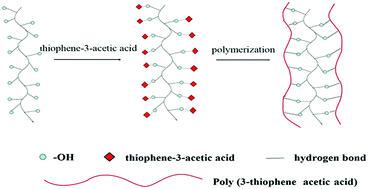
These results further confirm the formation mechanism of PTAA nanowires mentioned above and reported in the previous work.50 When the water-soluble macromolecules template (as the working electrode) is immersed into the solution containing TAA, monomers will be spontaneously adsorbed onto water-soluble polymer molecules through hydrogen bonds formed between TAA molecules and the –OH or –NH2 groups of template molecules. Finally, the absorbed monomers are polymerized preferentially along the chains of template to form PTAA nanowires (Scheme 2). Therefore, the orderly arrangement of water-soluble macromolecules on the ITO glass surface plays the principal role in the formation of PTAA nanowires. Because mPEG molecules contains only one –OH group on the end of the molecule chain (see Scheme 1), therefore strong interactions can not be formed between mPEG molecules and TAA monomers, which leads to no wire-like products.
![]() | ||
| Scheme 2 Diagram of the synthetic process of PTAA nanowires and the hydrogen-bond network between thiophene-3-acetic and water-soluble macromolecules. | ||
O),51,52 the peaks at 1407 cm−1 is associated with the ring stretching of TAA, while the peak at 780 cm−1 attributing the Cα–H stretching mode of the thiophene ring has no appear. These spectral results demonstrated that the PTAA were grown through the Cα–Cα coupling of the monomers. In comparison with the FTIR spectrum of normal PTAA film (Fig. 4), the spectra of nanowires obtained respectively from different systems (Fig. 5) containing HEC, Cs and PAM are the same with that of PTAA, which confirms the formation of wire-like PTAA.
![]() | ||
| Fig. 5 FTIR spectra of PTAA nanowires synthesized through systems containing HEC (a), Cs (b), and PAM (c) as template, respectively. | ||
The TAA emission peak of fluorescence spectrum appears in a shorter wavelength range (inset in Fig. 8). The fluorescence curves of partially soluble PTAA and nanowires have more than two emission peaks at longer wavelengths, compared with the monomer's peak. This suggests that PTAA has an effective conjugated chain length and it can make stronger and single fluorescent. It can be noticed that the curves of PTAA nanowires obtained from Cs system and PTAA film are a little similar, while those of nanowires produced from HEC and PAM systems are also alike. These results are consistent with the morphologies presented in Fig. 2 and 3, where the nanowires synthesized from Cs system are connected together. Additionally, from Fig. 8a–d, slight red shifts can be seen of emission peaks from the curves, which can be ascribed to different elongation of the PTAA's delocalized π-electron chain sequence.53
![]() | ||
| Fig. 8 The fluorescence spectra of TAA (inset) and partly dissolved PTAA film (a) and PTAA nanowires synthesized respectively through Cs (b), HEC (c), and PAM (d) systems (solvent: DMSO). | ||
![]() | ||
| Fig. 9 Cyclic voltammograms of PTAA nanowires synthesized respectively through Cs (a), HEC (b) and PAM (d) systems, and PTAA film (c). | ||
![]() | ||
| Fig. 10 Photograph of water drop on PTAA nanowires deposited on the glass substrate synthesized respectively through HEC (a), Cs (b) and PAM (c) systems. | ||
| This journal is © The Royal Society of Chemistry 2015 |