
Yun Huang*a,
Rui Huanga,
Shengdong Gonga,
Haijun Cao*b,
Yuanhua Lina,
Man Yanga and
Xing Lia
aSchool of Materials Science and Engineering, Southwest Petroleum University, Chengdu, 610500, China. E-mail: huangyun982@163.com; Tel: +86 28 83037409
bInstitute of Blood Transfusion, Chinese Academy of Medical Sciences, Chengdu, 610052, China. E-mail: chj007@163.com
First published on 1st May 2015
In order to incorporate inorganic nano-particles into a gel polymer electrolyte (GPE) in the form of chemical bonds to improve electrolyte performances, monomers of methyl methacrylate (MMA) and vinyl trismethoxy silane (VTMS) were chosen to synthesize the novel self-doped polymer of h-poly(methyl methacrylate-vinyl trismethoxy silane) (h-P(MMA-VTMS)), and then the obtained polymer was used as a matrix to prepare GPE. By the characterization of the resultant polymer, the composition and structure conformed to the design concept, and the self-doped polymer is amorphous and possesses two different glass transition temperatures (Tg) and a better thermal stability. From the investigation of the prepared GPE, it is thermally stable in the temperature range from 30 °C to 100 °C and the ionic conductivity reaches the level of 10−4 S cm−1 at room temperature. For the 50 wt% GPE system, the variation in ionic conductivity displays an Arrhenius behavior in the temperature range from 30 °C to 60 °C. The higher lithium ion transference number is 0.42, the compatibility with lithium metal anode is better and the electrochemical stability is stable up to 5.2 V versus Li/Li+.
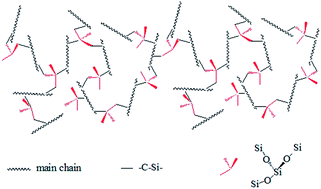
From the first GPE research in 1994, the improvement of GPE performances such as ionic conductivity at room temperature, mechanical property, thermal stability, electrochemical stability and C-rate performance of cells has been carried out for twenty years. The most efficient method to obtain prospective result is the composition and structure design of polymer matrix. It is obvious that each single polymer such as PMMA,18–20 PAN,21,22 PEO,23,24 PVDF,25,26 etc., is favorite to provide GPE some curtain property and do not meet all requirements of GPE. So in some reports, these monomers such as MMA, AN, EO and VDF were chosen to synthesize copolymer used as matrix for GPE. In addition, designing special structure such as comb-shape,27 graft-shape,28,29 star-shape30 and crosslink-shape31 for polymer matrix is also a very interesting measure. Each structure can promise characteristic property in one aspect. So in some recent researches, to achieve the wonderful effect, combining both method together to design polymer matrix with certain composition and signature structure is becoming popular. But this kind of method is undoubtedly expensive, which certainly limits the widespread appliance of battery. Besides, many polymer matrix designed do not mostly be achieved without appropriate synthesis route.
To quest for improving comprehensive properties of GPE by incorporating inorganic nanoparticles into electrolyte system is another promising method. The inorganic nanoparticles includes metal oxide, such as MgO,32,33 ZnO,34 Al2O3,32–35 TiO2,34–38,42 ZrO2,39,40 SnO2 (ref. 41) and CeO2,42 inorganic oxide SiO2,15,43–48 carbon nanotube,14 clay mineral29 found in many references. However, the high surface energy from large surface area of all inorganic nanoparticles usually leads to particle agglomeration, which negates any benefits associated with the nanoparticles.49 In order to overcome the aforementioned distinct drawback, a facile and efficient route to decrease the surface energy of inorganic nanoparticles is to change the hydrophilic to hydrophobic nature of nanoparticles by organic modification on the surface of particles using various monomers or polymer with some curtain chemical structure and functionality. Even so, incorporating inorganic nanoparticles into electrolyte system remains deeply ambivalent. There are two basic reasons: one is that the method of organic modification on nanoparticles surface just can solve the agglomeration problem to some extent, and the other is the organic modification drives up cost which finally limits the larger-scale application of GPE.
Bearing the two facts mentioned above, we predict one polymer which can be synthesized easily with simple route and is one kind of potential excellent matrix for GPE. The predicted polymer is based on the monomer of methyl methacrylate (MMA) and vinyl-trismethoxy silane (VTMS). MMA belongs to acrylate monomer and polyacrylate is one kind of the most extensive and outstanding polymer used as matrix for GPE. VTMS provides the very special functional group of methoxy silane which can change to segment of –Si–O–Si–. The formed segment can behave as inorganic nanoparticles and produces the similar modification function in GPE. In addition, the obtained –Si–O–Si– is chemically linked into the chain of the designed polymer and reaches the extent of molecule dispersion level, which completely resolves the agglomeration drawback of inorganic particles filler added physically. In the case of performance improvement, the train of thought of designing polymer matrix used for GPE will definitely attract a great deal of attention.
According to the above concept, in our present work, MMA and VTMS were chosen to synthesize copolymer of P(methylmethacrylate-co-vinyl-trismethoxy silane) (P(MMA-VTMS)), and then the obtained copolymer was hydrolyzed in acid solution to generate silanol group. At last in higher temperature, the dehydration condensation polymerization between silanol was carried out, and the segment of –Si–O–Si– was appeared in the resulted polymer. Because of the function of –Si–O–Si–, the ultimate product designated as h-P(MMA-VTMS) was obviously the so-called self-doped polymer. We demonstrate here for the first time the self-doped polymer of h-P(MMA-VTMS) as one new viable matrix to prepare GPE. So there were two projects in the manuscript. Firstly, the self-doped polymer of h-P(MMA-VTMS) was needed to be evidenced by Fourier Transform Infrared spectroscopy (FTIR), Nuclear Magnetic Resonance (NMR), X-ray diffraction (XRD), differential scanning calorimetry (DSC) and thermogravimetric analysis (TGA). Secondly, the manuscript discussed the results related to the most important properties of GPE. In this research, we reported a preliminary study demonstrating the feasibility of GPE based on the matrix of self-doped polymer of h-P(MMA-VTMS).
C group. This indicates that the resulted polymer is firstly formed through breaking of C
C bonds in each monomer, as shown in the first step in Scheme 1. The characteristic peak at 1731 cm−1 is the C
O group in polymer. And the symmetric stretching vibration of the siloxane (–Si–O–Si–) group appears at 1143 cm−1. The peaks at 1058 cm−1 and 959 cm−1 are for –Si–O–C– group, and reflect that some methoxy groups in VTMS are not hydrolyzed. The weak peak at 866 cm−1 is the designation of –Si–OH group and verifies that not all –Si–OH group carry out dehydration condensation reaction in the final step in Scheme 1. In addition, the peak area ratio of –Si–O–Si–, –Si–O–C– and –Si–OH can supply the definite percentage value of each specific group in the self-doped polymer of h-P(MMA-VTMS). So by quantitative analysis, the percentage value of –Si–O–Si–, –Si–O–C– and –Si–OH are 63.7%, 25.2% and 11.1% in h-P(MMA-VTMS), respectively. So Schemes 1 and 2 just reflect the ideal reaction results. With the same method, the monomer ration of MMA and VTMS is 7
:
3 which is determined by the peak area ratio of C
O group in MMA and Si group (–Si–O–Si–, –Si–O–C– and –Si–OH) in VTMS, so in Scheme 1 the value of m
:
n is 7
:
3.
The 29Si-NMR spectrum of the self-doped polymer, as shown in Fig. 3, shows a very wide peak in the range from −60 ppm to −140 ppm. The wide peak is the overlap result of many sharp peaks: the inorganic SiO2-like structure of Qn
Si–(OSi)n–OH4−n (n = 2–4) produced in the self-doped polymer has peaks at around −110 ppm for Q4, around −100 ppm for Q3 and around −90 ppm for Q2; the organic siloxane structure of Tn
R–Si–(OSi)n–OH3−n (n = 1–3) has peaks at around −70 ppm for T3 and around −60 ppm for T2. All these peaks indicate that we obtain the designed polymer matrix.
FTIR and NMR spectra reveal that the self-doped polymer h-P(MMA-VTMS) is successfully synthesized.
The thermal stability of the self-doped polymer h-P(MMA-VTMS) is determined by TGA under air atmosphere from room temperature to 500 °C. The result is shown in Fig. 5. The thermal degradation curve displays a three stage decomposition trend starting at 120 °C. The first stage starts from 120 °C to 220 °C with the weight loss due to the evaporation of residual solvent inside the polymer matrix; the second stage from 260 °C to 310 °C is due to the decomposition of organic phase in polymer; the third stage from 340 °C to 420 °C with a quick and large degradation process is attributed to the inorganic phase decomposition in h-P(MMA-VTMS). Therefore, the obtained polymer has favorable thermal stability which totally meets the thermal requirement of lithium ion battery. These results further proves that the synthesized polymer definitely and successfully is doped self by chemical bond connect form.
In these curves, there is one very interesting and important phenomenon. That is on blending with plasticizer of PC and lithium salt of LiClO4, the temperature point of thermal stability of four GPEs do not completely change compared with that of pure polymer matrix. The reason may be that the plasticizer molecule totally integrated into the chains of polymer, and one kind of strong attraction force is formed between plasticizer and polymer chain, which likely makes two components become one material.
![]() | (1) |
In eqn (1), the parameter of Rb usually is retrieved from the EIS. The EIS of GPEs based on the synthesized self-doped polymer h-P(MMA-VTMS) are presented in Fig. 10.
From Fig. 10, the Rb value is gradually increased with the weight percent of polymer matrix in GPE, which is a typical trend for GPE. Usually the Rb value is inversely proportional to the amount of plasticizer in GPE. The reason is that the more amount plasticizer endows the charge carries of lithium ion with the easier movement ability. So the ionic conductivity of GPEs with the polymer amount percent of 65 wt%, 60 wt%, 55 wt% and 50 wt% are 2.88 × 10⁻⁵ S cm−1, 6.89 × 10⁻⁵ S cm−1, 1.48 × 10⁻⁴ S cm−1 and 3.76 × 10⁻⁴ S cm−1, respectively. But in the EIS shapes, there is a significant difference. That is, the semicircle part in EIS of GPE gently appears with the polymer amount, which indicates that the interface impedance between electrolyte and stainless steel electrode ascends. It was not totally difficult to understand the trend. When polymer amount is increased, the plasticizer amount is conversely decreased in GPE, which definitely reduces the affinity between electrolyte and electrode, and ultimately the interface impedance raises gradually.
The relationship between temperature and ion conductivity is used to analyze the mechanism of ionic conduction in self-doped polymer GPE membranes in the temperature range from 30 °C to 60 °C, which is shown in Fig. 11 and 12. Based on the result of better ionic conductivity and self-standing ability, the flowing research will be established on the kind of 50 wt% GPE system.
From the insert in Fig. 11, the electrolyte bulk resistance Rb (Ω) is continuously increased with temperature. It is very easy to understand the relation. In GPE system, the motion of polymer chain is the movement driving force of current carriers of lithium ion, and the higher temperature endows the polymer chain with more flexibility and enhances segmental mobility,51 which undoubtedly and ultimately is beneficial to improve the ionic conductivity. The ionic conductivity is reasonably determined by the Arrhenius equation, which can be written as follows:
σ = A exp(−Ea/κT)
| (2) |
Fig. 12 typically depicts the temperature dependence of the ionic conductivity of 50 wt% GPE system. The fitting line shows satisfying linear correlation parameter R2 of 0.975 in Table 1, so the variation of the ionic conductivity displays a basic Arrhenius behaviour over the temperature range from 30 °C to 60 °C upwards. The highest measured conductivity of the membrane at 60 °C was 1.32 × 10⁻³ S cm−1. In addition, the lithium movement active energy Ea in the GPE is 68.9 kJ mol−1.
σ vs. 103T−1
| Linear fitting equation | Ea (kJ mol−1) | Linear correlation parameter R2 |
|---|---|---|
lg σ = −3.59 × 10³T−1 + 8.07 |
68.9 | 0.975 |
Lithium ion transference number (tLi+) is measured using a symmetric cell of Li/50 wt% GPE/Li by the DC polarization method combined with EIS method, as described by Bruce and Vincent.52 It can be obtained according to the following equation:
![]() | (3) |
tLi+ is considered as an important parameter to appreciate the performance of polymer electrolytes. In this paper, the lithium ion transference number of GPE is 0.42 (Fig. 13), which is much higher than that of many commercial separator and GPEs reported in references.
![]() | ||
| Fig. 13 Impedance spectra of the Li/GPE/Li cell measured before and after polarization (50 wt% GPE). | ||
The satisfying compatibility of GPE with lithium anode, which can be reflected by the interfacial impedance, is a key factor of application in lithium ion battery. In Fig. 14 the variations of impedance spectra with the storage time for the cell using the self-doped polymer based 50 wt% GPE are presented. The symmetrical Li/50 wt% GPE/Li cell has one kind of equivalent circuit expressed as Rb + Rct//CPE1 + Rp//CPE2 (+ represents series connection; // represents parallel connection). Rb, Rct and Rp are the bulk resistance of GPE, the charge transfer resistance between Li anode and passive layer and the resistance of passive layer, respectively. The passive layer is formed by the interaction of lithium metal with the plasticizer of PC in the GPE. CPE1 and CPE2 are the interfacial double layer capacitor between Li and passive layer and the capacitor of passive layer, respectively. The interfacial resistance of Ri between lithium metal anode and GPE is the summation of Rct and Rp. It can be seen that the interfacial resistance determined by the diameter of the semicircle exhibited in the impedance spectra increase with increasing storage time. With storage time, the thickness and structure of the formed passive layer is continuing to change, which leads to Ri increase.
The electrochemical potential window (i.e. working voltage range) is an important parameter of GPE evaluated from the point of view of application of electrochemical devices. And what is more important, the compatibility of GPE with cathode of lithium ion battery can be charactered by their electrochemical stability on stainless steel electrode under anodic oxidation. The working voltage range of the self-doped polymer GPE is determined by LSV using a Li/50 wt% GPE/SS cell. Fig. 15 shows the current response of the working electrode. The anodic current onset of the oxidative decomposition of organic solvent such as EC (ethylene carbonate), PC (ethylene carbonate) and DMC (dimethyl carbonate) in liquid electrolyte is 4.4 V (vs. Li/Li+),53 whereas there is no obvious current through the working electrode up to 5.2 V versus Li/Li+, and then the current onset that is related to the decomposition of GPE is appeared when the electrode potential is higher than 5.2 V (versus Li/Li+). The improvement of electrochemical stability should be ascribed to the gelation of the liquid electrolyte. The gelation improves the stability of the electrolyte because of the interaction between liquid electrolyte and polymer, which restricts the free movement and the activity of the liquid electrolyte in GPE.52 The result exhibits that the electrochemical stability window is 5.2 V for the self-doped GPE. Definitely, in order to significantly improve the capacity and energy density of battery, the operation voltage of cathode materials must be firstly enhanced. However this approach usually is prevented because of the oxidation decomposition of electrolyte under higher working voltage over 4.5 V. So the present adequate high electrochemical potential window make this kind of electrolyte potential choice for application in lithium ion batteries with a relatively board voltage cathode materials.
| This journal is © The Royal Society of Chemistry 2015 |