
Yang Songa,
Rui-Qing Fan*a,
Hui-Jie Zhanga,
Zhi-Wei Liua,
Xue-Tao Wanga,
Cai-Tu Tana,
Yu-Lin Yang*a and
Yu-Lei Wangb
aDepartment of Chemistry, Harbin Institute of Technology, Harbin 150001, P. R. China. E-mail: fanruiqing@hit.edu.cn; ylyang@hit.edu.cn; Fax: +86-0451-86413710
bNational Key Laboratory of Science and Technology on Tunable Laser, Harbin Institute of Technology, Harbin 150080, P. R. China
First published on 3rd February 2015
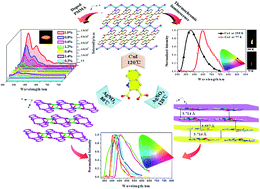
Three one-dimensional (1D) Ag(I)/Cu(I) coordination polymers, formulated as [Ag(2,3-Hqldc)]n (Ag1), [Ag(3-qlc)]2n (Ag2) and [CuI(3-Hqlc)]n (Cu1) based on the ligand quinoline-2,3-dicarboxylic acid (H2qldc), were synthesized through hydrothermal (solvothermal) method and structurally characterized by single-crystal X-ray diffraction, IR spectroscopy and elemental analysis. Molecular structural analysis reveals that Ag1 was a 1D + 1D → 1D infinite chain synthesized at a relatively low temperature 80 °C, which further forms a three-dimensional (3D) structure by π–π stacking interactions. Ag2 forms a 1D dimer chain structure and via π⋯π packing interactions shows a two-dimensional (2D) supramolecular network. Both Ag1 and Ag2 display stable blue luminescent in the solid state and in organic solvents (DMSO, CH3CN and CH3OH) at 298 K and 77 K. However, Cu1 possess a 1D ladder chain structure, which further forms a 2D structure by hydrogen bonding interactions. Cu1 shows tunable luminescence at 298 K and 77 K in the solid state with a large red-shift of 70 nm and the CIE color shifts from bright yellow (0.51, 0.48) to red (0.67, 0.30), indicating thermochromic luminescence for Cu1. After doping with poly(methylmethacrylate) (PMMA), not only are the luminescence intensity and lifetimes enhanced, but the thermal stability is also increased in comparison with Cu1. After Cu1 was doped with PMMA (Cu1@PMMA), the lifetime of the polymer film material Cu1@PMMA increases and reaches a maximum at 1.0% (τ = 95.57 μs), which is more than eight times longer than that of Cu1 (τ = 13.78 μs). Cu1@PMMA is confirmed as a bright yellow luminescent polymer film material.
In addition, monovalent copper complexes show a variety of structure and rich photophysical properties. Nevertheless, Cu(I) is easy to oxidize into Cu(II) in the process of synthesis, thus create monovalence copper complexes as luminescent material is difficult but very meaningful. A popular polymer matrix used as a host for luminescent transition coordination polymers is poly(methyl methacrylate) (PMMA), which is a low-cost, simply prepared polymer with excellent optical quality.8 Until now most of the reports are rare earth doped with PMMA.9 There is no doubt that rare earth element shows excellent luminescent properties, but luminous color of rare earth element has defects which is not easy to control. Compared with noble metal Pt, Au, Ag even rare earth, Cu(I) with the advantage of cheap and non-poison, which also can modify ligands and control the emitting. Hence, copper-based systems with favorable luminescence are beginning to receive more attention.10 When copper(I) coordination polymers incorporate with PMMA forming a new complex-containing polymer/film,11 it will lead to significant flexibility, versatility, thermal and photostability.12
In this work, we choose quinoline-2,3-dicarboxylic acid (H2qldc) as the ligand. H2qldc as a derivative of 2,3-H2pydc which has a relatively large π-conjugated system in the quinoline ring, which might not only contribute to the desirable fluorescence properties resulting from the interaction between 2,3-qldc2− anions and metal ions, but also easily assemble into high dimensionality, supramolecular networks via π⋯π packing interactions between two adjacent aromatic rings as well as hydrogen bonding interactions. To the best of knowledge, cases of metal–organic complexes linked by H2qldc have been presented. Y. P. Cai,13 J. H. Lin,14 G. B. Che15 and their co-workers use 2,3-H2qldc ligand to prepare a series of coordination polymers from zero- to two-dimension with Co(II), Zn(II), Cd(II), Mn(II) and Ln(III) ions, which are summarized in Table S1.†
Three Ag(I)/Cu(I) coordination polymers constructed from H2qldc, namely, [Ag(2,3-Hqldc)]n (Ag1), [Ag(3-qlc)]2n (Ag2) and [CuI(3-Hqlc)]n (Cu1) have been synthesized under hydrothermal conditions. During the solvothermal synthetic process, unexpected situ decarboxylation of H2qldc was observed. Through controlling the temperature (from 80 °C to 120 °C) makes the ligand 2,3-H2qldc decarboxylation and results in the formation of 3-Hqlc ligand. After decarboxylation, the dihedral angle between the planes of carboxyl and quinoline in one bridging organic ligand is 3.70° in the Ag2, which is much smaller than those of 61.98° and 30.49° in the Ag1. The nice coplanar feature of the structure in Ag2 can enhance the luminescent efficiency. The structure of Ag2 has been reported by C. B. Liu, et al.16 but they directly use 3-Hqlc as ligand rather than decarboxylation of H2qldc. In this work, we mainly talked about the decarboxylation process of H2qldc and compared with coordination polymer Ag1. What's more, we also discussed the luminescent properties of Ag1 and Ag2 in details. Both Ag1 and Ag2 display stable blue luminescent in the solid state and in different solvents (DMSO, CH3CN and CH3OH) at 298 K and 77 K. However, Cu1 shows the interesting property of thermochromic luminescence, which is rarely reported in literatures, and most of cases only talked about the luminescent properties in the solid state rather than the effect of solvent and temperature, more comparisons are summarized in Table S2.†
:
1 was dissolved in 8 mL H2O and stirred for 20 min. The final mixture was placed in a Teflon-lined stainless steel vessel (20 mL) under autogenous pressure and heated at 80 °C for 5 days. After slowly cooling to the room temperature, the mixture was washed with distilled water and colorless block-shaped crystals were filtered off and dried at room temperature (yield ca. 65%, based on silver metal). Elemental analysis (%): calc. for C11H6AgNO4 (Mr: 324.04): C, 40.77; N, 4.32; H, 1.87%. Found: C, 40.72; N, 4.38; H, 1.89%. IR (cm−1): 3515 (br, s), 3404 (br, s), 3142 (w), 2235 (m), 1591 (vs), 1372 (vs), 1285 (s), 1132 (vs), 1001 (m), 750 (vs), 673 (s), 553 (w), 476 (w). 1H NMR (400 MHz, DMSO-d6): δ = 8.98 (s, 1H, H2qldc–H1), 8.24 (s, 1H, H2qldc–H5), 8.14 (d, 1H, H2qldc–H4′), 7.95 (d, 1H, H2qldc–H2), 7.77 (d, 1H, H2qldc–H3) ppm. 1H NMR (400 MHz, CD3CN): δ = 9.13 (s, 1H, H2qldc–H1), 8.24 (s, 1H, H2qldc–H5), 8.18 (d, 1H, H2qldc–H4), 8.06 (d, 1H, H2qldc–H2), 7.84 (d, 1H, H2qldc–H3) ppm. 1H NMR (400 MHz, CD3OD): δ = 8.94 (s, 1H, H2qldc–H1), 8.13 (d, 2H, H2qldc–H4,5), 7.95 (d, 1H, H2qldc–H2), 7.76 (d, 1H, H2qldc–H3) ppm.
:
1 was dissolved in 8 mL H2O and stirred for 20 min. The final mixture was placed in a Teflon-lined stainless steel vessel (20 mL) under autogenous pressure and heated at 120 °C for 5 days. After slowly cooling to the room temperature, the mixture was washed with distilled water and colorless block-shaped crystals were filtered off and dried at room temperature (yield ca. 52%, based on silver metal). Elemental analysis (%): calc. for C20H12Ag2N2O4 (Mr: 560.06): C, 42.89; N, 5.00; H, 2.16%. Found: C, 42.85; N, 5.03; H, 2.19%. IR (cm−1): 3437 (br, s), 3044 (w), 1597 (vs), 1558 (vs), 1394 (vs), 1317 (s), 793 (vs), 761 (m), 586 (m), 476 (w). 1H NMR (400 MHz, DMSO-d6): δ = 9.32 (s, 1H, 3-qlc–H1), 9.01 (s, 1H, 3-qlc–H2), 8.20 (d, 1H, 3-qlc–H6), 8.12 (d, 1H, 3-qlc–H3), 7.89 (d, 1H, 3-qlc–H5), 7.67 (d, 1H, 3-qlc–H4) ppm. 1H NMR (400 MHz, CD3CN): δ = 9.39 (s, 1H, 3-qlc–H1), 9.84 (s, 1H, 3-qlc–H2), 8.13 (d, 2H, 3-qlc–H3,5), 7.89 (d, 1H, 3-qlc–H6), 7.71 (d, 1H, 3-qlc–H4) ppm. 1H NMR (400 MHz, CD3OD): δ = 9.39 (s, 1H, 3-qlc–H1), 9.05 (s, 1H, 3-qlc–H2), 8.28 (s, 1H, 3-qlc–H6), 8.13 (d, 1H, 3-qlc–H3), 7.93 (d, 1H, 3-qlc–H5), 7.74 (d, 1H, 3-qlc–H4) ppm.
:
1 was dissolved in 6 mL CH3CN and stirred for 20 min. The final mixture was placed in a Teflon-lined stainless steel vessel (20 mL) under autogenous pressure and heated at 120 °C for 5 days. After cooling to the room temperature, the mixture was washed with distilled water and yellow block-shaped crystals were filtered off and dried at room temperature (yield ca. 72%, based on copper metal). Elemental analysis (%): calc. for C10H7CuINO2 (Mr: 363.61): C, 33.00; N, 3.85; H, 1.93%. Found: C, 33.59; N, 3.88; H, 1.96%. IR (cm−1): 3437 (br, s), 3076 (br, m), 1700 (vs), 1613 (vs), 1427 (m), 1285 (vs), 925 (w), 782 (vs), 465 (w). 1H NMR (400 MHz, DMSO-d6): δ = 9.40 (s, 1H, 3-qlc–H1), 9.16 (s, 1H, 3-qlc–H2), 8.32 (d, 2H, 3-qlc–H3,5), 7.93 (d, 1H, 3-qlc–H6), 7.78 (d, 1H, 3-qlc–H4) ppm. 1H NMR (400 MHz, CD3CN): δ = 9.40 (s, 1H, 3-qlc–H1), 8.89 (s, 1H, 3-qlc–H2), 8.13 (d, 2H, 3-qlc–H3,5), 7.89 (s, 1H, 3-qlc–H6), 7.67 (s, 1H, 3-qlc–H4) ppm. 1H NMR (400 MHz, CD3OD): δ = 9.93 (s, 1H, 3-qlc–H1), 9.59 (s, 1H, 3-qlc–H2), 8.86 (d, 1H, 3-qlc–H6), 8.70 (d, 1H, 3-qlc–H3), 8.51 (d, 1H, 3-qlc–H5), 8.28 (d, 1H, 3-qlc–H4) ppm.
Interestingly, the decarboxylation of H2qldc was observed in the solvothermal synthetic process of Ag2 and Cu1. In order to study the decarboxylation process of H2qldc, a series of control experiments were conducted. We did the experiment under the condition of without adding metal salts, only ligand H2qldc in 8 mL H2O was placed in a Teflon-lined stainless steel vessel (20 mL) under autogenous pressure and heated at 120 °C for 5 days. We found that the decarboxylation of free H2qldc was performed under solvothermal conditions at 120 °C (without any other substance). The 13C NMR spectra of the reaction product as well as H2qldc are shown in Fig. S1 and S2 in the ESI,† in which the characteristic peaks of –COOH appeared at 167.99 and 166.22 ppm, but for the reaction product only one characteristic peak of –COOH appeared at 166.30 ppm. As aforementioned reaction fact, coordination polymer Ag1 can be obtained at 80 °C. Based on these facts, we can deduce that, the coordination between the ligand and the metal center may be occurred before the decarboxylation of H2qldc in Ag1. Meanwhile, when Ag1 assembling, the decarboxylation is too difficult to perform. As shown in TG curve, until 452.2 °C, Ag1 begins to lose the two carboxylates. Compared with Ag1, coordination polymer Ag2 was not obtained at 80 °C (other conditions remain unchanged except for the reaction temperature). The phenomenon can be explained as: in Ag2, the coordination reaction may be occurred after the decarboxylation process. The aryl group in H2qldc ligand as electron attracting group is beneficial to the cleavage of C–C bond. The reaction mechanism of Ag1 and Ag2 are shown in Scheme 1.
| Identification code | Ag1 | Cu1 |
|---|---|---|
| a R1 = ∑||Fo| − |Fc||/∑|Fo.b wR2 = [∑[w(Fo2 − Fc2)2]/∑[w(Fo2)2]]1/2. | ||
| Empirical formula | C11H6AgNO4 | C10H7CuINO2 |
| Formula mass | 324.04 | 363.61 |
| Crystal system | Triclinic | Monoclinic |
| Space group | p![]() |
P2(1)/n |
| a (Å) | 6.6702(13) | 4.2490(8) |
| b (Å) | 8.7729(18) | 15.962(3) |
| c (Å) | 9.1647(18) | 15.297(3) |
| α (°) | 78.49(3) | 90.00 |
| β (°) | 72.67(3) | 90.03(3) |
| γ (°) | 68.92(3) | 90.00 |
| V (Å3) | 475.13(2) | 1037.5(4) |
| Z | 2 | 4 |
| Dc/(g cm−3) | 2.265 | 2.328 |
| μ (Mo Kα)/mm−1 | 2.121 | 5.056 |
| F(000) | 316 | 688 |
| Crystal size | 0.20 × 0.18 × 0.15 mm | 0.14 × 0.14 × 0.12 mm |
| 2θ range (°) | 3.24–27.48 | 3.69–27.46 |
| Limiting indices | −8 ≤ h ≤ 8 | −5 ≤ h ≤ 5 |
| −11 ≤ k ≤ 11 | −20 ≤ k ≤ 20 | |
| −11 ≤ l ≤ 11 | −19 ≤ l ≤ 19 | |
| Data/restraints/parameters | 2168/0/155 | 2368/0/136 |
| GOF on F2 | 0.983 | 1.267 |
| Final R indices [I > 2σ(I)] | ||
| R1a | 0.0324 | 0.0814 |
| wR2b | 0.0937 | 0.2183 |
| R indices (all data) | ||
| R1 | 0.0404 | 0.0842 |
| wR2 | 0.0995 | 0.2192 |
| CCDC | 1036463 | 1036466 |
| a Symmetry transformations used to generate equivalent atoms: #1: −x, −y + 2, −z; #2: −x, −y + 1, −z + 1. | |||
|---|---|---|---|
| Ag1 | |||
| Ag(1)–N(1) | 2.261(3) | N(1)–Ag(1)–O(1)#2 | 128.8(1) |
| Ag(1)–O(4)#3 | 2.390(2) | O(1)#2–Ag(1)–O(4)#3 | 105.4(1) |
| Ag(1)–O(1)#2 | 2.295(3) | N(1)–Ag(1)–O(4)#3 | 120.8(0) |
| Cu1 | |||
| I(1)–Cu(1) | 2.645(2) | Cu(1)–I(1)–Cu(1)#1 | 80.4(1) |
| I(1)–Cu(1)#1 | 2.688(2) | Cu(1)–I(1)–Cu(1)#2 | 61.3(3) |
| I(1)–Cu(1)#2 | 2.694(3) | Cu(1)#1–I(1)–Cu(1)#2 | 104.3(1) |
| Cu(1)–N(1) | 2.051(1) | N(1)–Cu(1)–I(1) | 122.3(4) |
| Cu(1)–I(1)#1 | 2.688(2) | N(1)–Cu(1)–I(1)#1 | 109.8(4) |
| Cu(1)–I(1)#2 | 2.694(3) | I(1)–Cu(1)–I(1)#1 | 99.6(1) |
| Cu(1)–Cu(1)#2 | 2.723(4) | N(1)–Cu(1)–I(1)#2 | 100.9(4) |
| I(1)–Cu(1)–I(1)#2 | 118.7(2) | ||
| I(1)#1–Cu(1)–I(1)#2 | 104.3(1) | ||
| N(1)–Cu(1)–Cu(1)#2 | 134.9(4) | ||
| I(1)–Cu(1)–Cu(1)#2 | 60.2(3) | ||
| I(1)#1–Cu(1)–Cu(1)#2 | 114.0(4) | ||
| I(1)#2–Cu(1)–Cu(1)#2 | 58.5(5) | ||
. The asymmetric unit of Ag1 and Ag2 are shown in Fig. 1. The asymmetric unit of Ag1 contains one Ag(I) cation, one 2,3-Hqldc− anion. Ag(I) center is three-coordinated by one nitrogen atom (N1) from one 2,3-Hqldc− anion and two oxygen atoms (O1A and O4A) from two other 2,3-Hqldc− anions, forming a plane triangle. Ag–N bond length is 2.261(3) Å, Ag–O bond lengths are 2.295(3) and 2.390(2) Å respectively. All Ag–N and Ag–O bond lengths as well as the bond angles around Ag(I) ion are in the range expected for such coordination polymers.1b Two adjacent silver ions are connected through N1 and O4 atoms deriving from one 2,3-Hqldc− anion, giving rise to an infinite 1D zigzag chain. What's more, two adjacent 1D zigzag chains are linked by bridging O atom, forming a new 1D + 1D → 1D chain with a Ag⋯Ag separation of 4.168 Å (Fig. 2). It is noteworthy that, in the Ag1 crystal structure, it exits weak intermolecular forces including aromatic rings. Further analysis of the crystal packing reveals that adjacent 1D chains are further connected by face-to-face π⋯π interactions between quinoline ring with a centroid to centroid distance of 3.697 Å (Fig. 3a) and 3.785 Å (Fig. 3b). They play an important role in stabilizing the network structure, and further resulting in a 3D supramolecular architecture.
![]() | ||
| Fig. 1 The structural unit of Ag1 (a) and Ag2 (b) with labeling scheme and 50% thermal ellipsoids (hydrogen atoms are omitted for clarity). | ||
![]() | ||
| Fig. 2 Ball-and-stick representation of the 1D chain structure and the 1D + 1D → 1D chain structure in Ag1. | ||
Notably, though the chemical environments of the central Ag cations are the same in Ag1 and Ag2, the major difference is the dihedral angle between the carboxyl and quinoline in one bridging organic ligand. The dihedral angle between the two planes in one bridging ligand is 3.70° in the Ag2, which is much smaller than those of 61.98° and 30.49° in Ag1. Hence, Ag2 overcomes the shortcoming of the coplanarity, which is constructed by carboxyl and quinoline ring and shows fantastic coplanar structure.
| Coordination polymers/ligands | Absorption (nm) (ε/dm3 cm−1 mol−1) | Excitation (λ, nm) | Emission (λmax, nm) | CIE (x, y) | Quantum yields (Φ)b | Lifetimes (μs) | Conditionsa | ||||
|---|---|---|---|---|---|---|---|---|---|---|---|
| τ1 (μs) | A1% | τ2 (μs) | A2% | 〈τ〉 (μs) | |||||||
| a Concentration in DMSO, CH3CN and CH3OH solutions: (M) = 1 × 10⁻⁵ M.b Determined using quinine sulfate in 0.1 M sulfuric acid (Φ = 0.546) for Ag1, Ag2 and rhodamine B chloride in ethanol (Φ = 0.690) for Cu1 as a standard. | |||||||||||
| Ag1 | 267 (79 236) |
300 | 427, 631 | 0.17, 0.12 | 0.185 | 1.72 | 46.39 | 13.71 | 53.61 | 12.54 | DMSO, 298 K |
227 (139 893) |
300 | 416, 624 | 0.16, 0.05 | 0.143 | 1.77 | 45.68 | 13.49 | 54.32 | 12.33 | CH3CN, 298 K | |
222 (84 282) |
300 | 404, 611 | 0.15, 0.06 | 0.092 | 0.91 | 6.37 | 7.29 | 55.40 | 7.20 | CH3OH, 298 K | |
| — | 300 | 455 | 0.23, 0.29 | — | 0.89 | 54.51 | 7.08 | 45.49 | 6.27 | Solid, 298 K | |
| — | 300 | 453, 639 | 0.18, 0.22 | — | 1.37 | 51.73 | 18.03 | 48.27 | 16.78 | DMSO, 77 K | |
| — | 300 | 434, 626 | 0.16, 0.16 | — | 2.04 | 43.31 | 15.55 | 56.69 | 14.32 | CH3CN, 77 K | |
| — | 300 | 425, 614 | 0.15, 0.15 | — | 1.12 | 40.59 | 13.02 | 59.41 | 12.36 | CH3OH, 77 K | |
| — | 300 | 476 | 0.23, 0.30 | — | 1.81 | 54.10 | 18.10 | 45.90 | 16.38 | Solid, 77 K | |
| Ag2 | 276 (63 000) |
300 | 446, 609 | 0.23, 0.14 | 0.254 | 1.16 | 49.43 | 11.29 | 50.57 | 10.37 | DMSO, 298 K |
222 (54 294) |
300 | 431, 618 | 0.17, 0.06 | 0.212 | 1.44 | 64.73 | 10.99 | 35.27 | 9.14 | CH3CN, 298 K | |
215 (91 294) |
300 | 412, 628 | 0.18, 0.17 | 0.126 | 1.12 | 56.03 | 10.03 | 43.97 | 8.92 | CH3OH, 298 K | |
| — | 300 | 446 | 0.23, 0.27 | — | 1.20 | 50.40 | 8.33 | 49.60 | 7.42 | Solid, 298 K | |
| — | 300 | 471, 632 | 0.18, 0.26 | — | 1.29 | 48.60 | 13.03 | 51.40 | 12.03 | DMSO, 77 K | |
| — | 300 | 452, 628 | 0.15, 0.21 | — | 1.09 | 57.14 | 12.37 | 42.86 | 11.18 | CH3CN, 77 K | |
| — | 300 | 445, 631 | 0.17, 0.21 | — | 1.25 | 56.00 | 10.89 | 44.00 | 9.66 | CH3OH, 77 K | |
| — | 300 | 479 | 0.24, 0.33 | — | 1.74 | 43.02 | 19.02 | 56.98 | 17.90 | Solid, 77 K | |
| Cu1 | 297 (75 669) |
360 | 602 | 0.61, 0.39 | 0.283 | 1.40 | 50.24 | 16.07 | 49.76 | 14.88 | DMSO, 298 K |
276 (97 888) |
360 | 590 | 0.58, 0.41 | 0.224 | 1.71 | 47.03 | 13.17 | 52.97 | 11.99 | CH3CN, 298 K | |
274 (76 551) |
360 | 578 | 0.50, 0.49 | 0.151 | 1.09 | 44.33 | 11.47 | 55.67 | 10.74 | CH3OH, 298 K | |
| — | 360 | 576 | 0.51, 0.48 | — | 1.98 | 40.38 | 14.85 | 59.62 | 13.78 | Solid, 298 K | |
| — | 360 | 627 | 0.65, 0.34 | — | 1.84 | 52.33 | 28.11 | 47.67 | 26.35 | DMSO, 77 K | |
| — | 360 | 612 | 0.57, 0.43 | — | 1.22 | 46.15 | 17.14 | 53.85 | 16.22 | CH3CN, 77 K | |
| — | 360 | 606 | 0.57, 0.43 | — | 1.12 | 51.29 | 13.00 | 48.71 | 12.01 | CH3OH, 77 K | |
| — | 360 | 646 | 0.67, 0.30 | — | 2.58 | 46.03 | 22.50 | 53.97 | 1.847 | Solid, 77 K | |
| H2qldc | 274 (24 939) |
300 | 434 | 0.20, 0.20 | 0.016 | — | — | — | — | — | DMSO, 298 K |
237 (71 200) |
300 | 419 | 0.16, 0.06 | 0.012 | — | — | — | — | — | CH3CN, 298 K | |
235 (101 444) |
300 | 406 | 0.18, 0.12 | 0.008 | — | — | — | — | — | CH3OH, 298 K | |
| — | 300 | 398 | 0.20, 0.19 | — | — | — | — | — | — | Solid, 298 K | |
![]() | ||
| Scheme 2 Schematic energy level diagram of coordination polymers Ag1, Ag2 and Cu1 molecular orbitals ((1) MLCT; (2) d–s transitions, (3) intraligand transitions). | ||
The luminescence quantum yields of coordination polymers Ag1, Ag2, Cu1 and H2qldc are determined in DMSO, CH3CN, and CH3OH. The value of the quantum yields for H2qldc in DMSO, CH3CN and CH3OH are 0.016, 0.012 and 0.008, respectively, while those of Ag1 are 0.185, 0.143 and 0.092 (0.254, 0.212 and 0.126 for Ag2, 0.283, 0.224 and 0.151 for Cu1). The quantum yields of Ag1, Ag2 and Cu1 are much higher than that of the free ligand, which can be easily explained by aggregation of the pure ligands in the solvents, which would also be in accordance with their low quantum yield. Complexation with the silver or copper might make aggregation and π-stacking more difficult than for the pure ligands and when coordination polymers assemble, the enhancement after the connection of the ligand to metal center increases the conformational rigidity of the ligands, and the loss of energy via thermal vibration decay may be reduced. Compared with coordination polymers Ag1, Ag2 and Cu1, the luminescence quantum yields of Ag2 and Cu1 is significantly higher than Ag1, which is attributed to the decarboxylation effect. After decarboxylation making the dihedral angle of carboxyl and quinoline decreases and Ag1 has two dihedral angles are 61.98° and 30.49° respectively. However, dihedral angle of Ag2 is 3.70° and Cu1 is 5.47°. The nice coplanar feature of the structure in Ag2 and Cu1 can enhance the mobility of π electrons in organic aromatic rings, which is in favor of luminescent emission.
In the solid state, the maximum emission band for coordination polymer Ag1 is located at 455 nm (446 nm for Ag2), upon excitation at 300 nm, exhibiting blue emissions at 298 K. The solid-state fluorescence spectra of Ag1 and Ag2 exhibit strong red-shifted photoluminescence emission in comparison with that of free H2qldc ligand (λem = 398 nm). It is noted that there is no emission band for H2qldc ligand can be observed in the region, the photoluminescence origin of the emission bands for the coordination polymers Ag1 and Ag2 should be attributed to MLCT22b,26 (Scheme 2). At 77 K, the emission band for coordination polymer Ag1 is located at 476 nm and Ag2 is located at 479 nm (λex = 300 nm), exhibiting blue emissions in the solid state (Fig. 7), which shows that Ag(I) coordination polymers can be used as stable blue materials. The change of temperature from 298 K to 77 K causes a bathochromic shift of emission peaks in the solid state of Ag1 and Ag2. Obviously, the red shift of coordination polymer Ag2 is longer than Ag1, which due to the existence of Ag–Ag interaction in Ag2. Meanwhile, one of carboxyl removed, making the nice coplanar feature of the structure in Ag2 and improve the mobility of π electrons in organic aromatic rings, so that it shows the excellent luminescence. Ag2 shows stable luminescence at 298 K and 77 K in the solid state with the CIE color shifts from deep-blue (0.23, 0.27) to light blue (0.24, 0.33). Both Ag1 and Ag2 display stable blue luminescent in the solid state at 298 K and 77 K. The luminescent lifetimes for Ag1 and Ag2 in the solid state are determined. The luminescent lifetimes for Ag1 at 298 K and 77 K are 6.27 μs and 16.38 μs, respectively, while those of Ag2 are 7.42 μs and 17.90 μs. The luminescent lifetimes of Ag1 and Ag2 at 77 K are more than twice as those at 298 K in the solid state. A general trend is that the lifetime of emission of low-temperature (77 K) is longer than that in room temperature (298 K), which is attributed to the decrease of thermal vibration and nonradiative transition at low temperature.27
![]() | ||
| Fig. 7 Normalized emission spectra of coordination polymers Ag1, Ag2 and Cu1 in the solid state at 298 K and 77 K and the corresponding color coordinate diagram of emission. | ||
Coordination polymer Cu1 is different from Ag1 and Ag2 in the solid state, under UV irradiation, at room temperature, Cu1 emits an intense yellow light. The fascinating and visually impressive phenomenon of thermochromic luminescence of Cu1 is revealed by immersing the samples into liquid nitrogen (77 K). When exposed to UV light, the crystalline solid shows a color changing process from bright yellow luminescence at room temperature to red luminescence at low temperature of liquid nitrogen. Once the samples gradually warmed up to room temperature, the yellow emission is recovered, indicating a reversible thermochromic luminescence for Cu1. The variable temperature luminescence spectrum is shown in Fig. 7. Cu1 shows tunable luminescence at 298 K and 77 K in the solid state. The emission maximum shifts from 576 nm to 646 nm in the solid state luminescence spectrum when the temperature is decreased from 298 to 77 K. The red shift of 70 nm for Cu1 is large enough to make the color change visible by the naked eye and the CIE color shifts from bright yellow (0.51, 0.48) to red (0.67, 0.30). Their emission bands could be attributed to triplet cluster-centered (3CC) excited states, a combination of XMCT and d–s transitions21 (Scheme 2). The solid state lifetimes at room temperature is on the scale of microseconds (13.78 and 20.73 μs at 298 K and 77 K respectively), suggestive of their phosphorescent character. The long decay lifetime displayed by the Cu(I) coordination polymer, characteristic of triplet state emission.
The XRPD patterns for coordination polymers Ag1, Ag2 and Cu1 are shown in Fig. S10.† The diffraction peaks of both simulated and experimental patterns match well in key positions, indicating thus the phase purities of coordination polymers Ag1, Ag2 and Cu1.
Based on the excellent luminescence of Cu(I) coordination polymers, making it incorporated into polymer matrixes represents a new class of materials. The materials can serve as ideal candidates in the pursuit of application in farm plastic-film with optical transfer function.28 As an extension of this work, we describe the incorporation of the newly designed, and intensity luminescent Cu1 into PMMA, a low-cost and easily prepared polymer with excellent optical quality. The excitation spectrum of the PMMA polymer films doped with Cu1 at different concentrations [0.2, 0.4, 0.6, 0.8, 1.0, 1.2 and 1.4% (w/w)] is shown in Table 4. The emission spectrum of PMMA doped with coordination polymer Cu1 is at 578 nm (λex = 360 nm). The lifetimes for coordination polymer Cu1 and the PMMA matrixes doped with coordination polymer Cu1 are listed in Table 4. Noticeably, with the increase of the content of coordination polymer Cu1, the lifetime of the Cu1@PMMA films increases and reaches a maximum at 1.0% and then decreases with further increasing of the content of coordination polymer Cu1 (Fig. 9). It can be attributed to the fact that with a low concentration of coordination polymer Cu1 in the PMMA polymer, the coordination polymer Cu1 can disperse uniformly in the PMMA matrix and the PMMA effectively sensitizes the luminescence of the coordination polymer Cu1. Upon further increasing of the content of coordination polymer Cu1 to more than 1.0%, some aggregates formed in the film and the excition migration between the Cu1 resulted in the luminescence quenching of coordination polymer Cu1.29 Noticeably, with the increasing of the content of Cu1, the lifetime of Cu1@PMMA films reaches a maximum at 1.0% (τ = 95.57 μs), which is more than eight times longer than that of Cu1 (τ = 13.78 μs). All τ values for the doped polymer systems are higher than coordination polymer Cu1, indicating that radiative processes are operative in all the doped polymer films. Cu1@PMMA is confirmed as a yellow luminescence polymer film material.
| Excitation (λ, nm) | Emission (λmax, nm) | Integrated area | Lifetimes (μs) | |||||
|---|---|---|---|---|---|---|---|---|
| τ1 (μs) | A1% | τ2 (μs) | A2% | 〈τ〉 (μs) | ||||
| Cu1@0.2% PMMA | 360 | 578 | 24 862.07 |
1.17 | 8.66 | 35.86 | 91.34 | 37.75 |
| Cu1@0.4% PMMA | 360 | 578 | 88 384.10 |
1.41 | 8.75 | 46.05 | 91.25 | 45.92 |
| Cu1@0.6% PMMA | 360 | 578 | 160 371.01 |
1.18 | 6.44 | 50.26 | 93.56 | 50.18 |
| Cu1@0.8% PMMA | 360 | 578 | 229 682.46 |
1.01 | 4.25 | 83.43 | 95.75 | 83.39 |
| Cu1@1.0% PMMA | 360 | 578 | 334 392.39 |
2.08 | 2.93 | 95.63 | 97.07 | 95.57 |
| Cu1@1.2% PMMA | 360 | 578 | 72 764.47 |
1.13 | 9.42 | 47.14 | 90.58 | 47.03 |
| Cu1@1.4% PMMA | 360 | 578 | 31 401.74 |
1.03 | 8.57 | 43.69 | 91.43 | 43.60 |
![]() | ||
| Fig. 9 The emission spectra of PMMA polymer doped with coordination polymer Cu1 in 0.2–1.4% at 298 K under excitation at 360 nm. | ||
Footnote |
| † Electronic supplementary information (ESI) available. CCDC 1036463 and 1036466. For ESI and crystallographic data in CIF or other electronic format see DOI: 10.1039/c4ra16863a |
| This journal is © The Royal Society of Chemistry 2015 |