

Microwave-assisted synthesis of novel 2,3-disubstituted imidazo[1,2-a]pyridines via one-pot three component reactions†
Shaik Karamthulla,
Md. Nasim Khan and
Lokman H. Choudhury*
Department of Chemistry, Indian Institute of Technology Patna, Patna-800013, India. E-mail: lokman@iitp.ac.in; Fax: +91 612 227 7383; Tel: +91 612 2552038
First published on 10th February 2015
Abstract
An expeditious one-pot, metal-free, three-component reaction of arylglyoxals, cyclic 1,3-dicarbonyls and 2-aminopyridines in the presence of molecular iodine under microwave irradiation is reported. A wide variety of 2,3-disubstituted imidazo[1,2-a]pyridine derivatives can be synthesized in good to very good yields using this methodology. The salient features of this methodology are: metal-free, short reaction time, good yields, use of microwave heating and no harmful by-products.
Introduction
Imidazo[1,2-a]pyridines are important molecules for both organic and medicinal chemists due to their wide range of biological and pharmacological activities.1 Molecules with the imidazo[1,2-a]pyridine moiety exhibit anticancer,2 anti-inflammatory,3 antibacterial,4 antiprotozonal,5 antiviral,6 antiulcer,7 and antifungal8 properties. Some of the commercially available drugs such as, alpidem (I) used as an anxiolytic drug,9 zolpidem (II) used in the treatment of insomnia and some brain disorders,10 zolimidine (III), used for the treatment of peptic ulcers and gastro esophageal reflux disease,11 have a imidazo[1,2-a]pyridine scaffold. Similarly, olprinone (IV) is useful for the treatment of acute heart failure12 and necopidem (V) and saripidem (VI) are also important sedative and anxiolytic agents13 (Fig. 1) having a substituted imidazo[1,2-a]pyridine moiety. | ||
| Fig. 1 Representative examples of important substituted imidazo[1,2-a]pyridines. | ||
Considering the widespread applications of substituted imidazo[1,2-a]pyridine moiety there is a continuing interest in developing new and efficient synthetic routes.14 Some of the useful methods for the synthesis of imidazo[1,2-a]pyridines include reaction of α-halo carbonyl compounds with 2-aminopyridines,15 condensation between 2-aminopyridines and 2-bromo-1,2-diarylethanone,16 one-pot condensations of aldehydes, isonitriles, and 2-aminopyridines,17 three-component reactions of aldehydes, alkynes and 2-aminopyridines using copper catalysis,18 Suzuki-type cross-coupling between 3-halo-2-arylimidazo[1,2-a]pyridines and arylboronic acid,19 oxidative couplings through C–H activation,20 and from Morita–Baylis–Hillman acetates of nitroalkenes21 etc.
Although these methods are useful still some of these methods have limitations such as use of expensive reagents or commercially less available substrates and α-halo carbonyl compounds which have lachrymatory properties.
Therefore, we realized the need of a new methodology for the rapid synthesis of substituted imidazo[1,2-a]pyridines from the readily available starting materials under green conditions.
Use of microwave heating technology in organic synthesis has gained tremendous popularity due to its ability to reduce reaction times dramatically, usually in minutes.22 In addition to its advantage in terms of reaction time; it saves energy, cost as well as provides clean products in good to excellent yields. Multicomponent reactions (MCRs) in tandem with microwave-assisted chemistry offers lot of advantages in terms of selectivity, chemical yield, purity, enhanced reaction rates and simplicity.23 Considering the merits of microwave assisted MCRs very recently we have explored this strategy for the synthesis of fused heterocycles.24 In continuation of our work on arylglyoxal-based MCRs25,26 herein, we report a convenient method to access disubstituted imidazo[1,2-a]pyridine derivatives using three-component reaction of arylglyoxals, cyclic 1,3-dicarbonyls and 2-aminopyridines under microwave irradiation (Scheme 1).
 | ||
| Scheme 1 Synthesis of 2,3-disubstituted imidazo[1,2-a]pyridines by three component reactions. | ||
Result and discussion
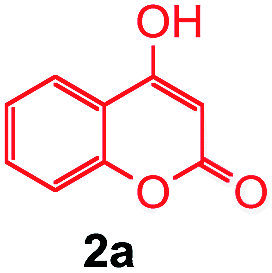
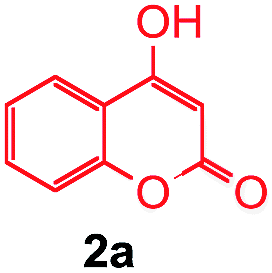
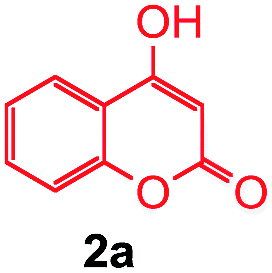
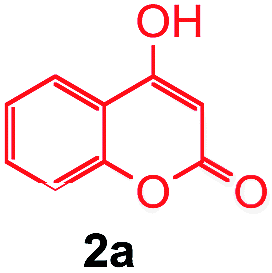
Initially, phenylglyoxal monohydrate (1a), 4-hydroxycoumarin (2a) and 2-aminopyridine (3a) were selected for the model reaction to check the feasibility of the proposed reaction. In absence of any catalyst the combination of these substrates in ethanol did not provide our desired three component product 4a both in room as well as reflux temperatures even after 24 hours (Table 1, entries 1–2). Next the same model reaction was tested in the presence of 20 mol% of p-toluene sulphonic acid (PTSA) in ethanol under both room temperature and reflux conditions. Unfortunately, in these cases also the desired three component product was not obtained. Changing solvent from ethanol to toluene in the presence of 20 mol% of PTSA under the reflux conditions provided only 6% of desired product 4a after 24 h. The product 4a was fully characterized by recording IR, 1H & 13C NMR as well as elemental analysis. Encouraged by this positive result we turned our attention to optimize the reaction condition by varying various parameters such as using microwave heating, changing catalyst, solvent etc. Interestingly, the same model reaction in the presence of 20 mol% PTSA in toluene under the influence of microwave heating at 130 °C for 15 minutes provided better yield (38%) than the conventional heating conditions (Table 1, entry 6). Next, the same model reaction was tested in the presence of various metal triflates such as Cu(OTf)2, Sc(OTf)3, and Bi(OTf)3 in ethanol under the influence of microwave irradiation and the yields obtained were moderate to good. To further investigate we also performed the same model reaction using readily available Lewis acids FeCl3 and CAN following the similar microwave reaction conditions. Results using these Lewis acids were found not encouraging (Table 1, entries 10 and 11). Then we shifted our attention to use molecular iodine as a catalyst in this MCR. Interestingly using the same amount of (20 mol%) iodine and microwave irradiation for 15 minutes the desired three component product was obtained in 72% yield (Table 1, entry 12). Encouraged by this result as well as considering the non metallic, ready availability and benign nature of molecular iodine.27 We focused our optimization using iodine by varying the amount of iodine as well as changing solvents. Finally, the optimized condition was obtained using 30 mol% I2 at 130 °C in ethanol as solvent (Table 1, entry 13).
|
|||||
|---|---|---|---|---|---|
| Entry | Solvent | Catalyst (mol%) | Temp. (°C) | Time (min h−1) | Yieldb (%) |
| a Reaction conditions: phenylglyoxal monohydrate (1 mmol), 4-hydroxycoumarin (1 mmol), and 2-aminopyridine (1 mmol).b Isolated yield. | |||||
| 1 | EtOH | — | RT | 24 h | 0 |
| 2 | EtOH | — | Reflux | 24 h | 0 |
| 3 | EtOH | PTSA(20) | RT | 24 h | 0 |
| 4 | EtOH | PTSA(20) | Reflux | 24 h | 0 |
| 5 | Toluene | PTSA(20) | Reflux | 24 h | 6 |
| 6 | Toluene | PTSA(20) | 130 | 15 min | 38 |
| 7 | EtOH | Cu(OTf)2(20) | 130 | 15 min | 65 |
| 8 | EtOH | Sc(OTf)3(20) | 130 | 15 min | 60 |
| 9 | EtOH | Bi(OTf)3(20) | 130 | 15 min | 69 |
| 10 | EtOH | FeCl3(20) | 130 | 15 min | 45 |
| 11 | EtOH | CAN(20) | 130 | 15 min | 42 |
| 12 | EtOH | I2(20) | 130 | 15 min | 72 |
| 13 | EtOH | I2(30) | 130 | 15 min | 82 |
| 14 | EtOH | I2(50) | 130 | 15 min | 68 |
| 15 | EtOH | HI(20) | 130 | 15 min | 58 |
| 16 | CH3CN | I2(30) | 130 | 15 min | 62 |
| 17 | THF | I2(30) | 130 | 15 min | Trace |
| 18 | DMF | I2(30) | 130 | 15 min | 42 |
| 19 | H2O | I2(30) | 130 | 15 min | 51 |
| 20 | EtOH | I2(30) | 100 | 15 min | 74 |

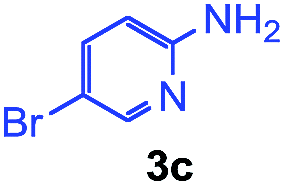
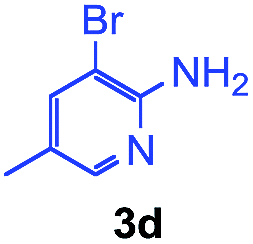
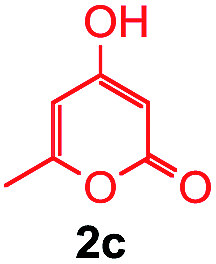
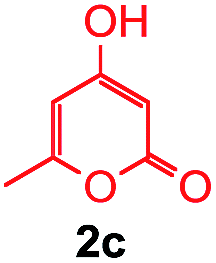
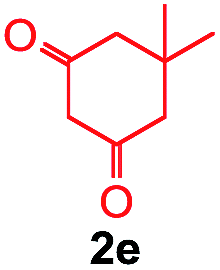
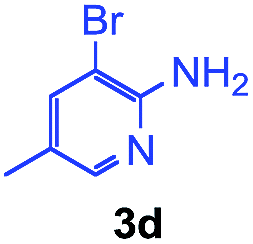
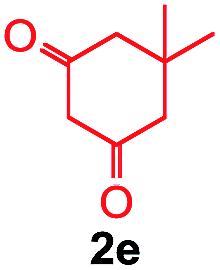
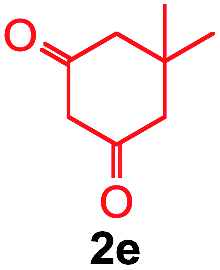
In order to explore the scope of this multicomponent reaction, a wide variety of phenylglyoxal derivatives, cyclic 1,3-dicarbonyl compounds and 2-aminopyridines were reacted under the optimized reaction conditions and the results are summarized in Table 2. Keeping 1a and 2a as fixed substrates 2-amino pyridine derivatives tethered with –Me, –Br, –Cl and –CF3 groups in different positions were reacted under the optimized reaction conditions and in all these cases the observed yields were good to very good (Table 2, entries 2–5). 2-Aminopyrdines with trifluoromethyl groups or –Cl/–Br provided lesser yields as compared to the unsubstituted 2-aminopyridine or its derivatives having electron donating groups. Lower yields in these cases may be attributed due to the reduced nucleophilicity of the primary amine or of the endocyclic nitrogen of 2-amino pyridines having electron withdrawing groups. Next the variability of arylglyoxal was also checked using its derivatives having –OMe, NO2 and –F substituents. Similar to phenylglyoxal monohydrate its derivatives having electron donating or withdrawing groups also underwent three component reactions to provide the corresponding 2,3-disubstituted imidazo[1,2-a]pyridines. Finally, we attempted to check the scope and generality of this MCR by replacing 4-hydroxy coumarin with other cyclic 1,3-dicarbonyls such as 4-hydroxy-1-methylquinolin-2(1H)-one, 4-hydroxy-6-methyl-2-pyrone and dimedone. Interestingly in all these cases the corresponding expected three component products were obtained in moderate to good yields. All these products were fully characterized by IR, 1H NMR, 13C NMR and by elemental analysis as well as by recording melting points.
|
||||||
|---|---|---|---|---|---|---|
| Entry | Substrate 1 | Substrate 2 | Substrate 3 | Time (min) | Product 4 | Yieldb (%) |
| a Reaction conditions: phenylglyoxal monohydrate or its derivatives (1 mmol), 1,3-dicarbonyls (1 mmol), 2-aminopyridine derivatives (1 mmol) and iodine (0.3 mmol), in ethanol at 130 °C (MW).b Isolated yield. | ||||||
| 1 |  |
 |
 |
15 |  |
82 |
| 2 |  |
 |
 |
15 |  |
84 |
| 3 |  |
 |
 |
15 |  |
72 |
| 4 |  |
 |
 |
15 |  |
83 |
| 5 |  |
 |
 |
15 |  |
65 |
| 6 |  |
 |
 |
15 | 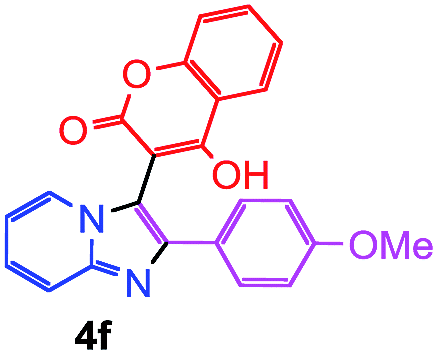 |
81 |
| 7 |  |
 |
 |
15 |  |
71 |
| 8 |  |
 |
 |
15 |  |
83 |
| 9 | 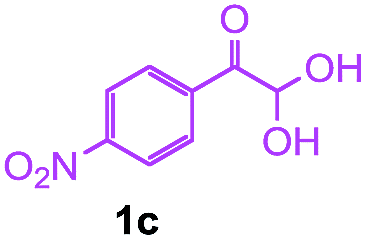 |
 |
 |
15 |  |
76 |
| 10 |  |
 |
 |
15 |  |
74 |
| 11 | 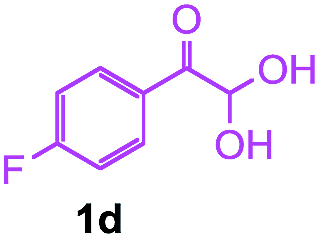 |
 |
 |
15 |  |
68 |
| 12 |  |
 |
 |
15 | 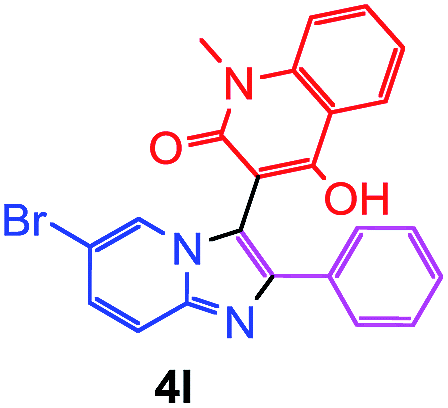 |
71 |
| 13 |  |
 |
 |
15 |  |
67 |
| 14 |  |
 |
 |
15 |  |
69 |
| 15 |  |
 |
 |
15 |  |
62 |
| 16 |  |
 |
 |
15 |  |
58 |
| 17 |  |
 |
 |
15 | 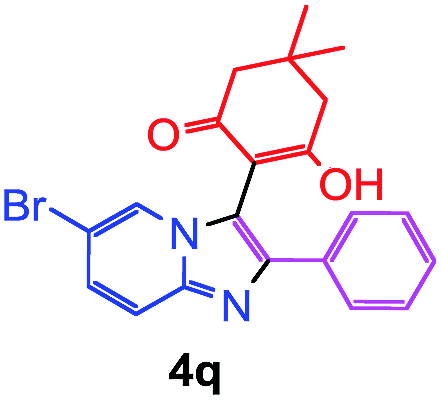 |
76 |
| 18 |  |
 |
 |
15 | 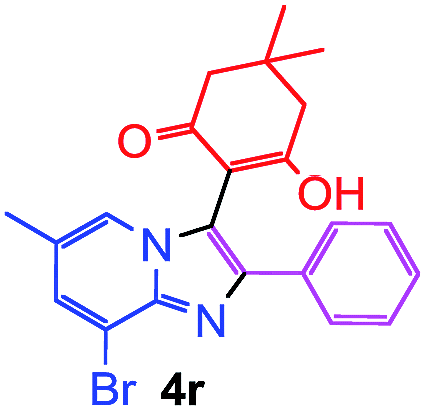 |
72 |
| 19 |  |
 |
 |
15 |  |
68 |
| 20 |  |
 |
 |
15 |  |
72 |

This three component reaction can also be extended to 2-aminopyrimidine. Using similar reaction conditions the combination of phenylglyoxal monohydrate, 2-aminopyrimidine and 4-hydroxycoumarine provided 78% yield whereas using 4-hydroxy-1-methylquinolin-2(1H)-one in place of 4-hydroxycoumarine provided 75% yields as shown in Scheme 2.
 | ||
| Scheme 2 Synthesis of 2,3-disubstituted imidazo[1,2-a]pyrimidines. | ||
On the basis of the above results a plausible reaction mechanism is shown in Scheme 3. It is believed that this reaction goes via Knoevenagel type reaction to form intermediate A. Then the 2-aminopyridine (3) undergoes aza-Michael addition to A affording intermediate B which subsequently undergoes cyclization followed by the loss of water to form desired product 4. Iodine can either act as Lewis acid28 or a source of in situ HI (ref. 29) in organic transformations. To know the actual role of iodine in this three component reaction a few experiments were done.
 | ||
| Scheme 3 Proposed mechanism for the synthesis of 4. | ||
In one of the experiment the model reaction i.e. reaction of 1a, 2a and 3a was tested using 30 mol% HI under the similar reaction conditions, and a moderate yield (55%) of 4a was obtained. To discard the role of in situ HI, we have performed another reaction in the presence of iodine (30 mol%) along with 30 mol% base (NaHCO3) keeping solvent and heating conditions same. Interestingly, this combination provided 81% of the desired three component product 4a. It is expected that if the reaction is catalyzed by HI in that case presence of equimolar amount of base will nullify the acid and will have drastic effect on the net yield obtained. Since in our case this did not happen thus we believe iodine is acting as a Lewis acid to activate carbonyl CO in all the steps as shown in Scheme 3.
Conclusion
In conclusion, we have developed an iodine mediated one-pot three component reaction for the synthesis of 2,3-disubstituted imidazo[1,2-a]pyridines by using 1,3-binucleophilic nature of 2-aminopyridines. A wide range of cyclic 1,3-dicarbonyls can be tetrhed in the 3-position of imidazo[1,2-a]pyridine moiety in one-pot by this MCRs. Considering the presence of 4-hydroxycoumarin/hydroxypyrone or 4-hydroxy-1-methylquinolin-2(1H)-one moiety linked with imidazo[1,2-a]pyridines or imidazo[1,2-a]pyrimidines it is expected that these hybrid molecules will exhibit promising medicinal activities. From operational point of view, this MCR is easy to perform simply by mixing readily available starting materials under microwave irradiation. All the reactions took place within short times with water as the only benign by-product.Experimental
General information
All starting materials were purchased either from Sigma Aldrich or Alfa Aesar and used without further purification. NMR spectra were recorded on 400 or 500 MHz for 1H and 100 or 125 MHz for 13C in D2O or DMSO-d6, chemical shift values were reported in δ values (ppm) downfield from tetramethylsilane. Infrared (IR) spectra were recorded on a Shimadzu IR Affinity-1, FTIR spectrometer. Elemental analyses were carried out using vario MICRO cube elemental analyzer. Microwave irradiation was carried out with Initiator 2.5 Microwave Synthesizers from Biotage, Uppsala, Sweden. Melting points were recorded by using SRS EZ-Melt automated melting point apparatus by capillary methods and uncorrected.Note: due to poor solubility of these compounds in common organic solvents, in most of the cases the resultant products were treated with 1.0 equivalent NaOH in 2 mL H2O to prepare the corresponding sodium enolate of the products and the solvent was removed under vacuum to record NMR in D2O.
Acknowledgements
L.H.C gratefully acknowledges financial support from the Department of Science and Technology India, with Sanction no. SR/FT/CS-042/2009 for carrying out this work. S.K and M.N.K are grateful to CSIR for their research fellowships (SRF). Authors are also grateful to IIT Madras, and SAIF, Panjab University for providing analytical facilities for characterization of compounds.References and notes
- (a) A. Gueiffier, A. M. Lhassani, A. Elhakmaoui, R. Snoeck, G. Andrei, O. Chavignon, J. C. Teulade, A. Kerbal, E. K. Essassi, J. C. Debouzy, M. Witvrouw, Y. Blache, J. Balzarini, E. De Clercq and J. P. Chapat, J. Med. Chem., 1996, 39, 2856 CrossRef CAS PubMed; (b) K. S. Gudmundsson, J. C. Drach and L. B. Townsend, J. Org. Chem., 1997, 62, 3453 CrossRef CAS; (c) Y. Abe, H. Kayakiri, S. Satoh, T. Inoue, Y. Sawada, K. Imai, N. Inamura, M. Asano, C. Hatori, A. Katayama, T. Oku and H. Tanaka, J. Med. Chem., 1998, 41, 564 CrossRef CAS PubMed; (d) C. Hamdouchi, J. Blas, M. Prado, J. Gruber, B. A. Heinz and L. Vance, J. Med. Chem., 1999, 42, 50 CrossRef CAS PubMed; (e) G. Trapani, M. Franco, A. Latrofa, L. Ricciardi, A. Carotti, M. Serra, E. Sanna, G. Biggio and G. Liso, J. Med. Chem., 1999, 42, 3934 CrossRef CAS PubMed; (f) J. Zhu, Eur. J. Org. Chem., 2003, 2003, 1133 CrossRef; (g) K. C. Rupert, J. R. Henry, J. H. Dodd, S. A. Wadsworth, D. E. Cavender, G. C. Olini, B. Fahmy and J. Siekierka, Bioorg. Med. Chem. Lett., 2003, 13, 347 CrossRef CAS; (h) A. Domling, Chem. Rev., 2006, 106, 17 CrossRef PubMed; (i) D. Bonne, M. Dekhane and J. P. Zhu, Angew. Chem., 2007, 119, 2537 CrossRef; (j) H. L. Wei, Z. Y. Yan, Y. L. Niu, G. Q. Li and Y. M. Liang, J. Org. Chem., 2007, 72, 8600 CrossRef CAS PubMed; (k) F. Couty and G. Evano, in Comprehensive Heterocyclic Chemistry III, ed. A. R. Katritzky, C. A. Ramsden, E. F. V. Scriven and R. J. K. Taylor, Elsevier, Oxford, 2008, vol. 11, p. 409 Search PubMed; (l) B. Jiang, T. Rajale, W. Wever, S. J. Tu and G. G. Li, Chem.–Asian J., 2010, 5, 2318 CrossRef CAS PubMed; (m) D. Hong, Y. X. Zhu, Y. Li, X. F. Lin, P. Lu and Y. G. Wang, Org. Lett., 2011, 13, 4668 CrossRef CAS PubMed; (n) S. Husinec, R. Markovic, M. Petkovic, V. Nasufovic and V. Savic, Org. Lett., 2011, 13, 2286 CrossRef CAS PubMed; (o) O. N. Burchak, L. Mugherli, M. Ostuni, J. J. Lacapere and M. Y. Balakirev, J. Am. Chem. Soc., 2011, 133, 10058 CrossRef CAS PubMed; (p) B. Chattopadhyay and V. Gevorgyan, Angew. Chem., 2012, 124, 886 CrossRef; (q) C. Enguehard-Gueiffier and A. Gueiffier, Mini-Rev. Med. Chem., 2007, 7, 888 CrossRef CAS.
- (a) P. V. Kumar and V. R. Rao, Indian J. Chem., Sect. B: Org. Chem. Incl. Med. Chem., 2005, 41B, 2120 Search PubMed; (b) O. Kim, Y. Jeong, H. Lee, S.-S. Hong and S. Hong, J. Med. Chem., 2011, 54, 2455 CrossRef CAS PubMed; (c) A. Kamal, J. S. Reddy, M. J. Ramaiah, D. Dastagiri, E. V. Bharathi, M. V. P. Sagar, S. N. C. V. L. Pushpavalli, P. Ray and M. Pal-Bhadra, Med. Chem. Commun., 2010, 1, 355 RSC.
- (a) C. Hamdouchi, J. de Blas, M. del Prado, J. Gruber, B. A. Heinz and L. Vance, J. Med. Chem., 1999, 42, 50 CrossRef CAS PubMed; (b) K. C. Rupert, J. R. Henry, J. H. Dodd, S. A. Wadsworth, D. E. Cavender, G. C. Olini, B. Fahmy and J. Siekierka, Bioorg. Med. Chem. Lett., 2003, 13, 347 CrossRef CAS.
- (a) Y. Rival, G. Grassy and G. Michel, Chem. Pharm. Bull., 1992, 40, 1170 CrossRef CAS; (b) M. Hammad, A. Mequid, M. E. Ananni and N. Shafik, Egypt. J. Chem., 1987, 29, 5401 Search PubMed.
- (a) T. Biftu, D. Feng, M. Fisher, G. B. Liang, X. Qian, A. Scribner, R. Dennis, S. Lee, P. A. Liberator, C. Brown, A. Gurnett, P. S. Leavitt, D. Thompson, J. Mathew, A. Misura, S. Samaras, T. Tamas, J. F. Sina, K. A. McNulty, C. G. McKnight, D. M. Schmatz and M. Wyvratt, Bioorg. Med. Chem. Lett., 2006, 16, 2479 CrossRef CAS PubMed; (b) M. A. Ismail, R. K. Arafa, T. Wenzler, R. Brun, F. A. Tanious, W. D. Wilson and D. W. Boykin, Bioorg. Med. Chem., 2008, 16, 681 Search PubMed; (c) A. Scribner, R. Dennis, S. Lee, G. Ouvry, D. Perrey, M. Fisher, M. Wyvratt, P. Leavitt, P. Liberator, A. Gurnett, C. Brown, J. Mathew, D. Thompson, D. Schmatz and T. Biftu, Eur. J. Med. Chem., 2008, 43, 1123 CrossRef CAS PubMed.
- (a) A. Gueiffier, M. Lhassani, A. Elhakmaoui, R. Snoeck, G. Andrei, O. Chaxignon, J. C. Teulade, A. Kerbal, E. M. Essassi, J. C. Debouzy, M. Witvrouw, Y. Blache, J. Balzarini, E. De Clercq and J. P. Chapat, J. Med. Chem., 1996, 39, 2856 CrossRef CAS PubMed; (b) A. Gueiffier, S. Mavel, M. Lhassani, A. Elhakmaoui, R. Snoeck, G. Andrei, O. Chavignon, J. C. Teulade, M. Witvrouw, J. Balzarini, E. De Clercq and J. P. Chapat, J. Med. Chem., 1998, 41, 5108 CrossRef CAS PubMed; (c) G. Puerstinger, J. Paeshuyse, E. Declercq and J. Neyts, Bioorg. Med. Chem. Lett., 2007, 17, 390 CrossRef CAS PubMed; (d) J. B. Veron, H. Allouchi, C. Enguehard Gueiffier, R. Snoeck, G. A. E. De Clercq and A. Gueiffier, Bioorg. Med. Chem., 2008, 16, 9536 CrossRef CAS PubMed.
- Y. Katsura, S. Nishino, Y. Inoue, M. Tomoi and H. Takasugi, Chem. Pharm. Bull., 1992, 40, 371 CrossRef CAS.
- Y. Rival, G. Grassy, A. Taudou and R. Ecalle, Eur. J. Med. Chem., 1991, 26, 13 CrossRef CAS.
- (a) B. Musch, P. L. Morselli and P. Priore, Pharmacol., Biochem. Behav., 1988, 4, 803 CrossRef; (b) S. Z. Langer, S. Arbilla, J. Benavides and B. Scatton, Adv. Biochem. Psychopharmacol., 1990, 46, 61 CAS; (c) P. G. George, G. Rossey, M. Sevrin, S. Arbilla, H. Depoortere and A. E. L. E. R. S. Wick, Monograph Ser., 1993, 8, 49 CAS.
- (a) J. M. Monti, S. D. Warren, S. R. Pandi-Perumal, S. Z. Langer and R. Hardeland, Clin. Med.: Ther., 2009, 1, 123 CAS; (b) B. Du, A. Shan, Y. Zhang, X. Zhong, D. Chen and K. Cai, Am. J. Med. Sci., 2014, 3, 172 Search PubMed.
- L. Almirante, L. Polo, A. Mugnaini, E. Provinciali, P. Rugarli, A. Biancotti, A. Gamba and W. Murmann, J. Med. Chem., 1965, 8, 305 CrossRef CAS.
- (a) Y. Uemura, S. Tanaka, S. Ida and T. Yuzuriha, J. Pharm. Pharmacol., 1993, 45, 1077 CrossRef CAS PubMed; (b) K. Mizushige, T. Ueda, K. Yukiiri and H. Suzuki, Cardiovasc. Drug Rev., 2002, 20, 163 CrossRef CAS PubMed.
- R. J. Boerner and H. J. Moller, Psychopharmakotherap, 1997, 4, 145 Search PubMed.
- (a) K. S. Gudmundsson and B. A. Johns, Org. Lett., 2003, 5, 1369 CrossRef CAS PubMed; (b) H. Cao, H. Zhan, Y. Lin, X. Lin, Z. Du and H. Jiang, Org. Lett., 2012, 14, 1688 CrossRef CAS PubMed; (c) J. Zeng, Y. J. Tan, M. L. Leow and X.-W. Liu, Org. Lett., 2012, 14, 4386 CrossRef CAS PubMed; (d) A. V. Gulevich, V. Helan, D. J. Wink and V. Gevorgyan, Org. Lett., 2013, 15, 956 CrossRef CAS PubMed; (e) O. A. Attanasi, L. Bianchi, L. A. Campisi, L. D. Crescentini, G. Favi and F. Mantellini, Org. Lett., 2013, 15, 3646 CrossRef CAS PubMed; (f) H. Huang, X. Ji, X. Tang, M. Zhang, X. Li and H. Jiang, Org. Lett., 2013, 15, 6254 CrossRef CAS PubMed; (g) C. Ravi, D. C. Mohan and S. Adimurthy, Org. Lett., 2014, 16, 2978 CrossRef CAS PubMed; (h) N. Devi, R. K. Rawal and V. Singh, Tetrahedron, 2015, 71, 183 CrossRef CAS PubMed; (i) A. K. Bagdi, S. Santra, K. Monir and A. Hajra, Chem. Commun., 2015, 51, 1555 RSC.
- (a) W. L. Mosby, in Heterocyclic Systems with Bridgehead Nitrogen Atoms, ed. W. L. Mosby, Wiley, New York, 1961, Part I; p. 460 and Part II; p. 802 Search PubMed; (b) W. L. Blewitt, in Special Topics in Heterocyclic Chemistry, ed. A. Weissberger and E. C. Taylor, Wiley, New York, 1977, p. 117 Search PubMed; (c) C. Sablayrolles, G. H. Cros, J. C. Milhavet, E. Rechenq, J.-P. Chapat, M. Boucard, J. J. Serrano and J. H. McNeill, J. Med. Chem., 1984, 27, 206 CrossRef CAS; (d) W. A. Spitzer, F. Victor, D. G. Pollock and J. S. Hayers, J. Med. Chem., 1988, 31, 1590 CrossRef CAS.
- (a) H. S. Patel, J. A. Linn, D. H. Drewry, D. A. Hillesheim, W. J. Zuercher and W. J. Hoekstra, Tetrahedron Lett., 2003, 44, 4077 CrossRef CAS; (b) L. Yin, F. Erdmann and J. Liebscher, J. Heterocycl. Chem., 2005, 42, 1369 CAS; (c) J. G. Kettle, S. Brown, C. Crafter, B. R. Davies, P. Dudley, G. Fairley, P. Faulder, S. Fillery, H. Greenwood, J. Hawkins, M. James, K. Johnson, C. D. Lane, M. Pass, J. H. Pink, H. Plant and S. C. Cosulich, J. Med. Chem., 2012, 55, 1261 CrossRef CAS PubMed; (d) C. Enguehard-Gueiffier, S. Musiu, N. Henry, J. B. Veron, S. Mavel, J. Neyts, P. Leyssen, J. Paeshuyse and A. Gueiffier, Eur. J. Med. Chem., 2013, 64, 448 CrossRef CAS PubMed; (e) Y. Wang, B. Frett and H.-Y. Li, Org. Lett., 2014, 16, 3016 CrossRef CAS PubMed.
- (a) K. Groebke, L. Weber and F. Mehlin, Synlett, 1998, 1998, 661 CrossRef PubMed; (b) H. Bienayme and K. Bouzid, Angew. Chem., Int. Ed., 1998, 37, 2234 CrossRef CAS; (c) C. Blackburn, Tetrahedron Lett., 1998, 39, 5469 CrossRef CAS; (d) C. Blackburn, B. Guan, P. Fleming, K. Shiosaki and S. Tsai, Tetrahedron Lett., 1998, 39, 3635 CrossRef CAS; (e) G. S. Mandair, M. Light, A. Russell, M. Hursthouse and M. Bradley, Tetrahedron Lett., 2002, 43, 4267 CrossRef CAS; (f) R. S. Varma and D. Kumar, Tetrahedron Lett., 1999, 40, 7665 CrossRef CAS; (g) S. M. Ireland, H. Tye and M. Whittaker, Tetrahedron Lett., 2003, 44, 4369 CrossRef CAS; (h) A. Shaabani, E. Soleimani and A. Maleki, Tetrahedron Lett., 2006, 47, 3031 CrossRef CAS PubMed; (i) A. T. Khan, R. S. Basha and M. Lal, Tetrahedron Lett., 2012, 53, 2211 CrossRef CAS PubMed.
- N. Chernyak and V. Gevorgyan, Angew. Chem., Int. Ed., 2010, 49, 2743 CrossRef CAS PubMed.
- V. Gembus, J.-F. Bonfanti, O. Querolle, P. Jubault, V. Levacher and C. Hoarau, Org. Lett., 2012, 14, 6012 CrossRef CAS PubMed.
- (a) L. Ma, X. Wang, W. Yu and B. Han, Chem. Commun., 2011, 47, 11333 RSC; (b) M. R. Collins, Q. Huang, M. A. Ornelas and S. A. Scales, Tetrahedron Lett., 2010, 51, 3528 CrossRef CAS PubMed; (c) A. K. Bagdi, M. Rahman, S. Santra, A. Majee and A. Hajra, Adv. Synth. Catal., 2013, 355, 1741 CrossRef CAS; (d) D. C. Mohan, R. R. Donthiri, S. N. Rao and S. Adimurthy, Adv. Synth. Catal., 2013, 355, 2217 CrossRef; (e) K. Pericherla, P. Kaswan, P. Khedar, B. I. Khungar, K. Parang and A. Kumar, RSC Adv., 2013, 3, 18923 RSC; (f) Z.-J. Cai, S.-Y. Wang and S.-J. Ji, Adv. Synth. Catal., 2013, 355, 2686 CrossRef CAS; (g) Y. Zhang, Z. Chen, W. Wu, Y. Zhang and W. Su, J. Org. Chem., 2013, 78, 12494 CrossRef CAS PubMed.
- D. K. Nair, S. M. Mobin and I. N. N. Namboothiri, Org. Lett., 2012, 14, 4580 CrossRef CAS PubMed.
- (a) A. Lew, P. O. Krutzik, M. E. Hart and A. R. Chamberlin, J. Comb. Chem., 2002, 4, 95 CrossRef CAS; (b) G. Minetto, L. F. Raveglia and M. Taddei, Org. Lett., 2004, 6, 389 CrossRef CAS PubMed; (c) W. S. Bremner and M. G. Organ, J. Comb. Chem., 2007, 9, 14 CrossRef CAS PubMed; (d) B. Jiang, L.-J. Cao, S.-J. Tu, W.-R. Zheng and H.-Z. Yu, J. Comb. Chem., 2009, 11, 612 CrossRef CAS PubMed; (e) L. Wen, C. Ji, Y. Li and M. Li, J. Comb. Chem., 2009, 11, 799 CrossRef CAS PubMed; (f) B. Jiang, F. Shi and S.-J. Tu, Curr. Org. Chem., 2010, 14, 357 CrossRef CAS; (g) B. Jiang, Q.-Y. Li, S.-J. Tu and G. Li, Org. Lett., 2012, 14, 5210 CrossRef CAS PubMed; (h) B. Jiang, X. Wang, H.-W. Xu, M.-S. Tu, S.-J. Tu and G. Li, Org. Lett., 2013, 15, 1540 CrossRef CAS PubMed; (i) W. Fan, Q. Ye, H.-W. Xu, B. Jiang, S.-L. Wang and S.-J. Tu, Org. Lett., 2013, 15, 2258 CrossRef CAS PubMed; (j) K. Pericherla, A. Jha, B. Khungar and A. Kumar, Org. Lett., 2013, 15, 4304 CrossRef CAS PubMed; (k) C. Val, A. Crespo, V. Yaziji, A. Coelho, J. Azuaje, A. E. Maatougui, C. Carbajales and E. Sotelo, ACS Comb. Sci., 2013, 15, 370 CrossRef CAS PubMed; (l) L.-P. Fu, Q.-Q. Shi, Y. Shi, B. Jiang and S.-J. Tu, ACS Comb. Sci., 2013, 15, 135 CrossRef CAS PubMed.
- (a) R. Gedey, F. Smith, K. Westaway, H. Ali, L. Baldisera, L. Laberge and J. Roussel, Tetrahedron Lett., 1986, 27, 279 CrossRef; (b) G. Majetich and R. J. Hicks, Journal of Microwave Power and Electromagnetic Energy, 1995, 30, 27 Search PubMed; (c) G. Majetich and R. Hicks, Radiat. Phys. Chem., 1995, 45, 567 CrossRef CAS; (d) S. Caddick, Tetrahedron, 1995, 51, 10403 CrossRef CAS; (e) V. Sridar, Curr. Sci., 1998, 74, 446 CAS; (f) A. Fini and A. Breccia, Pure Appl. Chem., 1999, 71, 573 CrossRef CAS; (g) M. Larhed and A. Hallberg, Drug Discovery Today, 2001, 6, 406 CrossRef CAS; (h) P. Lidström, J. Tierney, B. Wathey and J. Westman, Tetrahedron, 2001, 57, 9225 CrossRef; (i) D. A. Jones, T. P. Lelyveld, S. D. Mavrofidis, S. W. Kingman and N. J. Miles, Resour., Conserv. Recycl., 2002, 34, 75 CrossRef; (j) V. Santagada, E. Perissutti and G. Caliendo, Curr. Med. Chem., 2002, 9, 1251 CrossRef CAS; (k) J. Lu, B. Yang and Y. Bai, Synth. Commun., 2002, 32, 3703 CrossRef CAS PubMed; (l) N. Kuhnert, Angew. Chem., Int. Ed., 2002, 41, 1863 CrossRef CAS; (m) A. D. L. Hoz, A. Díaz-Ortiz and A. Moreno, Curr. Org. Chem., 2004, 8, 903 CrossRef; (n) C. O. Kappe, Angew. Chem., Int. Ed., 2004, 43, 6250 CrossRef CAS PubMed; (o) A. D. L. Hoz, A. Diaz-Ortiz and A. Moreno, Chem. Soc. Rev., 2005, 34, 164 RSC; (p) C. O. Kappe and D. Dallinger, Nat. Rev. Drug Discovery, 2006, 5, 51 CrossRef CAS PubMed; (q) S.-J. Tu, X.-D. Cao, W.-J. Hao, X.-H. Zhang, S. Yan, S.-S. Wu, Z.-G. Han and F. Shi, Org. Biomol. Chem., 2009, 7, 557 RSC; (r) M. A. Surati, S. Jauhari and K. R. Desai, Arch. Appl. Sci. Res., 2012, 4, 645 Search PubMed.
- M. N. Khan, S. Pal, S. Karamthulla and L. H. Choudhury, New J. Chem., 2014, 38, 4722 RSC.
- S. Karamthulla, S. Pal, M. N. Khan and L. H. Choudhury, Synlett, 2014, 25, 1926 CrossRef CAS PubMed.
- S. Karamthulla, S. Pal, M. N. Khan and L. H. Choudhury, RSC Adv., 2014, 4, 37889 RSC.
- (a) B. K. Banik, M. S. Manhas and A. K. Bose, J. Org. Chem., 1994, 59, 4714 CrossRef CAS; (b) B. K. Banik, S. Samajdar and I. Banik, J. Org. Chem., 2004, 69, 213 CrossRef CAS PubMed; (c) M. Jereb, D. Vrazic and M. Zupan, Tetrahedron, 2011, 67, 1355 CrossRef CAS PubMed; (d) P. T. Parvatkar, P. S. Parameswaran and S. G. Tilve, Chem.–Eur. J., 2012, 18, 5460 CrossRef CAS PubMed; (e) G. R. Reddy, T. R. Reddy, S. C. Joseph, K. S. Reddy and M. Pal, RSC Adv., 2012, 2, 3387 RSC; (f) G. Ramachandran, N. S. Karthikeyan, P. Giridharan and K. I. Sathiyanarayanan, Org. Biomol. Chem., 2012, 10, 5343 RSC; (g) Z. Fei, Y. Zhu, M.-C. Liu, F.-C. Jia and A.-X. Wu, Tetrahedron Lett., 2013, 54, 1222 CrossRef CAS PubMed; (h) S. Pal, M. N. Khan, S. Karamthulla and L. H. Choudhury, RSC Adv., 2013, 3, 15705 RSC.
- (a) M. Srivastava, P. Rai, J. Singh and J. Singh, New J. Chem., 2014, 38, 302 RSC; (b) K. B. Puttaraju and K. Shivashankar, RSC Adv., 2013, 3, 20883 RSC; (c) M. Kidwai, P. Mothsra, V. Bansal, R. K. Somvanshi, A. S. Ethayathulla, S. Dey and T. P. Singh, J. Mol. Catal. A: Chem., 2007, 265, 177 CrossRef CAS PubMed; (d) L.-Y. Zeng and C. Cai, J. Comb. Chem., 2010, 12, 35 CrossRef CAS PubMed; (e) A. Sagar, S. Vidyacharan and D. S. Sharada, RSC Adv., 2014, 4, 37047 RSC; (f) A. T. Khan, M. M. Khan and K. K. R. Bannuru, Tetrahedron, 2010, 66, 7762 CrossRef CAS PubMed; (g) F.-L. Yang and S.-K. Tian, Angew. Chem., Int. Ed., 2013, 52, 4929 CrossRef CAS PubMed; (h) M. Sharma and P. J. Bhuyan, RSC Adv., 2014, 4, 15709 RSC; (i) M. Sathishkumar and K. I. Sathiyanarayanan, RSC Adv., 2014, 4, 8808 RSC.
- (a) J. L. Wahlstrom and R. C. Ronald, J. Org. Chem., 1998, 63, 6021 CrossRef CAS; (b) F. Yang, Y.-F. Qiu, K.-G. Ji, Y.-N. Niu, S. Ali and Y.-M. Liang, J. Org. Chem., 2012, 77, 9029 CrossRef CAS PubMed; (c) J. S. Yadav, M. Satyanarayana, S. Raghavendra and E. Balanarsaiah, Tetrahedron Lett., 2005, 46, 8745 CrossRef CAS PubMed.
Footnote |
| † Electronic supplementary information (ESI) available: 1H NMR and 13C NMR spectra for all reactions products are available. See DOI: 10.1039/c4ra16298f |
| This journal is © The Royal Society of Chemistry 2015 |