Panneerselvam Sathishkumar*ab,
Ramalinga Viswanathan Mangalaraja*a,
Thangaraj Pandiyarajana,
M. A. Gracia-Pinillacd,
N. Escalonae,
C. Herrerae and
R. Garciae
aAdvanced Ceramics and Nanotechnology Laboratory, Department of Materials Engineering, Faculty of Engineering, University of Concepcion, Concepcion 407-0409, Chile. E-mail: sathish_panner2001@yahoo.com; mangal@udec.cl; Fax: +56 41 2203391; Tel: +56 41 2207389
bDepartment of Chemistry, Periyar Maniammai University, Vallam, Thanjavur 613403, Tamil Nadu, India
cUniversidad Autónoma de Nuevo León, Facultad de Ciencias Físico-Matemáticas, Av. Universidad, Cd. Universitaria, San Nicolás de los Garza, N.L., México
dUniversidad Autónoma de Nuevo León, Centro de Investigación e Innovación en Desarrollo de Ingeniería y Tecnología, Avenida Alianza 101 Sur PIIT Monterrey Apodaca, NL 66600, Mexico
eFaculty of Chemical Sciences, University of Concepcion, PO Box 160-C, Correo 3, Concepcion, Chile
First published on 12th February 2015
Cerium oxide (CeO2), Ce0.9Gd0.1O1.95 and Ce0.9Sm0.1O1.95 nanostructures were synthesized using 42 kHz ultrasound assisted sequential and co-precipitation techniques. The nanoporous nature of the powders was revealed from the BET analysis which showed that the observed pore size distributions and the H2 hysteresis loops of the respective nanostructures confirmed the existence of nanopores in various sizes and shapes. The nanoporous nature of the synthesized powders were further confirmed by the high resolution transmission electron microscopy (HRTEM) and high angle annular dark field (HAADF) scanning transmission electron microscopy (STEM) analyses. The perceived shift in the characteristic F2g Raman active band centered at 464 cm−1 indicated the defects were increased during the sequential co-precipitation synthesis of Ce0.9Gd0.1O1.95 and Ce0.9Sm0.1O1.95 nanostructures. Moreover, the intensity of the F2g peaks can be ordered as CeO2 < Ce0.9Sm0.1O1.95 (CP)1 < Ce0.9Gd0.1O1.95 (SP)2 < Ce0.9Sm0.1O1.95 (SP)2 < Ce0.9Gd0.1O1.95 (CP)1 which indicates the increase in the concentration of the defects like oxygen vacancies enhances the efficiency of the solid oxide fuel cells (SOFCs) as electrolyte materials. The diffuse reflectance UV-vis solid state spectroscopic analysis demonstrated the narrowing optical band gap of CeO2 during the sequential and co-precipitation of the Ce0.9Gd0.1O1.95 and Ce0.9Sm0.1O1.95 nanostructures.
The nanomaterials synthesized by the ultrasound assisted technique exhibited various interesting and unconventional physicochemical characteristics. The utilization of low frequency or power ultrasound (20–100 kHz) has been significantly increased in the recent years for various applications.5–9 The extreme conditions (high temperature and pressure) produced during the ultrasound irradiation generate non-selective free radicals within the aqueous medium which accelerates the chemical reaction among the precursors and enhances the physicochemical characteristics of the subsequent nanomaterials. On the other hand, cerium dioxide (CeO2) is a highly refractive ceramic material which is utilized for the various applications of day-to-day life.10–15 The CeO2 and modified CeO2 electrolytes possess interesting features for SOFCs. The balanced behaviour of Ce3+/Ce4+ generates the properties which enable the significant contribution of CeO2 in SOFC applications. The doping of rare earth ions into the CeO2 significantly increases the oxygen vacancies and oxygen storage properties of the resulting electrolytes.16,17 Nevertheless, the loading of rare earth oxides (RE2O3) into CeO2 enhances the oxygen ion conductivity and the mechanical properties of the resultant nanomaterials.18,19
CeO2 and modified CeO2 nanomaterials prepared by using various procedures such as precipitation,20 hydrothermal,21 spray-pyrolysis,22 sol–gel23 and combustion24 were reported in the literature. The low frequency ultrasound assisted synthesis of CeO2 and modified CeO2 nanomaterials was expected to modify the physicochemical characteristics and to improve the thermal and mechanical properties of the resulting solid electrolytes. In the present work, CeO2, Ce0.9Gd0.1O1.95 and Ce0.9Sm0.1O1.95 nanostructures were synthesized by using 42 kHz ultrasound. The effect of sequential and co-precipitation on the structural, morphological and optical properties of the Ce0.9Gd0.1O1.95 and Ce0.9Sm0.1O1.95 nanostructures was investigated. The developed methodology can be extended for the preparation of various nanomaterials.
![]() | ||
| Fig. 1 X-ray diffraction patterns of Gd2O3 (a), Sm2O3 (b), CeO2 (c), sequentially precipitated Ce0.9Gd0.1O1.95 (d), Ce0.9Sm0.1O1.95 (e) and co-precipitated Ce0.9Gd0.1O1.95 (f), Ce0.9Sm0.1O1.95 (g). | ||
The Raman spectra observed for the (co-precipitation and sequential precipitation) prepared nanostructures are shown in Fig. 2. They suggest that the vibrational changes occurred due to the introduction of rare earth oxides into the crystal structure of CeO2. The cubic fluorite crystal structures of CeO2, Ce0.9Gd0.1O1.95 and Ce0.9Sm0.1O1.95 can be identified from the strong and intense Raman active (F2g) bands at 455–470 cm−1. The oxygen vacancies in the crystal structure of CeO2 can be illustrated by the two less intensive bands which appear at the range of 250–290 and 605–625 cm−1.26 The CeO2 showed its characteristic F2g Raman active band centered at 464 cm−1, the sequentially and co-precipitated Ce0.9Gd0.1O1.95 and Ce0.9Sm0.1O1.95 nanostructures showed ∼± 2 nm shift in the F2g Raman active band for the cubic fluorite structure (inset of Fig. 2). The observed decrease in the intensity of the F2g band showed the increase in the concentration of defects like oxygen vacancies.29 The intensive Raman bands observed at 361 (Bg) and 345 cm−1 (Ag and Fg modes) suggested the cubic crystal structures of Gd2O3 and Sm2O3.27,28 The absence of the Raman active modes of Gd2O3 (361 cm−1), Sm2O3 (345 cm−1) and the shift observed at the F2g Raman active band for the cubic fluorite crystal structure (464 cm−1) clearly designated the incorporation of the rare earths into the crystal structure of CeO2. On the other hand, the intensity of the F2g peaks can be ordered as follows: CeO2 < Ce0.9Sm0.1O1.95 (CP)3 < Ce0.9Gd0.1O1.95 (SP)4 < Ce0.9Sm0.1O1.95 (SP)2 < Ce0.9Gd0.1O1.95 (CP)1.
![]() | ||
| Fig. 2 Raman spectra of various nanostructures (SP and CP denotes the sequential and co-precipitation syntheses). | ||
The HRTEM micrographs observed for the bare CeO2, Gd2O3 and Sm2O3 are presented in Fig. 3. The CeO2 exhibited nanoparticle morphology and the average grain size was ∼20 nm (Fig. 3a). The finger print lattice fringe distance was calculated as 0.31 nm (Fig. 3b) which corresponds to the (1 1 1) crystal plane of the cubic fluorite structure of CeO2. The micrographs of Gd2O3 and Sm2O3 revealed nanorod morphologies of several nanometers in length and thickness along with approximately 15% nanoparticle morphology (Fig. 3c and e). The finger print lattice fringe distances were calculated as 0.31 nm and 0.32 for the corresponding (2 2 2) crystal planes of Gd2O3 (Fig. 3d) and Sm2O3 (Fig. 3f), respectively. The HRTEM micrographs of the sequentially and co-precipitated Ce0.9Gd0.1O1.95 and Ce0.9Sm0.1O1.95 nanostructures demonstrated the formation of clear internal crystal lattice structures (Fig. 4 and 5). This confirmed that high crystallinity was achieved during the synthesis of the nanomaterials. The HRTEM micrographs (Fig. 4) of the sequentially (Fig. 4 a–c) and co-precipitated (Fig. 4 d–f) Ce0.9Gd0.1O1.95 nanostructures demonstrated that the significant number of bare Gd2O3 nanorods (Fig. 3c) were transformed to the nanoparticle morphology.
![]() | ||
| Fig. 4 HRTEM micrographs of sequentially precipitated Ce0.9Gd0.1O1.95 (a–c) and co-precipitated Ce0.9Gd0.1O1.95 (d–f). | ||
![]() | ||
| Fig. 5 HRTEM micrographs of sequentially precipitated Ce0.9Sm0.1O1.95 (a–c) and co-precipitated Ce0.9Sm0.1O1.95 (d–f). | ||
The HRTEM micrographs (Fig. 5) of the sequentially precipitated (Fig. 5 a–c) Ce0.9Sm0.1O1.95 nanostructures showed 25% nanorod morphology whereas the co-precipitated (Fig. 5 d–f) Ce0.9Sm0.1O1.95 nanostructures showed only 5% nanorod morphology. However, the ratio of nanorods versus nanoparticles had significantly decreased compared to the bare Sm2O3 (Fig. 3e). A similar kind of surface distribution of samarium was detected on the surface of CeO2 when compared with the Ce0.9Gd0.1O1.95. This confirmed that the 42 kHz low frequency ultrasound was adequate to stimulate the initiation of Ce0.9Gd0.1O1.95 and Ce0.9Sm0.1O1.95 nanostructures from the precursors. The grain size achieved for the Ce0.9Gd0.1O1.95 (Fig. 4a and d) and Ce0.9Sm0.1O1.95 (Fig. 5a and d) nanopowders was calculated to be ∼10 nm from the HRTEM analysis. The calculated grain size from the HRTEM analysis was in good agreement with the grain size calculated from the XRD patterns using the Debye–Scherrer equation. The observed decrease in the grain size suggested an increase in the defects of individual nanomaterials.30
The formation of nanoporous structures is shown in Fig. 4b, c and f, 5c, e and f (circled). The HRTEM micrographs additionally demonstrated the formation of Ce0.9Gd0.1O1.95 and Ce0.9Sm0.1O1.95 when the precursors underwent the ultrasonic irradiation. The sequentially precipitated nanostructures exhibited a greater number of nanopores when compared to the co-precipitated materials. The formation of the nanoporous structure was not observed for the bare Gd2O3 and Sm2O3 under the same laboratory conditions. The nanoporous structure of CeO2 was noticed from Fig. 3a, however the HRTEM analysis evidently suggested that the number of nanopores in CeO2 was found to increase during the synthesis of the rare earth doped CeO2.
The high angle annular dark field scanning transmission electron microscopy (HAADF-STEM) analysis of the sonochemically synthesized Ce0.9Gd0.1O1.95 and Ce0.9Sm0.1O1.95 revealed the formation of nanopores which can be easily identified as the black blotches in the micrographs (Fig. 6a and b & Fig. 7a and b). The diameters of the nanopores were measured as ∼1 to 2 nm during the HAADF-STEM analysis. The sequentially precipitated Ce0.9Gd0.1O1.95 and Ce0.9Sm0.1O1.95 exhibited a large number of nanopores when compared to the co-precipitated nanostructures. The HAADF emission by analysis confirmed the formation of Ce0.9Gd0.1O1.95 and Ce0.9Sm0.1O1.95 and no other phases belonging to impurities were detected. The EDX analysis of the corresponding nanomaterials is presented in Fig. 6c and d & Fig. 7c and d. The elemental analysis indicated the stoichiometric ratio of the nanomaterials.
![]() | ||
| Fig. 6 HAADF-STEM micrographs of sequentially precipitated Ce0.9Gd0.1O1.95 (a), Ce0.9Sm0.1O1.95 (b) and the corresponding EDX images (c and d). | ||
![]() | ||
| Fig. 7 HAADF-STEM micrographs of co-precipitated Ce0.9Gd0.1O1.95 (a), Ce0.9Sm0.1O1.95 (b) and the corresponding EDX images (c and d). | ||
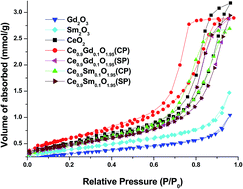
Brunar, Emmett and Teller (BET) analysis was performed for the sonochemically synthesized nanostructures to understand the various structural and textural properties of CeO2, sequentially and co-precipitated Ce0.9Gd0.1O1.95 and Ce0.9Sm0.1O1.95. Fig. 8 shows the type IV adsorption–desorption profiles measured for all the sonochemically synthesized nanopowders. The CeO2, Ce0.9Gd0.1O1.95 and Ce0.9Sm0.1O1.95 adsorption–desorption profiles demonstrated the narrow H2 type hysteresis loop which was not observed for Gd2O3 and Sm2O3. The observed H2 type hysteresis loops revealed the complex pore structures which can also be evidenced by the HRTEM and HAADF-STEM analyses. The surface areas and the various parameters associated with the pores are presented in Table 1 which illustrates the decrease in the surface area of the sequentially precipitated Ce0.9Gd0.1O1.95 and Ce0.9Sm0.1O1.95 compared to the bare CeO2. Besides, Barrett–Joyner–Halenda (BJH) analysis (Fig. 9) showed that the pore volume distribution attained for the bare CeO2 was not significantly altered during the sequential precipitation. However, the H2 hysteresis observed for co-precipitated rare earth doped ceria was broader (Fig. 8) than the bare CeO2. Also, the surface areas and pore diameters of the co-precipitated Ce0.9Gd0.1O1.95 and Ce0.9Sm0.1O1.95 were modified compared to the bare CeO2 (Table 1 and Fig. 9). Considerable changes occurred during co-precipitation indicated by the formation of different sized and shaped nanopores31 under the low frequency ultrasound assisted process. Moreover, Table 1 clarifies the various nanoporous properties of the synthesized nanostructures.
![]() | ||
| Fig. 8 BET analysis of various nanostructures (SP and CP denotes the sequential and co-precipitation). | ||
| S. no. | Nanopowder | BET surface area (m2 g−1) | Total pore volume (cm3 g−1) | Micropore volume (cm3 g−1) | Mesopore volume (cm3 g−1) | Pore diameter (nm) |
|---|---|---|---|---|---|---|
| a Co-precipitation.b Sequential precipitation. | ||||||
| 1. | CeO2 | 41 | 0.11 | 0.02 | 0.09 | 11.7 |
| 2. | Ce0.9Gd0.1O1.95 (CP)a | 48 | 0.10 | 0.02 | 0.08 | 8.3 |
| 3. | Ce0.9Sm0.1O1.95 (CP)a | 38 | 0.09 | 0.02 | 0.08 | 9.7 |
| 4. | Gd2O3 | 23 | 0.04 | 0.01 | 0.03 | 7.1 |
| 5. | Sm2O3 | 30 | 0.05 | 0.01 | 0.04 | 7.1 |
| 6. | Ce0.9Gd0.1O1.95 (SP)b | 36 | 0.10 | 0.02 | 0.08 | 11.9 |
| 7. | Ce0.9Sm0.1O1.95 (SP)b | 37 | 0.10 | 0.02 | 0.08 | 11.8 |
The diffuse reflectance (DR)-UV-vis spectral analysis of the synthesized nanostructures is presented in Fig. 10. The bare Gd2O3 and Sm2O3 showed their absorption maxima in the ultraviolet region and the absorption of bare CeO2 can be indexed in the visible light region. The characteristic visible light absorption of the bare CeO2 considerably demonstrated that the number of defects (fluorite crystal structure) was increased during the ultrasound irradiations which led to a shift in the characteristic absorption when compared to the commercial CeO2.32 The absence of the characteristic absorption of Gd2O3 and Sm2O3 in the DR-UV-vis spectra also supported the formation of Ce0.9Gd0.1O1.95 and Ce0.9Sm0.1O1.95 in addition to the Raman and HRTEM analyses. The absorption band edge was blue shifted for the sequentially precipitated Ce0.9Gd0.1O1.95 and Ce0.9Sm0.1O1.95 whereas it was red shifted for the co-precipitated Ce0.9Gd0.1O1.95 and Ce0.9Sm0.1O1.95 when compared to the same band of the bare CeO2 (Fig. 10). The Tauc plot derived from the Kubelka–Munk function is shown in Fig. 11. The optical band gap of the bare CeO2 was 2.228 eV which was significantly lower than the band gap reported for commercial CeO2.32 The optical band gaps of the sequentially precipitated Ce0.9Gd0.1O1.95 (2.321 eV) and Ce0.9Sm0.1O1.95 (2.410 eV) were higher than the bare CeO2 (2.228 eV). Besides, the co-precipitated Ce0.9Gd0.1O1.95 (2.214 eV) and Ce0.9Sm0.1O1.95 (2.212 eV) showed narrower optical band gaps than CeO2. The respective properties of Ce0.9Gd0.1O1.95 and Ce0.9Sm0.1O1.95, when compared to the optical band gap of bare Gd2O3 (5.05 eV), Sm2O3 (4.5 eV) and CeO2, indicated that the rare earth oxides acted as band gap modifiers during the ultrasound assisted sequential and co-precipitation.
![]() | ||
| Fig. 10 Diffuse reflectance (DR)-UV-vis spectra of various nanostructures (SP and CP denotes the sequential and co-precipitation). | ||
![]() | ||
| Fig. 11 Tauc plot of the synthesized nanostructures calculated from the DR-UV-vis spectrum using the Kubelka and Munk function (SP and CP denotes the sequential and co-precipitation). | ||
| This journal is © The Royal Society of Chemistry 2015 |