Naimeh Naseri*ab,
Sajjad Janfazac and
Rowshanak Iranid
aDepartment of Physics, Sharif University of Technology, Tehran, Iran. E-mail: naseri@sharif.edu
bSchool of Physics, Institute for Research in Fundamental Sciences (IPM), P.O. Box: 1939-55531, Tehran, Iran
cDepartment of Nanobiotechnology, Tarbiat Modares University, Tehran, Iran. E-mail: sajad.janfaza@gmail.com
dDepartment of Physics, Tarbiat Modares University, Tehran, Iran. E-mail: rowshanak.irani@gmail.com
First published on 28th January 2015
Today, regarding the limitation and environmental side effects of fossil fuel resources, solar hydrogen production is one of the main interests in the energy research area. The development of visible light sensitized semiconductors based on non-toxic components, low cost and available bio-species is an ongoing approach for H2 generation based on water splitting reactions. Here, two different morphologies of TiO2 photoanodes, nanoparticulated and nanotubular, have been modified with simply extracted bacteriorhodopsin (bR) without any linker. Achieving a significant enhancement in photoconversion efficiency of TiO2 photoanodes, η% was increased from 2.9 to 16.5 by bR addition to the TiO2 nanoparticulate electrode, whereas it increased from 0.5 to 1.9 for the nanotubular system. This result indicated that because of the large size of the extracted purple membranes, nanoparticles showed a greater number of explosion sites for bR attachment, and they were more efficient than the nanotubes. Moreover, comparing these values with the ones reported for bR/TiO2 photoanodes before, the simple proposed decoration method displayed a remarkable improvement in the visible response of the TiO2 based photoanodes. This approach can be beneficial to the area of solar water splitting, photoelectrochemical sensing, and any other photoresponsive systems.
From the first report about PEC water splitting using TiO2 photoanode by Fujishima and Honda,4 a huge number of researches have been published reflecting scientist's attempts to overcome the challenges in this field.5–7 One of the important difficulties is the large band gap of the low cost, stable semiconductors, which does not match with the main part of the solar spectrum (400 nm < λ < 700 nm). The addition of visible light responsive quantum dots,8 dyes, and low band gap semiconductors9 to the main photoelectrode and also doping with various anions/cations10–14 are ongoing procedures. In this context, finding visible light sensitized materials that are non-toxic and also highly abundant to fabricate bio-conjugated hybrid photoanodes is important. Gratzel has developed chlorophyll based solar cells in which by visible light irradiation, the photoexcited electrons were injected from chlorophyll to TiO2 and then they entered an external circuit.15,16 Similarly, this idea can be used for photoelectrochemical water splitting systems.
Bacteriorhodopsin (bR) is a protein in the purple membrane (PM) of Halobacteriumsalinarium, and it includes seven helices and one interior retinal chromophore.17 It can act as a visible light sensitized, activating building block in photoanodes, and it can also act as a proton pump for hydrogen generation.18 Recently, N. K. Allam et al. have attached bRs to the surface of TiO2 nanotubes using a specific chemical linker (3-mercaptopropionic acid), and they observed a 50% increase in photocurrent densities.19 A nearly similar enhancement was reported by S. Balasubramanian for Pt/TiO2 nanoparticles modified with bR using a long time process based on immersion of the samples in bR solution overnight.20 Despite these published reports, the obtained photocurrent improvement for bR modified systems are still low and the effect of supporting semiconductor (TiO2) morphology on the bR leading and performance is also obscure.
Herein, we have proposed a simple and fast one step method for the decoration of different TiO2 nanostructures with bR species, which increased the photocurrent density of the systems several times. On the other hand, a comparison between TiO2 nanotubular and TiO2 nanoparticulate films in PEC performance of bR/TiO2 photoanodes has been reported.
Self-organized TiO2 nanotubes arrays (TNA) were synthesized using an anodization method which is reported before.21,22 Briefly, titanium sheets (99.5% purity, 0.5 mm thickness) were anodized in an electrolyte solution containing deionized (DI) water and ethylene glycol with a ratio of 10
:
90 with 0.1 M NH4F and a small amount of 1 M H3PO4 (for reducing the pH to 5.6). The anodization was carried out at 60 V for 120 min. After the anodization, samples were sonicated for about 30 min in pure ethanol to eliminate the depress surface layer and open the nanotube's mouth. To crystallize TNAs in the anatase phase, the prepared samples were annealed in air at 520 °C for 6 hours with a heating rate of 90 °C per hour.
TiO2 nanoparticulate (TNP) films were fabricated using a commercial paste of well crystallized TiO2 nanoparticles in the anatase phase with an average size of 40 nm (Sharif Solar Co.). The paste was spread on a Ti sheet using the Doctor Blade method, and then, the obtained layers were heated at 450 °C for an hour to evaporate the solvent and decompose the binders.
The photoelectrochemical response of the bR/TiO2 photoanodes was studied in a three electrode glassy reactor using Ag/AgCl, Pt wire and phosphate buffer solution (pH = 8) as a reference electrode, counter electrode, and electrolyte, respectively. The reactor was equipped with a quartz window putting the photoanodes as working electrodes behind it and illuminating the layer. The light source was a xenon lamp (YUSHIO, 110 W) with a solar like spectrum. To check the photoactivity of deposited bR, the whole spectrum was eliminated except the green part (λ = 532 nm) by an optical cut off filter. Current–voltage measurements were performed using a galvanostat/potentiostat system (SAMA-500) in a linear sweep voltammetry mode with the scan rate of 100 mV s−1. All reported potentials are versus the Ag/AgCl reference electrode.
![]() | ||
| Fig. 1 (a) Optical absorption of the extracted bR solution, bR/TNP and bare TNP samples and (b) photographs of TNP and TNA photoanodes before and after decoration with bR. | ||
Moreover, Fig. 1(b) shows the image of the TiO2 photoanodes before and after functionalizing with bRs (represented as the purple appearance for bR decorated TiO2 samples) even after washing with DI water several times. This evidence confirmed the efficient attachment of photoactive species on the TiO2 surface by a simple immersion process and in the absence of any linker.
![]() | ||
| Fig. 2 SEM images of (a–c) nanotubular and (d) nanoparticulate TiO2 photoanodes before bR decoration. | ||
The photoresponse of the bare and bR decorated TiO2 photoanodes was measured by illuminating the sample with white light (380 nm < λ < 700 nm), and the results are shown in Fig. 3(b). In the case of the TNP photoanodes, loading bR on the system caused a remarkable increase in photocurrent density from 0.09 mA cm−2 for bare TNP to 0.64 mA cm−2 for bR/TNP electrode in the bias of +0.5 V. The lower enhancement was also observed for nanotubes, in which the photocurrent increased from 0.07 mA cm−2 to 0.12 mA cm−2 by decorating TNAs with bacteriorhodopsin. It is clear that the photoactivity improvement made by the bR species is significantly higher for TNP system than the TNA one, which is attributed to a greater number of effective sites in the nanoparticulate film for grafting bR. After PM extraction, the size of the obtained bR-included membrane was several hundred nanometers. On the other hand, the tubes were 100 nm in diameter. Hence, bR attached just on the top surface of the nanotubular TiO2 film, which led to covering the tube's mouths and lower effective bR loading in these systems. However, in both TNP and TNA based photoanodes, the addition of bR caused a negative shift in onset potential, which is beneficial for separating charge carriers and preventing photoexcited electron/hole recombination.1 All photoelectrochemical parameters are listed in Table 1.
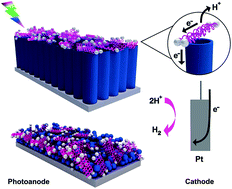
It is important to understand that this improvement is related to the visible light sensitivity of attached bR or any other changes in the TiO2/electrolyte interface after decoration with bR. In this regard, all prepared photoanodes are also studied by illuminating the samples with a single special wavelength, λ = 532 nm, which eliminated all possible excitations in the titanium dioxide layer (Fig. 3(c)). However, as can be seen in Table 1, the significant photocurrent enhancement was still observed for bR attached photoanodes, indicating the main mechanism for the photoactivation of samples was attributed to injection of electrons from the protein-retinal complex to the semiconducting nanostructures and also attributed to H+ pumping by bR. In fact, the absorption of green light photo by bR caused the excitation of electrons from the HUMO to the LUMO, and because the CB of TiO2 is located at a lower energy level, injection of the photoelectrons from bR to TiO2 is energetically favorable.24 These electrons finally transferred to the external circuit and reduced H+ on the Pt (counter electrode) surface, whereas water was oxidized on the photoanode surface. A schematic of this process is shown in Fig. 4. The photoelectrochemical efficiency of the prepared photoanodes was also estimated based on the photo-conversion efficiency, which is defined by the following equation:
![]() | (1) |
![]() | ||
| Fig. 4 Schematic of the synthesized bR decorated TNA and TNP photoanodes for the water splitting reaction. | ||
N. Allam et al. reported the decoration of TiO2 nanotubes with bR using 3-mercaptopropionin as a linker and observed a 50% increase in the photocurrent density of the systems.19 S. Balasubramanian et al. also modified TiO2 nanoparticles with bR by the immersion of the particles in the bR solution overnight, leading to a ∼50% enhancement in their photoresponce.20 Despite of these reports, the main advantage of the present system is the remarkable increase in the measured photocurrent, which was obtained in the absence of any chemical ligand as a linker. This may be due to the better performance of bR in buffer-based electrolyte (pH = 8) than that of citrate-based electrolyte (pH = 7) or it may be due to eliminating the sonication step that may denature the proteins. Hence, the bR species was attached to the TiO2 surface by a simple, low cost approach, effectively leading to considerably more increase in the photoresponse of the samples (1.7 and 7 times for TNA and TNP based systems, respectively).
As mentioned before, for better mechanical and electrical connection between bR and TiO2 nanostructures, the freshly annealed TiO2 was immersed in prepared bR solution as soon as it cooled to a suitable temperature (∼80 °C) to avoid absorption of any type of pollution. Another method for improving these self-organized attachments is the UV treatment of the substrate and/or heating the sample after immersion in the additive solution. To compare these techniques with each other in the bR/TiO2 nanoparticulate system, three different strategies were selected. In first sample, the hot (∼80 °C) TNP electrode just after annealing was immersed in bR solution (S1). In the second one, the surface of the TNP electrode, which was annealed a day before, was exposed to UV irradiation for an hour and then was immersed in bR solution (S2). In the third, annealed TNA was decorated with bR and then was heated in 80 °C for about 30 min (S3). Photocurrent measurements illustrated that the current densities of these bR-modified TNP photoanodes were 0.34, 0.11 and 0.28 mA cm−2 for the S1, S2 and S3 samples, respectively. This result suggested that heating the samples after modification led to a smaller enhancement in the photoactivity of the samples due to deactivation or denaturing of some of the grafted bR on the surface during the heating step. Moreover, UV treatment was not as efficient as other two approaches.
| This journal is © The Royal Society of Chemistry 2015 |