Yi-Ning Jin,
Hao-Cheng Yang,
He Huang and
Zhi-Kang Xu*
MOE Key Laboratory of Macromolecular Synthesis and Functionalization, Department of Polymer Science and Engineering, Zhejiang University, Hangzhou, 310027, China. E-mail: xuzk@zju.edu.cn
First published on 29th January 2015
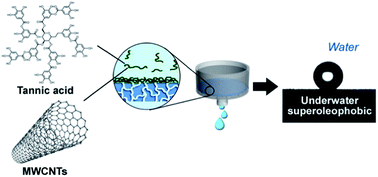
Multi-walled carbon nanotubes (MWCNTs) were facilely decorated with tannic acid (TA) and the MWCNTs/TA dispersion was vacuum-filtered to fabricate carbonaceous coatings with superoleophobicity and ultra-low oil adhesion underwater (OCA = 164.8°, SA = 2.7°). The super-oil-repellent property can be well maintained for long-term use, even in strong acidic, alkaline or saline environments.
To address this issue, CNTs should be hydrophilized before use. Numerous methods have been developed, including strong acid oxidation,14 ozone treatment,15 oxygen plasma etching,16 covalent modification17 and non-covalent interaction.18–20 Among them, non-covalent interaction proves to be convenient, flexible and mild, bringing no damage to the original structures of CNTs. The major challenge is to screen a compound to facilely and robustly decorate CNTs by this method.
Tannic acid (TA), a commercial product of polyphenol, has ten benzene rings surrounded by large numbers of phenolic hydroxyl groups (Fig. S1 in ESI†). It has been reported to be an excellent compound to help CNTs disperse in water.21,22 Because TA molecules can adsorb onto CNTs walls, with benzene rings anchoring to CNTs' graphene structures via π–π interactions. It forms a hydrophilic monolayer, shielding the graphene parts of CNTs to lessen their self-agglomeration, and continuing to adsorb more dissolved TA molecules via hydrogen bonding and other polar interactions.
Herein, we fabricated a TA-decorated MWCNTs coating with superior oil repellency underwater (Fig. 1a–c). Vacuum filtration was used as the method for its convenience in preparing an uniform-distributed MWCNTs surface.23–25 The coating has been verified for its superoleophobicity and ultra-low oil adhesion underwater, according to the result of oil contact angle (OCA) at 164.8° and sliding angle (SA) at 2.7°.
Commercial MWCNTs without pre-treatment are poorly suspended in water, as seen in Fig. 1a. They are easy to agglomerate due to the intermolecular π–π stacking and hydrophobic interactions. In contrast, a stable MWCNTs suspension can be obtained with the assistant of TA (Fig. 1a). It is due to the fact that TA molecules are decorated to the MWCNTs surface via π–π interaction, forming a hydrophilic monolayer to lessen the self-agglomeration of MWCNTs. The modification degree of TA to MWCNTs is 140 mg g−1 in mass ratio, as TA concentration can be quantified by UV-vis measurement at 275 nm (Fig. S2 in ESI†).21,22
The dispersibility of MWCNTs in water with or without TA decoration was examined by UV-vis measurement at 800 nm, as reported by Lin et al.22 TA has no absorbance at this wavelength. Therefore, there is a good correlation between the absorbance and MWCNTs concentration. The TA-decorated MWCNTs suspension shows a strong absorption at this wavelength (Fig. 1d), indicating a good and homogeneous dispersion. TEM images demonstrate that there are no changes on the microstructures of MWCNTs before and after TA decoration (Fig. 1e). These also suggest that TA molecules wrap on the MWCNTs surface in monolayer. TA decoration was further analysed by X-ray photoelectron spectroscopy (XPS) and laser confocal Raman micro-spectroscopy. It can be learned that the elemental ratio of oxygen to carbon (O/C) for the TA-decorated MWCNTs is as 3 times as that of the nascent MWCNTs (Fig. S3 and Table S1 in ESI†). Besides, a new peak appears at 531.7 eV (–OH) for the TA-decorated MWCNTs sample (Fig. S4 in ESI†). The results prove the successful decoration of TA. On the other hand, there are two bands in Raman micro-spectrum typically for MWCNTs (Fig. S5 in ESI†). Band D, arising at 1580 cm−1, is used to characterize the graphene structures in carbon materials. While Band G, around at 1320 cm−1, reflects the disorder sections such as defects and margins. It can be seen that no wavelength shift occurs for MWCNTs with TA decoration (Fig. S5a in ESI†), indicating that the modification process is mild and non-covalent, with no damage to the original graphene structures of MWCNTs.
The TA-decorated MWCNTs suspension was then coated on the surface of microporous polypropylene membrane (MPPM) by means of vacuum filtration (Fig. 1b). Fig. 1c shows that they can be uniformly coated on the surface of MPPM. Coatings of MWCNTs dispersed in N,N-dimethylformamide and N-methyl-2-pyrrolidone (DMF/NMP) were also fabricated for comparison. FE-SEM was used to characterize the surface and cross-sectional morphologies of the coatings (Fig. 2). The coating from DMF/NMP–MWCNTs is dense and smooth because hydrophobic MWCNTs are homogeneously dispersed in organic solvents. On the other hand, the TA-decorated MWCNTs forms relatively loose and rough surface with micro-scaled domains uniformly distributed (the average diameter is about 2 μm). This hierarchical morphology is beneficial to constructing liquid-repellent surfaces.
We measured water contact angles (WCAs) and oil contact angles (OCAs), respectively, to investigate the surface wettability of the as-prepared coatings. WCA is about 153.7° ± 4.8° at the coating surface from the nascent MWCNTs, indicating that this is a superhydrophobic surface. However, it decreases to 34° for the coating surface of the TA-decorated MWCNTs, demonstrating a wettability transition into hydrophilicity in air. It is known that hydrophilic surfaces with highly roughness are potential in realizing superoleophobicity underwater. 1,2-Dichloroethane was used as a model oil to evaluate this property. A 5 μL oil droplet was suspended on the micro-syringe tip and slowly lowered to reach the coating surface. We found that the drop could not be transferred to the surface even though it has been severely pushed downward (Fig. 3a). After the syringe was lifted up, the drop returned to spherical shape and there was no oil left on the coating surface. Fig. 3a depicts the whole process, from which the underwater superoleophobic property of the TA-decorated MWCNTs coatings can be observed.
The oil droplet was further forced to fall off to make an accurate measurement of OCA. Camera was set at continuous mode to capture the moment when the droplet just contacts the coating surface. Fig. 3b shows that OCA of the TA-decorated MWCNTs coating is 164.8° ± 5.7°, within the range of superoleophobicity (OCA > 150°). This underwater superoleophobicity can also be confirmed by the sliding behaviour of the oil droplet. In this case, the average sliding angle (SA) is only 2.7° for the TA-decorated MWCNTs coating, serving as a strong proof to illustrate the ultra-low oil adhesion underwater.
Fig. 4a demonstrates that our TA-decorated MWCNTs coatings have excellent oil repellency towards various oils including 1,2-dichloroethane, diesel, gasoline, hexane and petroleum ether. This oil repellency is even very durable in harsh environments. The as-prepared TA-decorated MWCNTs coatings were immersed and shaken in acidic (pH = 1, HCl), alkaline (pH = 12, NaOH) and saline solutions for 10 days. It can be seen from Fig. 4b that all OCAs are above 150° for the coating samples. And no MWCNTs fell off during the long-term shaking. A scouring test was conducted to further study the mechanical durability. Distilled water scoured the TA-decorated MWCNTs coatings at the rate of 20 L h−1 for 24 hours. It shows that the coatings maintain their original appearance, as well as the superoleophobic wettability underwater (Fig. S6 in ESI†). It is reasonable that TA molecules on the coatings can be washed away by organic solvents, such as ethanol, DMF, NMP, acetone and toluene (Table S2 in ESI†). However, they are easily adsorbed on the coatings again by solution filtration, making the coatings recover their superoleophobic wettability underwater (Table S3 in ESI†).
From the above results, it is clear that the TA-decorated MWCNTs coatings are hydrophilic in air and superoleophobic underwater with ultra-low oil adhesion. While the nascent MWCNTs coating shows opposite properties. It is superhydrophobic in air (Fig. 1f) with a WCA of 153° and the oil droplet can be thoroughly absorbed within one second, leaving the underwater coating wetted and contaminated (Fig. 3c). According to the theory developed by Cassie et al.,13 super-hydrophobic surfaces are originated from the formation of a water/air/solid three-system interface. When a water droplet is placed on the surface, air molecules are trapped in rough areas to reduce the contact area between water and solid, thus enhancing the surface repellency to water. Inspired by this, Jiang et al.12 have developed a theory for surface with superoleophobicity underwater. When a hydrophilic surface with great roughness is immersed underwater, water molecules can easily occupy the micro/nanostructures, forming a layer at the oil/solid interface. It serves as a natural protector towards oil immersion, endowing the surface with excellent superoleophobicity underwater. In our case, the TA-decorated MWCNTs coatings have hydrophilic surfaces with hierarchical rough morphology. For one, TA decoration shields the graphene structures and introduces large amounts of phenolic hydroxyl groups to MWCNTs, making the materials favourable to water. For the other, the hierarchical morphology gives rise to the Cassie state, that is, water molecules easily enter into the micro/nano-spaces among MWCNTs, forming an oil/water/solid interface to endow the coatings with super-oil-repellent property.
In conclusion, we fabricated TA-decorated MWCNTs coatings by means of vacuum filtration, which reveal superoleophobicity and ultra-low oil adhesion underwater. The coatings are proved to be durable in harsh environments. Considering the electronically conductive property of MWCNTs, such coatings with excellent oil repellency have great applications in electromagnetics, such as electromagnetic interference shielding materials, electrical devices protective clothing, and electronics textiles.9,26,27 However, it should be noted that vacuum filtration is not proper for practical application, especially for the fabrication of large area coatings. Efficient fabrication methods, such as spray drying and vacuum evaporation, should be explored in superoleophobic coatings research field.
Footnote |
| † Electronic supplementary information (ESI) available. See DOI: 10.1039/c4ra16074f |
| This journal is © The Royal Society of Chemistry 2015 |