DOI:
10.1039/C4RA16047A
(Paper)
RSC Adv., 2015,
5, 17366-17371
A flexible, transparent and ultrathin single-layer graphene earphone†
Received
9th December 2014
, Accepted 2nd February 2015
First published on 2nd February 2015
Abstract
Graphene is flexible and transparent with one-atom layer thickness, and is a novel building block with potential applications in future portable devices. Herein a flexible, transparent and ultrathin earphone based on single-layer graphene (SLG) is reported. The SLG earphone operates in the frequency range of 20 Hz to 200 kHz and has a highest sound pressure level (SPL) of 70 dB at a 1 cm distance. The SPLs emitted from one to six layers of stacked SLG are compared. It is observed that the SPL decreases with an increasing number of stacked layers. The SLG earphone, which is packaged with a commercial earphone casing, can play music clearly. Compared with a conventional earphone, the SLG earphone has a broader frequency response and a lower fluctuation. Testing results in both time and frequency domains show a frequency doubling effect, which indicates that the working principle is based on the electro-thermoacoustic (ETA) effect. As the SLG earphone operates in both the audible and ultrasonic frequency range, it can be used for a wide variety of applications.
Introduction
Flexible and transparent devices are of great importance for next generation electrical systems.1 Flexible and transparent transistors,2–5 solar cells,6–8 photodetectors,9,10 and light emitting diodes11 have been developed. To date, the commercial earphone is based on a magnetic coil,12 which could not achieve flexibility and transparency. But recently, various nanomaterials, including nanowires,13–15 carbon nanotubes,16–20 and graphene21,22 have been used for the development of novel sound sources based on the electro-thermoacoustic (ETA) effect. The main advantage of using nanomaterials is their low heat capacity per unit area (HCPUA), which can convert joule heating to sound waves more efficiently. Single-layer graphene (SLG) has the lowest HCPUA,23 which could be more efficient than other materials. Despite this potential, to date, there is no reported SLG earphone.
Here a SLG earphone, which operates according to the ETA effect, is demonstrated. Exploiting such a working principle, the SLG earphone is fundamentally different from conventional ones. A systematic study of the sound generation from one to six stacked layers of SLG is made here. The sound spectrum of the SLG earphone is significantly wider than a commercial earphone, covering both the audio and ultrasound frequencies up to 200 kHz. The earphone core is flexible, transparent and ultrathin. As a demonstration, the SLG earphone is packaged into a commercial earphone casing and tested successfully.
Experiment
Fabrication of SLG earphone
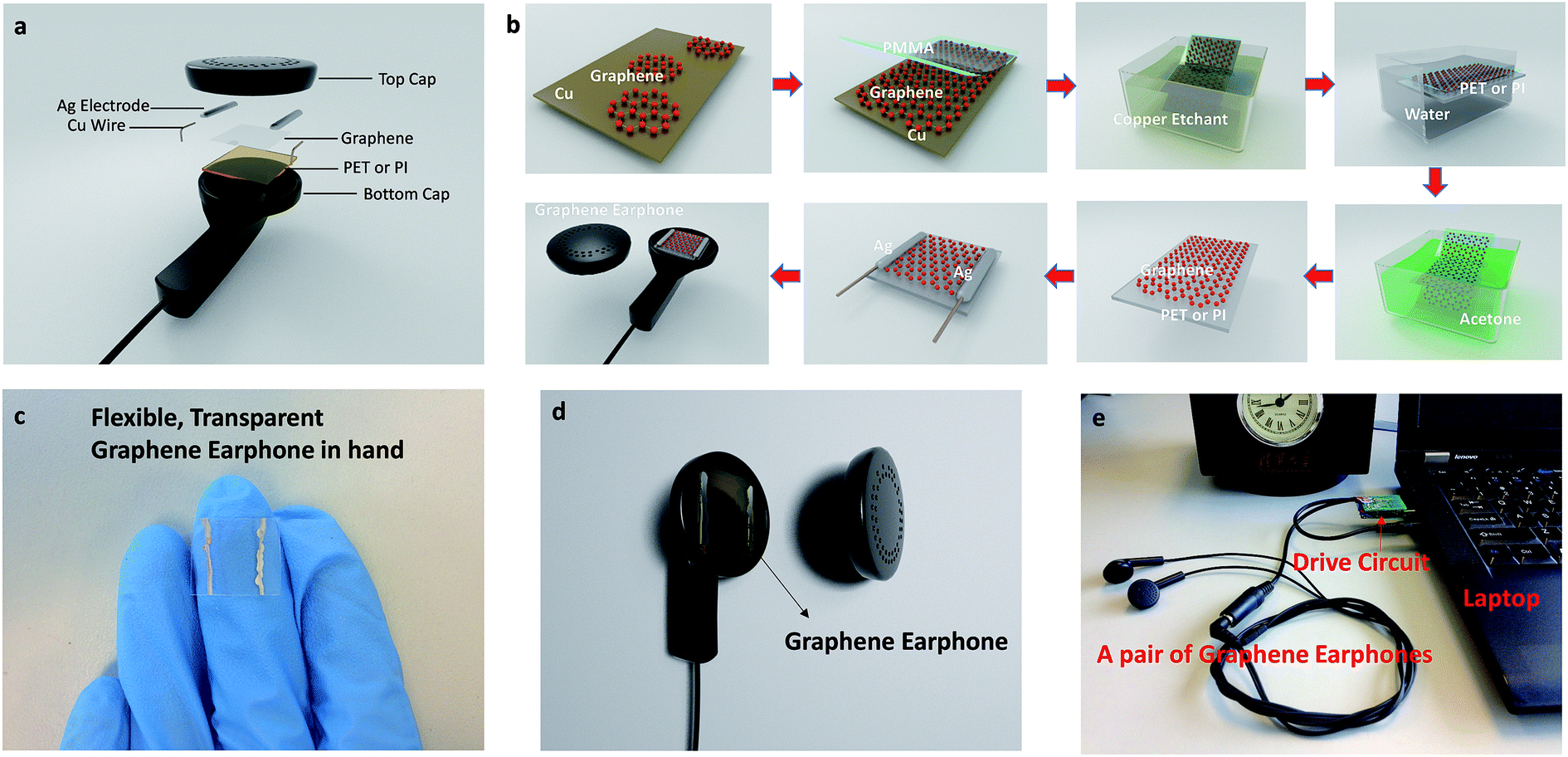
The schematic of graphene earphone is shown in Fig. 1a. The fabrication process of the SLG earphone has eight steps (Fig. 1b). Briefly, the SLG is grown on copper by CVD at 1000 °C. The domain size is ∼20 μm. Wet transfer is used to transfer the SLG on a polyethylene terephthalate (PET) or polyimides substrate. Subsequently, silver electrodes are applied to the SLG and wired out (Fig. 1c). Finally, the device is packaged into a commercial earphone casing (Fig. 1d). A drive circuit is also made to supply a DC bias so that the SLG earphone can directly connect to laptop for playing music (Fig. 1e). Real images of the fabrication process is shown in Fig. S1.†
 |
| | Fig. 1 (a) Schematic of the graphene earphone. (b) Fabrication process of the graphene earphone. (c) A single-layer graphene (SLG) earphone in hand. (d) View of the SLG earphone in a commercial earphone casing. (e) A Pair of SLG earphones connected to a laptop through a drive circuit. The music in laptop could be played through SLG earphone. | |
Stacked SLG fabrication and characterization
Large area of SLG (5 × 10 cm2) can be transferred on PET substrates with high transparency and flexibility (Fig. 2a). Stacked SLG (from one to six layers) were made and tested to understand the layer-dependence on sound performance. Furthermore n (2–6) such layers can be transferred to the same PET substrate (Fig. S2†). This can be done by repeated poly(methyl methacrylate) wet transfer of SLG grown on copper by CVD. Sheet resistance was measured by the automatic four point probe meter (model 280SI, Four Dimensions, Inc.). The sheet resistance of the SLG is ∼90 Ω □−1 (Fig. 2b), showing a higher quality as compared to roll-to-roll SLG, whose resistance is reported to be 125 Ω □−1.24 Stacking SLG layers decreases the sheet resistance down to 26 Ω □−1 in a six-layer stack. It is observed that the transparency of the stacked layers decreases with an increasing number of layers (Fig. S3†). The stacked SLGs were also transferred to SiO2/Si substrates for optical (Fig. S4†) and Raman analysis. Two-dimensional images of SLGs surface were captured by white light interference microscope microXAM-1200 (MapVue AE Inc.). As the stacked SLGs were not perfectly aligned, the layer number could be identified through the edges of the films (Fig. 2c). The Raman spectroscopy was conducted using a laser with a wavelength of 532 nm (HORIBA Inc.). Raman spectra show that the SLG yield stronger 2D peaks as compared with G peaks (Fig. 2d). There are almost no D-peaks indicating a C–C lattice structure with very little defects. Due to the random stacking of SLG layers, unlike graphite, the intensities of the G and 2D peaks increase together. Statistical results show that 2D/G ratios are larger than 1 for stacked SLG layers (Fig. 2e).
 |
| | Fig. 2 (a) A highly transparent 5 cm × 10 cm SLG on PET. The dashed lines show the edges of the graphene film. (b) Images of graphene films with 1 to 6 stacked layers on a SiO2/Si substrate captured by a white light interference microscope. Each graphene layer can be identified by the color contrast and corner shape. (c) Sheet resistance vs. layer number of SLG films. The quality of SLG (<100 Ω □−1) is even better than well-known roll-to-roll SLG.24 (d) Raman spectra of graphene films with different numbers of stacked layers. Due to the random stack of graphene layers, unlike graphite, the intensities of the G and 2D peaks increase together. (e) 2D/G ratio of graphene films with different numbers of stacked layers. The 2D/G ratios are larger than unity, indicating the presence of SLG. | |
Sound testing
The acoustic platform for testing the SLG earphones consisted of a standard microphone and a dynamic signal analyzer. A 1/4 inch standard microphone (Earthworks M50) was used to measure the sound pressure level of the loudspeakers. This microphone has a very flat frequency response reaching up to 50 kHz and a 31 mV Pa−1 high sensitivity. A signal analyzer (Agilent 35670A) was used to generate sine signals to drive the earphones, perform fast Fourier transform analysis and record the value of the sound pressure level. Our testing was performed in a soundproof box measuring 1.0 × 0.5 × 0.5 m3. In order to avoid echo, the box was filled with sound-absorbing sponges.
Results and discussion
Layer dependence on sound performance
The sound performance of the stacked SLGs are tested by applying 5 V AC and 5 V DC signals. The frequency is swept from 20 Hz to 50 kHz. The original results of SPL vs. frequency is shown in Fig. S5.† From layers 1 to 5, the sound pressure level (SPL) decreased (Fig. 3a) which could be explained by an increased heat capacity per unit area (HCPUA). It is concluded that the SLG has the highest SPL due to its lowest HCPUA (Fig. 3b). It is also noticed that there is an anomaly for a six-layer SLG stack. Since six layers have a larger HCPUA, it is expected that the SPL would be lower. However, another SPL influencing factor is the thermal leakage from the substrate. As six layers have a larger total gap, the thermal coupling with the substrate is weaker, which in-turn could enhance the sound performance. The six-layer device has much lower thermal coupling with substrate than other sample. A direct evidence is that during the wet transfer, the six-layer graphene is much easier to peel off from the substrate, which indicates the six-layer graphene has weaker interaction with the substrate compared to other samples. Based on this observation, it is hard to stack more than six layers. And it also confirmed that the effective thermal coupling of the six-layer graphene is much weaker than other samples.
 |
| | Fig. 3 (a) The SPL vs. frequency for different graphene layers. The single-layer graphene has the highest SPL value. The measure distance is fixed at 1 cm. (b) The SPL vs. layer number for different acoustic frequencies. The thinner graphene has higher sound pressure due to lower HCPUA. | |
Sound performance of the SLG earphone
The time domain response of the SLG earphone is investigated and compared to a commercial earphone. An input sine signal is swept from 0 Hz to 20 kHz in 20 s. It is observed that the SLG earphone reaches 20 kHz in 10 s (Fig. 4a), indicating that the output frequency has been doubled. In order to reproduce the same frequency as the input signal, a DC bias is added and both single-frequency and double-frequency tones are generated (Fig. 4b). There are no obvious differences from one layer to six layers graphene both in time and frequency domain (Fig. S6†). It is also noted that the conventional earphone only has a single-frequency tone (Fig. 4c).
 |
| | Fig. 4 (a) The amplitude spectrum and its Fourier transform of the sound generated by the SLG earphone driven by an AC signal. (b) The amplitude spectrum and its Fourier transform of the sound generated by the SLG earphone driven by an AC + DC signal. (c) The amplitude spectrum and its Fourier transform of the sound generated by a conventional magnetic coil earphone. | |
The SLG earphone also has a wider frequency response than a commercial earphone, especially in the ultrasound range (Fig. 5a). The sound spectrums of the SLG earphone under different input power levels are also tested (Fig. 5b) and a linear relationship is observed (Fig. 5c). The frequency-doubling effect in the SLG earphone is also found in time-domain (Fig. 5d). A sine-pulse response testing shows that the delay time is 20 μs (Fig. 5e), which is similar to a commercial earphone. As shown in Fig. 5f, this is the first experimental demonstration that the graphene earphone can emit sounds up to 200 kHz. In Table 1, the performance of our SLG earphone is compared with previous efforts.20,22,23 The SPL of SLG earphone is 10 dB higher than CNT earphone and 35 dB higher than rGO earphone due to the lower HCPUA of graphene. The SPL of SLG earphone is also 24 dB higher than previous graphene speaker due to the better quality of graphene film. Our SLG has the even lower sheet resistance than well-known roll-to-roll graphene.24 The higher conductivity of SLG can convert electrical power to Joule heating more efficiency. The SLG earphone reported in this work represents the state-of-art earphone, which could open wide applications in consumer electronics such as in phones, tablets and computers (etc.).
 |
| | Fig. 5 (a) SPL curves of a SLG graphene earphone compared with a commercial earphone. (b) The SPL of the graphene earphone under different power levels. (c) Power-dependent sound pressure under different frequencies. (d) A 10 kHz input signal fed to the SLG earphone and the corresponding sound signal collected by the microphone, showing the frequency-doubling effect. (e) The measured acoustic response for a single 10 kHz sine-pulse input, showing a time delay of 20 μs. (f) The measured acoustic response driven by different frequencies in a sine-pulse. | |
Table 1 A performance comparison of recent acoustic devices. SLG earphone has the highest SPL and widest frequency range. Note the input power are normalized to 1 W
| Materials |
SPL (dB) |
f limit (kHz) |
References |
| CNT |
60 |
20 |
Nano Lett. 2013 (ref. 20) |
| rGO |
35 |
50 |
ACS Nano 2014 (ref. 22) |
| SLG |
46 |
20 |
Adv. Mater. 2012 (ref. 23) |
| SLG |
70 |
200 |
This work |
Theoretical analysis of SLG earphone
The schematic shows the sound generation process in a SLG earphone (Fig. 6a), which is different from conventional mechanical damping. Simulation results show a good agreement with the experimental results (Fig. 6b). The minor discrepancy in low frequency is due to the environment noise.
 |
| | Fig. 6 Sound generation in a SLG graphene earphone. An applied (a) signal causes (b) Joule heating, inducing (c) longitudinal, and (d) spherical sound waves in the near- and far-fields respectively. (e) SPL vs. frequency showing that the model agrees well with the experiment. The inset illustrates the model of sound generation in a SLG earphone. | |
Potential applications for transparent SLG earphone
The concept of “transparent electronics” was proposed by John. F. Wager25 and has attracted a lot of attention. The transparent earphone is very useful for consumer and military applications. For example, the transparent earphone could be used as a hearing aid. A transparent hearing aid can give the user a sense of privacy and therefore increased comfort. Similarly, such a transparent earphone can also provide a camouflaged communication link with a remote location.
Conclusion
A transparent, flexible SLG earphone has been demonstrated for the first time operating based on the ETA effect. The earphone operates in the range of 20 Hz to 200 kHz, with a highest SPL of 70 dB. These metrics indicate that the SLG earphone has a performance exceeding other recent state-of-the-art sound generation devices. Furthermore, the SLG earphone has a broader frequency response and a lower fluctuation as compared to a commercial earphone. A systematic study of the sound generation performance of one to six stacked SLG layers was conducted. Further performance enhancement can be achieved by driving the SLG earphone using pulse density modulation. The SLG earphone technology is expected to bring transparent flexible earphone in the field of acoustics.
Notes
The authors declare no competing financial interest.
Acknowledgements
This work was supported by National Natural Science Foundation (61434001), 973 Program (2015CB352100), National Key Project of Science and Technology (2011ZX02403-002), and Special Fund for Agroscientic Research in the Public Interest (201303107) of China. H.T is thankful for receiving support through the Ministry of Education Scholarship of China. M.A.M is thankful for receiving support from the postdoctoral fellowship (PDF) program of the Natural Sciences and Engineering Research Council of Canada (NSERC).
References
- J. A. Rogers, T. Someya and Y. Huang, Science, 2010, 327, 1603–1607 CrossRef CAS PubMed.
- K. Nomura, H. Ohta, A. Takagi, T. Kamiya, M. Hirano and H. Hosono, Nature, 2004, 432, 488–492 CrossRef CAS PubMed.
- E. Artukovic, M. Kaempgen, D. S. Hecht, S. Roth and G. GrUner, Nano Lett., 2005, 5, 757–760 CrossRef CAS PubMed.
- T. Georgiou, R. Jalil, B. D. Belle, L. Britnell, R. V. Gorbachev, S. V. Morozov, Y.-J. Kim, A. Gholinia, S. J. Haigh, O. Makarovsky, L. Eaves, L. A. Ponomarenko, A. K. Geim, K. S. Novoselov and A. Mishchenko, Nat. Nanotechnol., 2013, 8, 100–103 CrossRef CAS PubMed.
- S. Ju, A. Facchetti, Y. Xuan, J. Liu, F. Ishikawa, P. Ye, C. Zhou, T. J. Marks and D. B. Janes, Nat. Nanotechnol., 2007, 2, 378–384 CrossRef CAS PubMed.
- C.-C. Chen, L. Dou, R. Zhu, C.-H. Chung, T.-B. Song, Y. B. Zheng, S. Hawks, G. Li, P. S. Weiss and Y. Yang, ACS Nano, 2012, 6, 7185–7190 CrossRef CAS PubMed.
- M. W. Rowell, M. A. Topinka, M. D. McGehee, H.-J. Prall, G. Dennler, N. S. Sariciftci, L. Hu and G. Gruner, Appl. Phys. Lett., 2006, 88, 233506 CrossRef PubMed.
- L. G. De Arco, Y. Zhang, C. W. Schlenker, K. Ryu, M. E. Thompson and C. Zhou, ACS Nano, 2010, 4, 2865–2873 CrossRef PubMed.
- N. Liu, H. Tian, G. Schwartz, J. B. H. Tok, T.-L. Ren and Z. Bao, Nano Lett., 2014, 14, 3702–3708 CrossRef CAS PubMed.
- Z. Gao, W. Jin, Y. Zhou, Y. Dai, B. Yu, C. Liu, W. Xu, Y. Li, H. Peng, Z. Liu and L. Dai, Nanoscale, 2013, 5, 5576–5581 RSC.
- D. Zhang, K. Ryu, X. Liu, E. Polikarpov, J. Ly, M. E. Tompson and C. Zhou, Nano Lett., 2006, 6, 1880–1886 CrossRef CAS PubMed.
- M. R. Gander, J. Audio Eng. Soc., 1981, 29, 10–26 Search PubMed.
- A. O. Niskanen, J. Hassel, M. Tikander, P. Maijala, L. Gronberg and P. Helisto, Appl. Phys. Lett., 2009, 95, 163102 Search PubMed.
- V. Vesterinen, A. O. Niskanen, J. Hassel and P. Helisto, Nano Lett., 2010, 10, 5020–5024 CrossRef CAS PubMed.
- H. Tian, D. Xie, Y. Yang, T.-L. Ren, Y.-X. Lin, Y. Chen, Y.-F. Wang, C.-J. Zhou, P.-G. Peng, L.-G. Wang and L.-T. Liu, Appl. Phys. Lett., 2011, 99, 253507 CrossRef PubMed.
- L. Xiao, Z. Chen, C. Feng, L. Liu, Z.-Q. Bai, Y. Wang, L. Qian, Y. Zhang, Q. Li, K. Jiang and S. Fan, Nano Lett., 2012, 12, 2652 CrossRef CAS.
- K. Suzuki, S. Sakakibara, M. Okada, Y. Neo, H. Mimura, Y. Inoue and T. Murata, Jpn. J. Appl. Phys., 2011, 50, 01BJ10 CrossRef.
- A. E. Aliev, M. D. Lima, S. Fang and R. H. Baughman, Nano Lett., 2010, 10, 2374–2380 CrossRef CAS PubMed.
- L. Xiao, P. Liu, L. Liu, Q. Li, Z. Feng, S. Fan and K. Jiang, J. Appl. Phys., 2011, 110, 084311 CrossRef PubMed.
- Y. Wei, X. Lin, K. Jiang, P. Liu, Q. Li and S. Fan, Nano Lett., 2013, 13, 4795–4801 CrossRef CAS PubMed.
- H. Tian, T.-L. Ren, D. Xie, Y.-F. Wang, C.-J. Zhou, T.-T. Feng, D. Fu, Y. Yang, P.-G. Peng, L.-G. Wang and L.-T. Liu, ACS Nano, 2011, 5, 4878–4885 CrossRef CAS PubMed.
- H. Tian, C. Li, M. A. Mohammad, Y. L. Cui, W. T. Mi, Y. Yang, D. Xie and T. L. Ren, ACS Nano, 2014, 8, 5883–5890 CrossRef CAS PubMed.
- J. W. Suk, K. Kirk, Y. Hao, N. A. Hall and R. S. Ruoff, Adv. Mater., 2012, 24, 6342–6347 CrossRef CAS PubMed.
- S. Bae, H. Kim, Y. Lee, X. Xu, J.-S. Park, Y. Zheng, J. Balakrishnan, T. Lei, H. Ri Kim, Y. I. Song, Y.-J. Kim, K. S. Kim, B. Ozyilmaz, J.-H. Ahn, B. H. Hong and S. Iijima, Nat. Nanotechnol., 2010, 5, 574–578 CrossRef CAS PubMed.
- J. F. Wager, Science, 2003, 300, 1245–1246 CrossRef CAS PubMed.
Footnote |
| † Electronic supplementary information (ESI) available: Testing results of graphene earphones. See DOI: 10.1039/c4ra16047a |
|
| This journal is © The Royal Society of Chemistry 2015 |
Click here to see how this site uses Cookies. View our privacy policy here.