Yuxi Liua,
Chong Tianab,
Bin Yana,
Qingye Lua,
Yijun Xiea,
Jian Chenc,
Rajender Guptaa,
Zhenghe Xua,
Steven M. Kuznickia,
Qingxia Liua and
Hongbo Zeng*a
aDepartment of Chemical and Material Engineering, University of Alberta, Edmonton, AB T6G 2V4, Canada. E-mail: Hongbo.Zeng@ualberta.ca; Fax: +1-780-492-2881; Tel: +1-780-492-1044
bState Key Laboratory of Coal Combustion, Huazhong University of Science and Technology, Wuhan 430074, P. R. China
cNational Institute for Nanotechnology, National Research Council, Edmonton, Alberta T6G 2M9, Canada
First published on 27th January 2015
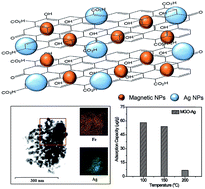
Mercury emission from combustion flue gas causes considerable environmental challenges and serious adverse health threats, and elemental mercury (Hg0) is the most challenging chemical form for removal. In this work, four types of graphene oxide (GO) based composite adsorbents were successfully synthesized by depositing Ag nanoparticles (NPs) and/or magnetic ferrite NPs on GO sheets (denoted as GO, GO–Ag, MGO and MGO–Ag), characterized and applied for the removal of Hg0 for the first time. The presence of Ag NPs on GO greatly enhances the Hg0 removal capability of GO–Ag and MGO–Ag as compared to that of pure GO, which is mainly attributed to the amalgamation of Hg0 on Ag NPs. MGO–Ag shows the best Hg0 removal performance and thermal tolerance among the four types of adsorbents developed, which can effectively capture Hg0 up to 150–200 °C in a simulated flue gas environment and can be also effectively recycled and reused. Our results indicate that the graphene oxide based composites (i.e. MGO–Ag) have significant potential applications for mercury emission control in coal-fired power plants.
Much effort has been devoted to the development of efficient adsorbents to remove mercury from combustion flue gases. Efficient adsorbents typically require large specific surface area which ensures sufficient contact between adsorbents and mercury, and high degree of surface reactivity for a suitable mercury adsorption capacity. Therefore, porous materials13–17 such as activated carbons, zeolite, and mesoporous silica have been extensively explored as scaffolds to impregnate active chemicals including chlorine, sulfur, bromide, iodine and noble metals, and are employed as adsorbents.13,18,19 However, most of these sorbents are difficult to regenerate due to the strong chemical interactions involved in mercury adsorption, thereby incurring high operating costs. It is of paramount benefit to explore a novel scaffold and develop efficient mercury adsorbents with feasible recycling ability under suitable regeneration temperature, which will not only greatly enhance the mercury removal performance but also significantly reduce the operation cost of sorbent injection.
Graphene oxide (GO) derived from graphene has received much attention over the past few years as a novel adsorbent substrate for various applications due to its outstanding features,20 such as large specific surface area, high water dispersibility, and good surface functionalization feasibility. Taking advantage of the abundant functional groups and large surface areas, various functionalized GO composites, such as polypyrrole-reduced GO (RGO), RGO–MnO2, RGO–Ag and RGO–SnO2 composites, have been developed for removal of Hg2+ in water treatment and detection of Hg2+.21,22 Metal and metal oxide nanoparticles were among the most intensively studied Hg0 adsorbents in previous studies.23–25 In particular, noble metal nanoparticles, such as silver and gold, are the most intriguing ones,20,24,26,27 which can efficiently capture mercury vapour by forming Ag–Hg or Au–Hg amalgam at temperatures close to flue gas conditions and can be regenerated by release of captured mercury through thermal treatment, providing a feasible way to regenerate mercury adsorbents. Meanwhile, surface functional groups (e.g. hydroxyl, epoxy, carboxyl) on adsorbents have been reported as active sites for Hg0 adsorption.28 Thus, GO composites decorated with noble metal nanoparticles are expected to have great potential in mercury removal from coal flue gases. Yet, to date, no study has been reported on GO based composites for removal of elemental mercury from flue gases.
Herein, we applied GO, for the first time, as a scaffold for developing a regenerable mercury sorbent. By incorporating silver and magnetic nanoparticles on GO surfaces, GO and several GO based composites including magnetic nanoparticle–GO (MGO), silver nanoparticle–GO (GO–Ag), and MGO–Ag were synthesized, characterized and applied to remove Hg0 under various temperatures. The recyclability of MGO–Ag was investigated and its Hg0 adsorption capacity was also explored in simulated combustion gases.
000) were purchased from Alfa Aesar. α-D-Glucose (96%), iron(III) chloride hexahydrate (FeCl3·6H2O, 99.0%) and iron(II) chloride tetrahydrate (FeCl2·4H2O, 99.0%) were supplied by Sigma-Aldrich. Potassium permanganate (KMnO4, 99.0%), ammonia solution (29.5 wt%) and silver nitrate (AgNO3, 99.7%) were provided by Fisher Scientific.
:
1 mole ratio was added to a homogenous aqueous solution of GO (5 mg mL−1, 50 mL) prepared via 45 min ultrasonication treatment at room temperature. The whole system was heated to 90 °C, and pH of the mixture was adjusted to 10 by using 30 wt% ammonia solution. After being vigorously stirred for 40 min, the solution was cooled down to room temperature. The resulting black composites were collected by a magnet and washed thoroughly with copious amount of DI water and then reclaimed by freeze drying, and the final product was denoted as MGO. MGO–Ag was synthesized by the same procedure as that for GO–Ag with MGO as the initial reactant.
To further verify the successful synthesis of the GO composites and characterize the compositions of the NPs, XRD and XPS analyses was conducted. The XRD patterns of GO, GO–Ag, GO–1/2Ag, GO–1/4Ag, MGO and MGO–Ag are shown in Fig. 2a. GO exhibits a clear diffraction peak at 9.92°, indicating an expanded GO interlayer spacing of 0.89 nm calculated from Bragg equation. Compared with the ∼0.34 nm d-spacing of the pristine graphite, the d-spacing of GO is much larger due to the addition of surface oxygen-containing functional groups.33,34 Comparing the XRD spectra of GO and GO–nanoparticle composites, a typical diffraction peak for GO at 9.92° was absent in the GO–nanoparticle composites, revealing further exfoliation of GO sheets by ultrasonication,34 which leads to the effective dispersion of Ag NPs and magnetic NPs during synthesis. The diffraction peaks shown in the XRD spectra of GO–Ag and MGO–Ag at 2θ = 38.2°, 44.3°, 64.5°, 77.5° and 81.6° can be assigned to (1 1 1), (2 0 0), (2 2 0), (3 1 1) and (2 2 2) crystallographic planes of silver nanoparticles (in good agreement with no. 04-0783 JCPDS Card), indicating the successful deposition of Ag NPs on GO surfaces. In addition, the XRD data of MGO and MGO–Ag displays the diffraction peaks originating from both cubic Fe3O4 (JCPDS Card no. 75-0449) and cubic γ-Fe2O3 (JCPDS Card no. 39-1346), indicating that the co-precipitation method results in simultaneous formation of Fe3O4 and γ-Fe2O3 on GO surfaces.
![]() | ||
| Fig. 2 (a) XRD spectra of GO, GO–Ag, GO–1/2Ag, GO–1/4Ag, MGO and MGO–Ag composites. XPS survey scans of (b) C on GO, (c) Ag on MGO–Ag and (d) Fe on MGO and MGO–Ag. | ||
The XPS spectra of all the synthesized composites are shown in Fig. S2a (ESI†) which display the major element peaks of C1s, O1s, Ag 3d and Fe 2p. The C1s XPS spectrum of GO (Fig. 2b) can be fitted with five curves located at 284.6 eV (C
C/C–C), 285.5 eV (C–OH), 286.9 eV (C–O–C), 287.8 eV (C
O) and 288.9 eV (COOH), respectively, confirming the successful synthesis of GO. The C1s XPS spectra of the GO–nanoparticle composites with similar peaks are shown in Fig. S2b–f (ESI†). After the deposition of silver and magnetic nanoparticles, sharp XPS peaks at 368.2 eV and at 374.2 eV assigned to Ag 3d5/2 and Ag 3d3/2 were clearly detected on GO–Ag and MGO–Ag composites, which are in accordance with the reported binding energy of metallic silver.35,36 Furthermore, a small satellite peak of Fe 2p3/2 at ∼718 eV appears on the Fe XPS spectra (Fig. 2d) of both MGO and MGO–Ag, indicating the coexistence of γ-Fe2O3 and cubic Fe3O4 on GO surfaces (consistent with XRD measurements in Fig. 2a).37 The loading percentages (atomic number ratio) of Ag and Fe on MGO–Ag as detected by XPS are 3.39% and 4.27%, respectively. All the above results demonstrate the successful synthesis of GO–nanoparticle composites.
In order to test the possibility of recycling the developed MGO and MGO–Ag composites via applying an external magnetic field, the magnetism of the as-prepared MGO and MGO–Ag was evaluated by magnetic hysteresis loop measurements. As shown in Fig. 3, both MGO and MGO–Ag show typical superparamagnetism with no hysteresis loops, which guarantees the convenient reclamation of MGO and MGO–Ag composites after mercury adsorption and re-dispersion of these composites via withdrawal of the magnetic field for recycling. Saturation magnetizations of 14.9 emu g−1 and 13.4 emu g−1 were measured for MGO–Ag and MGO, respectively, which are comparable to that of ultrafine magnetic nanoparticles reported previously38,39 and strong enough for easy separation of the MGO and MGO–Ag composites (see inset graph in Fig. 3). It should be noted that a slightly higher saturation magnetization was obtained for MGO–Ag than that of MGO, which is most likely attributed to the magnetic moment change induced by the dipolar interactions between ferrite and Ag nanoparticles.40
![]() | ||
| Fig. 3 Magnetization curves of MGO and MGO–Ag. The inset photographs: separation of MGO and MGO–Ag by a magnet. | ||
![]() | ||
| Fig. 4 Mercury breakthrough at different temperatures on various composite materials: GO, GO–Ag, MGO and MGO–Ag. | ||
As shown in Fig. 4, with the incorporation of Ag NPs, the as-prepared GO–Ag composites exhibit enhanced Hg0 adsorption capability as compared to that of GO as evident from the lower mercury breakthrough, especially at high temperatures, which is mainly due to a stable Ag–Hg amalgam formed.18,19,24,25 The Hg0 adsorption capability of GO–Ag could be further enhanced by increasing the silver content loaded on GO surfaces. The results in Fig. 5 clearly demonstrate that increasing Ag loading on GO–Ag composites strengthens their Hg0 adsorption capability as evident from the low mercury breakthrough at 150–250 °C, i.e., Hg0 breakthrough of GO–Ag < GO–1/2Ag < GO–1/4Ag. Because mercury could be reversibly released from Ag–Hg amalgam, the GO–Ag composites could be easily regenerated after a thermal treatment at a high temperature. As shown in Fig. S6 (ESI†), unlike GO composites, GO–Ag composites could nearly fully recover its Hg0 adsorption capability after thermal treatment at 350 °C, indicating that the GO–Ag based composites are highly regenerable.
In order to confer the feasible reclamation ability of the GO–Ag composites during recycling, magnetic nanoparticles were introduced onto the GO composites, which allows the MGO–Ag to be easily separated under an external magnetic field (as shown in Fig. 3). The impact of the addition of magnetic nanoparticles on the Hg0 adsorption capability of MGO and MGO–Ag composites was shown in Fig. 4. Overall, the incorporation of magnetic nanoparticles does not weaken the Hg0 adsorption capability of MGO composites as compared to that of GO over the whole temperature range studied (50–250 °C). The further addition of Ag NPs significantly enhanced the Hg0 adsorption capability of MGO–Ag, which shows the best Hg0 removal performance among all the four composites (i.e. GO, GO–Ag, MGO, and MGO–Ag) particularly at high temperature (150–250 °C) as shown in Fig. 4, indicating the best tolerance at high temperature. It is believed that physisorption and Ag–Hg amalgamation play important roles in the adsorption of Hg0 on the GO based adsorbents,19,24 and all the four composites show weakened Hg0 adsorption capability at 250 °C, which provides a feasible method for recycling the adsorbent materials (as discussed later). The above results also indicate that the deposition of both Ag NPs and magnetic iron oxide NPs on GO could synergistically enhance the Hg0 capturing capability and temperature tolerance of the MGO–Ag composites as compared to the other three adsorbents, which shows significant potential for the removal of Hg0 from flue gases. This synergic performance is most likely achieved through Ag–Hg amalgamation coupled with chemi-sorption and amalgamation of Hg0 on ferrite oxide NPs as reported previously.13,25,42
To explore the recyclability of MGO–Ag, the mercury breakthrough recycling test was carried out at 200 °C, and the regeneration of the MGO–Ag composite was achieved by thermal treatment at 370 °C as detected by CVAFS. Fig. 6 shows that MGO–Ag could maintain almost 100% of the Hg0 adsorption capability (equivalent to almost 0% breakthrough) even after 5 cycles of reuse. Meanwhile, the TEM, TEM-EDX and XPS results of the MGO–Ag composites after recycling test (see Fig. 7 and S7 in ESI†) show that the composites maintain their physical and chemical structures after recycling, demonstrating excellent stability. The above results further demonstrate that the MGO–Ag composites could be regenerated after a thermal treatment at high temperature without significant destruction of MGO–Ag and deterioration of Hg0 adsorption capability, suggesting that the as-prepared MGO–Ag has great potential application in Hg0 removal from practical flue gases.
![]() | ||
| Fig. 7 (a) TEM image of MGO–Ag after recycling test. (b) HRTEM image of MGO–Ag after recycling test with EDX spectra (insets). | ||
The Hg0 adsorption capacity of MGO–Ag was further tested by continuous exposure to simulated flue gases (consisted of 4% O2, 12% CO2, 400 ppm SO2, 300 ppm NO and 75 μg m−3 Hg0 that is two times higher than the Hg0 concentration in real flue gases43,44) at a flow rate of 1.2 L min−1 for 0.5 h to explore its potential practical mercury removal capability in coal combustion flue gases, and the inlet and outlet Hg0 concentrations of the gas flow were monitored by a VM-3000 Mercury Vapour Detector. Fig. 8 shows that MGO–Ag exhibits Hg0 capture capacity of about 60 μg g−1 (w/w, adsorbed Hg0/adsorbent) at 100 to 150 °C, which is much higher than Hg0 capture capacity of previously reported adsorbents such as fly ash (10–30 μg g−1 at 135 °C)45 and magnetic zeolite silver composites (13.3–40 μg g−1 at 150 °C)18 under similar experimental conditions. Furthermore, it demonstrates a faster Hg0 adsorption rate in the simulated flue gases: ∼4.5 ppm Hg0 (w/w, Fig. S8 in ESI†) was captured by 15 mg MGO–Ag in the first 5 min over the whole temperature range (100–200 °C), which outperforms the previously reported Ag NPs based composites within the same exposure time (∼140 ppb of chabazite-based Ag composite and ∼30 ppb of magnetic zeolite silver composite).24,46 It is also noted that the Hg0 capture capacity of MGO–Ag dramatically drops to ∼7 μg g−1 as the temperature of simulated flue gases increases to 200 °C. All the above results indicate that the MGO–Ag composites could be used as potential adsorbents for mercury emission control in the practical downstream flue gas (typically with a temperature of 100–150 °C) of coal-fired power plant.43
![]() | ||
| Fig. 8 The Hg0 adsorption capacity of MGO–Ag under continuous exposure to simulated flue gases for 0.5 h from 100 °C to 200 °C. | ||
Footnote |
| † Electronic supplementary information (ESI) available: Additional FE-SEM images, TEM images, TEM-EDX spectra, XPS spectra, TGA analysis, and mercury adsorption results of the GO based composites, and experiment setup for mercury breakthrough test. See DOI: 10.1039/c4ra16016a |
| This journal is © The Royal Society of Chemistry 2015 |