Liu Yuan*,
Liu Xiangxuan*,
Li Rong,
Wen Wu and
Wang Xuanjun
Xi'an Research Institute of High Technology, Xi'an 710025, China. E-mail: xiangxuanstudy@sina.cn; liuyuanbixue@163.com
First published on 11th December 2014
Microwave absorbing composites with carbon fiber (CF) and carbonyl iron (CI) particles as absorbers were prepared by a metal organic chemical vapor deposition (MOCVD) process. The structure and morphology analyses demonstrate that the composites have a complete core–shell structure with CF as core and CI layers as shell. The electromagnetic parameters can be adjusted by changing the CI content in the composites. Compared with CF, the composites have higher complex permeability and permittivity, which gradually increase with increasing CI content. When CF–CI = 1
:
8.8 (labeled as S2), the reflection loss (RL) of S2 exceeds −10 dB from 2 to 18 GHz for the absorber thickness between 0.9 and 3.9 mm, and a minimum RL value of −21.5 dB was observed at 6.6 GHz corresponding to a matching thickness of 2.0 mm. CI-doped CF by MOCVD can significantly improve the electromagnetic properties of CF and CF–CI composites could be used as an effective microwave absorption material.
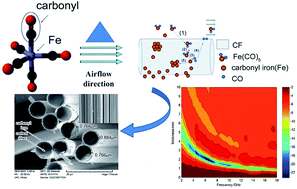
Carbon fiber (CF) has broad application prospects in the EMW absorption fields because of its excellent performance properties, such as low density, high specific strength, high modulus and so on. However, CF is a resistive loss material with no magnetic property, and it has poor absorption properties when used alone. Thus, CF is always used with other materials, such as Ni,9 SiC,10 and Fe3O4 (ref. 11) to improve their combined absorbing performance. Carbonyl iron (CI) powders are widely applied in absorbing materials with high saturation magnetization and a relative permeability at microwave frequencies.12–14 According to related studies, CI powders can effectively improve high-frequency dielectric properties by adjusting the content of iron on the samples.15 However, CI has limited applications because of its narrow absorption bandwidth and heavy weight. Recently, microwave absorbing properties of several composites, such as CF–CI,16,17 CI/carbon black (CB)/CF18 have been investigated. Although aforementioned absorbers (CF–CI and CI/CB/CF) have exhibited favorable EMW absorption, both of them have not been reported to exhibit a reflection loss (RL) that exceeds −10 dB (90% EMW absorption) in the whole 2–18 GHz frequency range. Moreover, the CI and CF were simply mixed in the aforementioned research. There are no reported experimental results on the electromagnetic properties of the composites with CI as shell and CF as core. This special structure and interface interactions between the core and shell is in favor of EMW absorption.19
Thus, we designed a process to deposit CI on the CF surface to fabricate a new CF–CI composite with core–shell structures that possesses the advantages of these two materials by using the metal organic chemical vapor deposition (MOCVD) method, which has low deposition temperature, fast and flexible deposition rate, and controllable synthetic material composition.20 This new composite might obtain remarkable EMW absorption through thin and low-mass density layer absorbers in the entire 2 to 18 GHz frequency range. The morphology, complex permittivity and permeability, and EMW absorption of the composites are investigated.
The pretreatment of CF (TORAY T300-1k) involved the following: (1) the CF was immersed into acetone for 2 h and then washed with distilled water; (2) the CF was treated with nitric acid [HNO3] for 5 h and then washed with distilled water.22 After the pretreatment, 1 g CF was placed on a stand and then put into the reactor. 15 mL of iron pentacarbonyl {Fe(CO)5, 99.9%; Shaanxi XingHua Chemical Co. Ltd.} was decanted into the evaporator. N2 was passed through the system to ensure that the air in the tube was blown out. The N2 supply was then turned off while closing the valve between the reactor and evaporator. When CF and Fe(CO)5 were heated to 240 and 80 °C, the valve between the reactor and the evaporator was opened. Fe(CO)5 vapor was blown into the reactor by N2 at a rate of 30 mL min−1 for 10, 30, 50, 70 min, respectively. The N2 flow was controlled by a gas flow meter. HH-SA digital thermostat oil bath pot was used to heat Fe(CO)5. Pipings were coated with a layer of insulation sleeve to prevent Fe(CO)5 gas condensation at low temperatures before Fe(CO)5 gas entered the reactor. The final sample was cooled to room temperature under N2 protection. The weight content of iron in the composites was determined by comparing the weights of specimens before and after the experiment. The mass ratios of CF to CI were approximately1: 5, 1
:
8.8, 1
:
11, and 1
:
14.3, and the composites were labeled as S1, S2, S3 and S4, respectively.
![]() | (1) |
![]() | (2) |
![]() | ||
| Fig. 2 SEM images of CF (a), CF–CI composites (b-S1, c-S2, d-S3, and e-S4) and SEM images of the microstructure of S2 composites coating surface (f). | ||
The EDS line scan pattern through the sample surface and cross section (spots A and B in Fig. 2c and d) are shown in Fig. 4. The Fe, C distribution cladding layer confirmed that elemental iron existed, and the shell material was CI.
![]() | ||
| Fig. 5 Complex permittivity (a and b) and permeability (c and d) of CF and CF–CI composites at 2–18 GHz and Cole–Cole plots (e) and f−1(μ′)−2μ′′ (f) values of S2. | ||
The resonance behavior of the material complex permittivity is typically sourced from the space charge, dipole, ionic, and electron polarizations.28 However, dipole polarization has a dominating function in the metal matrix composite and can operate at higher frequencies compared with that of the space charge polarization. Ionic and electronic polarizations generally operate at THz and PHz.28 Thus, the complex permittivity should be derived from the dipole polarization in CF–CI composites. According to the Debye dipolar relaxation expression: (ε′ − ε∞)2 + (ε′′)2 = (εs − ε∞)2, the plot of ε′ versus ε′′ would be a single semicircle, which is usually defined as the Cole–Cole semicircle.29 Fig. 5e presents the Cole–Cole plots of S2 composite with circle radius continuously varying. Trajectory equation is no longer a circle or semi-circle, but a spiral curve precession, suggesting that the dipole polarization is a Lorentz-type resonance other than a Debye dipolar relaxation. It is reasonable that the higher complex permittivity (both the ε′ and ε′′) can be obtained when the composites are filled with higher content of CI, due to the higher Lorentz-type resonance in the CF–CI composites.
The complex permeability curves of CF and CF–CI composites versus frequency are shown in Fig. 5c and d. The complex permeability still showed a multiple resonance phenomenon and higher values were found for CF–CI composites with higher CI contents prior to this intersecting point. From the permeability real part of view, the value declined as the frequency increased. The real permittivity value showed fluctuation at about 11 and 16 GHz while the imaginary permittivity showed fluctuation about 9 and 14 GHz. A general loss of microwave magnetic material is primarily from eddy current losses, magnetization vector rotation, natural resonance, and magnetic domain wall resonance.30 Magnetization vector rotation only occurs in a strong magnetic field, and the magnetic domain wall resonance contribution at microwave frequency is very small and can be neglected.31 Therefore, the EMW loss of S2 was primarily caused by eddy current losses or natural resonance. If S2 magnetic loss is only from the eddy current loss, then f−1(μ′)−2μ′′ should be a constant value.32 The values of f−1(μ′)−2μ′′ versus the frequency of S2 are shown in Fig. 5f. The value showed a downward trend as the frequency increased. Hence, the eddy current loss could be ruled out. Hence, S2 magnetic loss was primarily dominated by natural resonance.
, where ρ and μ0 are resistivity of the particle and permeability of free space, respectively.34 The average skin depth δ as a function of the frequency for the iron base ferromagnetic alloy is about 2 μm.33 For core–shell structure composites, the shell thickness of S3 and S4 exceed 2 μm, so the absorbing performances of composites turn bad. On the other hand, the real part of the complex permittivity, which increase (as shown in Fig. 5a) too larger with the CI mass increase, will impair the impedance matching between the absorb coating and free space.35
The microwave absorbing properties of the S2 with different thicknesses is shown in Fig. 7a. It can be seen that the reflectance peak gradually moved to a lower frequency as the thickness increased. The absorption property increases with the thickness, and the minimum value was −21.5 dB at 6.6 GHz with a thickness of 2.0 mm, whereas the RL dramatically decreases when the thickness of coating exceeds 2.0 mm. The RL of S2 (0.9 to 3.9 mm in thickness) was less than −10 dB in the whole 2 to 18 GHz frequency range. It is worth noting that the EMW absorption of the coating can be tuned easily by simply changing the coating thickness. A comparison of the measured RL of the coating at thickness d = 0.9 mm and the calculated results is illustrated in Fig. 7b. Although the measured results and calculated values slightly differ, both measured and theoretically calculated results have similar curve patterns and absolute values.
![]() | ||
| Fig. 7 Microwave absorbing properties of the S2 with different thicknesses (a) and comparison (b) of measured and calculated RL for S2 (d = 0.9 mm). | ||
:
8.8, labeled as P1) between CF and CI to clarify the effect of the core–shell structure. The SEM image of P1 show that the CI particles and CF were uniformly mixed, which is illustrated in Fig. 8a. The complex permittivity of S2 and P1 composites are shown in Fig. 8b, respectively. The real part complex permittivity of P1 has the same phenomenon compared to S2, both with multiple resonances. The real part the complex permittivity of S2 is higher than that of P1, which indicates that the storage capability of electric energy of S2 is larger than P1. The imaginary part complex permittivity of P1 decreases as the frequency increases, and it is lower than S2 at most of the frequency. This indicates that the dielectric loss of the S2 is different from P1 and the core–shell structure increases the dielectric loss. Various studies comprising many types of core–shell absorbing materials draw the similar conclusion that the core–shell interface occurs at the micro dielectric relaxation, which causes the loss of EM energy.2,35–39 After the CI film grew on the CF surface, the conductive phase CI distributed on the surface of lower conductivity CF. The free charge gathered the two-phase interface because of the differences in the electrical properties of the two-phases. These aggregate charges induced polarization under the action of EM fields, thereby increased the dielectric constant. The composite strength of the free charge polarization size has a direct effect on the strength of relaxation, and polarization depends primarily on the size of the charge density and the size of the two-phase interface. For this study, the increase of the dielectric loss of S2 is also likely to be due to interfacial polarization phenomenon at the core–shell interface under the action of EMW.
![]() | ||
| Fig. 8 SEM image(a) of P1, complex permittivity and permeability (b and c) of S2 and P1, and EMW spread schemes (d) of S2 composites. | ||
The complex permeability curves of S2 and P1 versus frequency are shown in Fig. 8c. The permeability of S2 is almost higher than the peak of the P1, which shows significant multiple resonance phenomena. The results indicate that the magnetic energy storage capacity and magnetic loss of S2 are stronger than that of the mixed powder P1.40 Moreover, the core–shell structure effectively increased the propagation of EMW in the course of its interior for CF/Fe core–shell composites (Fig. 8d). By multiple reflections between the core–shell interfaces, the EMW attenuation is effectively improved.41,42
Microwave RL curves are shown in Fig. 9 with different thicknesses of P1. It is clear to see that the microwave absorbing properties of the composite powder S2 (Fig. 6b) is much better than that of the mixed powder P1. These results fully indicate that core–shell structure plays a dominant role in the EM properties of the samples.
Absorbing materials with a good effect must meet two conditions: one is EMW must penetrate into the interior of material as much as possible, that is a good wave impedance matching characteristic, the other is the material must be able to consume the incoming EMW, which should possess a large attenuation constant.43 The characteristic impedance of the material can be calculated according to
.44 As can be seen from Fig. 10a, impedance characteristics of S2 was better than P1 over 2–18 GHz. The attenuation constant can be expressed as
.45 EMW entering into the materials should be almost entirely attenuated (attenuation characteristic) for achieving low reflection. The attenuation constants of the samples are illustrated in Fig. 10b. The highest attenuation constant was obtained with S2. In summary, all the results mentioned in section 3.5 can explain why the dielectric properties of core–shell structure S2 have increased compared to the simple CF–CI mixture P1 and why S2 has the best EMW absorption properties.
We compare S2 with some similar reported composites for EMW absorption properties shown in Table 1. It can be seen that the S2 has stronger RL absorption and broader absorption bandwidth at a lower mass density and a thinner absorber layer.
:
CI was 1
:
8.8, a minimum RL value of −21.5 dB at 6.6 GHz on a coating with a matching thickness of 2.0 mm was found. An RL of composites (0.9–3.9 mm in thickness) is less than −10 dB over the range of 2–18 GHz.
This study fabricates an effective MOCVD method for the manufacturing of CI-coated CF as new composite fillers for EM wave absorption with good absorption properties, a simple process and low costs. The thicknesses and/or the compositions of the deposition layers can be modified for other applications through the control of catalytic processes and plating conditions.
| This journal is © The Royal Society of Chemistry 2015 |