Wonsang Koha,
Ji Hye Leeb,
Seung Geol Lee*b,
Ji Il Choic and
Seung Soon Jang*d
aSchool of Physics, Georgia Institute of Technology, 837 State Street, Atlanta, GA 30332-0430, USA
bDepartment of Organic Material Science and Engineering, Pusan National University, 2, Busandaehak-ro 63beon-gil, Geumjeong-gu, Busan 609-735, Republic of Korea. E-mail: seunggeol.lee@pusan.ac.kr; Fax: +82-51-512-8175; Tel: +82-51-510-2412
cGraduate School of EEWS, Korea Advanced Institute of Science and Technology, 291 Daehak-ro, Yuseong-gu, Daejeon 305-701, Republic of Korea
dSchool of Materials Science and Engineering, Georgia Institute of Technology, 771 Ferst Drive NW, Atlanta, GA 30332-0245, USA. E-mail: SeungSoon.Jang@mse.gatech.edu; Fax: +1-404-894-9140; Tel: +1-404-385-3356
First published on 26th March 2015
In this study, we investigated the mechanisms of Li adsorption on a graphene–C60 nanobud system using density functional theory. Li adsorption on the hybrid system was enhanced compared to those using pure graphene and C60. The Li adsorption energies ranged from −1.784 to −2.346 eV for the adsorption of a single Li atom, and from −1.905 to −2.229 eV for the adsorption of two Li atoms. Furthermore, adsorption energies were similar at most positions throughout the structure. The Li adsorption energy of an 18-Li adsorbed system was calculated to be −1.684 eV, which is significantly lower than Li–Li binding energy (−1.030 eV). These results suggest that Li atoms will be adsorbed preferentially (1) between C60 and C60, (2) between graphene and C60, (3) on graphene, or (4) on C60, rather than form Li clusters. As more Li atoms were adsorbed onto the graphene–C60 nanobud system because of its improved Li adsorption capability, the metallic character of the system was enhanced, which was confirmed via analysis of band structure and electronic density of states.
In this study, we focused on a covalently bonded graphene–C60 nanobud system to investigate its capacity for the adsorption of single as well as multiple Li atoms. Graphene–C60 nanobuds are hybrid zero-dimensional and two-dimensional carbon materials with varied electronic and magnetic characteristics depending on the connection points of both the graphene and C60.5f The graphene–C60 nanobud system utilizes C60 as the electron acceptor from Li and graphene as the charge transport channel throughout the electrode. Therefore, Li adsorption on the graphene–C60 electrode is expected to be more favorable than on a pure graphene-based electrode because of the higher electron affinity of C60. We used the first-principles computational method DMol3 from Accelrys7 to investigate the electrochemical characteristics of the graphene–C60 nanobud system, such as its adsorption capabilities and charge transfer properties. We calculated Li adsorption energy of the hybrid system and the accompanying changes in electronic properties such as band structure, density of states (DOS), and charge distribution as a function of Li adsorption using DFT. In addition, we studied the mechanism of Li adsorption in comparison with Li cluster formation by calculating Li adsorption energies on various regions of the graphene–C60 nanobud structure.
![]() | (1) |
![]() | ||
| Fig. 1 The unit cell structure of the graphene–C60 nanobud system: (a) top, (b) side, and (c) expanded views. The cell parameters are a = b = 12.3 Å, c = 35 Å, α = β = 90°, and γ = 120°. | ||
| System | Binding energy (eV) | Bond length (Å) | Charges (e) | Band gap (eV) | |
|---|---|---|---|---|---|
| Graphene | C60 | ||||
| Graphene–C60 (hh) | 2.632 | 1.637 | 0.059 | −0.059 | 0 |
| Graphene–C60 (hp) | 3.319 | 1.652 | 0.103 | −0.103 | 0.30 |
As shown in the table, the binding energy of the hh structure (2.632 eV) appears more favorable than that of the hp structure (3.319 eV). However, to obtain the nanobud structures, extra energy was needed to form the covalent bonds via the sp3 hybridization of carbon. A narrow band gap of 0.30 eV was developed between the orbitals of graphene and C60 in the middle of the hybridization when graphene was connected to the bond between the pentagonal and hexagonal sites of the C60. The charge distribution of the system through Mulliken population analysis showed charge transfer from the graphene to C60 for all of the systems owing to the relatively strong electron affinity of C60.
The band structures and DOS of pure graphene, pure C60, and the graphene–C60 nanobud system are represented in Fig. 2. The graphene–C60 nanobud system has different characteristics than its components and shows a unique band structure because of the covalent bonds between graphene and C60. The band structure also differs depending on the C–C bond position, which can be attributed to the π-bonds involved in the reaction. Hence, graphene–C60 nanobud:hh has no band gap, whereas graphene–C60 nanobud:hp has an indirect band gap (0.30 eV) owing to the different degree of π-bond character in these systems.
Also, at 0.4–0.5 Å (relative distance from the optimized nanobud structure), the chemical bonds between C60 and neighbour carbons from graphene are broken and the global minimum energy point is obtained. The energy barrier from the graphene–C60 nanobud to the graphene–C60 hybrid system is determined as ∼0.50 eV, which confirms that the graphene–C60 nanobud is in a meta-stable state.
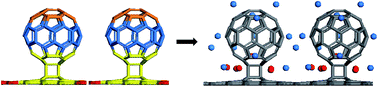
To describe the Li adsorption mechanism on the graphene–C60 nanobud system more systematically, we defined four distinct adsorption regions, as shown in Fig. 4a–d: (i) graphene side (region 1, red), (ii) between graphene and C60 (region 2, yellow), (iii) between C60s (region 3, blue), and (iv) C60 side (region 4, orange). The Li atom is expected to interact with graphene alone in region 1 and with C60 alone in regions 3 and 4, whereas it can interact with both graphene and C60 simultaneously in region 2.
We placed one Li atom at various positions in each region of the graphene–C60 nanobud system, as shown in Fig. 4. The adsorption energies and charge distributions of the one-Li adsorption systems are summarized in Table 2. The adsorption of Li on the graphene side (−1.905 eV) was enhanced compared with that of pure graphene (−1.375 eV). This enhancement can possibly be explained by the charge distribution of the graphene–C60 nanobud system and the unit structure of the nanobud system. For example, in the absence of Li, a small degree of charge (|0.059|e) is transferred from graphene to C60, making the graphene positively charged (Table 2). Thus, charge transfer from the adsorbed Li can occur to a greater extent in the graphene side region, contributing to its enhanced adsorption. At the same time, a Li atom in region 1 can still interact with C60 because of the planar structure of graphene and the size of the unit structure of the graphene–C60 nanobud system. We could confirm this interaction through the amount of charge transfer to C60 (−0.334e), which is comparable with that to graphene (−0.524e). Most of the Li atoms maintained their original position after optimization.
| System | Adsorption energy (eV) | Charge (e) | ||
|---|---|---|---|---|
| Li | Graphene | C60 | ||
| Graphene–C60 (hh) | N/A | N/A | 0.059 | −0.059 |
| 1 Li on graphene | −1.375 (−1.096 (ref. 3b)) | 0.813 | −0.813 | N/A |
| 1 Li on C60 (pentagon) | −1.838 (−1.820 (ref. 13)) | 0.794 | N/A | −0.794 |
| Pos1@graphene (region1) | −1.905 | 0.858 | −0.524 | −0.334 |
| Pos2@graphene (region1) | −2.346 | 0.863 | −0.428 | −0.435 |
| Pos1@C60 (region2_hexa) | −2.345 | 0.871 | −0.427 | −0.444 |
| Pos2@C60 (region2_penta) | −2.182 | 0.856 | −0.477 | −0.379 |
| Pos3@C60 (region3_hexa) | −2.002 | 0.856 | −0.028 | −0.828 |
| Pos4@C60 (region3_penta) | −2.158 | 0.865 | −0.025 | −0.840 |
| Pos5@C60 (region4_hexa) | −1.784 | 0.800 | −0.015 | −0.785 |
| Pos6@C60 (region4_penta) | −1.840 | 0.785 | −0.011 | −0.774 |
However, the Li atom positioned near C60 (Pos2@graphene) clearly moves closer to C60, whereas the Li atoms initially placed closer to the C–C bond in the junction (Pos1 and Pos2@C60) are repelled. This repositioning may be attributed to the strong covalent bond between graphene and C60, which may prevent Li from forming bonds with carbon atoms in the system and keep Li out of the junction. The adsorption energies are also low near the graphene–C60 junction (region 2; −2.345 eV) and between C60s (region 3; −2.158 eV) owing to the strong electron affinity of C60. The amount of charge transfer from an adsorbed Li atom to the graphene–C60 nanobud system ranges from 0.785e to 0.871e depending on its position. The corresponding band structures of the one-Li-adsorbed nanobud systems, presented in Fig. 5, did not substantially change compared to the parent system prior to adsorption. However, the bands shift downward when the Li atom is adsorbed on the C60 side.
Initial and optimized structures of systems with two Li atoms adsorbed in different regions on the graphene–C60 nanobud system are displayed in Fig. 6. The Li adsorption energies of both Li atoms calculated using eqn (1) are listed in Table 3. In region 1 of the nanobud system (Fig. 6a), two-Li adsorption results in the same adsorption energy using either the N.N.N. scheme (−1.971 eV) or the N.N. scheme (−1.972 eV). This is because both the second Li atoms moved to similar positions on the C60 side due to the strong electron affinity of C60. Furthermore, the two-Li adsorption energy (−1.972 eV) was lower than that of the one-Li system (−1.905 eV), even though the adsorption energy usually increases as the number of Li atoms increases. This result is also related to the size of the unit structure because both Li atoms are strongly affected by the presence of C60; therefore, the adsorption is even lower in the two-Li system. Adsorption energies were low and similar values were obtained for each position (Fig. 6b, −2.109 to −2.141 eV) in region 2 because of simultaneous interactions with both components. The adsorption energy in region 3 (between C60s) was also low, ranging from −1.943 to −2.229 eV, because of the strong electron affinity of C60. In regions 2 and 3 of the nanobud system, it appeared that the adsorption was independent of the adsorption sites when compared with the other regions, although the adsorption energy of the N.N.N. scheme was slightly lower than the N.N. scheme in both regions. In region 4, the adsorption energy was calculated to be −1.987 eV for the pentagonal site (Fig. 6d, N.N.N. site) and −1.905 eV for the hexagonal site (N.N. site).
| System | Adsorption energy (eV) |
|---|---|
| 2 Li on region1: N.N.N. site | −1.971 |
| 2 Li on region1: N.N. site | −1.972 |
| 2 Li on region2: radial (N.N.N. site) | −2.141 |
| 2 Li on region2: radial (N.N. site) | −2.133 |
| 2 Li on region2: axial (N.N. site) | −2.109 |
| 2 Li on region3: axial (N.N.N. site) | −2.130 |
| 2 Li on region3: axial (N.N. site) | −2.091 |
| 2 Li on region3 to region2: N.N.N. site | −2.229 |
| 2 Li on region3 to region2: N.N. site | −2.199 |
| 2 Li on region3 to region4: N.N.N. site | −1.984 |
| 2 Li on region3 to region4: N.N. site | −1.943 |
| 2 Li on region4: radial (N.N.N. site) | −1.987 |
| 2 Li on region4: radial (N.N. site) | −1.905 |
| 18 Li atoms on graphene–C60 nanobud | −1.684 |
This result suggested a slight preference for Li adsorption via the N.N.N. scheme rather than the N.N scheme; however, this dependence was weak when we considered both the unit size of the system and the planar structure of the graphene. The Li adsorption mechanism was strongly influenced by C60; therefore, Li adsorption will occur over the entire C60 surface before proceeding to the graphene sites in the graphene–C60 nanobud system. We also determined the corresponding changes in the band structures for several two-Li atom systems in each region of the graphene–C60 nanobud system, as shown in Fig. 7. Compared with the one-Li adsorption system, significant band shifts were observed whenever another Li atom was added to the nanobud system. The bands in close proximity to the additional Li atom were mainly affected and shifted down, owing to the increased in Fermi levels as electrons were injected from the Li atoms into the system.
![]() | ||
| Fig. 7 Band structures for adsorption of two Li atoms in different regions on the graphene–C60 nanobud system: (a) region 1, (b) region 2, (c) region 3, and (d) region 4. | ||
Finally, we added many Li atoms around the graphene–C60 nanobud system based on the N.N.N. scheme. The initial and optimized structures for the addition of 18 Li atoms on the substrate are presented in Fig. 8a, and the adsorption energy is listed in Table 3. In this scheme, the Li storage capability of the graphene–C60 nanobud system is increased by ∼3 times and 1.5 times compared with the Li capability of the single graphene and C60 with the same volume (or area), respectively. From the optimized structure, it was clear that the Li atoms initially attached to the graphene-side sites were attracted toward the C60. However, Li atoms initially located around C60 retained their positions.
![]() | ||
| Fig. 8 (a) Initial and optimized structures, (b) band structure, and (c) density of states for the multi-Li adsorbed system. | ||
The adsorption energy for the multi-Li adsorption was −1.684 eV for the entire nanobud system. This adsorption energy indicated that Li adsorption will take place on the C60 side until all of the available sites are completely filled before proceeding to the graphene sites, as found for the adsorption of two Li atoms. Even though the Li adsorption energy decreased with an increasing number of Li atoms, all of these adsorption energies are lower than the Li–Li binding energy (−1.030 eV).14
Therefore, Li cluster formation is not likely to occur until all of the available sites on the graphene–C60 nanobud system are covered. In addition, the adsorption energy is lower than those of pure graphene (−1.086 eV) and C60 (−1.594 eV) systems with the same number of Li atoms. Therefore, in terms of Li adsorption, the graphene–C60 nanobud system appears to be promising for use as a possible electrode in Li batteries. Fig. 8b shows the band structure of the multi-Li adsorbed graphene–C60 nanobud system. The number of available energy bands around the Fermi level increased significantly, which indicated that Li adsorption enhanced the metallic characteristics of the system, such as its conductivity. This result was confirmed by the DOS, shown in Fig. 8c as a function of the number of Li atoms. In this figure, the Li-adsorbed systems have more DOS around the Fermi level, especially when more than two Li atoms are adsorbed, compared with the graphene–C60 nanobud system prior to adsorption. This result demonstrates the enhanced metallic character of the graphene–C60 nanobud system, which could contribute to increases in its electron transport properties.
We found that Li adsorption was enhanced for the graphene–C60 nanobuds compared with pure graphene. This enhanced adsorption capability may be explained by the high electron affinity of C60 and the charge transfer from graphene to C60. Furthermore, by analyzing Li adsorption as a function of the regions in the graphene–C60 system, we determined that Li adsorption would preferentially occur on the C60 side, specifically at the space between graphene and C60 or between two C60s, and proceed toward the graphene side. Consequently, it is unlikely that Li clusters would be formed in this system because the Li–C adsorptive interaction was more stable than the Li–Li binding interaction.
Although there was no significant change in the band structure after one Li atom was adsorbed on the graphene–C60 nanobud system, additional Li adsorptions shifted the energy bands downward and even removed the band gap of the nanobud system as a result of electron injection from Li to the system. The DOS in the nanobud system also indicated that the metallic character of the graphene–C60 system was enhanced as the number of Li atoms increased. Hence, it is expected that the graphene–C60 nanobud system will demonstrate enhanced conductive properties along with excellent Li adsorption capabilities compared with pure graphene.
| This journal is © The Royal Society of Chemistry 2015 |